Frances Willard founded the Woman’s Christian Temperance Union in 1884 to carry the message of women’s emancipation throughout the world. Based in the United States, the WCTU rapidly became an international organization, with affiliates in forty-two countries. Ian Tyrrell tells the extraordinary story of how a handful of women sought to change the mores of the world — not only by abolishing alcohol but also by promoting peace and attacking prostitution, poverty, and male control of democratic political structures.
In describing the work of Mary Leavitt, Jessie Ackermann, and other temperance crusaders on the international scene, Tyrrell identifies the tensions generated by conflict between the WCTU’s universalist agenda and its own version of an ideologically and religiously based form of cultural imperialism. The union embraced an international and occasionally ecumenical vision that included a critique of Western materialism and imperialism. But, at the same time, its mission inevitably promoted Anglo-American cultural practices and Protestant evangelical beliefs deemed morally superior by the WCTU.
Tyrrell also considers, from a comparative perspective, the peculiar links between feminism, social reform, and evangelical religion in Anglo-American culture that made it so difficult for the WCTU to export its vision of a woman-centered mission to other cultures. Even in other Western states, forging links between feminism and religiously based temperance reform was made virtually impossible by religious, class, and cultural barriers. Thus, the WCTU ultimately failed in its efforts to achieve a sober and pure world, although its members significantly shaped the values of those countries in which it excercised strong influence.
As and urgently needed history of the first largescale worldwide women’s organization and non-denominational evangelical institution, Woman’s World / Woman’s Empire will be a valuable resource to scholars in the fields of women’s studies, religion, history, and alcohol and temperance studies.
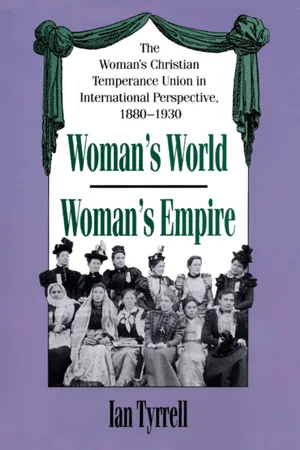
eBook - ePub
Woman's World/Woman's Empire
The Woman's Christian Temperance Union in International Perspective, 1880-1930
- 400 pages
- English
- ePUB (mobile friendly)
- Available on iOS & Android
eBook - ePub
Woman's World/Woman's Empire
The Woman's Christian Temperance Union in International Perspective, 1880-1930
About this book
Information
1: Introduction
On the fifteenth of November, 1884, a woman sailed from the city of San Francisco, bound for Honolulu and beyond on board the steamship Alameda. Nothing in her demeanor or her departure hinted at the significance of her undertaking. The event itself was inauspicious, marked only by the well-wishes of a few close friends. Yet this woman’s journey would touch off one of the most unusual and intriguing episodes in the history of women, in the history of evangelical reform, and in the history of American relations with the rest of the world. Mary Clement Leavitt, a former Boston schoolteacher and the mother of three, had embarked on a mission of reconnaissance on behalf of Frances Willard, the American president of the Woman’s Christian Temperance Union. Leavitt left in the knowledge that her voyage was the vital first step toward the creation of an international women’s temperance organization.
What she did not know at the time were the epic proportions of the journey she would complete and the extent of the organizing work she would set in motion. The trip across the Pacific to join the hemispheres in battle against all “brain poisons” would eventually take her around the world and involve eight years away from home, much of the time in the company of men alone, rarely in the presence of anyone who spoke the Queen’s English, or even the American variety. Women had certainly embarked before on long international trips, and as missionaries had voyaged to exotic lands unprotected by male companions. Some may have gone around the world. But none had, so far as can be ascertained, undertaken so solitary and protracted a journey through so many countries. When Leavitt returned triumphant to Boston and an appointment as honorary World’s president of the WCTU in 1891, she was sixty-two and, allegedly, the heroine of a half-million temperance women in five continents. She was, Frances Willard said, “our white ribbon Stanley.”1
This story is not Leavitt’s alone, but that of many women who contributed to the missionary impulse of the WCTU from the 1870s to the 1930s. Only one of these women individually rivaled Leavitt’s prodigious feat, but together their efforts made the WCTU an international force in the temperance and women’s movements. The World’s WCTU had spread to more than forty national affiliates and many more countries by the 1920s, and at its peak in 1927 the organization had 766,000 dues-paying members and claimed a following of more than a million women. Certainly no organization made a more persistent claim to pursue the international aspects of temperance reform. But the WCTU’s work also rivaled the achievements of the suffrage movement in the dissemination on an international level of the principles of women’s emancipation.2
The WCTU was not the largest organization of women in the United States over the period from the 1870s to the 1930s. Nor was it the only women’s group operating on an international plane. In their combined impact, the missionary efforts of the various women’s boards of the American evangelical churches exceeded the WCTU in financial commitments and in numerical support for international action, certainly after the turn of the century, and probably before as well.3 The WCTU’s missionary work was clearly an outgrowth of this larger social movement and must be seen in the context of missionary developments. Yet the WCTU’s emphasis was different and deserves separate treatment.
As the first mass organization among women devoted to social reform, the WCTU’s program was more overtly political in its aims and in its effects on women. The WCTU linked the religious and the secular through concerted and far-reaching reform strategies based on applied Christianity. Its focus could never be upon purely gospel work or soul saving, though these remained the foundation of women’s temperance. The leavening influence of the White Ribbon movement, exerted through its connections to both church-based evangelism and the more explicitly feminist groups such as the women’s suffrage societies and the National Council of Women, made the organization of critical importance in both religion and women’s emancipation. Caught between those differing interests, the WCTU exposed on both the national and international levels the inconsistencies and weaknesses of the women’s movement as well as its many strengths and achievements.
This influence was often exerted in unexpected ways that have typically been missed by historians because the WCTU has not been put into an intelligible context of religion and reform. The WCTU’s international campaigns were not unique. They were, in fact, part of a much larger outreach of American power and culture. A large part of American expansion took the form not of political or even economic penetration but of the spread of institutions and cultural values. The most obvious examples of cultural penetration were the missionary groups but the role of others such as the YMCA and the United Society for Christian Endeavor must never be underestimated.4 The WWCTU was an integral part of this process and indeed maintained strong ties with these bodies. The Christian Endeavor movement, begun by the Reverend Francis Clark and devoted to revitalization of the Protestant churches through interdenominational social gospel work, was remarkably similar to the WCTU in its international ambitions, its emphasis on Christian and family values, its elevation of women to a position of equality, and its willingness to tackle all manner of social reforms. This should not be surprising, since Frances Willard addressed Christian Endeavor conferences, and the movement in fact took from her the Do-Everything policy and so extended the WWCTU’s influence beyond its own ranks to include many other church people, including many men. This was how the WCTU operated on an international level as part of an interlocking elite of organizations and personnel that created the constituency of Anglo-American internationalism.5
The only part of that context of reform that has received much recent attention is “first-wave feminism.” Historians have studied the turn-of-the-century women’s movement, including the International Woman Suffrage Alliance organized by Carrie Chapman Catt and the various peace initiatives that culminated in the Women’s International League for Peace and Freedom after World War I. Ironically, this rehabilitation has ignored the international efforts of the WCTU, even though these were far more extensive and more indicative of the scope and limits of internationalism than any other part of the women’s movement except the vast foreign missionary endeavors. Indeed, the various international organizations sponsored principally by the leaders of the American women’s movement were often mere letterhead organizations of interest to only a small minority of activists. This criticism was much less true in the case of women’s international temperance activity, though the limits to internationalism in the WCTU must still be acknowledged.6
One women’s group that did take the principles of internationalism very seriously was the YWCA. Because this organization was formally separatist like the WCTU, sent out its own emissaries as did the WCTU, organized a World’s YWCA, and promoted international sisterhood, comparisons with the work of temperance women are inevitable. As an expression of the social gospel in action, the YWCAs ultimately proved by the 1920s to be formidable competitors for the energies of young Christian women. Yet it must be remembered that the WWCTU began in the 1880s. The World’s YWCA held its first convention in 1898, but the YWCA’s international heyday was much later. The overwhelming proportion of its overseas missionary appointments came in the 1920s and beyond, as a recent study shows. The World’s WCTU was a pioneer in work later taken up by the YWCA and other social gospel groups.7
Feminism’s international aspirations were by no means unusual. Temperance, too, had its share of similar ideas. The most grandiosely conceived scheme was undoubtedly that of the WLAA, started after World War I and dedicated to worldwide prohibition. That organization’s most recent chronicier finds the WLAA American-dominated and not genuinely international in its scope. But the league did at least illustrate the global ambitions of the American prohibitionist movement and showed that these sentiments went well beyond the WCTU. What has not been noticed, however, is the role of the World’s WCTU in providing a model for international activity. Ernest Cherrington, who inspired and directed the league’s work, candidly admitted that it was the temperance women who had carried the burden of international organizing in the period from 1876 to 1920. This work his organization hoped to emulate in the 1920s.8
Earlier and more formidable competition for the WWCTU among temperance groups came not from the WLAA but from the Good Templars, whose networks of lodges extended over many countries by the 1880s. Through the activities of women like Jessie Forsyth, British-born but a longtime American resident who ended her organizing days in Australia, the Templars provided illustration of persistent internationalist sentiment in temperance circles that supplemented the WWCTU’s work. I say supplemented because the Templars and the WWCTU were not antagonistic and mutually exclusive organizations. It can be easily demonstrated that the Templars provided recruits for the WCTU and that through the Templars the influence of the World’s WCTU was once again extended beyond its own ranks.9
All of these organizations made the WCTU more than an important part of the nineteenth-century international women’s temperance movement. The WCTU became, like the Christian Endeavor societies and the YMCA and YWCA, a critical instrument for spreading the American dream. More prosaically and accurately put, the WWCTU constituted an important vehicle for the assertion of the values associated with one kind of American dream at a time of broader economic, political, and cultural expansion of Western societies with which the WCTU could only partly sympathize. The dreams of temperance women that the gospel might soon triumph in heathen lands were endangered by the dreams of merchants who hoped to gain by exporting alcohol to indigenous peoples. Military expansionism also made many in the WCTU uncomfortable. But hostility to aspects of Western cultural penetration could only be discharged by reliance on the extension of European and, specifically, Anglo-American power and by insistence on the values that were deemed to represent the best or truest elements of that culture. The efforts of temperance women to emancipate their sisters from subordination to prevailing customs ironically became enmeshed in the extension of European values and in the domination of large portions of the globe by the imperial powers. The dialectic of internationalism as a concept and the Anglo-American roots of the WCTU’s power cannot be escaped in any analysis of the World’s work.10
Here the WCTU forged its own version of a cultural imperialism. William T. Stead, the English journalist, gave expression to these aspirations for the creation of an Anglo-American cultural aegis in his The Americanization of the World in 1902. Stead, who looked favorably on the women’s temperance movement, understood that the WCTU was part of this Americanizing and westernizing process. Enthused Stead: “[The World’s WCTU’s] indirect influence in compelling women at once to . . . recognize their capacity to serve the State in the promotion of all that tends to preserve the purity and sanctity of the home, has been by no means one of the least contributions which America [has] made to the betterment of the world.”11 To the extent that this process involved the extension of Anglo-American colonial authority or de facto political and military domination over other peoples, the World’s WCTU became, from one point of view, culturally imperialistic. But behind that simple and somewhat glib phrase are layers of meaning that must be probed in all of their complexity through the experience of temperance women. As a missionary endeavor, the WCTU could hardly avoid the currents of cultural imperialism that have been analyzed by a variety of historians of the women’s missionary movements. The WCTU did seek to assert Western value systems in much the same way as more orthodox missionaries did. That has been the subject of frequent and ironic comment. Some have even suggested that women missionaries were “more culturally imperialistic” than their male counterparts.12
History is replete with such ironies in which the dominated become agents of domination. No exception, the history of women’s temperance is rooted in the ambiguous implications of the struggle of women to be free. This is not to deny the reality of the physical or economic oppression these temperance women sought to overcome, nor is it to reduce their vast and complex experience to the simplistic formula of personal advantage. The women of the WCTU, in the course of building their movement, constructed a web of institutions and values that purported to unite women in a worldwide sisterhood. The world of women they created did exist in all the richness of its culture, but that very world circumscribed their freedom of action and limited their ability to comprehend the complexities of that other world, with its other cultures and other classes of women. The confrontation of the reformer’s conception of how the larger world ought to operate with the tough experience of its material realities and alternative cultural meanings constitutes an important concern in this book.
If cultural imperialism is a predictable theme in the writing on American missionary endeavors, in the case of the WCTU the export of values and institutions was vastly more complicated. Unlike Anglo-American missions, the WCTU proselytized as extensively in Britain and the British empire as in non-Christian lands. Since drinking and associated “vices” were as much if not more commonly associated with European peoples, the notion of the cultural superiority of whites and the Christian religion could not be assumed. WCTU campaigns abroad involved not only hierarchical relations between Europeans and their colonial dependents but also similar relations of power among European nations.
The WCTU enterprise was also complicated, if one wishes to stress the evidence for cultural imperialism, by its assimilationist and universalistic emphasis. Provided one accepted the values of the WCTU, there was nothing to prevent a non-American member from rising to positions of power within the organization. Australian women, at many points the unwitting and uncomprehending victims of cultural penetration that could only truthfully be described as cultural imperialism, became at other times missionaries in the reexport trade, taking the message of abstinence and purity back to the United States and Britain as well as to the nonwhite world. This reciprocity of metropolitan and colonial reform would be manifest in the issue of women’s suffrage as well, in which colonies like New Zealand and South Australia outstripped Britain and almost all of the American states.
Nor should the insistence on the dimension of cultural imperialism be taken to mean that the WCTU simply forced its own conception of a superior morality on less fortunate peoples. Collaboration and solicitation always played their parts as the WCTU confronted the non-Anglo-Saxon world. Often it was the non-American and even the non-Western clients who sought to extend the WWCTU’s domain, and the leaders of the movement in America were as much the victims of misleading assessments of power and potential at the periphery as they were the instigators of their own illusions. These international relationships the WCTU preferred to describe as evidence of sisterly solidarity, but the WWCTU’s genuine egalitarianism was inevitably encased in hierarchical conceptions of evangelical reform. The processes of benevolence created constituencies of givers and receivers locked in reciprocal and unmistakably maternal relations that sat uneasily alongside the commitment to sisterhood.
Although non-Americans and nonwhites became linked in a dependence on American moral power and material largesse, the penetration of WCTU values outside the United States hardly proceeded without obstruction. Quite the contrary. The resilience of different cultures appears as a recurrent theme; so too does the interaction of American women with women and men of markedly different expectations on the liquor question and on the issue of women’s emancipation. The lives of these WCTU women were irrevocably altered in the process. They saw much that was honorable and instructive in the lands they hoped to conquer in the name of Christ and sobriety, and they forged bonds of sympathy with their sisters based on a common awareness of their sex’s oppression.
But contradictions remained as gigantic fissures in the substance of their enterprise. Any endeavor of a missionary kind faced this stubborn difficulty. Christianity provided the energizing force for the WCTU crusade, and Christianity provided the materials for an antiimperialist critique...
Table of contents
- Cover Page
- Woman’s World Woman’s Empire
- Copyright Page
- Dedication
- Contents
- Illustrations
- Preface
- 1: Introduction
- 2: Origins of Temperance Internationalism
- 3: The World’s WCTU
- 4: Bands of Ribbon White around the World
- 5: In Dark Lands
- 6: Sisters, Mothers, and Brother-Hearted Men
- 7: Alcohol and Empire
- 8: Peace as a Way of Life
- 9: A Fatal Mistake?
- 10: Women, Suffrage, and Equality
- 11: Women and Equality
- 12: Prohibition and the Perils of Cultural Adaptation
- Epilogue Divergent Meanings of the World’s WCTU
- Appendix
- Notes
- Index
Trusted by 375,005 students
Access to over 1.5 million titles for a fair monthly price.
Study more efficiently using our study tools.
Frequently asked questions
Yes, you can cancel anytime from the Subscription tab in your account settings on the Perlego website. Your subscription will stay active until the end of your current billing period. Learn how to cancel your subscription
No, books cannot be downloaded as external files, such as PDFs, for use outside of Perlego. However, you can download books within the Perlego app for offline reading on mobile or tablet. Learn how to download books offline
Perlego offers two plans: Essential and Complete
- Essential is ideal for learners and professionals who enjoy exploring a wide range of subjects. Access the Essential Library with 800,000+ trusted titles and best-sellers across business, personal growth, and the humanities. Includes unlimited reading time and Standard Read Aloud voice.
- Complete: Perfect for advanced learners and researchers needing full, unrestricted access. Unlock 1.5M+ books across hundreds of subjects, including academic and specialized titles. The Complete Plan also includes advanced features like Premium Read Aloud and Research Assistant.
We are an online textbook subscription service, where you can get access to an entire online library for less than the price of a single book per month. With over 1.5 million books across 990+ topics, we’ve got you covered! Learn about our mission
Look out for the read-aloud symbol on your next book to see if you can listen to it. The read-aloud tool reads text aloud for you, highlighting the text as it is being read. You can pause it, speed it up and slow it down. Learn more about Read Aloud
Yes! You can use the Perlego app on both iOS and Android devices to read anytime, anywhere — even offline. Perfect for commutes or when you’re on the go.
Please note we cannot support devices running on iOS 13 and Android 7 or earlier. Learn more about using the app
Please note we cannot support devices running on iOS 13 and Android 7 or earlier. Learn more about using the app
Yes, you can access Woman's World/Woman's Empire by Ian Tyrrell in PDF and/or ePUB format, as well as other popular books in History & North American History. We have over 1.5 million books available in our catalogue for you to explore.