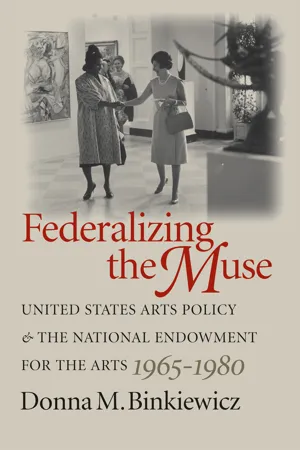
The National Endowment for the Arts is often accused of embodying a liberal agenda within the American government. In Federalizing the Muse, Donna Binkiewicz assesses the leadership and goals of Presidents Kennedy through Carter, as well as Congress and the National Council on the Arts, drawing a picture of the major players who created national arts policy. Using presidential papers, NEA and National Archives materials, and numerous interviews with policy makers, Binkiewicz refutes persisting beliefs in arts funding as part of a liberal agenda by arguing that the NEA’s origins in the Cold War era colored arts policy with a distinctly moderate undertone.
Binkiewicz’s study of visual arts grants reveals that NEA officials promoted a modernist, abstract aesthetic specifically because they believed such a style would best showcase American achievement and freedom. This initially led them to neglect many contemporary art forms they feared could be perceived as politically problematic, such as pop, feminist, and ethnic arts. The agency was not able to balance its funding across a variety of art forms before facing serious budget cutbacks. Binkiewicz’s analysis brings important historical perspective to the perennial debates about American art policy and sheds light on provocative political and cultural issues in postwar America.
I must study politics and war, that my sons may have the liberty to study mathematics, philosophy, geography, natural history and naval architecture, navigation, commerce and agriculture in order to give their children the right to study painting, poetry, music, and architecture.
—John Adams, “Letter to Abigail Adams, 1780”
Throughout most of its history the United States stood apart in the realm of national arts policies. Other nations routinely spent large percentages of their gross national products on cultural endeavors. The French and Austrian monarchies generously patronized the arts for centuries, while modern constitutional states also supported culture. They did so as a matter of course, not only during prosperous eras but in difficult times as well. Even in the depths of World War II’s Battle of Britain, British Prime Minister Winston Churchill set aside funds to maintain art and culture rather than shifting those funds to military budgets. Churchill believed that art was essential to morale and that the nation’s cultural heritage represented the essence of what the war effort aimed to preserve. By the middle of the twentieth century, European countries were spending between twenty and forty times what the United States allocated for arts support, and they considered it a source of national pride.1
The United States historically shied away from such action. Social and political obstacles long prevented the American government from instituting a national arts policy. Important factors, including national and international prestige, presidential support for arts policy, and congressional backing, only converged during the 1960s to enable the establishment of a permanent federal arts policy.
The U.S. Government and the Arts, 1776–1932
Until the twentieth century, the United States government possessed no official arts policy. This stand was rooted deep in the nation’s history, stemming from religious and social traditions in early American culture. Puritan founders in Britain had condemned the lavish decorations and expenditures on art of the royal European courts and the church. Puritan New Englanders feared that indulging in the arts would distract colonists from industrious pursuits and foster idle ones instead. In the colonial period, little art existed in America, and colonists were limited to enjoying art in the forms of hand-crafted furniture and costume. They remained indifferent to arts policy.2 Southern colonists enjoyed the arts to a greater extent, although they recognized that higher forms of music and theater were limited to the elite planter class who could afford such leisurely activities. Throughout the colonies, people fashioned distinctly American folk art forms; and, although enjoyed by “middling and lower sorts,” these remained relegated to an inferior aesthetic status. Americans from various regions and social classes did not expect or desire their colonial governments to institute arts programs and no federal government yet existed to consider a national policy.3
American leaders also reflected the attitudes of the American population in the eighteenth and nineteenth centuries. Most governing elites believed that the federal government’s first concerns in the early national period were to establish a workable form of democratic government and to achieve basic political, economic, and social stability. The arts had to be deferred for the time being. As John Adams stated, “I must study politics and war, that my sons may have the liberty to study mathematics, philosophy, geography, natural history and naval architecture, navigation, commerce and agriculture in order to give their children the right to study painting, poetry, music, and architecture.”4 Moreover, many in Congress believed that federal support for the arts would result either in the elitist control of artistic freedom that marred European art patronage or the encouragement of frivolous luxury.5 Even Thomas Jefferson, who greatly admired European art and enjoyed French culture while he served as the U.S. minister to France, considered the court of Louis XVI at once authoritarian and licentious. Upon his return to the United States and election as president, Jefferson pursued U.S. economic and geographic growth with the Louisiana Purchase but otherwise maintained a low level of U.S. involvement in international affairs and advocated minimal federal expansion. He never advocated national encouragement of the arts.6
During the Jacksonian period, Americans’ celebration of the common man and sense of self-sufficiency were powerful forces that kept American leaders away from formal artistic pursuits or European-style patronage. Indeed, the element of anti-intellectualism that emerged in the Jacksonian era actively hindered arts support as Congress raised tariffs on importation of art, and Jackson’s antielitist rhetoric widened the gap between “cultured” society and the democratic masses.7
In this early period, the federal government only supported the arts through occasional architectural projects. As construction of federal buildings proceeded, the government often commissioned architects, sculptors, muralists, and painters to embellish such structures, including the Capitol.8 During the nineteenth century, federal agencies began to commission statuary more frequently. Still, the results hardly encouraged future arts support. In 1832, Congress hired Horatio Greenough to design a statue of George Washington for the Capitol rotunda.9 When completed in 1843, the piece depicted Washington dressed in a Roman toga and sandals, seated on a throne, holding a sword in his extended hand.10 Few were ready to accept such an imperial image of their beloved republican President, so the statue was ridiculed and, eventually, removed.11 Although Greenough’s George Washington proved less than successful, Congress continued to hire artists to adorn the nation’s capital, generally with historical paintings and sculptures which they considered more acceptable.
Some congressmen called for support for the arts by various additional means in the late nineteenth and early twentieth centuries when the United States sought a larger role in international affairs and worked to bolster its national status. In the 1870s, Rep. Samuel Cox (R-N.Y.) sponsored a bill for the establishment of a Federal Arts Council.12 Later in 1891, Congress passed a bill creating a National Conservatory of Music but failed to appropriate funds for its support.13 While these attempts at arts policy indicated concern for the arts by some in the national legislature, their failures demonstrated that the majority in Congress remained unconvinced that the arts were worthy of national support. Most considered financial support for such purposes impractical or out of their jurisdiction. While America busied itself with expansion and industrialization, they maintained that the nation had little time for leisurely artifice.14
Early in the twentieth century, the federal government demonstrated an increased readiness to engage in arts support. President Theodore Roosevelt became one of the most recognized advocates of art and culture, inviting artists to the White House and patronizing art performances.15 He was also noticeably interested in the United States’ relative position in the world— both as a political and military power and as an advanced “civilization.” His concerns reflected leading Americans’ desire in this period to show that amid proliferating urbanization, industrialization, bureaucratization, specialization, and consumerization, American culture remained both democratic and highly civilized.16 Roosevelt, who had already expanded government action in a variety of areas during his administration, issued an executive order in 1909 to create a Council on the Fine Arts—a thirty-member body that would, upon request, advise the president and Congress on the aesthetics for public buildings, monuments, and parks in Washington, D.C., and on other arts issues. The council met only once before Roosevelt left office, recommending an extension of the Mall from the Capitol beyond the Washington Monument to the Potomac River with a new memorial to Lincoln to be constructed near the water’s edge.17
William Howard Taft took control of the Executive Office only a month later and abolished the council. Taft objected not to the council’s mission but to the way it had been implemented. He believed that legislation rather than presidential action was the proper avenue for public policy. Therefore, in 1910, he asked Congress to approve a Commission on the Fine Arts. After some discussion, including opposition to “experts” who some congressmen feared would move beyond a mere advisory role, Congress ultimately authorized the commission with a paltry annual budget of $10,000.18 The Progressive faith in expertise and desire to use government for the betterment of American society at this point outweighed opposition to federal involvement in the arts. The Commission on the Fine Arts remained in place until the 1970s. Its founding demonstrated the power of presidential attention to arts policy both by Roosevelt and Taft, whose interest was a significant factor in winning its approval in Congress. The commission operated quietly for decades securing projects ranging from the Lincoln Memorial to the Watergate Complex. Nevertheless, the commission fell far short of a national arts policy. It remained a small advisory committee concerned with the capital city alone.
Government Art Projects during the New Deal
The first significant action by the federal government to create a national arts policy came in the 1930s under the auspices of the New Deal Works Progress Administration. The rationale for the 1930s programs and their ultimate successes and shortcomings provides the essential background for the founding of the National Endowment for the Arts in the 1960s. Many arguments in favor of U.S. government involvement in the arts, as well as protests against such affiliation, carried over from the 1930s into the 1960s.
Taking office in the midst of the Great Depression, President Franklin Delano Roosevelt implemented new monetary, commercial, industrial, and agricultural policies to spur renewed economic activity in the country and stimulate greater employment. In May of 1933, FDR signed the order creating the Federal Emergency Relief Administration (FERA) and assigned Harry Hopkins its director.19 Under this policy federal art programs commenced.
Ten thousand artists were unemployed in March of 1933, as compared to fifteen million unemployed Americans overall. Prior to the establishment of the WPA, most artists were forced to choose between their calling or a more practical line of work that could provide a steady income.20 During the depression the arts were considered an unaffordable luxury, which made it difficult for artists to support themselves through the sale of their work. Those who wished to continue as artists without taking on another form of work were left with the culturally disgraceful option of accepting handouts for unemployment.21
Hopkins, head of the new FERA, acknowledged this cultural assumption that the dole was degrading for the recipient; he also understood that the government had limited funds and that federal relief seemed to extend the unsavory handout principle. In the face of congressional opposition to subsidies and to further economic reconstruction, Hopkins called for the development of a work relief program. Along with other agency heads, principally Harold Ickes of the Public Works Projects Administration and Edward Bruce of the Treasury Department, Hopkins asserted that artists were like any other American worker who paid rent, bought groceries, and had family obligations and, therefore, that they should merit employment relief for their professions just as other unemployed workers did.
Congress granted this wish in November of 1933 by creating the Civil Works Administration (CWA), which included artists as part of the white collar work force. Artists’ work fell under the control of the Treasury Department, which had commissioned art for government buildings in the past. Secretary of the Treasury Henry Morgenthau then created the Public Works of Art Projects (PWAP) and appointed Edward Bruce as its director. The arts projects under the PWAP were divided into sixteen regional divisions and granted a budget of $1,039,000 from Hopkins; it provided work relief for approximately 25 percent of needy artists in 1933.22
After the elimination of the PWAP in 1934, heated debates and negotiations over implementing the WPA art programs exposed major congressional concerns over the necessity of government involvement in the arts. Especially in the midst of the Great Depression, congressional leaders often considered art to be a luxury that the federal government could ill afford. They believed arts funding would be a misuse of taxpayers’ money. Furthermore, during the 1930s Keynesian economics remained in its formative stages, and the majority of leaders believed in fiscal conservatism.23
Partisan politics also arose as a ...
Table of contents
Cover Page
Halftitle Page
Title Page
Copyright Page
Dedication
Contents
Acknowledgments
Abbreviations
Introduction
PART I: FEDERALIZING THE MUSE
Chapter 1. Prelude to Policy
Chapter 2. Let Us Begin: Arts Policy during the Kennedy Administration
Chapter 3. Let Us Continue: Arts Policy during the Johnson Administration
PART II: THE ENDOWMENT
Chapter 4. Creating an Agency: The National Council on the Arts and Its Agenda
Chapter 5. A Modernist Vision: Visual Arts Program Administration, 1967–1975
Chapter 6. The Improbable Patron: Richard Nixon and the Expansion of Arts Policy
Chapter 7. The Pluralist Seventies
Conclusion
Notes
Bibliography
Index
Trusted by 375,005 students
Access to over 1.5 million titles for a fair monthly price.
Study more efficiently using our study tools.
Frequently asked questions
Yes, you can cancel anytime from the Subscription tab in your account settings on the Perlego website. Your subscription will stay active until the end of your current billing period. Learn how to cancel your subscription
No, books cannot be downloaded as external files, such as PDFs, for use outside of Perlego. However, you can download books within the Perlego app for offline reading on mobile or tablet. Learn how to download books offline
Perlego offers two plans: Essential and Complete
Essential is ideal for learners and professionals who enjoy exploring a wide range of subjects. Access the Essential Library with 800,000+ trusted titles and best-sellers across business, personal growth, and the humanities. Includes unlimited reading time and Standard Read Aloud voice.
Complete: Perfect for advanced learners and researchers needing full, unrestricted access. Unlock 1.5M+ books across hundreds of subjects, including academic and specialized titles. The Complete Plan also includes advanced features like Premium Read Aloud and Research Assistant.
Both plans are available with monthly, semester, or annual billing cycles.
We are an online textbook subscription service, where you can get access to an entire online library for less than the price of a single book per month. With over 1.5 million books across 990+ topics, we’ve got you covered! Learn about our mission
Look out for the read-aloud symbol on your next book to see if you can listen to it. The read-aloud tool reads text aloud for you, highlighting the text as it is being read. You can pause it, speed it up and slow it down. Learn more about Read Aloud
Yes! You can use the Perlego app on both iOS and Android devices to read anytime, anywhere — even offline. Perfect for commutes or when you’re on the go. Please note we cannot support devices running on iOS 13 and Android 7 or earlier. Learn more about using the app
Yes, you can access Federalizing the Muse by Donna M. Binkiewicz in PDF and/or ePUB format, as well as other popular books in Politics & International Relations & North American History. We have over 1.5 million books available in our catalogue for you to explore.