World War II and its aftermath brought devastating material losses to millions of West Germans. Military action destroyed homes, businesses, and personal possessions; East European governments expelled 15 million ethnic Germans from their ancestral homes; and currency reform virtually wiped out many Germans' hard-earned savings. These “war damaged” individuals, well over one-third of the West German population, vehemently demanded compensation at the expense of those who had not suffered losses, to be financed through capital levies on surviving private property.
Michael Hughes offers the first comprehensive study of West Germany’s efforts to redistribute the costs of war and defeat among its citizenry. The debate over a Lastenausgleich (a balancing out of burdens) generated thousands of documents in which West Germans articulated deeply held beliefs about social justice, economic rationality, and political legitimacy. Hughes uses these sources to trace important changes in German society since 1918, illuminating the process by which West Germans, who had rejected liberal democracy in favor of Nazi dictatorship in the 1930s, came to accept the social-market economy and parliamentary democracy of the 1950s.
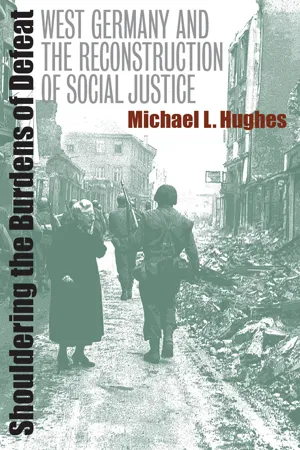
eBook - ePub
Shouldering the Burdens of Defeat
West Germany and the Reconstruction of Social Justice
- 280 pages
- English
- ePUB (mobile friendly)
- Available on iOS & Android
eBook - ePub
Shouldering the Burdens of Defeat
West Germany and the Reconstruction of Social Justice
About this book
Information
Chapter 1: Inflation, Destruction, Expulsion
World War II devastated Europe. Between 1939 and 1945, well over 30 million Europeans lost their lives; millions more suffered injury, torture, or privation; and few Europeans escaped the loss of some loved one, friend, or acquaintance. The war also imposed enormous material losses. Land, sea, and air warfare destroyed business premises and inventory, public buildings, homes, and personal property. Expropriation, plunder, and expulsion deprived millions of Europeans of much or all of their property. Wartime monetary and fiscal policies shifted wealth from citizens to the state and even among citizens. Moreover, the costs did not end in May 1945, because states had to rebuild, recompense wartime losses, and support the disabled and impoverished.1
Although Germany started the war and devastated its enemies, Germans also suffered. Seven million died because of the war. Total German war costs were 716 billion RM from 1933 to 1945, with a similar sum in Deutsche Mark paid out since 1948 to cover war-related costs. Support payments from the German government to various war victims and their survivors will not end until well into the twenty-first century.2
One important subset of German war costs was “war damages”—material losses of real and paper assets that Germans suffered as a result of the war and defeat. Losses of real property were approximately 105 billion RM. Some 18 million West Germans, more than one-third of the population, had lost most or all of their real property, leaving them at best poorer but more usually impoverished. West Germans would also lose 90–93.5 percent of their paper assets, including hundreds of billions of Reichsmark in savings, to suppressed inflation and currency reform.3 Based on popular expectations that society should protect citizens from arbitrary war damages, Germans identified and Nazi legislation defined a category of war-damaged with a widely acknowledged entitlement to recompense.
LEGAL RECOMPENSE FOR WAR DAMAGES
Before the eighteenth century, people scarcely imagined anyone might secure recompense for war damages. They generally assumed that they had little control over their lives and must accept whatever fate or the gods laid upon them. Job, who ultimately submits to a God who has devastated his life as part of a wager with Satan, exemplifies such human resignation. For Christians, everything that happened, no matter how small, was part of God’s larger plan, even if it seemed arbitrary and callous to human beings. War was one of the Four Horsemen of the Apocalypse, whose visitations humankind had to endure as God’s will, trusting in the hope of a better life hereafter.4
In the eighteenth century, some Europeans, the philosophes, began to suggest that human misery was not inevitable. They believed not that every particular event was part of God’s plan but rather that a benevolent God had created a rational universe and had placed human beings within it as autonomous agents who would have to make their own decisions. The philosophes and many other Europeans therefore began actively to pursue happiness as something subject to human design and effort, not divine will. “The upshot,” Paul Hazard writes, “was that happiness became a right, something to which we were entitled.” Any human misery that did not result from individual fault was unreasonable and unjust. Indeed, it implicitly called into question the new moral order of the rational, benevolent universe. People must make whole again the victims of such unmerited suffering—not only to help those victims but to restore the moral order. Not surprisingly, then, the French Revolutionary and Napoleonic Wars sparked the first tentative proposals that a state should recompense its citizens for war losses.5
Economic and social developments in nineteenth-century Europe strengthened citizens’ claims to recompense. The state came to have an interest in recompense to help rebuild national economic assets. Greater material security, consequent on economic growth and medical advances, increased people’s expectations and society’s ability to compensate individuals for the consequences of life’s disasters. Some measure of security came to seem the norm. Further, Europeans increasingly recognized a social right to some guaranteed minimum for workers and other poor citizens, making it difficult to deny compensation for those devastated by war damages. A West German journalist writing in 1948 exaggerated only a little when he asserted, “People in the 19th century thought they had come so far that they could erect and maintain a protective wall between war and the civilian population.”6
That wall, though, still rested on the shaky foundation of government acquiescence. Germany first granted compensation for war damages after the brief and successful Franco-Prussian War. The relevant legislation denied any right to recompense by stating that compensation must be by special law. The citizen could hope only for social assistance at the grace of the state. War damages resulted from sovereign acts, and one still could not sue the sovereign, who was the monarch and not the people.7
In the twentieth century, popular leverage on the German state increased. The state could not easily ignore citizen soldiers and voters, especially when total war required that it draw into its war effort people from all social classes. When war broke out in 1914, the German common soldier received 53 Pfennige (about 13 cents) per day—nowhere near enough to support a wife and children left behind. The war soon produced other victims, such as disabled veterans and war widows and orphans. To allow these victims to tumble into poverty would have devastated the soldiers’ morale. The German government hence quickly introduced a number of measures to assist these people. It explicitly distinguished those measures from the widely despised welfare, to avoid humiliating the recipients and the soldiers on whom they had depended.8
German war-damage compensation nonetheless proved minimal after World War I, even though Germany escaped most of that war’s enormous direct devastation. German wartime legislation did entitle individuals to have their damages officially registered. Yet it also denied any entitlement (Rechtsanspruch) to compensation, which remained subject to governmental discretion. War and postwar governments did grant partial compensation for material losses and for loss of an economic existence for the self-employed (but not for their employees!). Inflation and hyperinflation, though, eroded or obliterated the value of that compensation. Subsequent legislation did offer up to 10-20 percent compensation, but with substantial delays that eroded its value.9
When World War II began, the Nazis hesitated to commit themselves on the issue of war-damages compensation. They could not be sure how successful German arms or how expensive German war damages would be. Although insurance policies normally excluded war damages, the government did order private insurers to cover war losses up through July 1940, asserting that damages had been minimal enough that the companies could afford it. Further, on 8 September 1939, the Nazis issued a War-Damages Registration Decree that provided for the registration of war damages to real property but that explicitly postponed compensation against a future decision. The decree did, though, provide for prepayments in special cases, particularly to forestall economic ruin for the self-employed.10
This decree began the process of giving a legal identity to a subgroup of Germans who might be denominated the war-damaged. “War-damaged” was not a purely arbitrary construct. Some 1940s Germans would suffer significant material losses, and others would not. Some would see military action, espedally bombing, destroy their homes, businesses, or personal property; some would flee in terror or be expelled from their homes, forcing them to abandon all their possessions; some would see the value of their paper assets slashed by inflation. Those who suffered such losses came out of the war with a different set of experiences and a different situation than did those who had not suffered such losses. Both the damaged and the undamaged were conscious of those differences. Nonetheless, how many Germans would suffer war damages, how many would come to perceive themselves as war-damaged, and which the society would recognize as war-damaged and with what consequences, remained to be seen.11
Germany’s rapid, cheap run of victories in 1939 and 1940 produced an overweening optimism in Germany and a generous attitude toward war damages. On 30 November 1940 the Nazis issued the War-Damages Decree. The decree provided in principle for full compensation for war damages, including those from the loss of use of destroyed property. Compensation was not to be interest bearing, and the state would disburse compensation only when the individual could replace the lost property or when payment was indispensable to ensure life’s necessities. Eventually, the regime ruled that individuals would have to cover minor losses from their own resources.12
Implicit in this legislation was Hitler’s expectation that final victory would enable him to extract any compensation costs from the conquered. As Lastenausgleich expert Walter Seuffert (SPD—Social Democratic Party, the moderate socialists) put it in 1951, “this [compensation] law was a very generous discounted bill by the National Socialist regime, one that was to be redeemed by the enemy through the subjugation of several peoples, who would pay the bill.” No one at the time, he went on, had expected Germans to have to settle these costs among themselves.13
One notable aspect of this war-damages legislation was the extent to which the Nazis failed to give it a purely National Socialist character. Certainly the exclusion on racial grounds of Jews and other “non-Aryans” from compensation reflected Nazi ideology. Nonetheless, the civil servants who drafted the War-Damages Decree drew its fundamental principles from the compensation practices of the Second Empire and the Weimar Republic. The decree hence reflected liberal values by being structured around the principle of compensation for individual property losses, including loss of the use of property, but not for the loss of a job. The timing and priority of compensation were to be based on national-economic considerations, but no government could afford to do otherwise. Indeed, the Wilhelmine and Weimar governments had acted similarly.14
Ideologically, though, the Nazis were promoting during the war an anti-individualistic notion of social obligation. No compensation was really possible for loss of one’s own life or, despite survivors’ pensions, for that of a loved one, and the exigencies of the war economy would long delay compensation payments for most material losses. Maintaining the morale of the troops, the armament workers, and their relatives required an emphasis on selfless sacrifice for the community. Meyers Lexikon, in a volume published in 1940, defined sacrifice as the “voluntary, self-evident, silent setting into action of one’s strength and personality for the achievement of communal goals . . . without the expectation of sacrifice from others.” This definition directly reflected both the needs of a state at war and the communalist strain in Nazism. Nazi wartime propaganda actively promoted the need for sacrifice. For example, in his famous “Total War Speech” of 18 February 1943, Goebbels asserted, “The Volk wants to take on all, even the heaviest, burdens and is prepared to make any sacrifice if it serves the cause of victory.” Even the churches seconded such calls. Moreover, wartime propaganda emphasized revenge on Germany’s enemies, not compensation to German war-damaged.15
Even the Nazis, though, felt compelled to soften extravagant demands for selfless sacrifice with a more communal ideology of shared sacrifice. Already in April 1941 Goebbels suggested that the German people expected “to distribute justly the burdens that are now as a rule associated with war and to make them bearable for everyone.” An official commentary on the War-Damages Decree asserted, “According to the National Socialist conception, the individual citizen is not a subject whom the sovereign or state can dispose of at will. Rather, the individual is a member of the racial community with the rights thereto pertaining, and from that follows the obligation of the racial community on its side to step in for the racial comrade who has made a sacrifice for it, and to at least take from him the burdens where his sacrifice exceeds substantially what has been expected of the majority of other racial comrades.”16
Germans’ new status as citizens or “members of the racial community,” not subjects, presumably played an important role here. When the prince was the sovereign, the subjects could not sue him for the consequences of his actions. Yet now the people were the sovereign, explicitly under the Weimar Constitution that officially remained in force in Nazi Germany and implicitly in Nazi ideology of the leader as the apotheosis of the racial community. Hence, they could more easily make claims on a state that was in principle their agent, not an overweening ruler with implicitly absolute power.
The Nazis also moved away rhetorically, if not legally, from the individual recompense that the War-Damages Decree offered toward a more communally defined recompense. In their limited public discussions of war damages, they preferred to gush over how much “more beautifully and opulently” German cities would be rebuilt after the war. Even as Goebbels emphasized revenge, he reassured the war-damaged, “In thanks for their currently proven heroic resolution it will be an obligation of honor of the whole Volk to rebuild the cities and the buildings in the air war areas more beautifully than ever.” Significantly, Goebbels and company were not promising to replace as private property each individual’s losses. One of the great historical unknowns is how communalistic a victorious Nazi Germany would have been. As in other areas, the Nazis remained during the war committed to apparently opposing conceptions, here legally individualistic but rhetorically communal.17
Unfortunately, the sources are not available to explore systematically how wartime Germans responded to the mixed messages of Nazism. When it came to material losses, wartime and postwar actions suggest that they overwhelmingly rejected Nazi calls for selfless sacrifice. They remained committed, not surprisingly, to having their lost property, all of their lost property, restored. A German government had, after all, acknowledged their entitlement to restitution. Yet the Nazis had also reinforced the idea that the community as a whole had an obligation to share the burdens of war equitably rather than leaving unlucky individuals to bear them alone.
INFLATION
The first “war damages” that struck large numbers of Germans were losses in the value of their paper assets: their savings deposits, bonds, war-damages compensation claims, and so on. The Nazis financed much of their war effort with the hidden tax of inflation, which left paper assets formally in existence while substantially eroding their purchasing power. Average Germans had few opportunities for evading this inflationary policy. Efforts to compensate inflation losses hence played a role in the Lastenausgleich.
Because governments must strive to maintain popular support for their war efforts, they have found it difficult to impose stiff taxation that would soak up large chunks of people’s earnings to finance the war. Instead, governments have tended to rely on the sale of government paper (war bonds, treasury notes, and the like) to their citizens, to divert people’s purchasing power away from current consumption and into the government’s coffers. Yet there are limits to how much people are willing to save, to how much they are willing to forego consumption. Governments have then introduced economic controls to allocate resources directly to war-related, and away from consumer-goods, production. They have also printed more money to finance the war. To prevent an immediate inflation of prices from consumer-goods shortages and the increased money supply (especially for vital goods such as food, rent, and clothing), wartime governments have also eventually introduced price controls and rationing.18
Germans had experienced such inflationary war finance during and after World War I. The Wilhelmine Reich had run up enormous war debts while more than doubling the money supply. It had weakened the economy’s ability to service those debts by foregoing investment to divert resources to immediate war needs. Postwar democratic governments faced massive costs for...
Table of contents
- Cover Page
- Shouldering the Burdens of Defeat: West Germany and the Reconstruction of Social Justice
- Copyright Page
- Dedication
- Contents
- Acknowledgments
- Abbreviations
- Introduction
- Chapter 1: Inflation, Destruction, Expulsion
- Chapter 2: Obstacles and Opportunities
- Chapter 3: Currency Reform Prejudices the Lastenausgleich
- Chapter 4: First Aid for the War-Damaged
- Chapter 5: Individual Virtue, Individual Lastenausgleich
- Chapter 6: Economic Exigencies
- Chapter 7: The Politics Of a Lastenausgleich
- Chapter 8: Making Policy
- Chapter 9: Toward Liberal Democratic Stability
- Conclusion
- Notes
- Bibliography
- Index
Trusted by 375,005 students
Access to over 1.5 million titles for a fair monthly price.
Study more efficiently using our study tools.
Frequently asked questions
Yes, you can cancel anytime from the Subscription tab in your account settings on the Perlego website. Your subscription will stay active until the end of your current billing period. Learn how to cancel your subscription
No, books cannot be downloaded as external files, such as PDFs, for use outside of Perlego. However, you can download books within the Perlego app for offline reading on mobile or tablet. Learn how to download books offline
Perlego offers two plans: Essential and Complete
- Essential is ideal for learners and professionals who enjoy exploring a wide range of subjects. Access the Essential Library with 800,000+ trusted titles and best-sellers across business, personal growth, and the humanities. Includes unlimited reading time and Standard Read Aloud voice.
- Complete: Perfect for advanced learners and researchers needing full, unrestricted access. Unlock 1.5M+ books across hundreds of subjects, including academic and specialized titles. The Complete Plan also includes advanced features like Premium Read Aloud and Research Assistant.
We are an online textbook subscription service, where you can get access to an entire online library for less than the price of a single book per month. With over 1.5 million books across 990+ topics, we’ve got you covered! Learn about our mission
Look out for the read-aloud symbol on your next book to see if you can listen to it. The read-aloud tool reads text aloud for you, highlighting the text as it is being read. You can pause it, speed it up and slow it down. Learn more about Read Aloud
Yes! You can use the Perlego app on both iOS and Android devices to read anytime, anywhere — even offline. Perfect for commutes or when you’re on the go.
Please note we cannot support devices running on iOS 13 and Android 7 or earlier. Learn more about using the app
Please note we cannot support devices running on iOS 13 and Android 7 or earlier. Learn more about using the app
Yes, you can access Shouldering the Burdens of Defeat by Michael L. Hughes in PDF and/or ePUB format, as well as other popular books in History & European History. We have over 1.5 million books available in our catalogue for you to explore.