In the twentieth century, illiteracy and its elimination were political issues important enough to figure in the fall of governments (as in Brazil in 1964), the building of nations (in newly independent African countries in the 1970s), and the construction of a revolutionary order (Nicaragua in 1980). This political biography of Paulo Freire (1921–97), who played a crucial role in shaping international literacy education, also presents a thoughtful examination of the volatile politics of literacy during the Cold War.
A native of Brazil’s impoverished northeast, Freire developed adult literacy training techniques that involved consciousness-raising, encouraging peasants and newly urban peoples to see themselves as active citizens who could transform their own lives. Freire’s work for state and national government agencies in Brazil in the early 1960s eventually aroused the suspicion of the Brazilian military, as well as of U.S. government aid programs. Political pressures led to Freire’s brief imprisonment, following the military coup of 1964, and then to more than a decade and a half in exile. During this period, Freire continued his work in Chile, Nicaragua, and postindependence African countries, as well as in Geneva with the World Council of Churches and in the United States at Harvard University.
Andrew J. Kirkendall’s evenhanded appraisal of Freire’s pioneering life and work, which remains influential today, gives new perspectives on the history of the Cold War, the meanings of radicalism, and the evolution of the Left in Latin America.
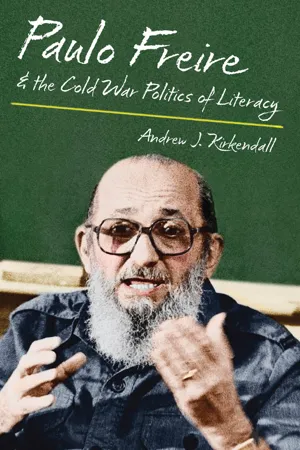
- 264 pages
- English
- ePUB (mobile friendly)
- Available on iOS & Android
eBook - ePub
Paulo Freire and the Cold War Politics of Literacy
About this book
Information
Notes
Abbreviations
- APE-PE
- Arquivo Público Estadual de Pernambuco
- APE-RGN
- Arquivo Público Estadual de Rio Grande do Norte
- BCNC
- Biblioteca del Congreso Nacional de Chile, Santiago
- Carter Library
- Jimmy Carter Presidential Library, Atlanta, Georgia
- CCIAF
- Churches' Commission International Activities Files
- CCPDF
- Commission on Churches' Participation in Development Files
- CPDOC
- Centro de Pesquisa e Documentação de História Contemporânea do Brasil, Rio de Janeiro
- DOPS
- Departamento de Ordem Político e Social (Department of Political and Social Order), Pernambuco
- FRUS
- U.S. Department of State, Foreign Relations of the United States (Washington: Government Printing Office, 1958–68)
- FUNESC
- Fundação Espaço Cultural da Paraíba in João Pessoa (Cultural Space Foundation of Paraíba), Arquivo Histórico, João Pessoa, Paraíba
- IP
- Inquérito Policial
- IPF
- Instituto Paulo Freire (Paulo Freire Institute), São Paulo
- JFK Library
- John F. Kennedy Presidential Library, Boston, Massachusetts
- PPPUS
- Public Papers of the Presidents of the United States (Washington: Federal Register Division, National Archives and Records Service, General Services Administration, 1961–62)
- RG 59
- Record Group 59, Department of State, National Archives II, College Park, Maryland
- RG 84
- Record Group 84, Department of State, National Archives II, College Park, Maryland
- RG 286
- Record Group 286, U.S. Agency for International Development, National Archives II, College Park, Maryland
- SECERN
- Serviço Cooperativo de Educação (Cooperative Education Service)
- Sergipe Inquérito
- Poder Judiciário, Estado de Sergipe, Comarca de Aracaju—Segunda Vara Criminal, Forum Gumercindo Bessa, Auditória da Sexta Regiao Militar (Exército, Marinha, e Aeronautica) Bahia—Sergipe Number 27/65, 1965
- STM
- Superior Tribunal Militar (Military High Court), Brasília
- UCA
- Universidad Centroamericana, Instituto de Historia de Nicaragua y Centroamérica, Managua
- WCCA
- World Council of Churches, Archives, Geneva
Introduction
1 Freire's longtime associate Marcos Arruda plays with one of these images when he has President Luís Inácio Lula da Silva mistake St. Peter for Freire in “Crônica de Amanha,” in Cartas a Lula, p. 228. See also the discussion of Freire as myth in Alípio Casali and Vera Barreto's preface in Ana Maria Araújo Freire, Paulo Freire, pp. 20–21.
2 See Westad, Global Cold War, particularly pp. 3–7, 32–38, 67–72, 86–109, and 396–404; and Cullather, “Miracles of Modernization,” p. 231.
3 Graff, Labyrinths of Literacy, pp. 2–3. Graff argues that simple causal linkages between literacy and development are not sustained by historical evidence. See also Staples, Birth of Development, particularly pp. 1–12, although she does not address literacy itself. Nor does Arturo Escobar, Encountering Development, or Saldaña-Portillo, Revolutionary Imagination. For a recent discussion of the presumed link between literacy and development, see Bartlett, “Human Capital or Human Connections?,” particularly pp. 1613–18 and 1628–30.
4 Cullather, “Miracles of Modernization,” p. 227; Weinstein, “Developing Inequality.”
5 Graff, Labyrinths of Literacy, p. 30.
6 Hobsbawm, Age of Extremes, pp. 96–97, 272–74, and 377–86. For a different perspective, which stresses a more mainstream European acceptance (and a more complicated etiology) of planning, see Judt, Postwar, particularly pp. 67–77. On the increasing acceptance in the United States of the idea of planning (and particularly how it played a role in the postwar transformation of Japan), see Westad, Global Cold War, p. 24. See also Arnove and Graff, National Literacy Campaigns, p. 3.
7 Graff, Labyrinths of Literacy, pp. 35 and 61; Arnove and Graff, National Literacy Campaigns, pp. 5, 6–8, and 10–17. Regarding “modernity,” see Cooper, Colonialism in Question, particularly pp. 113–49.
8 Bhola, Campaigning for Literacy, pp. 39–57; Ben Ekloff, “Russian Literacy Campaigns, 1861–1939,” in Arnove and Graff, eds., National Literacy Campaigns, pp. 127–29, 134–35, 138–41, and 144–45. See also Fitzpatrick, ed., Cultural Revolution in Russia, pp. 1–2 and 25–26; Fitzpatrick, Education and Social Mobility in the Soviet Union, pp. 9, 158–59, 161–64, and 171–72; Gail Warshofsky Lapidus, “Educational Strategies and Cultural Revolution: The Politics of Soviet Development,” in Fitzpatrick, ed., Cultural Revolution in Russia, pp. 79–80; and Reese, Stalin's Reluctant Soldiers, pp. 80–82. Regarding the New Economic Policy phase, see Clark, Uprooting Otherness, pp. 15, 17–19, 32–33, 36–37, 72, 87–88, 93, 115–16, 170, and 178–80.
9 Charles W. Hayford, “Literacy Movements in Modern China,” in Arnove and Graff, eds., National Literacy Campaigns, pp. 163–64 and 167; for an official perspective, see Wang Yanwei, “People's Participation and Mobilization: Characteristics of the Literacy Campaigns in China,” in Carron and Bordia, eds., Issues in Planning, pp. 47–50; for a sympathetic treatment, see Bhola, Campaigning for Literacy, pp. 73–90.
10 For a discussion of the evolution of Marxist understandings of consciousness, see, for example, Kolakowski, Main Currents of Marxism, particularly pp. 105–7, 121–22, 128–30, 143–45, 148–49, 262–67, 278–84, 386–88, 420–24, 566–76, 664–74, 1010–13, and 1180–83. On the emphasis on state planning in the Third World, see, for example, Westad, Global Cold War, pp. 90–97; and Engerman, Modernization from the Other Shore, pp. 153–243.
11 For an admiring portrait of Laubach, see Medary, Each One Teach One, particularly pp. 4–6, 16–18, 21–27, 36–62, 81–109, and 116–22.
12 Kirkendall, Class Mates, particularly pp. 39–61, and “Student Culture and Nation-State Formation.”
13 Szuchman, Order, Family, and Community in Buenos Aires, pp. 151–63.
14 Vaughan, State, Education, and Social Class in Mexico, pp. 14, 25, 33–35, 89, 113–15, 125, 144, 162, 189, 211, and 258–66. See also Vaughan, Cultural Politics in Revolution, pp. 5–6, 44, 65, 75, and 189–201. Regarding Torres Bodet, see Jones, International Policies for Third World Education, pp. 38–40.
15 Arthur Gillette, “The Experimental World Literacy Program: A Unique International Effort Revisited,” in Arnove and Graff, eds., National Literacy Campaigns, p. 197. Phillip W. Jones calls “universal literacy” UNESCO's “most extensive and intensive single commitment” (Jones, International Policies for Third World Education, p. 1).
16 Kirpal, “UNESCO's Contribution to Development,” in Pompei et al., In the Minds of Men, p. 117; Jones, International Policies for Third World Education, pp. 33–34. Jones's fine work aside, the history of UNESCO is just beginning to be written. See Droit, Humanity in the Making, particularly pp. 43, 50, 57–59, 62, and 66.
17 A good introduction to the subject can be found in Oman and Wignaraja, Postwar Evolution of Development Thinking, particularly pp. 1–2, 9–13, and 37–57. See also Love, Crafting the Third World, pp. 1–5 and 213–26; and Mallorquin, Celso Furtado, pp. 26–29, 32–46, and 51–81.
18 Regarding “fundamental education,” see Jones, International Policies for Third World Education, pp. 22–23, 26, and 47–87; and UNESCO, World Illiteracy at Mid-Century, pp. 5, 16, and 190–93. See also Lionel Elvin, “Education,” in Pompei et al., In the Minds of Men, pp. 55 and 58–59; Kirpal, “UNESCO's Contribution to Development,” in Pompei et al., In the Minds of Men, p. 123; René Maheu, “Serving the Minds of Men,” in Pompei et al., In the Minds of Men, pp. 301–3; Droit, Humanity in the Making, pp. 57–59; and Valderrama, History of UNESCO, pp. 47, 60, 66, 82, 104, and 124.
19 Westad, Global Cold War, pp. 106–9.
20 Adiseshiah's remarks in UNESCO Correspondence Files 372 (8) MP 01 A 63 (81), “Extension Primary Education LA Major Project No. 1,” 17 March 1958, pp. 2, 12, and 14. For a general introduction to UNESCO's efforts in Latin America in the first twenty-five years of its existence, see Juan Goméz Millas, “Latin America,” in Pompei et al., In the Minds of Men, pp. 177–99. See also UNESCO Courier, July/August 1966, p. 72.
21 I discuss this at some length in Class Mates.
22 Bomeny, Os Intelectuais da Educação, pp. 11–21. The history of voting in Brazil is traced in Letícia Bicalho Canêdo, “Aprendendo a Votar,” in Pinsky and Pinsky, eds., História da Cidadania, pp. 517–43. See also Love, “Political Participation in Brazil.” Regarding the frequent denial of the vote to illiterates in Latin America generally, see Sabato, “On Political Citizenship.”
Chapter One
1 Regarding the history of Brazilian education, see Fernando de Azevedo, Brazilian Culture, pp. 325–99 and 415–40. His partisan participant's perspective on the New School can be found on pp. 440–86. See also Bomeny, Os Intelectuais da Educação, pp. 11–13, 16, 20–26, 31–33, 39–43, and 50–53; Cury, Ideologia e Educação Brasileira, particularly pp. 65–98 and 165–69; Reis Filho, A Educação e a Ilusao Liberal em São Paulo, pp. 178–79; and Monarcha, A Reinvenção da Cidade e da Multidão, pp. 14, 16–20, 43, and 97. Lourenço Filho attempted to make Brazilians aware of trends in pedagogy in Europe and the United States in Introdução ao Estudo da Escola Nova; regarding the philosophy of the New School, see particularly pp. 17–27, 34–115, 151–54, and 163–64. See also Dávila, Diploma of Whiteness.
2 Skidmore, Politics in Brazil, pp. 12–33, 39–41, and 48–53. See also French's thoughtful examination of the Vargas lega...
Table of contents
- Cover Page
- Paulo Freire & the Cold War Politics of Literacy
- Copyright Page
- Dedication
- Contents
- Illustrations
- Acknowledgments
- Introduction / Paulo Freire & the Twentieth-Century Drive for Development
- One / Entering History
- Two / The Revolution that Wasn't & the Revolution that Was in Brazil, 1961–1964
- Three / Reformist Chile, Peasant Consciousness, & the Meaning of Christian Democracy, 1964–1969
- Four / Paulo Freire & the World Council of Churches in the First & Third Worlds, 1969–1980
- Five / The Sandinistas & the Last Utopian Experiment of the Cold War, 1979–1980
- Six / The Long, Slow Transition to Democracy in Brazil & the End(?) of Utopia, 1980–1997
- Epilogue / Legacies of a Cold War Intellectual in a Post–Cold War World
- Notes
- Bibliography
- Index
Trusted by 375,005 students
Access to over 1.5 million titles for a fair monthly price.
Study more efficiently using our study tools.
Frequently asked questions
Yes, you can cancel anytime from the Subscription tab in your account settings on the Perlego website. Your subscription will stay active until the end of your current billing period. Learn how to cancel your subscription
No, books cannot be downloaded as external files, such as PDFs, for use outside of Perlego. However, you can download books within the Perlego app for offline reading on mobile or tablet. Learn how to download books offline
Perlego offers two plans: Essential and Complete
- Essential is ideal for learners and professionals who enjoy exploring a wide range of subjects. Access the Essential Library with 800,000+ trusted titles and best-sellers across business, personal growth, and the humanities. Includes unlimited reading time and Standard Read Aloud voice.
- Complete: Perfect for advanced learners and researchers needing full, unrestricted access. Unlock 1.5M+ books across hundreds of subjects, including academic and specialized titles. The Complete Plan also includes advanced features like Premium Read Aloud and Research Assistant.
We are an online textbook subscription service, where you can get access to an entire online library for less than the price of a single book per month. With over 1.5 million books across 990+ topics, we’ve got you covered! Learn about our mission
Look out for the read-aloud symbol on your next book to see if you can listen to it. The read-aloud tool reads text aloud for you, highlighting the text as it is being read. You can pause it, speed it up and slow it down. Learn more about Read Aloud
Yes! You can use the Perlego app on both iOS and Android devices to read anytime, anywhere — even offline. Perfect for commutes or when you’re on the go.
Please note we cannot support devices running on iOS 13 and Android 7 or earlier. Learn more about using the app
Please note we cannot support devices running on iOS 13 and Android 7 or earlier. Learn more about using the app
Yes, you can access Paulo Freire and the Cold War Politics of Literacy by Andrew J. Kirkendall in PDF and/or ePUB format, as well as other popular books in History & History of Education. We have over 1.5 million books available in our catalogue for you to explore.