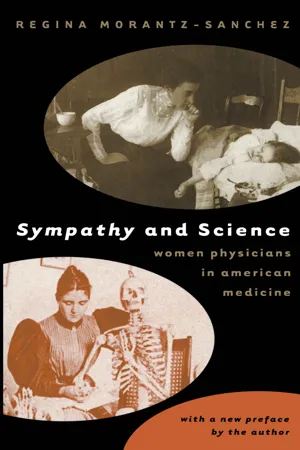
When first published in 1985, Sympathy and Science was hailed as a groundbreaking study of women in medicine. It remains the most comprehensive history of American women physicians available. Tracing the participation of women in the medical profession from the colonial period to the present, Regina Morantz-Sanchez examines women’s roles as nurses, midwives, and practitioners of folk medicine in early America; recounts their successful struggles in the nineteenth century to enter medical schools and found their own institutions and organizations; and follows female physicians into the twentieth century, exploring their efforts to sustain significant and rewarding professional lives without sacrificing the other privileges and opportunities of womanhood.
In a new preface, the author surveys recent scholarship and comments on the changing world of women in medicine over the past two decades. Despite extraordinary advances, she concludes, women physicians continue to grapple with many of the issues that troubled their predecessors.
- 504 pages
- English
- ePUB (mobile friendly)
- Available on iOS & Android
eBook - ePub
About this book
CHAPTER 1
Colonial Beginnings: Public Men and Private Women
Whether sympathy and science and practical energy are incompatible, time must determine; at any rate, tears and tenderness are more to my taste than oaths and hard looks. In fact, although it may seem queer, I had rather have a doctor smelling of rose and ihlang-ihlang, than of tobacco and whisky!
Augustus K. Gardner, M.D., 1870.
It was an early November morning in 1869, and Dean Ann Preston of the Woman’s Medical College of Pennsylvania, normally a rather austere woman, could not hide her delight. For several years she had sought to gain permission for students to attend the teaching clinics in general surgery at the Pennsylvania Hospital in Philadelphia. Preston well understood the value of being exposed to some of Philadelphia’s greatest clinicians. Although the Women’s Medical College had its own small hospital, where surgery had been taught since 1854, the school’s meager resources meant that it could not match the majestic surgical amphitheaters or the distinguished surgical faculties of the renowned major hospitals of Philadelphia. Today she had finally received permission from the Pennsylvania’s managers to bring her students to the Saturday clinics. Preston had no reason to expect trouble, for the women had already been attending clinics at Philadelphia’s Blockley Hospital for almost a year.
Neither she nor the thirty-five students who eagerly accompanied her that day were in the least prepared for the ensuing events—events that would be reported and rehashed in great detail in newspapers from Boston to New York over the next several months. Dr. Elizabeth Keller, later senior surgeon at the New England Hospital for Women and Children, never forgot the experience. Neither did Dr. Eliza Jane Wood, whose scrapbook of clippings can still be found in her file at the Medical College of Pennsylvania in Philadelphia.
The men were “determined to make it so unpleasant for us,” Keller recalled, “that from choice, we would not care to attend another [clinic].” She remembered being greeted by jeers, whistles, groans, and the stamping of feet, while some men actually threw stones.1 Wood carefully preserved the Philadelphia Evening Bulletin’s detailed description of the incident:
The students of the male colleges, knowing that the ladies would be present, turned out several hundred strong, with the design of expressing their disapproval of the action of the managers of the hospital particularly, and of the admission of women to the medical profession generally.
Ranging themselves in line, these gallant gentlemen assailed the young ladies, as they passed out, with insolent and offensive language, and then followed them into the street, where the whole gang, with the fluency of long practice, joined in insulting them....
During the last hour missiles of paper, tinfoil, tobacco-quids, etc., were thrown upon the ladies, while some of these men defiled the dresses of the ladies near them with tobacco juice.2
Although such violent public displays of male opposition were not frequent occurrences in the decades after the Civil War, women physicians who experienced such unpleasantries often remembered them with bitterness.3 In spite of their discomfort, however, what is most significant about the incident in Philadelphia and those few that occurred in other cities was not the extraordinary nastiness of the male students, or even the more measured protest against female students in the form of a letter a few days later from some faculty members. On the contrary, the event’s historical importance was instead to demonstrate that in 1869, public sympathies lay, not with the male students or their recalcitrant teachers, but with the women.
The managers of the Pennsylvania Hospital, for example, refused to yield to the coarse behavior and determined that women should continue to be admitted to the Saturday morning clinics in spite of the men’s bad manners. Moreover, the Evening Bulletin, in conjunction with most of the other newspapers in the Northeast that reported the story, had nothing but contempt for the misconduct. The Philadelphia Public Ledger, for example, labeled the response “moral carditis,” arguing that “this community has been the victim of an insult which it is compelled to resent to the uttermost.” Hinting that women might indeed be the intellectual superiors of men after all, the editors denounced the male students for “seeking to triumph over struggling mind, encased though it was in a female shell.”4
Besides considerable public sympathy, the women students had also won a number of male physicians to their cause. Only a year after the Philadelphia incident, a prominent New York physician, Augustus K. Gardner, published an article in Leslie’s Illustrated News proclaiming himself ready to “eat my words” on the subject of women physicians. Acknowledging that twenty years before he had had some “unkind, and, I am now free to confess unjust” remarks to make about them, he wished to set the record straight. Not ashamed to admit publicly that he himself had changed both “in looks” and “in opinions,” Gardner observed that he had “lived to see women advanced.” No longer a figment of men’s imagination, women doctors were now “powers... educated, erudite, thoughtful.” What this meant to Gardner, and to other supporters like him, was that although one might still harbor notions that females were different and probably “the weaker vessel,” one would, nevertheless, be willing to give women their chance at self-improvement. “A woman who feels an irresistible impulse to study medicine,” he wrote,
so strong as to overcome her natural timidity, or to be willing to take the obloquy and covert, if not open, insults from the world in general, and very often her own family and friends in particular—she will make a better doctor than a stupid lout, of whom, being found good for nothing, his father makes either a minister or a doctor.... The great limitations to women come from society, and are not from esssential inferiorities of the sex.
I say, today, Don’t interfere with women. Give them a fair chance. If, side by side with a man, a woman does an equal day’s work, pay the two alike.... Now, let women study medicine as thoroughly and as freely as men; let them stand equal with male doctors, and let those who want the one or the other employ either, as they may be found capable. I, for one, will give women physicians every countenance; meet with them on equal footing....5
Like Dr. Gardner, women who entered medicine in the midnineteenth century also believed that things had changed. “Our age is a progressive one,” explained Dr. Prudence Saur in her graduating thesis from the Woman’s Medical College of Pennsylvania. Women had a new and important role to play in the upward advance of humanity, agreed Angenette A. Hunt.6 Their dean, Dr. Ann Preston, who had done so much to make the study of medicine a reality for women, felt that the entrance of women into the profession marked the advance of civilization and the “fuller appreciation of the scope of Christianity.” “You feel that you have not gone out of your way to seize upon medicine as on some far off thing,” she told her students, but with significant social progress, its study “has come to you.”7
Women physicians’ enthusiasm reflected their confidence that they lived in the best of all possible worlds. They were convinced that women’s status had changed for the better in the nineteenth century, and that the range of female activity had dramatically broadened in their lifetime. With new conditions had come novel opportunities not available to their predecessors. So they believed, but how historically accurate was this assessment?
Until recently, most scholars would have taken issue with their rosy picture of the nineteenth-century woman’s expanded options and life-choices. Researchers, basing their conclusions on the work of Elizabeth A. Dexter, have emphasized the social confinement of Victorian women as compared with the relative flexibility of seventeenth- and eighteenth-century sex roles. They have argued that American women in the colonial and revolutionary periods had experienced a degree of autonomy and independence shared neither by their English counterparts nor their nineteenth-century descendants. They have found that even though most women in the colonies worked within their homes, and in the context of the family economy, they labored in a wide variety of occupations, sometimes exhibiting a considerable measure of status. There were female butchers, silversmiths, and upholsterers; women ran plantations, mills, shipyards, shops, and taverns. They pursued journalism, printing, teaching, tanning, and the healing arts. Most acquired their skills through apprenticeship training, often with their immediate families. 8
In keeping with this diverse range of female tasks, the colonies also boasted a varied group of women healers who earned part or all of their incomes from medical practice. Some were urban specialists in infant care who came to aid well-to-do mothers after childbirth, and lived six to ten weeks with a particular family before moving on. Resident nurses who were frequently consulted in folk medicine before advanced illness made it necessary to procure the aid of a physician also peopled the ranks of colonial medical practitioners. Teenaged girls, too, were sent to nurse sick relatives or attend childbeds, and many acquired significant knowledge through experience. Cotton Mather, for example, believed in woman’s natural affinity for healing and taught medicine to his own daughter.9 In addition, we know that women were employed as nurses in the American forces during the Revolution, and history has preserved the name of at least one woman, a Mrs. Allyn, who served as an army surgeon during King Phillip’s War.10
Women were most commonly occupied with medical practice as midwives. So formidable was the custom of using midwives in the management of childbirth in the colonies that a man, Francis Rayns, was prosecuted and fined in 1646 by a Maine court for acting as a midwife.11 Colonial American women faced the perils of childbirth in the company of a community of other females who provided both companionship and medical assistance. The science of obstetrics as it is now known was still in its infancy. Midwifery in these years was a folk art that remained unquestionably women’s work.12
A handful of American midwives were formally trained in Europe in the seventeenth and eighteenth centuries. Many more acquired their skill by reading midwifery manuals and apprenticing themselves to more experienced women when they could. But ability varied considerably. It is likely, in fact, that Dr. Valentine Seaman was quite correct when he claimed in 1800 that the “greater part” of these women came to their calling by accident, “having first been catched ... with a woman in labour.”13
Still, midwives earned the respect and high regard of their communities. Indeed, of all the women who practiced healing in the colonies, skilled midwives probably enjoyed the highest status. A study of loyalist women’s property claims after the American Revolution, for example, found that at least one Charleston midwife, Janet Cumming, testified to yearly earnings of four hundred pounds sterling, an income equivalent to that of a prosperous merchant, lawyer, or government official. Earlier, in Plymouth Colony, the annals of Rehoboth record the arrival in 1663 of Samuel Fuller and his mother, he to practice medicine, she to act as midwife and “answer the town’s necessity, which was great.” The epitaph of Mrs. Wiat of Dorchester, who died in 1705, testified to her attendance at over one thousand successful births, while the Boston Weekly News-Letter in 1730 mourned the death of the “noted midwife” Mary Bradway, who lived to be one hundred years old. Numerous examples of such skilled and revered women exist in colonial records.14
The social importance of midwives and the record of female employment in other occupations prompted the notion that these years represented a “golden age” in its tolerance for a wide variation of roles for women. After the Revolution, historians have argued, women’s opportunities were gradually constricted. Women presumably lost status and eventually were displaced from professions—like medicine—where they had been active. What was described as an informal equality between men and women fostered by the preindustrial economy allegedly gave way to a rigidification of the sexual spheres culminating in the cult of domesticity and the idealistic glorification of wifehood and motherhood in the nineteenth-century.
Recent research has concentrated more closely on the social context of the greater colonial flexibility in definitions of women’s work, however. The result has been a more complex picture of social relations, intimating that earlier interpretations were too simplistic. Newer scholarship suggests, in fact, that Ann Preston and her students at the Woman’s Medical College of Pennsylvania may well have been more accurate when they claimed in the 1860s that women’s entrance into the medical profession was something wholly new in modern history.
Revisionist historians do not dispute earlier evidence that women in colonial America performed a wider range of economic tasks than their nineteenth-century descendants. Their findings suggest instead that such role flexibility should not automatically be interpreted to indicate high status for women in a particular culture, unless it holds such meaning for the participants themselves. In this regard, recent work has demonstrated that in seventeenth- and eighteenth-century America, women’s labor was so inextricably tied to household, husband, and children that no one dared challenge the assumption that their lives would be bounded primarily by the domestic circle. In colonial society both men and women knew their place; there was little need to analyze its dimensions. Hence, the historian will search in vain for lengthy treatises on masculinity and femininity, or systematic definitions of women’s roles. Such evidence usually appears when commonly held assumptions are breaking down. The absence of a public ideology about gender suggests a range of agreement so broad that the premises could be left unstated. Though a sexual division of labor existed, it was less ideologically defined than it would be in the nineteenth century and remained largely unspoken. Thus, women might perform a multiplicity of economic tasks, but the social meaning of their work would always be found in its relation to the family welfare. The variegated nature of women’s production indicated, not the extensive economic opportunity available to them, but rather the length and breadth of their economic responsibility.15
In this context, the practice of medicine by women takes on a meaning different than historians had originally thought. Let us look, for example, at childbirth. Before 1760 no other event in a woman’s life cycle exhibited greater female control or firmer female bonding. At the beginning of labor, a parturient mother “called her women together,” leaving male members of the household to wait on the periphery in anticipation. The midwife remained in control of the event, while neighbors and friends offered comfort and support. Only when women were not available did men participate in delivery, and only in difficult cases were physicians called to intervene. The experience of William Byrd of Virginia was typical. “I went to bed about 10 o’clock,” he wrote in his diary, “and left the women full of expectation with my wife.”16
A number of historians have acknowledged the central role this “social childbirth” experience played in strengthening bonds between women and enriching domestic female culture.17 Yet Laurel Thatcher Ulrich has rightly cautioned us not to interpret even premodern childbirth as an event entirely independent of male jurisdiction. In the colonies two men—the minister and the physician—might occasionally challenge female sovereignty by virtue of their status as “learned gentlemen.” In 1724, for example, the Reverend Hugh Adams of Durham, New Hampshire, was called to Exeter by a midwife attending a woman who had been in labor three and one-half days. Adams, whose scant obstetrical knowledge consisted primarily of reading a few English treatises on childbirth, claimed in his memoirs to have performed version—the complicated procedure of turning the fetus in utero—in order to deliver the child safely. The significance of such a story lies neither in this man’s pompous temerity in plunging ahead, nor even in his extraordinary luck when the infant lived. Although not common, this example of male interference still stands as a reminder of the powerful status of the “learned man” in a society where women had no learning, and the sanction such status afforded its beneficiaries to intrude if necessary at the last moment on a woman’s event.18
In a society where a woman’s destiny was to marry, have children, and direct the work of the household, the practice of medicine by women also remained linked to the private sphere. Even when they did care for the sick, they did not enjoy the same status as many of their male counterparts, but doctored primarily as skilled amateurs. Women employed as nurses in the American forces during the Revolution, for example, were rarely allowed to administer medicine and received much lower pay than male nurses or physicians.19 Even “professional” midwives functioned entirely within this context. They were primarily women who needed to contribute to the family economy, or widows without an alternative means of support, and they used traditional skills available to them according to the sexual division of labor. When they had difficulty, they were expected to appeal to physicians. Thus, women who practiced medicine in the colonies were never considered part of the medical profession, in spite of the fact that in these years American medical professionalism was itself in disarray and the medical credentials of many male practitioners left much to be desired.
Originating in the t...
Table of contents
- Title Page
- Copyright Page
- Table of Contents
- Dedication
- Preface
- Acknowledgements
- Introduction
- CHAPTER 1 - Colonial Beginnings: Public Men and Private Women
- CHAPTER 2 - The Middle-Class Woman Finds Health Reform
- CHAPTER 3 - Bringing Science into the Home: Women Enter the Medical Profession
- CHAPTER 4 - Separate but Equal: Medical Education for Women in the Nineteenth Century
- CHAPTER 5 - Women and the Profession: The Doctor as a Lady
- CHAPTER 6 - The Woman Professional: The Lady as a Doctor
- CHAPTER 7 - Science, Morality, and Women Doctors: Mary Putnam Jacobi and ...
- CHAPTER 8 - Doctors and Patients: Gender and Medical Treatment in ...
- CHAPTER 9 - Hopes Unfulfilled: Women Physicians and the Social Transformation ...
- CHAPTER 10 - The Emergence of Social Medicine: Women’s Work in the Profession
- CHAPTER 11 - Integration in Name Only
- CHAPTER 12 - Quo Vadis?
- APPENDIX - Notes on Methodology
- Bibliography
- Notes
Trusted by 375,005 students
Access to over 1.5 million titles for a fair monthly price.
Study more efficiently using our study tools.
Frequently asked questions
Yes, you can cancel anytime from the Subscription tab in your account settings on the Perlego website. Your subscription will stay active until the end of your current billing period. Learn how to cancel your subscription
No, books cannot be downloaded as external files, such as PDFs, for use outside of Perlego. However, you can download books within the Perlego app for offline reading on mobile or tablet. Learn how to download books offline
Perlego offers two plans: Essential and Complete
- Essential is ideal for learners and professionals who enjoy exploring a wide range of subjects. Access the Essential Library with 800,000+ trusted titles and best-sellers across business, personal growth, and the humanities. Includes unlimited reading time and Standard Read Aloud voice.
- Complete: Perfect for advanced learners and researchers needing full, unrestricted access. Unlock 1.5M+ books across hundreds of subjects, including academic and specialized titles. The Complete Plan also includes advanced features like Premium Read Aloud and Research Assistant.
We are an online textbook subscription service, where you can get access to an entire online library for less than the price of a single book per month. With over 1.5 million books across 990+ topics, we’ve got you covered! Learn about our mission
Look out for the read-aloud symbol on your next book to see if you can listen to it. The read-aloud tool reads text aloud for you, highlighting the text as it is being read. You can pause it, speed it up and slow it down. Learn more about Read Aloud
Yes! You can use the Perlego app on both iOS and Android devices to read anytime, anywhere — even offline. Perfect for commutes or when you’re on the go.
Please note we cannot support devices running on iOS 13 and Android 7 or earlier. Learn more about using the app
Please note we cannot support devices running on iOS 13 and Android 7 or earlier. Learn more about using the app
Yes, you can access Sympathy and Science by Regina Morantz-Sanchez in PDF and/or ePUB format, as well as other popular books in Medicine & Medical Theory, Practice & Reference. We have over 1.5 million books available in our catalogue for you to explore.