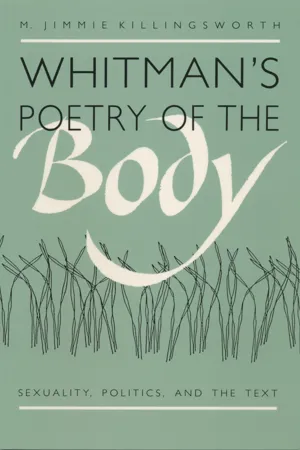
This book combines literary and historical analysis in a study of sexuality in Walt Whitman’s work. Informed by his “new historicist” understanding of the construction of literary texts, Jimmie Killingsworth examines the progression of Whitman’s poetry and prose by considering the textual history of Leaves of Grass and other works.
Killingsworth demonstrates that Whitman’s “poetry of the body” derives its radical power from the transformation of conventional attitudes toward sexuality, traditional poetics, and conservative politics. The sexual relation, with its promise of unity, love, equality, interpenetration, and productivity for partners, becomes a metaphor for all political and social relationships, including that of poet and reader. The effect of the poems is protopolitical, an altering of consciousness about the body’s relation to other bodies, a shifting of the categories of knowledge that foretells political action.
Killingsworth traces the interplay in Whitman’s poetry between sexual and textual themes that derive from Whitman’s political response to the historical turbulence of mid–century America. He describes a subtle shift in Whitman’s prose writings on poetics, which turn from a view of poetry in the early 1850s as morally and politically efficacious to a chastened romanticism in the postwar years that frees the poet from responsibility for the world outside his poems.
Later editions of Leaves of Grass are marked by the poet’s deliberate repression of erotic themes in favor of a depoliticized aestheticism that views art not as a motivator of political and moral action but as an artifact embodying the soul of the genius.
- 218 pages
- English
- ePUB (mobile friendly)
- Available on iOS & Android
eBook - ePub
About this book
Information
Index
- Adams, Henry, 67
- Adhesiveness, 112
- Adolescence, 5, 7, 10, 17–22, 28, 51–53, 83–87, 118, 123
- Allen, E. M., 144
- Allen, Gay Wilson, 86–87, 142, 176 (n. 6)
- Amativeness, 56, 112, 154
- American Phrenological Review, 56, 89
- “Are You the New Person Drawn toward Me?” 124–25, 149
- Aries, Phillipe, 29
- “As Adam Early in the Morning,” 114
- Aspiz, Harold, 69
- Asselineau, Roger, 144
- Autobiography of an Androgyne, The (“Earl Lind”), 108
- Autoeroticism. See Masturbation
- “Backward Glance O’er Travel’d Roads, A,” 145, 153–54
- Barthes, Roland, 82–83
- Beach, Calvin, 71
- Beauvoir, Simone de, 64
- Beaver, Harold, 53–54, 101
- Bedient, Calvin, 21, 48
- Berman, Harold, 127
- Bible, 121, 127–30
- Black, Stephen A., 41, 62, 132–33
- Blackstone, William, 99
- Blodgett, Harold W, 129
- Bloom, Harold, 37–38
- Bourgeoisie. See Middle class
- Bradbury, Ray, 2
- Bradley, Sculley, 129
- Brooklyn Daily Times, 33
- Bucke, Richard Maurice, 22, 165
- Bullough, Vern, 98
- “Bunch Poem.” See “Spontaneous Me”
- Burroughs, John, 106, 144
- “By Blue Ontario’s Shore,” 56, 75–77, 81, 151–52
- Bychowski, Gustav, 36
- Byron, George Gordon, Lord, 98
- Cady, Joseph, 138, 175 (chap. 2, n. 1)
- “Calamus,” xviii, 54, 87, 96–130, 132–33, 135–43, 145, 147–50, 167–73
- “Calamus 1.” See “In Paths Untrodden”
- “Calamus 2.” See “Scented Herbage of My Breast”
- “Calamus 3.” See “Whoever You Are Holding Me Now in Hand”
- “Calamus 8.” See “Long I Thought That Knowledge Alone Would Suffice”
- “Calamus 9.” See “Hours Continuing Long”
- “Calamus 11.” See...
Table of contents
- Cover Page
- Halftitle Page
- Title Page
- Copyright Page
- Dedication
- Contents
- Acknowledgments
- Note on the Text and the Abbreviations
- Introduction
- ONE Original Energy: 1855
- TWO Procreation and Perfectibility: 1856
- THREE The Tenderest Lover: 1860
- FOUR Silence: 1865–1876
- FIVE From Poetry to Prose: 1871–1891
- Notes
- Bibliography
- Index
Trusted by 375,005 students
Access to over 1.5 million titles for a fair monthly price.
Study more efficiently using our study tools.
Frequently asked questions
Yes, you can cancel anytime from the Subscription tab in your account settings on the Perlego website. Your subscription will stay active until the end of your current billing period. Learn how to cancel your subscription
No, books cannot be downloaded as external files, such as PDFs, for use outside of Perlego. However, you can download books within the Perlego app for offline reading on mobile or tablet. Learn how to download books offline
Perlego offers two plans: Essential and Complete
- Essential is ideal for learners and professionals who enjoy exploring a wide range of subjects. Access the Essential Library with 800,000+ trusted titles and best-sellers across business, personal growth, and the humanities. Includes unlimited reading time and Standard Read Aloud voice.
- Complete: Perfect for advanced learners and researchers needing full, unrestricted access. Unlock 1.5M+ books across hundreds of subjects, including academic and specialized titles. The Complete Plan also includes advanced features like Premium Read Aloud and Research Assistant.
We are an online textbook subscription service, where you can get access to an entire online library for less than the price of a single book per month. With over 1.5 million books across 990+ topics, we’ve got you covered! Learn about our mission
Look out for the read-aloud symbol on your next book to see if you can listen to it. The read-aloud tool reads text aloud for you, highlighting the text as it is being read. You can pause it, speed it up and slow it down. Learn more about Read Aloud
Yes! You can use the Perlego app on both iOS and Android devices to read anytime, anywhere — even offline. Perfect for commutes or when you’re on the go.
Please note we cannot support devices running on iOS 13 and Android 7 or earlier. Learn more about using the app
Please note we cannot support devices running on iOS 13 and Android 7 or earlier. Learn more about using the app
Yes, you can access Whitman's Poetry of the Body by M. Jimmie Killingsworth in PDF and/or ePUB format, as well as other popular books in Literature & Literary Criticism in Poetry. We have over 1.5 million books available in our catalogue for you to explore.