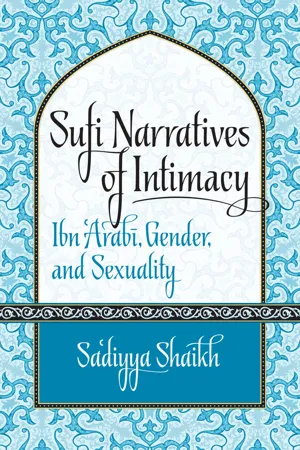
Thirteenth-century Sufi poet, mystic, and legal scholar Muhyi al-Din ibn al-'Arabi gave deep and sustained attention to gender as integral to questions of human existence and moral personhood. Reading his works through a critical feminist lens, Sa'diyya Shaikh opens fertile spaces in which new and creative encounters with gender justice in Islam can take place. Grounding her work in Islamic epistemology, Shaikh attends to the ways in which Sufi metaphysics and theology might allow for fundamental shifts in Islamic gender ethics and legal formulations, addressing wide-ranging contemporary challenges including questions of women’s rights in marriage and divorce, the politics of veiling, and women’s leadership of ritual prayer.
Shaikh deftly deconstructs traditional binaries between the spiritual and the political, private conceptions of spiritual development and public notions of social justice, and the realms of inner refinement and those of communal virtue. Drawing on the treasured works of Sufism, Shaikh raises a number of critical questions about the nature of selfhood, subjectivity, spirituality, and society to contribute richly to the prospects of Islamic feminism as well as feminist ethics more broadly.
- 304 pages
- English
- ePUB (mobile friendly)
- Available on iOS & Android
eBook - ePub
About this book
Information
Topic
Theology & ReligionSubtopic
Islamic TheologyChapter One
Craving Completion
Sufism, Subjectivity, and Gender before Ibn ʿArabī
The heavens and earth contain Me not, but the heart of my faithful servant contains Me.—Ḥadīth qudsī
I love nothing that draws my servant near to Me more than I love what I have made obligatory for him. My servant never ceases drawing near to Me through superogatory works until I love him. And when I love him I am his hearing through which he hears, his sight through which he sees, his hand through which he grasps, and his foot through which he walks.—Ḥadīth qudsī
Springing from the heart of Islam’s spiritual reservoir, Taṣawwuf, or Sufism, can be described as the process by which a believer embraces the full spiritual consequences of God’s oneness (tawḥīd).1 The goal of the Sufi path is to enable a human being, through the cultivation of virtuous excellence (iḥsān), to commune directly and experientially with her Creator. In the historical development of Sufism, one encounters varied and increasingly sophisticated notions of the mystical path, or ṭarīqa. Such a path generally entails that the Sufi aspirant, under the guidance of a spiritual master, follows a practical method of purification and refinement of the self, undergoing many states (aḥwāl) and stages (maqāmāt) that lead to progressive unveilings of the divine reality (ḥaqīqa).2
Notions of the self and its refinement, the rigors of the mystical path, and the nature of the God-human relationship are core concerns in Sufism. All of these concerns inform Sufi approaches to issues of gender, sexuality, and marriage. Historically, both male and female Sufis have reflected a continuum of positions on sexuality and marriage: some have strongly rejected marriage and sexuality; others have accepted the normative status of marriage and sex in Islam without fuss; while still others have heartily extolled the spiritual virtues of marital and sexual relationships.
This chapter commences by exploring some of the preliminary constructs of personality, psychology,3 and purification in Sufism. These perspectives on human nature and spiritual endeavor provide a foundation from which to analyze varying Sufi approaches to questions of gender. Exploring Sufi understandings of human nature and psychology nudges open some of the ways in which an Islamic anthropology and its gendered dimensions are configured. I examine the ways that these underlying religious anthropologies serve varying Sufi views on asceticism, celibacy, sexuality, and marriage. I also analyze the manners in which gender ideologies permeated the lives and relations between Sufi women and men as gleaned from biographical writings. In particular, I devote careful and critical attention to the complex ways in which Sufis used gendered language to navigate discussions of spirituality, gender, and social power differentials.
Core Sufi concepts of self and the spiritual path as well as the real-life interactions between Sufi men and women covered in this chapter allow for a social contextualization of Ibn ʿArabī’s ideas within a whole history of Sufi anthropologies and gender ideologies. This review chapter provides readers with a mapping on issues of self, gender, and some of the related developments in Sufism. While this chapter is less analytical than other chapters in this book, it provides background on some of the historical and conceptual terrain of Sufism and gender.
Personality and Sufi Psychology
Since the goal of the Sufi path is to deepen the God-human relationship, meticulous attention is given to removing spiritual obstacles within the individual that may impede progress along that path. This focus on purifying and disciplining the self has resulted in an elaborate and detailed inquiry into the mechanics of personality. Some of the organically genderless assumptions within Sufism include the priority given to an individual’s inner state in relation to behavior and thought, the view that the same spiritual imperatives apply to all humanity, and the accompanying notion that the inner is not determined by one’s biology. Exploring notions of personality and psychology within Sufism provides a necessary starting point for the exploration of its gender ideology.
The components and dynamics of personality in Sufism may be conceptualized in relation to the tripartite relationship between the soul (nafs), the heart (qalb), and the spirit (rūḥ) as identified in the Qurʾān.4 The nafs, which can be identified as one’s self-awareness, is a dynamic entity determined by the spiritual state of the individual.5 It can range from being dominated by base instincts and cravings to being characterized by a state of peace and submission to God, with varying intermediate possibilities. Its most unrefined state is what the Qurʾān calls al-nafs al-ammāra, the commanding soul, or “the soul that incites to evil” (Q. 12:53). In this sense, it is defined by self-centered, egoistic, and compulsive tendencies. Drawing a person to the realm of selfhood and transient desires, the nafs al-ammāra is responsible for the separation and dispersion from the original unitive state between God and humanity. In its blindness to the true nature of reality, the nafs al-ammāra perceives worldly attractions such as power, fame, wealth, and physical gratification as meaningful in themselves. Thus, it has an inordinate love for the ephemeral attractions of the world.
On the Sufi path, the greater jihād (struggle) against the inclinations of the nafs al-ammāra is reflected in the statement of an early Sufi woman, Umm Talq, that “the nafs is king if you indulge it, but is a slave if you torment it.”6 One well-known Sufi, Ḥujwīrī, compares the nafs to an animal such as a wild horse or dog that needs to be trained or even enslaved to change its nature and teach it its place on the spiritual path.7 Subduing the instinctual elements of self is seen as essential to spiritual purification, which in turn facilitates a deeper knowledge of God. Another early Sufi, Umm ʿAlī, reflects this insight in the view that “one who is confirmed in the knowledge of true servitude will soon attain the knowledge of lordship.”8 Thus, the first step in spiritual practice relates to the subjugation of the commanding self. Only then is it possible to attain knowledge of lordship—that is, the realization of the complete divine imperative of vicegerency that exists latently within all humanity.
The entity that represents the opposite of the lower soul is the spirit (rūḥ), which is a subtle life-giving entity blown into every human being from God’s self (Q. 15:29). While the nafs is associated with the self-centeredness and blindness of the devil, the rūḥ has been associated with the angelic qualities of luminosity and discernment.9 The Qurʾān states that “the spirit is from the command of my Lord and you [humanity] have been granted but a little knowledge of it” (Q. 17:85). Human beings are unable to understand the real nature of the rūḥ; suffice it to say that it reflects on that which pulls one toward God and the higher echelons of spiritual awareness.
The opposing spiritual forces activated by the respective inclinations of the nafs al-ammāra and the rūḥ struggle for supremacy within the individual’s heart (qalb) and give rise to various thoughts, ideas, and impulses known as khawāṭir. Moral choice for the early masters depended on a careful analysis and discernment of these forces, the resultant khawāṭir, and the aspirants’ responses.10
This third constituent, the qalb, is the center of human spiritual receptivity in the Sufi scheme. In a ḥadīth qudsī, God calls the human heart God’s own abode, which is not to be confused with the physical heart, the emotions, or the rational mind. The heart is the spiritual center of the human being. However, the level of receptivity of the heart is contingent on the spiritual state of the individual. Through succumbing to evil khawāṭir and the torpor of earthly desires, most hearts become rusted or opaque.
This rust or veil on the heart can only be removed by persistent remembrance and invocation of God, abstinence from incorrect behavior, performance of good actions, including service to other human beings, and other rigorous spiritual practices.11 As the aspirant pursues such spiritual disciplines, the commanding soul is weakened, abandoning evil commands and transforming into a different state of being known as the nafs al-lawwāma, “the blaming soul” (Q. 75:2). This transformation marks the emergence of the conscience, where the striving for good has been integrated and internalized. Thus the soul, aware of its own imperfections, reprimands the person if he or she inclines toward anything that constitutes spiritual negligence.
With consistent striving and purification, the heart is cleansed and illuminated by the divine light of the spirit, and the soul of the seeker is satisfied. It is then that the nafs al-muṭmaʾinna, “the soul at peace” (Q. 89:27), dominates the individual. This state is described in the ḥadīth qudsī, where God says, “The heavens and earth contain me not, but the heart of my faithful servant contains me.”12 For the mystic to fully realize the presence of God in the heart, it is necessary to entirely subdue and surrender those individualistic instincts that battle to remain sovereign. For Sufis, it is through the complete submission of the self to the Creator, through a pervasive state of islām, that real human potentiality can be attained.13
Gender Imbrications on the Sufi Path
Some Sufis have used gendered language to understand the different modes of spiritual engagement on the path. For example, some Sufis have descr...
Table of contents
- Cover Page
- Sufi Narratives of Intimacy
- Copyright Page
- Dedication
- Contents
- Acknowledgments
- Introduction Tales of Contention
- Chapter One Craving Completion
- Chapter Two Charting Ibn Arabī’s Religious Anthropology
- Chapter Three Mysticism and Gender
- Chapter Four Reading Gender and Metaphor in Ibn Arabī’s Cosmos
- Chapter Five The Poetics and Politics of Adam and Eve
- Chapter Six Witnessing God in Women
- Chapter Seven Ibn Arabī and Islamic Feminism
- Appendix Selected Poems from the Dīwān Ibn Arabī
- Notes
- Bibliography
- Index of Qurānic Verses
- Index of Traditions (Ahadīth)
- General Index
- Series
Trusted by 375,005 students
Access to over 1.5 million titles for a fair monthly price.
Study more efficiently using our study tools.
Frequently asked questions
Yes, you can cancel anytime from the Subscription tab in your account settings on the Perlego website. Your subscription will stay active until the end of your current billing period. Learn how to cancel your subscription
No, books cannot be downloaded as external files, such as PDFs, for use outside of Perlego. However, you can download books within the Perlego app for offline reading on mobile or tablet. Learn how to download books offline
Perlego offers two plans: Essential and Complete
- Essential is ideal for learners and professionals who enjoy exploring a wide range of subjects. Access the Essential Library with 800,000+ trusted titles and best-sellers across business, personal growth, and the humanities. Includes unlimited reading time and Standard Read Aloud voice.
- Complete: Perfect for advanced learners and researchers needing full, unrestricted access. Unlock 1.5M+ books across hundreds of subjects, including academic and specialized titles. The Complete Plan also includes advanced features like Premium Read Aloud and Research Assistant.
We are an online textbook subscription service, where you can get access to an entire online library for less than the price of a single book per month. With over 1.5 million books across 990+ topics, we’ve got you covered! Learn about our mission
Look out for the read-aloud symbol on your next book to see if you can listen to it. The read-aloud tool reads text aloud for you, highlighting the text as it is being read. You can pause it, speed it up and slow it down. Learn more about Read Aloud
Yes! You can use the Perlego app on both iOS and Android devices to read anytime, anywhere — even offline. Perfect for commutes or when you’re on the go.
Please note we cannot support devices running on iOS 13 and Android 7 or earlier. Learn more about using the app
Please note we cannot support devices running on iOS 13 and Android 7 or earlier. Learn more about using the app
Yes, you can access Sufi Narratives of Intimacy by Sa'diyya Shaikh in PDF and/or ePUB format, as well as other popular books in Theology & Religion & Islamic Theology. We have over 1.5 million books available in our catalogue for you to explore.