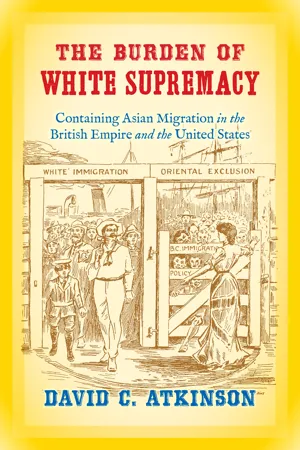
From 1896 to 1924, motivated by fears of an irresistible wave of Asian migration and the possibility that whites might be ousted from their position of global domination, British colonists and white Americans instituted stringent legislative controls on Chinese, Japanese, and South Asian immigration. Historians of these efforts typically stress similarity and collaboration between these movements, but in this compelling study, David C. Atkinson highlights the differences in these campaigns and argues that the main factor unifying these otherwise distinctive drives was the constant tensions they caused. Drawing on documentary evidence from the United States, Great Britain, Australia, Canada, South Africa, and New Zealand, Atkinson traces how these exclusionary regimes drew inspiration from similar racial, economic, and strategic anxieties, but nevertheless developed idiosyncratically in the first decades of the twentieth century.
Arguing that the so-called white man’s burden was often white supremacy itself, Atkinson demonstrates how the tenets of absolute exclusion — meant to foster white racial, political, and economic supremacy — only inflamed dangerous tensions that threatened to undermine the British Empire, American foreign relations, and the new framework of international cooperation that followed the First World War.
eBook - ePub
The Burden of White Supremacy
Containing Asian Migration in the British Empire and the United States
- 334 pages
- English
- ePUB (mobile friendly)
- Available on iOS & Android
eBook - ePub
The Burden of White Supremacy
Containing Asian Migration in the British Empire and the United States
About this book
Information
Topic
SozialwissenschaftenSubtopic
Asiatische GeschichteCHAPTER ONE
The Language of Immobility in Australasia
A surge of global migration arose during the second half of the nineteenth century. For the tens of millions engaged in this astonishing transfer of people, migration variously represented an attempt to escape the privations of poverty and war, the wrenching theft of personhood that characterized enslavement and indenture, or a chance to pursue new opportunities and experiences. Whatever the inspiration, this immense outflow of human beings forged new communities throughout the southern and western hemispheres, even as it violently dislocated surviving indigenous societies and transformed the African, Asian, and European polities from which multitudes of men, women, and children departed. The mass migrations of this period often reflected the expansive imperatives of both old and emerging empires, the administrators of which sought increased commercial and strategic influence or the alleviation of domestic social and economic problems. This ongoing swell continued to define the colonies established to achieve those ends as the nineteenth century drew to a close.1
In this chapter I examine one particular aspect of this world-historical paroxysm of mobility: the supposed threat posed by large-scale Asian labor migration to Australia and New Zealand. Though these colonies were themselves sustained by migration, their governments carefully managed migrant inflows, privileging British immigrants almost exclusively and erecting barriers against non-British—and particularly nonwhite—entry. Many white Australasians especially dreaded the unbridled movement of racially debilitating and economically competitive Asian workers, who circulated through imperial networks of trade and labor with increasing frequency as the nineteenth century progressed. So while the conduits of mobility in the British South Pacific generously expanded for those Britons deemed suitable settlers, they tightly contracted when prospective Asian immigrants approached Australasian ports.
While Canadian, American, and South African agitators promoted analogous restriction policies during these years, the Australasian case is distinct for reasons that existing studies often overlook, either because they emphasize congruities in the character of Asian restriction across the British Empire and the United States or because they focus on Chinese rather than Japanese or South Asian migration.2 First of all, a particular blend of anxieties and concerns motivated Australasian activists. Proximity to Asia—and relative remoteness from British naval protection and other centers of white population—motivated the governments of both New Zealand and Australia to enact nationwide systems of restriction that were broadly popular colonywide. Australians in particular agonized about the enormous size and relative emptiness of their continental colony: fewer than four million white Australians clustered along some 16,000 miles of coastline in 1901. These numbers provoked a pervasive sense of demographic, geographic, and racial crisis, especially when compared to the hundreds of millions of potential migrants that purportedly strained against overcrowding in Asia. Conversely the most visceral outbreaks of anti-Asian politics in North America were at least initially confined to western regions of Canada and the United States, where Asian migrants typically settled and worked. Similarly white settlers in southern Africa’s four pre-union colonies encountered Asian migrants differently depending on their experience with South Asian or Chinese indentured labor.
In addition the governments of New Zealand and Australia ultimately based their immigration controls upon language literacy tests. They did so after experimenting with more direct forms of racial exclusion and only following pressure from the British and Japanese governments. The debate over the enactment of these educational tests incited controversy in both colonies. As those legislators who preferred explicit racial exclusion complained, indirect restriction via such examinations at least theoretically left open the possibility that some racially undesirable applicants might legitimately gain entry. Australasians were obliged to accept the literacy test as a mode of exclusion in part due to the timing of the pivotal restriction drives described in this chapter. These campaigns crested between two seminal events in British foreign relations: the negotiation of the Anglo-Japanese Treaty of Commerce and Navigation in 1894 and the ratification of the Anglo-Japanese Alliance in 1902. This vital imperial and international context exerted significant pressure on Australasian legislators as they contemplated checks on Japanese immigration in particular during this period. The deployment of literacy tests in Australasia therefore contrasted with remote systems of restriction in Canada and the United States, which eventually either limited migrant mobility at the source or elsewhere beyond the border.
The New Zealand restriction campaign also differed from its contemporaries because very few Japanese and South Asian migrants actually settled there. Instead the impassioned intracolonial and interimperial discussions I examine derived mostly from anxieties about the simple possibility of unrestrained Japanese and South Asian movement across New Zealand’s borders. The government depicted new immigration curbs as an urgent countermeasure against an upsurge of Asian mobility that was almost entirely imaginary. New Zealand’s immigration controls were therefore prophylactic rather than reactive, preventative measures designed to paralyze circuits of Japanese and South Asian labor in the South Pacific before they inundated the colony. This once again contrasted with the situation in southern Africa, North America, and even Australia, where South Asian and Japanese migrants settled or sojourned in larger numbers in the prerestriction years, thanks to more extensive transpacific commercial relationships, imperial systems of indenture, established migration networks, or the existence of older, more established immigrant communities.
As elsewhere, however, the Australasian restriction battles of the late nineteenth and early twentieth centuries aggravated tensions inside the British Empire and complicated international politics in the Pacific. Left to their own devices, the governments of New Zealand and the six prefederation colonies of Australia would have enacted racially explicit border controls to prohibit all nonwhite immigration in the late nineteenth century. But they were compelled to restrain their exclusionary urges. As subjects of an extensive British Empire that administered considerable nonwhite populations, Australasian colonists were expected to respect Great Britain’s manifold imperial commitments. Similarly Britain’s deepening relationship with the emergent Meiji Empire—demonstrated first by the 1894 Anglo-Japanese Treaty of Commerce and Navigation and later by the 1902 Anglo-Japanese Alliance—forced white Australians and New Zealanders to defer their basest legislative instincts, much to the irritation of those who advocated categorical racial exclusion.
This dilemma pitted British imperial prerogatives that favored a greater degree of labor mobility and commercial openness against the colonial preference for racial homogeneity and wage protectionism. Sydney’s Bulletin, an avowedly nationalistic and racist weekly publication, encapsulated the Australasian position in May 1897. Anticipating London’s agenda at the forthcoming Conference of Colonial Premiers, the Bulletin insisted, “Britain is too remote from Asia to suffer by Asiatic immigration … therefore it doesn’t care in the least about Asiatic exclusion itself.” The periodical’s exasperated editorialists concluded that the secretary of state for the colonies, Joseph Chamberlain, would protect British commercial interests in Asia at the expense of Australasians’ racial aspirations: “[Britain] can get valuable trade privileges from Asiatic states if it gives their subjects, in return, free access to British territories. And, as the only important British territory that is within easy reach of Asiatic immigration is Australasia, this means that J. Bull would get the commercial advantages for himself, while Australasia would pay for them by being eaten up with the swarming brown and black and yellow millions.”3 At the same time, a Colonial Office official succinctly summarized the imperial government’s predicament: “The Colonies wish to exclude the Indians from spreading themselves all over the Empire. If we agree, we are liable to forfeit the loyalty of the Indians. If we do not agree we forfeit the loyalty of the Colonists.”4 The Foreign Office might have issued a similar warning by simply substituting Japan for India. Determined to maintain white supremacy in their distant settlements, white colonists had created an intractable problem that would perturb British imperial and foreign relations for decades to come.
In the first section I examine the New Zealand Parliament’s attempt to attenuate inbound Asian migration flows in 1896. The politics surrounding this episode exemplify the tenor and substance of broader Australasian restriction efforts prior to Great Britain’s intercession the following year. Despite claims to the contrary, New Zealand’s proposed legislation was a preventative measure that divided even its supporters into those who demanded total and explicit Asian exclusion and those who counseled caution and conceded the imperial and international complications that approach would cause. In the second section I analyze the imperial government’s response to that bill and others like it throughout the Australian colonies. Chamberlain was cognizant of the prevailing mood and recognized the inevitability of restriction. He nevertheless strove to moderate the toxicity of Australasian laws during the 1897 Colonial Conference in London by insisting upon adoption of the Natal formula, a language examination that disbarred Asian immigrants on educational rather than racial grounds. Australians were reluctant to implement that device. The Natal formula became the cornerstone of the infamous White Australia Policy following federation in 1901, enshrined in the Immigration Restriction Act that supported that policy for the next seven decades. But many Australian legislators initially resented this approach because it did not actually prevent Asian mobility and instead required enforcement either at the border or, in some cases, within the Commonwealth itself. The debate over Australia’s formative restriction measure was therefore deeply contentious and dominated by arguments over the appropriate form of exclusion in the midst of a particularly sensitive imperial and international context. The future prime minister of Australia, William Morris Hughes, captured that core issue when he declared during the debates, “We want a white Australia, and are we to be denied it because we shall offend the Japanese or embarrass His Majesty’s Ministers? I think not.”5
Limiting Asian Mobility before the Natal Formula: The New Zealand Case, 1896
On the evening of November 25, 1896, the British foreign secretary received an agitated visit from Katō Takaaki, the Japanese envoy in London. The Marquis of Salisbury reported the Japanese diplomat’s exasperation with recently passed discriminatory legislation in Britain’s Australasian colonies. Having enacted prohibitions against Chinese immigrants in the previous decade, legislators in the six Australian colonies and New Zealand had recently turned their attention toward Japanese and South Asian exclusion. Katō quite reasonably insisted that restrictions on his country’s migrants in New Zealand and New South Wales were both unconscionable and unwarranted given the almost complete absence of Japanese immigrants in New Zealand and the negligible number then residing in New South Wales. Such legislation violated the spirit of the recently concluded Anglo-Japanese Treaty of Commerce and Navigation and served only to distress Japanese relations with the two British colonies. Katō therefore urged the Foreign Office to disallow the offensive statutes.6 After conferring with his counterpart in the Colonial Office, the foreign secretary promised to veto the Australasian legislation pending further discussion with colonial representatives at the following summer’s Conference of Colonial Premiers in London.7
Katō’s protest came amid a deluge of anti-Asian immigration laws in Britain’s Australasian colonies. The previous summer, for example, the government of New South Wales had attempted to expand the colony’s existing restrictions, which since 1881 were directed against only Chinese immigrants. The colony’s newly proposed bill went much further, explicitly prohibiting the entry of “all persons belonging to any coloured race inhabiting the Continent of Asia or the Continent of Africa.”8 Legislators were candid about the intent of their new statutes. In language that characterized the tone of the debate, Representative John Haynes enjoined his colleagues to “bring the matter forward for final settlement on behalf of the white races of Australia and declare that there will be no divergence whatever from the complete exclusion of the inferior races of the globe from this country.”9 Similarly indelicate legislation was under consideration in the other Australasian parliaments. In each case legislators fully expected the British government to begrudge the insensitivity of their bills toward imperial subjects—especially South Asians—as well as new strategic partners and customers in East Asia. And yet they persisted, convinced that the danger posed by Asian immigration demanded action regardless of British and Japanese sensibilities.
In addition to revealing the intensity, architecture, and implications of Asian restriction in Australasia at the close of the nineteenth century, New Zealand’s 1896 measure also exposes three interrelated characteristics of all antipodean restriction efforts before Chamberlain’s intervention at the Colonial Conference the following year. First, this case reveals the transition from targeted controls on Chinese immigrants to broader and more diplomatically awkward attempts to preemptively curtail South Asian and Japanese mobility. Officials in both the Foreign Office and the Colonial Office had long tolerated legislative slights against Chinese subjects, who suffered under near-colonial domination with British complicity. They would not, however, countenance affronts by white governments against South Asian and Japanese subjects, especially ones so boldly and emphatically enshrined in law. Second, these discussions uncover the conflicted domestic politics of Australasian restriction. There was widespread support for restriction, but the bluntness of the proposed legislation nevertheless alienated some legislators who correctly predicted that the British government would not condone unconcealed racial discrimination. Others nonetheless believed that only explicitly enumerated restriction clauses could definitively achieve the widely held goal of Asian exclusion. These arguments over the forthrightness of Asian restriction characterized contemporaneous debates throughout the Australasian colonies during this period. Third, this example demonstrates the divisive and far-reaching imperial and international tensions engendered by white Australasians’ commitment to limiting the movement of Asian migrants, along with the efforts of British imperial authorities to ameliorate the potentially damaging consequences of colonial racism.
New Zealand’s 1896 bill was just the latest in a series of restrictive immigration laws introduced by that colony’s government during the late nineteenth century. Parliament first passed the Chinese Immigrants Act in 1881, following two decades of anti-Chinese agitation. That regulation imposed tonnage ratio restrictions on arrivin...
Table of contents
- Cover
- Title Page
- Copyright
- Dedication
- Contents
- Acknowledgments
- Introduction: The Politics of Asian Mobility in the British Empire and the United States
- Chapter One: The Language of Immobility in Australasia
- Chapter Two: Mobility and Indenture in Southern Africa
- Chapter Three: The Politics of Asian Labor Mobility in North America
- Chapter Four: The Limits of Anglo-American Solidarity and Collaboration
- Chapter Five: The Politics of Asian Restriction in a World at War
- Chapter Six: Making Peace with Asian Immobility: London, Paris, and Washington
- Chapter Seven: Reinforcing Asian Immobility on the Pacific Rim
- Conclusion: The Burdens of White Supremacy
- Notes
- Bibliography
- Index
Trusted by 375,005 students
Access to over 1.5 million titles for a fair monthly price.
Study more efficiently using our study tools.
Frequently asked questions
Yes, you can cancel anytime from the Subscription tab in your account settings on the Perlego website. Your subscription will stay active until the end of your current billing period. Learn how to cancel your subscription
No, books cannot be downloaded as external files, such as PDFs, for use outside of Perlego. However, you can download books within the Perlego app for offline reading on mobile or tablet. Learn how to download books offline
Perlego offers two plans: Essential and Complete
- Essential is ideal for learners and professionals who enjoy exploring a wide range of subjects. Access the Essential Library with 800,000+ trusted titles and best-sellers across business, personal growth, and the humanities. Includes unlimited reading time and Standard Read Aloud voice.
- Complete: Perfect for advanced learners and researchers needing full, unrestricted access. Unlock 1.5M+ books across hundreds of subjects, including academic and specialized titles. The Complete Plan also includes advanced features like Premium Read Aloud and Research Assistant.
We are an online textbook subscription service, where you can get access to an entire online library for less than the price of a single book per month. With over 1.5 million books across 990+ topics, we’ve got you covered! Learn about our mission
Look out for the read-aloud symbol on your next book to see if you can listen to it. The read-aloud tool reads text aloud for you, highlighting the text as it is being read. You can pause it, speed it up and slow it down. Learn more about Read Aloud
Yes! You can use the Perlego app on both iOS and Android devices to read anytime, anywhere — even offline. Perfect for commutes or when you’re on the go.
Please note we cannot support devices running on iOS 13 and Android 7 or earlier. Learn more about using the app
Please note we cannot support devices running on iOS 13 and Android 7 or earlier. Learn more about using the app
Yes, you can access The Burden of White Supremacy by David C. Atkinson in PDF and/or ePUB format, as well as other popular books in Sozialwissenschaften & Asiatische Geschichte. We have over 1.5 million books available in our catalogue for you to explore.