The natural beauty of Austin, Texas, has always been central to the city’s identity. From the beginning, city leaders, residents, planners, and employers consistently imagined Austin as a natural place, highlighting the region’s environmental attributes as they marketed the city and planned for its growth. Yet, as Austin modernized and attracted an educated and skilled labor force, the demand to preserve its natural spaces was used to justify economic and racial segregation. This effort to create and maintain a “city in a garden” perpetuated uneven social and economic power relationships throughout the twentieth century.
In telling Austin’s story, Andrew M. Busch invites readers to consider the wider implications of environmentally friendly urban development. While Austin’s mainstream environmental record is impressive, its minority groups continue to live on the economic, social, and geographic margins of the city. By demonstrating how the city’s midcentury modernization and progressive movement sustained racial oppression, restriction, and uneven development in the decades that followed, Busch reveals the darker ramifications of Austin’s green growth.
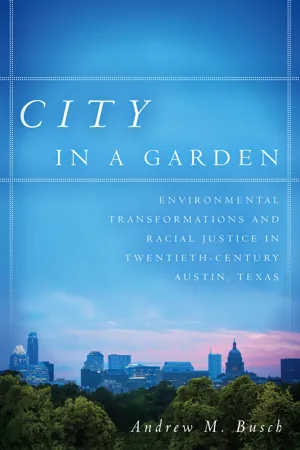
eBook - ePub
City in a Garden
Environmental Transformations and Racial Justice in Twentieth-Century Austin, Texas
- 336 pages
- English
- ePUB (mobile friendly)
- Available on iOS & Android
eBook - ePub
City in a Garden
Environmental Transformations and Racial Justice in Twentieth-Century Austin, Texas
About this book
Information
Topic
Ciencias socialesSubtopic
Ciencia medioambiental1 A Mighty Bulwark against the Blind and Raging Forces of Nature
Harnessing the River
The people of Central Texas had a river. It was given to them in the Divine plan of their homeland. It was a fickle, mean, dangerous river.… They have built dams to control flood waters and store up water for drought times. In the future they will build more dams and levees. Someday the whole river will obey them.
—Lyndon Johnson, 1939
The year 1893 was pivotal for Austin and for the United States. The financial panic, signaled by the failure of the Philadelphia and Reading Railroad in February of that year, put an expeditious close to the railroad boom of the 1880s and portended a decade of high unemployment and weak currency on Wall Street. Agricultural uprisings mobilized southern and western farmers against eastern moneyed interests and manifested themselves in the People’s Party, whose presidential candidate, James Weaver, won nearly 9 percent of the popular vote in the 1892 election. Labor unrest was also on the ascent; violent battles fought in Chicago and in Homestead, Pennsylvania, and a series of other strikes between 1885 and 1893 undercut the supremacy of industrial capitalism and cast yet another shadow on the unchecked growth of the American economy. Perhaps because the more established cities were in such turmoil, Harper’s Weekly chose to come all the way from panicked Manhattan, bypassing the midwestern heartland’s factory towns, to do a story on Austin, the capital city of Texas and home to its new university, in 1893. It was a positive story filled with hopeful news for a young area that the writer saw as unburdened by the problems of the 1890s.
The short piece, titled “Engineering Triumphs in Texas,” was packed with much information about Austin as well as civic booster rhetoric common to the Gilded Age. Contrary to popular opinion on the East Coast, Texas was not a frontier outpost, “home of the outlaw and the desperado,” with “rough riders, quicker shooters, hard drinkers.” Such stereotypes, the article continued, “do a serious injustice to the largest State in the Union, and to the public spirit and intelligence of a people whose efforts have secured to Texas a rate of progress in the accumulation of wealth and population and in advancement towards a high state of civilization second to no other in America.” Austin, the article went on, is ready to change places with Boston and become the modern Athens. And what will be the economic engine for this all-but-certain growth? It will be the new high-water dam at Austin, recently completed and a symbol of the “great public spirit in new enterprises,” with “a capacity to deal with large public improvements in a large way.” The Colorado River, as of yet not contributing anything worth mentioning to the city’s wealth and prosperity and, in fact, detracting from the city’s value with floods and droughts, must be harnessed and put to work by the large engineering marvel. When finally and fully completed, the $1.4 million structure, financed with municipal bonds, will give the city much-needed flood protection and also be able to deliver over fourteen thousand horsepower for sixty hours a week to Austin. When completed, the dam did provide Austin with consistent power and flood protection. It was also featured on the cover of Scientific American in 1896 and widely considered an engineering marvel.1
In the several years following the dam’s completion in 1893, it became evident that the “engineering triumph” so lauded by Harper’s was anything but a triumph. The granite and limestone structure, sixty-eight feet high and sixty-six feet wide at its base, was not securely anchored to the rocky soil, which makes up the ground in most of Central Texas. Within months of completion, cracks began to show in the dam’s base and were letting through small amounts of water, and water was also passing directly underneath the dam. The leaks became ever more apparent over the following years, until in April 1900, the first major flood since the dam’s completion came roaring down the river, destroying the dam and power generating station and leaving over $9 million worth of property damage and forty-seven fatalities in its wake. A large portion of the destroyed dam sat in the river near downtown Austin for many years after the flood, a constant and obvious reminder that the city was still at the mercy of the Colorado, rather than the subjugator of it.2
As for many burgeoning western and southern cities in the late nineteenth and early twentieth centuries, the relationship between the urban and the natural worlds was paramount in Austin and its hinterland. While some utopian thinkers dreamed of urban space integrated with nature, the gap between theory and practice was often wide.3 Many planners and engineers, increasingly forced to deal with human settlements in less than ideal locations, imagined nature as something to be overcome, harnessed, and put to work for humans. Similarly, by the late nineteenth century, conservation efforts were increasingly viewed as part of the engineering realm. Politicians and residents began to view science and technology as reasonable solutions to social problems, and engineers led the way.4 “Finishing” nature, improving the landscape while still using it, was a social goal. One of the highest expressions of improvement was multiple-use development for waterways that combined flood protection with other social and economic benefits.5 Central Texans almost universally viewed the harsh yet picturesque landscape from this perspective; controlling the unpredictable floodwaters was of great significance to regional progress, but there were other distinctly important uses for the river. It would transform the lives of rural farmers in the western reaches of the Hill Country by providing electricity and bring manufactories, resorts, and cheap power to Austin. Politicians, businesspeople, and boosters spoke of the dam as a panacea that would provide stability and economic growth in the form of flood control, irrigation, and hydroelectric power.
This chapter looks at the difficult process of achieving that goal from the 1890s to the 1930s in Austin. During this period, damming the river was a central theme when Austinites and other businesspeople and politicians in Central Texas discussed being progressive. To be progressive meant to harness the region’s capital, labor power, and engineering expertise to control nature, profit from it, and stabilize society. The dam allowed Austinites to reimagine their city as they wished it to be, and they viewed its failure as a civic shortcoming. After a number of failures and fatalities and the destruction of property, by the 1930s even conservative Austinites recognized that using federal resources to harness the river was the best way to secure the region’s future. Dams became a symbol of elusive modernity in Central Texas, technologies that demonstrated the region’s collective civic pride as well as the importance of water to society. At the same time, regional leaders yoked their future to New Deal liberalism in the 1930s, sometimes apprehensively, because private outfits and the City of Austin alone could not marshal the funds and expertise necessary to complete even one dam. With the creation of the Lower Colorado River Authority, Austin’s New Dealers transformed Central Texas into a progressive political place defined by cooperation with the federal government. Yet the geography of improvements also exacerbated racial differences, demonstrating that even New Deal liberalism stopped short of racial reconciliation.
The Landscape
The site for Austin, from its founding, was associated with natural beauty and a pristine landscape. In 1839 Mirabeau Lamar and a group of five elected commissioners chose the site for Austin as the capital of the Republic of Texas at a small outpost called Waterloo, which had natural beauty and pleasant hills and was located close to what they thought would eventually be the center of the state. Although it was not as good for agriculture and trade as some spots along the Brazos River to the north and east, members of Lamar’s party and others agreed that the site “would give delight to every painter and lover of extended landscape.” The site was “composed of a chocolate colored sandy loam, intersected by two beautiful streams of permanent and pure water.” The beautiful hills to the west, the commission wrote to the government at Houston, are “generally well watered, fertile in a high degree, and has every appearance of health and salubrity of climate.” One migrant called the site “a fairy land,”6 and a young Frederick Law Olmsted claimed in the 1850s that the city was “the pleasantest place we had seen in Texas.”7 From the beautiful territory, Lamar envisioned a garden, closer to wilderness than to the current capital at Houston, from which he wanted to distance the new capital. Although he admired the large river winding down from the mountains and hoped it would be navigable and supply waterpower, he chose the site primarily because its beauty and health benefits would be an attractive possession for all the people of Texas.8
Owing to its unusual siting choice and unlike most prominent cities of the nineteenth century, Austin lacked “natural advantages,” physical aspects of the landscape that were beneficial for trade, shipping, or defense. This almost always meant proximity to water, usually to sites with natural harbors, or access to large rivers. Indeed, the sites for almost all the major cities of the United States in the nineteenth century were selected because of their natural advantages. The earliest were port cities on the East Coast established in the seventeenth and eighteenth centuries principally for trade. New York City was located at the southern tip of Manhattan Island, in perhaps the best natural harbor on the East Coast and with access to two large rivers to service internal hinterlands. Baltimore and Boston were similarly established in fine natural harbors with inland water access to facilitate trade. Philadelphia was situated as the shortest portage between the Delaware and the Schuylkill Rivers, the former bringing ships from the Atlantic and the latter sending them inland. Newer cities on the West Coast, such as San Francisco and Seattle, were similarly located in natural harbors advantageous to waterborne commerce.9
The major inland cities of the nineteenth century were similarly located on water trade routes, either the Great Lakes or large rivers. Chicago was situated at the shortest portage between Lake Michigan and the Illinois River, which provided access to the Mississippi. Buffalo grew into a bustling city as the western terminus of the Erie Canal, where it met Lake Erie. The largest inland cities of the antebellum period were all sited at strategic locations along the major rivers. Cincinnati and Louisville were founded as trading ports on the Ohio River. St. Louis, the largest inland city by 1870, was sited to control all trade flowing from the Missouri River into the Mississippi. New Orleans’s location between the mouth of the Mississippi and Lake Pontchartrain was so strategically important for trade that founders ignored its perilously low topography.10
Austin lacked these advantages and was subject to the unpredictability of Central Texas’s weather and the harshness of its topography. Like all rivers, the Colorado is characteristic of the topography, geology, vegetation, and climate of the regions it drains. The river itself winds an 865-mile course from its headwaters in far eastern New Mexico to the Matagorda Bay on the Gulf of Mexico. It begins on the high plains of northwestern Texas as a small stream. As it reaches the Edwards Plateau, the 36,660-square-mile ecoregion directly to the west of Austin, it becomes more dramatic, carving out canyons and changing its elevation more quickly. Its drainage area is over 42,000 square miles, much of which is flood-prone. Average rainfall increases as the river enters the Balcones Escarpment at the eastern edge of the Edwards Plateau, immediately adjacent to Austin. The three major tributaries all enter within 150 miles upstream of Austin. The Colorado exits the escarpment at Austin, and downstream it becomes a coastal plain river.11 Although humans had been using the river’s resources for millennia and many imagined different uses for it with modifications, little about the river was altered. It maintained its natural state well into the late nineteenth century save a smattering of small dams used to power grist mills and cotton gins upriver from Austin.12 Lamar hoped that the Colorado River would prove navigable, but the decision to locate Austin near it was made quickly and in the absence of scientific hydrology. It did not, largely because of its unpredictable flow. Just four years after Austin was founded, the river rose thirty-six feet above its normal level, destroying much of the town and punishing the small agricultural settlements downriver from Austin. The Colorado Navigation Company, founded in 1851, used a small federal grant to improve the river for navigation in 1854, but by 1860 the river was no longer navigable due to lack of upkeep.13
Lamar also could not have imagined how perilous and dangerous life along the Colorado could be. If someone came to Central Texas during a moderately wet year, the river might look placid and the entire landscape could appear absolutely verdant, similar to areas with higher, more consistent rain totals to the east. The region gets roughly thirty-two inches of rain per year, but the average is not a meaningful number given the drought-flood cycle. While normally arid, Central Texas is prone to severe flooding because it can receive rain from tropical hurricanes coming off the Gulf of Mexico and large, wet air masses arriving from any direction. Texas has six of the twelve largest-recorded forty-eight-hour rain totals in the world, and the Balcones Escarpment, a 400-mile-long uplift immediately west of Austin, is particularly vulnerable to heavy flooding because large storms often stall over it. The rocky, nonporous limestone exacerbates the problem. The lower Colorado basin has been called “flash flood alley” for its propensity to flood quickly and without warning. U.S. Geological Survey hydrologists consider the basin along the escarpment the most flood-prone in the continental United States. For residents, life along the river or its numerous creeks was risky and uncertain and often entailed major damage to property, injury, and death. Conversely, under drought conditions the Colorado routinely slowed to a trickle. Thus navigation for transport and trade via water was unrealistic in Austin, and the city remained largely separated from other Texas regions for most of its early history.14
While many people found the landscape beautiful, it was also harsher, isolated, and more difficult to cultivate than Lamar had imagined. Austin is situated on the eastern edge of the Edwards Plateau, which was created millions of years ago when the area immediately east of...
Table of contents
- Cover
- Title Page
- Copyright
- Dedication
- Contents
- List of Illustrations and Maps
- Acknowledgments
- Introduction: The Trouble with Green
- 1. A Mighty Bulwark against the Blind and Raging Forces of Nature: Harnessing the River
- 2. A Distinct Color Line Mutually Conceded: Race, Natural Hazards, and the Geography of Austin before World War I
- 3. A Mecca for the Cultivated and Wealthy: Progressivism, Race, and Geography after World War I
- 4. The Playground of the Southwest: Water, Consumption, and Natural Abundance in Postwar Austin
- 5. Industry without Smokestacks: Knowledge Labor, the University of Texas, and Suburban Austin
- 6. Building a City of Upper-Middle-Class Citizens: Urban Renewal and the Racial Limits of Liberalism
- 7. More and More Enlightened Citizens: Environmental Progressivism and Austin’s Emergent Identity
- 8. Technopolis: The Machine Threatens the Garden
- 9. Of Toxic Tours and What Makes Austin, Austin: Battles for the Garden, Battles for the City
- Epilogue: From Garden to City on a Hill: The Emergence of Green Urbanity
- Notes
- Bibliography
- Index
Trusted by 375,005 students
Access to over 1.5 million titles for a fair monthly price.
Study more efficiently using our study tools.
Frequently asked questions
Yes, you can cancel anytime from the Subscription tab in your account settings on the Perlego website. Your subscription will stay active until the end of your current billing period. Learn how to cancel your subscription
No, books cannot be downloaded as external files, such as PDFs, for use outside of Perlego. However, you can download books within the Perlego app for offline reading on mobile or tablet. Learn how to download books offline
Perlego offers two plans: Essential and Complete
- Essential is ideal for learners and professionals who enjoy exploring a wide range of subjects. Access the Essential Library with 800,000+ trusted titles and best-sellers across business, personal growth, and the humanities. Includes unlimited reading time and Standard Read Aloud voice.
- Complete: Perfect for advanced learners and researchers needing full, unrestricted access. Unlock 1.5M+ books across hundreds of subjects, including academic and specialized titles. The Complete Plan also includes advanced features like Premium Read Aloud and Research Assistant.
We are an online textbook subscription service, where you can get access to an entire online library for less than the price of a single book per month. With over 1.5 million books across 990+ topics, we’ve got you covered! Learn about our mission
Look out for the read-aloud symbol on your next book to see if you can listen to it. The read-aloud tool reads text aloud for you, highlighting the text as it is being read. You can pause it, speed it up and slow it down. Learn more about Read Aloud
Yes! You can use the Perlego app on both iOS and Android devices to read anytime, anywhere — even offline. Perfect for commutes or when you’re on the go.
Please note we cannot support devices running on iOS 13 and Android 7 or earlier. Learn more about using the app
Please note we cannot support devices running on iOS 13 and Android 7 or earlier. Learn more about using the app
Yes, you can access City in a Garden by Andrew M. Busch in PDF and/or ePUB format, as well as other popular books in Ciencias sociales & Ciencia medioambiental. We have over 1.5 million books available in our catalogue for you to explore.