- 270 pages
- English
- ePUB (mobile friendly)
- Available on iOS & Android
eBook - ePub
About this book
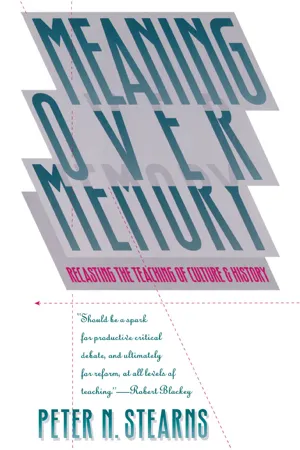
In the midst of the heated battles swirling around American humanities education, Peter Stearns offers a reconsideration not of what we teach but of why and how we teach it. A humanities program, says Stearns, should teach students not just memorized facts but analytical skills that are vital for a critically informed citizenry. He urges the use of innovative research as the basis of such a curriculum, and he offers specific suggestions on translating curriculum goals into courses that can be taught alongside or instead of the more conventional staples.
Information
Topic
ÉducationSubtopic
Éducation généraleChapter One: The Question of Urgency: The Issues in Perspective
Amid all the problems that beset American schools and colleges, why bother with another plan for the humanities? The essential answer to this question involves tracing the opportunities a proper humanistic curriculum will offer in improving understanding and even, to some measurable extent, bettering the larger climate of American education. The answer follows from a recognition that, however unintentionally, several current initiatives risk worsening what we already have. Both of these points underlie the chapters that follow. Before we begin, however, a brief justification will help clarify the situation of the humanities within the larger educational setting.
The outpouring of concern about American education in recent years has been so diverse and so vast that it would be easy to overload. Even a fairly casual newspaper reader knows much about what is wrong with our school system. Drugs and violence pervade many high schools. Achievement levels often deteriorate after grade school, so that many high school seniors read at lower levels than they did as sixth graders. Scores on the College Board and similar tests have stagnated for a decade—give or take a few adjustments—after a precipitous decline in the late 1960s and early 1970s.1 Educational performances in many other countries eclipse our own. Japanese students go to school more days per year than their American counterparts. They demonstrate a greater ability to focus on educational goals rather than on other stimuli in the classroom. Compared to most urban East Asians and most Europeans, American students do badly on mathematics and science tests. On average, the intellectual capacities of recently recruited American teachers compare unfavorably with those of Americans in the professions or in business (judging by college scores and grades), and the status of the occupation is not highly regarded.
This list of problems is intimidating, because the problems are varied and real. Virtually no type of school and no category of American student is exempt from some serious concern. It is also true that Americans place immense faith in education as a solution to social ills. They see the provision of scholastic opportunities as one of society’s crucial obligation to the masses; after the school years, inequalities and outright pathologies become the fault of individuals, not of the nation as a whole.2 This faith raises expectations to high levels and makes Americans vulnerable to particular dismay when they hear reports of deteriorations or inadequacies in the system. As a nation, we have often praised education for its vital social role while condemning its effectiveness and attacking intellectual values. Several authorities have plausibly argued that this mood is upon us once again.3
In this context, various panaceas are periodically ventured. Currently fashionable, and not necessarily a bad idea, is the notion of voluntary national testing that will encourage schools to toe the mark and provide a better means of goading and measuring student performance than the more haphazard instruments now available. Other systemic proposals involve the idea of allowing free choice of schools under some kind of government voucher system, or (slightly passe already) the idea of relying heavily on the testing and retesting of teachers. And there are many ongoing laments about the lack of interest in teaching and about curricular issues at the college level.
Problems of teaching about society and about human behavior and values—the subject matter of the humanities and related social sciences—clearly form only part of a much larger picture. The issues and approaches discussed in this book do not address the full and ominous range of educational challenges currently on the agenda. They do not relate directly to structural proposals about schools. They do not deal with drugs and weapons in the lockers. They do not deal head on with deficiencies in science and math training and the availability of qualified teachers in these areas. They do not explicitly address the need for fuller competitiveness with the economies of Japan or the new European Community juggernaut. My focus is limited, and certainly this essay is not meant to detract from appropriate attention to many other educational concerns that some may judge more pressing.
Nevertheless, while fully recognizing the number of agonizing dilemmas that can engage Americans concerned about their schools and colleges, I believe that the current problems facing education in the humanities—and the opportunities that we are at risk of passing by—do claim a genuine urgency for several reasons.
First, as I suggested in the previous chapter, the smoke raised by the current name-calling in the humanities arena too readily beclouds any coherent focus. Because Americans value courses in English, history, and related subjects to some degree but also tend to have a somewhat hazy notion of what the disciplines behind them entail, it is hard to sort through the current battles. Clarification is essential if we are to determine more fully what the real issues are and then to move toward constructive solutions. A large amount of time is now being consumed by debates in this area. Universities are being clobbered because of their real or imagined deficiencies in dealing with humanities issues the way many Americans, and many American leaders, wish them to do. Simply as a means of improving the intellectual and educational climate in a vital area, then, the present effort to move discussion to a more fruitful plane is timely.
It is worth noting at this early stage, by way of an initial illustration, that many of the attacks on universities for rigid “political correctness” stances that seek to privilege minorities and limit free expression of criticism in their direction have far more to do with student life decisions than with fundamental curricular issues. Lots of deans have issued rulings about Confederate flags in dorms and drunken epithets directed against women and gays, and their decisions may in some instances go too far in protecting “diversity” from even verbal unpleasantness. Rulings of this sort are not unrelated to curricular issues: colleges that have pushed African history requirements, say, in lieu of Western civilization (the Mount Holyoke pattern at present) do reveal their own views of political correctness at a classroom level. It remains true, however, that overall curricula have changed relatively little, even at avantgarde institutions, during the current political correctness campaign.4 In many instances, long curricular discussions have yielded very little in the way of novel results. Although non-Western history and literature courses have gained ground, there has been no revolution in subject matter, and stagnation, more than sweeping change, may be our real problem.5 Conservative efforts to blast universities over these issues predicate an anarchy that does not exist, and one must assume a larger agenda on the conservatives’ part in indulging in the recurrent American pastime of intellectual-bashing.
Similarly, humanities in the lower schools also have not changed dramatically. Students encounter a somewhat different selection of literature with the introduction of some nonwhite and non-Western authors in their texts. In history classes, high school seniors have notably increased their ability to identify Harriet Tubman as a major figure in American history—a shift that might be either modestly applauded or lamented, depending on one’s point of view. But, with this exception, the major presidents—with George Washington at their head—continue to constitute the most widely known and frequently cited figures in U.S. history for these same seniors. In this, generations of school training persist unchallenged. Thus actual changes in the body of student knowledge largely come about through what is at most a gradual evolution, not the ominous abandonment of the mainstream that some critics evoke.
Humanities curricula, in sum, are not in some crisis phase of heedless experimentalism. Yet the distractions of current editorializing, which may provoke unfounded counterreactions, do lend an immediacy to the curricular issues that should be discussed. On the positive side, this same furor may provide one of those rare moments at which opportunities for constructive change in the humanities, brewing for several decades, can fruitfully be seized—and the urgency is that we not let that moment slip.
To be more specific, the quality of education in humanities and related social science subjects—history, literature, philosophy, languages, and large swathes of anthropology, sociology, and political science—is central to three wider concerns detailed below—all of them pressing, all of them warranting a genuine sense of priority despite the many other claims on educational attention. The current political and international scene calls for analytical abilities too many Americans needlessly lack. These abilities depend on training in areas that may be downgraded because of our fascination with technological lag, and the structural reforms looming on the educational horizon generally may do more harm than good if, along with their implementation, we fail to gain a clearheaded understanding of the humanities essentials.
1. Various authorities have claimed to be appalled at the ignorance of American students in subjects like history, and I will address this issue at various points. Some of their formulations are dated at best; some suggest a past level of knowledge for which there is no evidence, claiming deterioration, then, without a factual base.6 Nevertheless, certain kinds of ignorance, whether or not they are more advanced than in the past, are extremely troubling. President George Bush claimed, in a 1991 commencement address in Michigan, that the United States had become “the most egalitarian system in history and one of the most harmonious.” The latter claim could be defended, at least in the brief historical moment of 1973-9, but the first is preposterous, and the notion that such a statement could be made and credited (and in a university setting) is staggering. Granted, politicians notoriously exaggerate; granted that the public has considerable built-in skepticism; granted, finally (lest we become too narrowly political), that the American system can be defended on many grounds. Nevertheless, the president’s remarks so clearly echoed widespread student assumptions about American achievements, so clearly reflected the factual ignorance and analytical simplicity both of potential audiences and even, perhaps, of political speakers dazzled by their own myths, that doubts about the quality of our education concerning our own society, its directions of change, and its comparative standing cannot be put to rest. As the principal sources of social information and relevant analytical training, the humanities and kindred social sciences (including, in this case, economics and statistics) clearly require a new kind of attention, freed from some of the present distracting debate and concentrating on their classic goals—updated in implementation—of providing an informed and alert citizenry.
The world we live in may be changing more rapidly than ever before.7 It is certainly becoming more complex in relation to our own expectations. This complexity demands—urgently demands, in fact—better understanding of the patterns amid which we live. Regardless of whether the deterioration of humanities learning is real or imagined, we need to develop a series of humanistic appreciations more attuned to our changing setting, including the ways in which this setting clashes with the expectations many Americans maintain. We need a better grasp of what is happening in our own society and in societies around it. Using available humanistic tools, we can attain this grasp.
The international framework places the most obvious demands on this component of our education. The United States increasingly operates in an intricate international context, dealing with societies whose cultures are not simple extensions of our own. There is reason to believe that, in the not-too-distant past, improved training in history and related subjects helped the United States to better deal with Europe than it had earlier in the twentieth century. The spread of Western civilization courses, which broke into a more parochial Americanist program leavened, at best, with some ancient history, did provide a better-informed and more analytically sophisticated public and may have contributed to an improved policymaking climate as well, as the United States dealt with Europe after World War II. Now the challenge is to extend education yet again, to encompass the larger global dimension. Even more than in domestic matters, this requires new levels of attention and also outright innovation, both in content and in analytical range. The debates that currently dominate humanities education distract us, on the whole, from sensible discussion of how to meet this goal. The need to take a more constructive direction is pressing.
2. American intellectual and educational life has long been complicated by divisions between scientific and nonscientific—or, broadly speaking, humanistic—approaches. These are the two cultures to which C. P. Snow referred in discussing Western intellectual endeavors more generally.8 The divisions are by no means complete ones, and later in this discussion we will return to look at the linkages. Nevertheless, scholars focusing on “hard” data—that is, quantifiable and/or laboratory-replicable facts—are often prone to disparage their humanistic colleagues, who deal with impressionistic evidence, who cannot fully “prove” any major claim, and who seem to enjoy dispute and ambiguity. The government, despite a recent desire to promote humanities standards, shares and enhances the disparity in spending only .5 percent of federal research funds in humanities areas.
Science-humanities debates can be fruitful, for both scholars and students. We should have more of them. At this moment, however, the scientists’ tendency to disparage the humanities in general, or to acknowledge only those that fulfill traditional culture-conveyance roles without pretending to advance claims of truth or analysis, risks overtipping the desirable balance. The current arguments within the humanities disciplines themselves encourage some scientists—and perhaps even more social scientists who are bent on asserting their own scientific claims without quite possessing the secure prestige of physics or chemistry—to dismiss the humanities more cavalierly than ever. At the same time, our national preoccupation with educational reforms designed to prod us to the level of the Japanese (or whoever) in science and technology moves us in the same direction. Few of our leaders have urged us to match or surpass other nations in our social and cultural knowledge and skills—yet in fact the challenge is reasonable and should be addressed. Indeed, we have a chance to excel in instilling useful analytical methods and cultural understandings (not, for example, a strong point in Japanese education), and we should seize this chance.
The point is obvious. Education in the humanities is at risk of being systematically downgraded because it presents a needless impression of incoherence and internal controversy and because of its failure to advance analytical claims that parallel—though while differing from—those of science. The glory of the humanistic and “soft” social science disciplines is that they allow scholars and students to address vital questions that simply cannot be answered scientifically, in the conventional sense, and yet should not be ignored—questions about human nature, about the ways societies and political systems function, about the ways social change occurs. We urgently need to develop curricula that will display these features of the humanities to better advantage, not to end debate and disagreement—for it is true, and probably useful, that humanists love to quarrel among themselves—but to situate that debate on different grounds. The danger of shrinking the humanities sector and drifting toward an unduly narrow and technical educational base is real, especially if we define education in terms of business competitiveness in the most short-run sense; but the danger is also avoidable.
3. Some of the structural innovations being discussed as ways to deal with problems of educational quality in general have important implications for the humanities. They could easily add to the trivialization of humanistic education if a secure alternative vision of goals is not put forth.
The interest in national testing programs serves as a good example, important in its own right amid current enthusiasms. As I noted in the introduction, a number of sensible testing approaches are under discussion, and it is also true that several projects are studying the possibilities for improving those skills that can be examined in machine-gradable formats.9
The fact is, however, that widespread testing in the United States has almost invariably meant machine-gradable questions dealing either with aptitudes or, in substantive fields like physics or literature, with memorized recall.10 It may be that standardized tests might do somewhat better in future, given innovative procedures, but the lay observer has the right to skepticism. Years of College Board experimentation with “new style” multiple-choice questions, imaginatively designed to elicit interpretive skills, did not alter the impressions the Board’s achievement tests made on history teaching, for example: teachers continued to stress memorization, leaving analytical skills to the students’ own talents. The dominant approach to testing in the major disciplines is driven by a fascination with aptitude scoring, an odd but durable American passion. It appeals to economy: tests of this sort are by far the cheapest to grade, and though Americans love education they also love to pinch the purse. It appeals also to a real suspicion of teachers that goes hand in hand with the love affair, in principle, with schooling. Americans do not trust their teachers to grade generalized tests; their attitudes contrast notably with most European systems, wherein essay grading or oral examinations are hallowed components of testing programs. Finally, Americans fail to distinguish between subjects in which machine-graded tests are appropriate because they include easily measured skills components, and subjects in which the principal educational objectives lie beyond this testing mode. We tend to equate grammar with literary analysis, or problem sets with a more basic grasp of scientific method.
When discussion turns, then, to new national tests, it requires no paranoia to fear the implications for the humanities. The United States has generated one test that is not simply multiple choice: the Advanced Placement (AP) tests offered by the College Board to give high school students college-level credit (subject to the stipulations of whatever college a student attends). AP tests in all subjects—including, of course, history, English, and modern languages—have a significant essay component, though the Board has also insisted on a substantial multiple-choice segment because only that format provides statistical, or psychometric, reliability. The tests are not, as a result, analytically equivalent to essay examinations in real courses at many universities. They are too short and too dominated by memorization. Further, the multiple-choice component, combined with larger educational and testing traditions in this country, encourages many high school AP teachers (like their counterparts who prepare students for the strictly multi...
Table of contents
- Cover Page
- Title Page
- Copyright Page
- Dedication
- Contents
- Preface
- Acknowledgments
- Introduction
- Chapter One: The Question of Urgency: The Issues in Perspective
- Chapter Two: Innovations in the Humanities: Before the Crisis
- Chapter Three: Sacred Cows in Humanities Teaching, and How They Got Grazing Rights
- Chapter Four: Answering the Canon Fire: The Debate Miscast
- Chapter Five: Clearing the Decks for Creative Planning
- Chapter Six: Education: The Central Mission of the Humanities
- Chapter Seven: Rethinking Actual Curricula: The Conversion to Analysis
- Conclusion: Educating for Democracy
- Notes
- Index
Trusted by 375,005 students
Access to over 1.5 million titles for a fair monthly price.
Study more efficiently using our study tools.
Frequently asked questions
Yes, you can cancel anytime from the Subscription tab in your account settings on the Perlego website. Your subscription will stay active until the end of your current billing period. Learn how to cancel your subscription
No, books cannot be downloaded as external files, such as PDFs, for use outside of Perlego. However, you can download books within the Perlego app for offline reading on mobile or tablet. Learn how to download books offline
Perlego offers two plans: Essential and Complete
- Essential is ideal for learners and professionals who enjoy exploring a wide range of subjects. Access the Essential Library with 800,000+ trusted titles and best-sellers across business, personal growth, and the humanities. Includes unlimited reading time and Standard Read Aloud voice.
- Complete: Perfect for advanced learners and researchers needing full, unrestricted access. Unlock 1.5M+ books across hundreds of subjects, including academic and specialized titles. The Complete Plan also includes advanced features like Premium Read Aloud and Research Assistant.
We are an online textbook subscription service, where you can get access to an entire online library for less than the price of a single book per month. With over 1.5 million books across 990+ topics, we’ve got you covered! Learn about our mission
Look out for the read-aloud symbol on your next book to see if you can listen to it. The read-aloud tool reads text aloud for you, highlighting the text as it is being read. You can pause it, speed it up and slow it down. Learn more about Read Aloud
Yes! You can use the Perlego app on both iOS and Android devices to read anytime, anywhere — even offline. Perfect for commutes or when you’re on the go.
Please note we cannot support devices running on iOS 13 and Android 7 or earlier. Learn more about using the app
Please note we cannot support devices running on iOS 13 and Android 7 or earlier. Learn more about using the app
Yes, you can access Meaning Over Memory by Peter N. Stearns in PDF and/or ePUB format, as well as other popular books in Éducation & Éducation générale. We have over 1.5 million books available in our catalogue for you to explore.