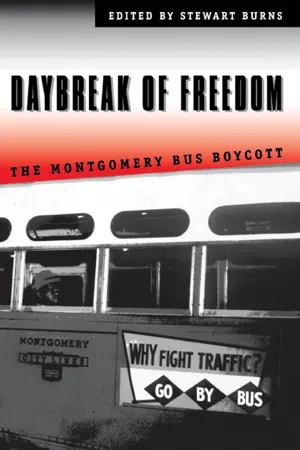
The Montgomery bus boycott was a formative moment in twentieth-century history: a harbinger of the African American freedom movement, a springboard for the leadership of Martin Luther King Jr., and a crucial step in the struggle to realize the American dream of liberty and equality for all. In Daybreak of Freedom, Stewart Burns presents a groundbreaking documentary history of the boycott. Using an extraordinary array of more than one hundred original documents, he crafts a compelling and comprehensive account of this celebrated year-long protest of racial segregation.
Daybreak of Freedom reverberates with the voices of those closest to the bus boycott, ranging from King and his inner circle, to Jo Ann Robinson and other women leaders who started the protest, to the maids, cooks, and other 'foot soldiers' who carried out the struggle. With a deft narrative hand and editorial touch, Burns weaves their testimony into a riveting story that shows how events in Montgomery pushed the entire nation to keep faith with its stated principles.
- 392 pages
- English
- ePUB (mobile friendly)
- Available on iOS & Android
eBook - ePub
About this book
Information
Prelude . . . 1 . . .
For a generation, Charles Hamilton Houston, Thurgood Marshall, and other lawyers for the National Association for the Advancement of Colored People (NAACP) had pursued litigation through federal courts challenging racial segregation. Precedent upon precedent, the NAACP legal juggernaut won a succession of court battles in the 1940s that advanced black voting rights and desegregation of public postgraduate education. The NAACP legal reform strategy culminated in the Brown v. Board of Education decision of May 17,1954, declaring public school segregation unconstitutional.
Four days after the unanimous Supreme Court ruling, an English professor at Alabama State College in Montgomery wrote a letter to the mayor urging him to accept minor reforms to improve the treatment of black passengers on the city’s segregated buses. Jo Ann Gibson Robinson, president of the Women’s Political Council, warned him that a number of black organizations were considering a boycott of buses if changes were not made. She had been directly lobbying the city commissioners to remedy bus inequities since she became head of the WPC four years before. Although she claimed to oppose such “forceful measures” as a bus boycott, she was a lightning rod for the community’s rising sentiment for direct action. Indeed, that spring her own students at all-black Alabama State, including seventeen-year-old freshman Richard Nelson, had started their own bus boycott. Students had thrown bricks and bottles at buses and physically removed riders. According to Nelson, she had tried to discourage them from boycotting.1
May 21, 1954
Honorable Mayor W. A. Gayle
City Hall
Montgomery, Alabama
Dear Sir:
The Women’s Political Council is very grateful to you and the City Commissioners for the hearing you allowed our representative during the month of March, 1954, when the “city-bus-fare-increase case” was being reviewed. There were several things the Council asked for:
1. A city law that would make it possible for Negroes to sit from back toward front, and whites from front toward back until all the seats are taken.
2. That Negroes not be asked or forced to pay fare at front and go to the rear of the bus to enter.
3. That busses stop at every corner in residential sections occupied by Negroes as they do in communities where whites reside.
We are happy to report that busses have begun stopping at more corners now in some sections where Negroes live than previously. However, the same practices in seating and boarding the bus continue.
Mayor Gayle, three-fourths of the riders of these public conveyances are Negroes. If Negroes did not patronize them, they could not possibly operate.
More and more of our people are already arranging with neighbors and friends to ride to keep from being insulted and humiliated by bus drivers.
There has been talk from twenty-five or more local organizations of planning a city-wide boycott of busses. We, sir, do not feel that forceful measures are necessary in bargaining for a convenience which is right for all bus passengers. We, the Council, believe that when this matter has been put before you and the Commissioners, that agreeable terms can be met in a quiet and unostensible manner to the satisfaction of all concerned.
Many of our Southern cities in neighboring states have practiced the policies we seek without incident whatsoever. Atlanta, Macon and Savannah in Georgia have done this for years. Even Mobile, in our own state, does this and all the passengers are satisfied.
Please consider this plea, and if possible, act favorably upon it, for even now plans are being made to ride less, or not at all, on our busses. We do not want this.
Respectfully yours,
The Women’s Political Council
Jo Ann Robinson, President
MCDA-AMC.
1 “ASU Student Left Buses before Parks”, Montgomery Advertiser, December 1, 1995; editor’s interview with Richard Nelson, December 4,1995, Montgomery, Ala.
Two years later, in the March 1956 conspiracy trial of Martin Luther King Jr., bus passengers testified under oath in Montgomery Circuit Court about their past mistreatment by white bus drivers and how they had challenged it in different ways.
Thelma Glass, a geography professor at Alabama State College, testified about activities of the Women’s Political Council in regard to the bus situation and other issues of concern to black Montgomery.1
Thelma Glass, having been duly sworn, was examined and testified as follows:
DEFENSE LAWYER: State your name to the Court.
THELMA GLASS: Thelma Williams Glass.
DEFENSE: Do you live in Montgomery?
GLASS: Yes, I do.
DEFENSE: How long have you lived in Montgomery?
GLASS: Since 1947. Just recently I have been working around the college at Montgomery.
DEFENSE: Are you a member of the Women’s Political Council?
GLASS: I am.
DEFENSE: Do you know when that council was first organized?
GLASS: Yes, I do. The Women’s Political Council was organized in the spring of 1949.
DEFENSE: For what purpose or purposes was this council organized?
GLASS: Well, maybe the best overall purpose, I could say, would be to promote good citizenship. We have maybe one or two specific activities we have always listed in our prospectus under citizenship.
DEFENSE: What are those activities?
GLASS: The Women’s Political Council naturally is concerned with women’s activities. In the first place, we enter into political and civic problems, particularly those relating to Negroes. In the second place, we encourage women to become registered voters, to pay poll tax and vote. In the third place, to enter those women in a better national government as a result. Most activities are proposed and designed to acquaint women with current problems.
DEFENSE: As a member of this group, have they had any connection with the Montgomery bus situation?
GLASS: Well, that is one of our specific problems, particularly as relating to Negroes, and one of our current civic problems. Problems relating to the busses have recently been part of our program.
DEFENSE: What were some of those problems your group has considered?
PROSECUTOR: We object to what the group considered, what it did or didn’t.
JUDGE: If it has to do with busses it would be admissible. What they considered wouldn’t be.
DEFENSE: What particular problem has your organization taken up with the bus company, if any?
GLASS: We have been trying for the past six years, we have had various committees from the Women’s Political Council who have made appeals to the City Commissioners. The things particularly that we had asked for—maybe there are four specific things as I can remember that we did send committees to ask for specifically.
DEFENSE: What are those things?
GLASS: Well, the very first thing we objected to mainly was Negroes have had to stand over empty seats.
PROSECUTOR: We object.
JUDGE: Testify to what you took up with the City Commission, what you told them. That would be admissible.
DEFENSE: Had this group had a meeting with the City officials of Montgomery?
GLASS: Oh, yes, sir, it has numerous meetings.
DEFENSE: You have called on the bus company?
GLASS: We have.
DEFENSE: Will you tell the court what happened?
PROSECUTOR: We object to that unless it is shown the time, the date it happened and where.
GLASS: In November, 1953, a committee from the Women’s Political Council actually asked for seven specific things, I think. Not all pertaining to the busses, but I can tell you about six of the things.
PROSECUTOR: We object to anything unless it pertains to the busses.
JUDGE: Objection sustained.
GLASS: Negroes had to stand over empty seats when no whites were riding; requesting them not to occupy those seats where they are unoccupied; Negroes pay fares at the front door, get off and go to the rear door to board the bus; when fares are paid at the front passengers should get on at the front; there is a danger of a passenger being struck without the driver knowing it; and there have been instances where persons have paid their fares and the bus has driven off and left them standing; busses stop in sections occupied by white at every corner, but in sections occupied by Negroes they stop at every other block; since all pay the same fare the busses should stop at every corner in all communities. Those are the specific things that this committee asked for in November of 1953 that deal with busses.
DEFENSE: Have you had any other meetings with the City Commissioners on the bus situation?
GLASS: On the bus situation we have.
DEFENSE: Do you remember the dates?
GLASS: This meeting in March of 1954, the Women’s Political Council, along with a large labor group, the Federation of Women’s Clubs, the Citizens’ Steering Committee, the Progressive Democrats, along with representatives of the Women’s Political Council.
DEFENSE: Did you attend this particular meeting?
GLASS: This particular meeting in March, 1954, I did.
PROSECUTOR: We move to strike all that testimony.
JUDGE: If you were not there you wouldn’t know what happened, you couldn’t testify to that. Where you were present, you could.
DEFENSE: Will you testify as to what happened at this particular meeting in 1954?
GLASS: Well, we went before the Commission with a full program we later on developed with a re-statement of some of the same things the committee had worked on in November of 1953.
DEFENSE: Was that the Montgomery City Commission?
GLASS: That is the Montgomery City Commission. The usual seating arrangement, people were still complaining of standing over empty seats; let Negroes board the busses at the front where they paid their fares; many had been left on the sidewalk after paying their fares; busses should stop at every corner; people had to walk, and they had a right complaining, and names and dates, and names of busses, the bus lines, and specific experiences with Negroes, were turned over to the Commission from people who complained against the bus company. [. . .]
Georgia Gilmore: having been duly sworn, was examined and testified as follows: [. . .]
DEFENSE: How long have you been a resident of the City of Montgomery?
GEORGIA GILMORE: I don’t know how long. I came here in 1920.
DEFENSE: During the time you have resided in the City of Montgomery, have you had opportunity to ride the busses owned by the Montgomery Bus Line?
GILMORE: Yes, sir, I have. At that time I did all my riding on the busses. They were my sole transportation because I didn’t own any car or motor vehicle whatsoever.
DEFENSE: I believe you stated you did all your riding?
GILMORE: Did all my riding.
DEFENSE: When did you stop riding the busses?
GILMORE: October of 1955.
DEFENSE: For what purpose did you cease riding the busses?
GILMORE: The last of October, 1955, on a Friday afternoon between the hours of three and five o’clock I was on the corner of Court and Montgomery Street, and I usually rode Oak Park or South Jackson busses for both of them came up to that corner. This particular Oak Park bus came up to the corner. I don’t know the driver’s name. I would know him if I saw him. He is tall and has red skin. This bus driver is tall, hair red, and has freckles, and wears glasses. He is a very nasty bus driver. This particular time the bus was pretty near full of colored people, only two white people on the bus. I put my money in the cash box and then he told me to get off. He shouted I had to get on in back. I told him I was alr...
Table of contents
- Cover Page
- Daybreak of Freedom . . .
- Copyright Page
- Dedication
- Contents. . .
- Preface . . .: The Spirit of Montgomery
- Acknowledgments. . .
- Overview. . .: The Proving Ground
- Chronology. . .
- Editorial Practices. . .
- Abbreviations for Collections and Archives . . .
- Prelude . . . 1 . . .
- December. . . 2 . . .
- January. . . 3 . . .
- Interlude . . . 4 . . .
- February. . . 5 . . .
- Interlude . . . 6 . . .
- March . . . 7 . . .
- Interlude . . . 8 . . .
- Spring. . . 9 . . .
- Summer. . . 10 . . .
- Fall. . . 11 . . .
- Winter: Return of the Light. . .
- Selected Bibliography...
- Index. . .
Trusted by 375,005 students
Access to over 1.5 million titles for a fair monthly price.
Study more efficiently using our study tools.
Frequently asked questions
Yes, you can cancel anytime from the Subscription tab in your account settings on the Perlego website. Your subscription will stay active until the end of your current billing period. Learn how to cancel your subscription
No, books cannot be downloaded as external files, such as PDFs, for use outside of Perlego. However, you can download books within the Perlego app for offline reading on mobile or tablet. Learn how to download books offline
Perlego offers two plans: Essential and Complete
- Essential is ideal for learners and professionals who enjoy exploring a wide range of subjects. Access the Essential Library with 800,000+ trusted titles and best-sellers across business, personal growth, and the humanities. Includes unlimited reading time and Standard Read Aloud voice.
- Complete: Perfect for advanced learners and researchers needing full, unrestricted access. Unlock 1.5M+ books across hundreds of subjects, including academic and specialized titles. The Complete Plan also includes advanced features like Premium Read Aloud and Research Assistant.
We are an online textbook subscription service, where you can get access to an entire online library for less than the price of a single book per month. With over 1.5 million books across 990+ topics, we’ve got you covered! Learn about our mission
Look out for the read-aloud symbol on your next book to see if you can listen to it. The read-aloud tool reads text aloud for you, highlighting the text as it is being read. You can pause it, speed it up and slow it down. Learn more about Read Aloud
Yes! You can use the Perlego app on both iOS and Android devices to read anytime, anywhere — even offline. Perfect for commutes or when you’re on the go.
Please note we cannot support devices running on iOS 13 and Android 7 or earlier. Learn more about using the app
Please note we cannot support devices running on iOS 13 and Android 7 or earlier. Learn more about using the app
Yes, you can access Daybreak of Freedom by Stewart Burns in PDF and/or ePUB format, as well as other popular books in History & North American History. We have over 1.5 million books available in our catalogue for you to explore.