- 212 pages
- English
- ePUB (mobile friendly)
- Available on iOS & Android
eBook - ePub
About this book
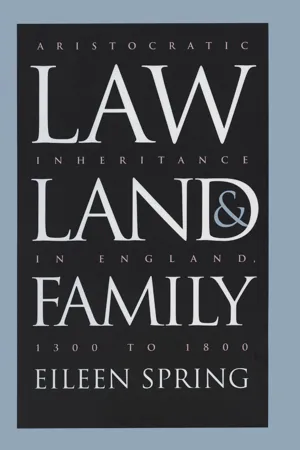
Eileen Spring presents a fresh interpretation of the history of inheritance among the English gentry and aristocracy. In a work that recasts both the history of real property law and the history of the family, she finds that one of the principal and determinative features of upper-class real property inheritance was the exclusion of females. This exclusion was accomplished by a series of legal devices designed to nullify the common-law rules of inheritance under which — had they prevailed — 40 percent of English land would have been inherited or held by women. Current ideas of family development portray female inheritance as increasing in the seventeenth and eighteenth centuries, but Spring argues that this is a misperception, resulting from an incomplete consideration of the common-law rules. Female rights actually declined, reaching their nadir in the eighteenth century. Spring shows that there was a centuries-long conflict between male and female heirs, a conflict that has not been adequately recognized until now.
Information
1: The Heiress-at-Law
And thou shall speak unto the children of Israel, saying, If a man die, and have no son, then ye shall cause his inheritance to pass unto his daughter.
—Numbers 27:8
—Numbers 27:8
Jane and Elizabeth attempted to explain to their mother the nature of an entail. They had often attempted it before, but it was a subject on which Mrs Bennet was beyond the reach of reason, and she continued to rail bitterly against the cruelty of settling an estate away from a family of five daughters in favour of a man whom nobody cared anything about.
—Jane Austen, Pride and Prejudice
—Jane Austen, Pride and Prejudice
By the common law rules of inheritance women in English landed society fell into two classes. Some were altogether excluded from inheriting; others were entitled to succeed to the family estate. The woman thus entitled, the heiress-at-law, is clearly a figure due historical attention, and there are good reasons to begin an account of inheritance with her.
Despite the importance of the right she possessed, the heiress-at-law has never been singled out for long-term consideration. Where she has been the focus of attention, discussion has always been chronologically limited, and her history has not been carried any distance through the course of legal changes that are relevant to it. Usually she has been discussed as but part of the family, and attention has been focused largely on eldest sons and their relations with younger children, with younger sons or with daughters who were not heiresses, as the case may be. Indeed the very words “heiress-at-law” have an unfamiliar ring.
When the heiress is concentrated on, however, when her story is separated from that of younger children and followed over the long run, broad new historical perspectives open. They open in family history. Since no property right was more significant than the right to succeed to a landed estate, no right was more symbolic of the status of women. What became of that right must mean revision in current theories of family development, particularly as those theories have been based heavily on the families that are discussed in this work. New perspectives open in the history of real property law itself. When the interests of the heiress are followed, a hitherto unrecognized pattern becomes apparent. The heiress emerges as the principal factor in the legal history of large landowners, and thus as a principal factor in the development of real property law. There are not only good, but imperative, reasons why an account of English inheritance should begin with the heiress-at-law.
1
The common law rules of inheritance by definition form the starting point for the story of the heiress. These rules were established shortly after the Norman Conquest, and they were not overridden by statute until 1925. The prime rule is well known. Land descended to the eldest son to the exclusion of his siblings. The next rule, much less well known, was that if there was no son, land descended to daughters. The common law thus gave a preference to males but a limited preference. It chose son over daughter, but daughter over collateral male. In common law, then, the daughter where there was no son was heir, not her uncle, nor her nephew, nor her male cousin. If there were several daughters, they were equally heirs. Originally only one among daughters had been heir, but about the middle of the twelfth century this rule had been changed, and daughters thereafter took equally.
What did these rules mean in practical terms? What proportion of inheritances would by common law go to women? To some degree the answer depends on the size of the family, that is, on whether population was rising, falling, or stationary. It depends less on the demographic situation, however, than may at first be thought, for as population fluctuates, it is mostly younger children whose numbers alter, but younger children do not affect the heirship calculation at issue significantly. That is to say, the chance of the heir’s being male or female remains relatively stable. Two calculations by E. A. Wrigley are helpful in making this point clear. In a stationary population there is a 40 percent chance that a man will die leaving no son. When population rises at the rate experienced during the great growth of European population, that figure is not greatly changed, becoming 32 percent.1 It is not to be concluded from these figures that 40 or 32 percent of inheritances would go to women. The figures do not immediately indicate what proportion of inheritances would go to women; they do indicate that the proportion would not vary greatly as population rose. In any case, for the preindustrial era, for the bulk of recorded time, the reasonable working hypothesis is that population was stationary, that is, stationary in size from one generation to the next. Mere reflection on a stationary population will soon suggest that a considerable proportion of inheritances must go to women by common law rules. Since each generation only reproduces itself, the average family must in the end be small. Many children may have been born, but many of them would have died in the lifetime of their father. Given families small in the end, some considerable number must consist of female children only.
Fortunately we are no longer dependent upon general reflection. Demographers have produced a formula that may be used to calculate more precisely what proportion of inheritances would in a stationary population go to women by common law rules. Wrigley has further calculated that in a stationary population 20 percent of men who married left no children, 20 percent left daughters only, and 60 percent left one or more sons.2 If this calculation is put together with the common law, 20 percent of inheritances would go to women directly, going from fathers to daughters. More than 20 percent of inheritances would, however, go to women all told. The 20 percent of men who died without children did have heirs, and some of these were bound to be female. Under the further rules of common law, the heir of a man dying without children was first his brother, or if brother was deceased, any children he had left, male and female according to the rules already laid out. Failing the brother and his children, the sister or her children took. Should there be neither brother nor sister, the heir was sought further back in the male line, first among uncles and their children, and then among aunts and their children.3 (Fathers and grandfathers were excluded as heirs. This is what is meant when it is said that land did not ascend: it did not ascend lineally. The exclusion of lineal ascendants persisted until 1834.) Precision is not possible as to the extent of collateral inheritance, but it is accurate enough to say that about one-quarter of collateral inheritances would go to women. Thus when indirect inheritance by collateral females is added to direct inheritance by daughters, 25 percent of all inheritances would at common law go to women.
What the rules meant in practical terms may be seen in another way—by considering what percentage of women would at common law be heiresses. More than one woman in a family would often be heir, for as already noted, daughters took equally, and this was but a specific example of the general rule that females of equal degree took equally. The percentage of women who would be heiresses, when coheiresses are considered, can readily be reached through Wrigley’s formula. Let us assume for the sake of simplicity a population of 100 men leaving, by definition in a stationary society, 100 sons and 100 daughters. The formula indicates that the sons are not spread evenly, but that all are sons of 60 of the men. Thus it tells us that 60 of the sons are eldest son (meaning eldest or only sons) and that 40 are younger sons. The formula also indicates that there are 20 families with daughters only, where naturally there must be 20 eldest daughters (that is, eldest or only daughters). If 60 eldest sons have 40 younger brothers, then 20 eldest daughters have 13 younger sisters. Therefore 33 out of the total of 100 daughters would be directly heiresses, heirs to their fathers. Putting the conclusion in general terms, 33 percent of women in a stationary society would by common law be directly heiresses. Since a further number would be heiresses when collateral inheritance is considered, it is to be calculated that nearly 42 percent of women would be heiresses by common law.
Thus despite the well-known generalization that the common law sent estates to eldest sons, upon examination it is found that in the norm of a stationary population, the common law would send 25 percent of estates to women. Since by equal division 50 percent of estates would go to women, the common law may be looked on as cutting female inheritance in half, but only in half. Moreover, 42 percent of women would at common law be heiresses, though many of the heiresses would be required to divide estates. Fully 33 percent of women would be directly heirs of their fathers. The heiress was no rare bird by common law rules.
2
Such was the common law, but what were the hard facts? How often were women who were heiresses-at-law actually heiresses? Evidence on the down-to-earth aspect of female inheritance exists for two widely separated periods that clearly indicate the course of development.
In two important articles S. F. C. Milsom and J. C. Holt have discussed female inheritance in the twelfth and early thirteenth centuries.4 While noting that in the period rules were not quite hard and fast, both portray women as succeeding according to common law rules. Where there was no son, the daughter was heir, her succession ensured because the principle of heritability of land had been established while the feudal system of land tenure gave no right of testamentary disposition. In other words, wills of land being then impossible, the common law heir succeeded to whatever land his—or her—father died possessed of. Neither Milsom nor Holt enters into quantitative analysis, although Holt does point out that a good number of baronies in short order went to females. In effect, both indicate that in early feudal times something like the figures laid out above for female inheritance were real, not merely theoretic.
Milsom and Holt discuss other aspects of female inheritance, and both stress—it is the theme of their articles—that in early feudal times a woman’s land went in fact to her husband for his life, and that the right of the heiress was less to enjoy property than to transmit it. Until she was widowed, an heiress did not enjoy the use of her property. This is an important aspect of the heiress’s history. It indicates what is a long-term continuity in it. Until the end of the nineteenth century the use of a married woman’s landed property in law went to her husband; and for centuries in practice it did too. Among substantial landowners it seems to have remained the norm to settle an heiress’s land upon her husband for life. When that greatest of all eighteenth-century heiresses, the Percy heiress, inherited her vast estates, their use went to her husband, and he (who had been an unremarkable baronet) was duly created Duke of Northumberland. Important as this aspect of the heiress’s history is, when all is said and done, it is of secondary importance. Of prime importance is the question of entitlement: Who was the heir? And this is where change took place. What Milsom and Holt make clear is that in early feudal times the daughter where there was no son was heir. She, or her husband through her, did take. She was the heir in the sense that her father’s brother was not.
Thanks to extraordinary statistical work by Lawrence and Jeanne Stone we have figures for inheritance by women at a much later date. In An Open Elite?, a book that focuses on the relations between businessmen and landowners, the Stones have presented as thorough a study of landed inheritance as we are ever likely to have. They have analyzed the dispositions of more than two thousand owners of 362 country houses in three English counties—Hertfordshire, Northamptonshire, and Northumberland—from 1540 to 1880.5 The study deals in country houses, but the houses are but the visible and countable hearts of landed estates. The coverage of Northumberland is less thorough than that of the other two counties. This discrepancy is a matter of significance for some historical questions, particularly for questions about the professional background of entrants into the elite, but it is not a matter of significance for discussions of inheritance. There is no reason to think that the heirship principles of English landowners differed from county to county. On matters of inheritance, the Stones’ study well represents the body of English elite landowners, including both the aristocracy and the gentry.6
There is no need to consider the Stones’ figures with statistical nicety, comparing them period by period, for the order of magnitude they display leaps from the page. In one table the Stones indicate what proportion of inheritances went from fathers to children, showing what proportion went to sons and what to daughters. If the average is taken over the period 1540 to 1780, 5 percent went to daughters.7 In a second table the Stones indicate what proportion of inheritances went to women and what to men, thus considering inheritance by collateral females as well as by daughters. If a similar average is taken, 8 percent went to women.8 These figures for female inheritance, 5 percent and 8 percent, are to be set alongside the comparable figures to be expected at common law, 20 and 25 percent respectively. Landowners had thus cut the rate of female succession dramatically, to less than one-third that by common law rules. Or to put the conclusion another way, since the common law itself when compared to equal division cut female inheritance in half, landowners had actually cut it to less than one-sixth. As for the number of women who were disherisoned, whereas 33 percent of women would have inherited from their fathers if the common law had prevailed, less than 10 percent actually did so; and whereas 42 percent would have inherited all told if the common law had prevailed, less than 13 percent actually did so.
While these figures tell a decided story of the reduction of female inheritance, they do not tell quite so complete a story as it is possible to tell. How far, it may be asked, could inheritance by females be reduced? As John Knox bewailed, reviewing what he called the “monstrous regiment of women" who were heirs to Edward VI, sometimes God unaccountably leaves only women wherever one looks in the family tree. The question how far female inheritance could be reduced is not answerable in quite the form in which the question has been phrased, but an answer sufficient to the point is to be had if the rate at which patrilines die out is considered. When a patriline dies out a female has become at least unavoidable. The female thus unavoidable may succeed to the estate or she may not; but if she does not, the male who succeeds...
Table of contents
- Cover Page
- Law, Land, and Family
- Copyright Page
- Dedication
- Contents
- Acknowledgments
- Introduction
- 1: The Heiress-at-Law
- 2: The Widow
- 3: Younger Children
- 4: The Pattern Considered
- 5: The Strict Settlement
- 6: Theories of the Family
- 7: Conclusion
- Appendixes
- Index
Trusted by 375,005 students
Access to over 1.5 million titles for a fair monthly price.
Study more efficiently using our study tools.
Frequently asked questions
Yes, you can cancel anytime from the Subscription tab in your account settings on the Perlego website. Your subscription will stay active until the end of your current billing period. Learn how to cancel your subscription
No, books cannot be downloaded as external files, such as PDFs, for use outside of Perlego. However, you can download books within the Perlego app for offline reading on mobile or tablet. Learn how to download books offline
We are an online textbook subscription service, where you can get access to an entire online library for less than the price of a single book per month. With over 1.5 million books across 990+ topics, we’ve got you covered! Learn about our mission
Look out for the read-aloud symbol on your next book to see if you can listen to it. The read-aloud tool reads text aloud for you, highlighting the text as it is being read. You can pause it, speed it up and slow it down. Learn more about Read Aloud
Yes! You can use the Perlego app on both iOS and Android devices to read anytime, anywhere — even offline. Perfect for commutes or when you’re on the go.
Please note we cannot support devices running on iOS 13 and Android 7 or earlier. Learn more about using the app
Please note we cannot support devices running on iOS 13 and Android 7 or earlier. Learn more about using the app
Yes, you can access Law, Land, and Family by Eileen Spring in PDF and/or ePUB format, as well as other popular books in History & British History. We have over 1.5 million books available in our catalogue for you to explore.