An account of the problems facing German veterans after WWII and the ways in which they were addressed in the decade following Germany’s defeat. The primary focus is on the major pieces of veterans' legislation passed in the early years of the German Federal Republic. Historical context is provided by the first two chapters and the conclusion, which compares and contrasts the fate of veterans and their sociopolitical impact on German society following the two world wars.
Originally published in 1993.
A UNC Press Enduring Edition — UNC Press Enduring Editions use the latest in digital technology to make available again books from our distinguished backlist that were previously out of print. These editions are published unaltered from the original, and are presented in affordable paperback formats, bringing readers both historical and cultural value.
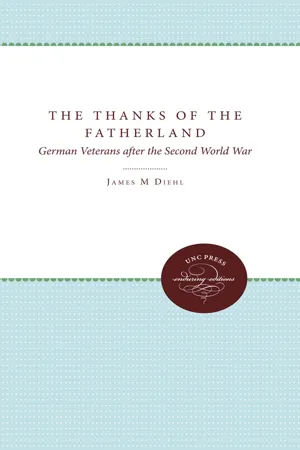
- 360 pages
- English
- ePUB (mobile friendly)
- Available on iOS & Android
eBook - ePub
About this book
Information
NOTES
Abbreviations
In addition to the abbreviations used in the text, the following abbreviations are used in the notes.
- AdsD/FES
- Archiv der sozialen Demokratie/Friedrich-Ebert-Stiftung, Bonn/Bad Godesberg
- BAF
- Bundesarchiv-Militärarchiv, Freiburg im Breisgau
- BAK
- Bundesarchiv, Koblenz
- DBDr
- Deutscher Bundestag. Anlagen zu den stenographischen Berichten. Drucksache
- DKOV
- Deutsche Kriegsopferversorgung
- IfZ
- Institut für Zeitgeschichte, Munich
- NARS
- National Archives and Records Service, Washington, D.C.
- OMGUS
- Office of Military Government, United States
- PAB
- Parlamentsarchiv, Bonn
- PRO
- Public Record Office, Kew, England
- VDB
- Verhandlungen des Deutschen Bundestags. I. Wahlperiode 1949. Stenographische Berichte
Chapter 1
1. The unification of the state organizations in the Kyffhäuserbund followed the building of a monument celebrating German unification that had been sponsored by the veterans’ organizations. The monument, a classic example of the bombastic style of Wilhelmine public monuments, was built on the Kyffhäuser, a mountain in central Germany. According to German legend, the Hohenstaufen Emperor Frederick Barbarossa resided in the mountain, from which he would come to rescue Germany in time of crisis. On the early history of German veterans’ organizations and the formation of the Kyffhäuserbund, see Alfred Westphal, “Die Kriegervereine,” in Deutschland als Weltmacht. Vierzig Jahre Deutsches Reich, herausgegeben vom Kaiser-Wilhelm-Dank (Berlin, 1911), and Wilhelm Reinhard, “Der N.S.-Reichskriegerbund,” in Das Dritte Reich im Aufbau, Band 3 (Berlin, 1939). Also cf. Christopher James Elliott, “The Kriegervereine and the Weimar Republic,” Journal of Contemporary History 10/1 (January 1975): 1–2.
2. Eckart Kehr, “Zur Genesis des Königlich Preussischen Reserveoffiziers,” in Der Primat der Innenpolitik. Gesammelte Aufsätze zur preussisch-deutschen Sozialgeschichte im 19. und 20. Jahrhundert, herausgegeben und eingeleitet von Hans-Ulrich Wehler (Berlin, 1965). On the conversion of the veterans’ organizations into a “bulwark against Social Democracy,” see Klaus Saul, “Der ‘Deutsche Kriegerbund.’ Zur innenpolitischen Funktion eines ‘nationalen’ Verbandes im kaiserlichen Deutschland,” Militärgeschichtliche Mitteilungen, 1969/1. See also Reinhard Höhn, Sozialismus und Heer, Band 3 (Bad Harzburg, 1969), and Martin Kitchen, The German Officer Corps, 1890–1914 (London, 1968), chapters 6–7.
3. Westphal, “Die Kriegervereine,” p. 762.
4. On the pacifist subculture and its relation to the dominant culture, see Roger Chickering, Imperial Germany and a World without War: The Peace Movement and German Society, 1892–1914 (Princeton, 1975). In addition to the Kriegervereine, there were other organizations that propagated antisocialist, antipacifist, and promilitary values. Two of the main ones were the German Army League (Deutscher Wehrverein) and the Young Germany League (Jungdeutschlandbund). On the former, see Marilyn S. Coetzee, The German Army League: Popular Nationalism in Wilhelmine Germany (Oxford, 1990). On the latter see Klaus Saul, “Der Kampf um die Jugend zwischen Volksschule und Kaserne. Ein Beitrag zur ‘Jungendpflege’ im Wilhelminischen Reich, 1890–1914,” Militärgeschichtliche Mitteilungen, 1971/1, and Derek S. Linton, Who Has the Youth Has the Future: The Campaign to Save Toung Workers in Imperial Germany (Cambridge, 1991) .
5. Kyffhäuser-Bund der Deutschen Landeskriegerverbände, Sitzung des Vorstandes vom 30. und 31. Oktober 1915, NSDAP Hauptarchiv, folder 913. Most of the materials of the NSDAP Hauptarchiv are currently in the Bundesarchiv in Koblenz, Germany (Bestand NS26). The material is also available on microfilm as part of the Hoover Institution Microfilm Collection in Stanford, California. See Grete Heinz and Agnes F. Peterson, eds., NSDAP Hauptarchiv: Guides to the Hoover Institution Microfilm Collection (Stanford, 1964). For a detailed account of the Kyffhäuserbund’s activity during the war based on these materials, see James M. Diehl, “The Organization of German Veterans, 1917–1919,” Archiv für Sozialgeschichte, 11 (1971).
6. The terms “forces of movement” and “forces of order,” as well as the general analytical framework for their interplay during the war, are taken from Arno J. Mayer, Political Origins of the New Diplomacy, 1917–1918 (New York, 1970). On the founding of the Fatherland Party, see Dirk Stegemann, “Zwischen Repression und Manipulation. Konservative Machteliten und Arbeiter- und Angestelltenbewegung, 1910–1918,” Archiv für Sozialgeschichte 12 (1972).
7. Robert W. Whalen, Bitter Wounds: German Victims of the Great War, 1914–1939 (Ithaca, N.Y., 1984), chapters 6–7. For a contemporary comparative survey, see Edward T. Devine, Disabled Soldiers and Sailors Pensions and Training (New York, 1919).
8. For a concrete and crucial example of the importance of soldiers and the efforts of contending political factions to win their allegiance in Russia, see Alexander Rabinowitch, “The Petrograd Garrison and the Bolshevik Seizure of Power,” in Revolution and Politics in Russia: Essays in Memory of B.I. Nicolaevsky, edited by Alexander Rabinowitch and Janet Rabinowitch (Bloomington, 1972). For a comparative overview, see Stephen R. Ward, ed., The War Generation: Veterans of the First World War (Port Washington, N.Y., 1975).
9. Although elections to Germany’s national parliamentary body, the Reichstag, were based on universal suffrage, those to the Prussian diet, the Landtag, were still held on the basis of an antiquated and undemocratic three-class suffrage system that had been introduced during the wave of reaction that followed the abortive revolution of 1848. Based on the principle that representation should be proportional to the amount of direct taxes paid to the state, the Prussian three-class system gave enormous power to the wealthy while virtually disenfranchising the poorer members of society. In the 1898 elections to the Prussian Landtag, for example, two-thirds of the representatives were elected by less than 15 percent of the population. In 1913, although they polled nearly 30 percent of the vote, the Social Democrats won only 10 seats, while the Conservatives, who polled less than 15 percent, won 143. The manifest inequity of the three-class system was further compounded by indirect and public voting procedures as well as extensive gerrymandering.
10. On Kuttner, see Whalen, Bitter Wounds, pp. 121–24, 191.
11. Vorwärts, 31 December 1916.
12. Ibid., 3 April 1917. Bericht des Bundesvorstandes mit Protokoll der Verhandlungen des 2. Reichsbundestages, Würzburg, 11.–15. Mai, herausgegeben vom Reichsbund der Kriegsbeschädigten, Kriegsteilnehmer, und Kriegshinterbliebenen (Berlin, [1920]), p. 18. See also Whalen, Bitter Wounds, pp. 119–21.
13. Vorwärts, 4 June 1917.
14. For details, see Diehl, “Organization,” and “Germany: Veterans’ Politics under Three Flags,” in The War Generation: Veterans of the First World War, edited by Stephen R. Ward (Port Washington, N.Y., 1975).
15. In this regard, it is interesting to note that shortly before the end of the war Westphal and other leaders of the Kyffhäuserbund were taken for a tour by the Supreme Command through the recently conquered areas in the Baltic and Ukraine. Diehl, “Organization,” p. 171.
16. The percentage of nondisabled veterans in the Reichsbund was only slightly over 12 percent; the increased emphasis on the problems of the survivors of those killed in the war was made evident when shortly after the end of the war the organization’s name was changed to the National League of War-Disabled, War Veterans, and Survivors (Reichsbund der Kriegsbeschädigten, Kriegsteilnehmer, und Kriegshinterbliebenen).
17. On the wartime demands of the Kriegsopfer, see Diehl, “Organization,” and Whalen, Bitter Wounds, chapter 8. For details on the changes in the system, see Helmut Rühland, “Entwicklung, heutige Gestaltung und Problematik der Kriegsopferversorgung in der Bundesrepublik Deutschland” (Inaugural dissertation, Universität Köln, 1957), pp. 37–61, and Whalen, Bitter Wounds, chapters 9–10.
18. On the hardships suffered by German war widows, see, in addition to Whalen, Bitter Wounds, Karin Hausen, “The German Nation’s Obligations to the Heroes’ Widows of World War I,” in Behind the Lines: Gender and the Two World Wars, edited by Margaret Randolph Higonnet et al. (New Haven, 1987).
19. Michael Geyer, “Ein Vorbote des Wohlfahrtsstaates: Die Kriegsopferversorgung in Frankreich, Deutschland und Grossbritannien nach dem Ersten Weltkrieg,” Geschichte und Gesellschaft 9/2 (1983): 252, 255; Whalen, Bitter Wounds, pp. 133–36.
20. Political conflict was avoided, but the war victims did not necessarily gain as a result; above all, they failed to achieve one of their major wartime objectives: to be colegislators and not merely the objects of postwar legislation dealing with war victims. On the whole, as Michael Geyer has noted, the nature of the RVG served to diminish rather than to enhance the political position of German war victims. Geyer, “Vorbote,” pp. 248–49, 255–58.
21. Ibid., pp. 237–41, 256.
22. For more on these omissi...
Table of contents
- Cover Page
- THE THANKS OF THE FATHERLAND
- Copyright Page
- Dedication
- CONTENTS
- PREFACE
- ABBREVIATIONS
- INTRODUCTION
- ONE WORLD WAR I, VETERANS, AND THE WEIMAR REPUBLIC
- TWO VETERANS IN THE THIRD REICH
- THREE THE AFTERMATH OF WAR: THE OCCUPATION YEARS
- FOUR EARLY AND PROVISIONAL LEGISLATION
- FIVE THE FEDERAL WAR VICTIMS’ BENEFITS LAW
- SIX THE 131 LAW
- SEVEN THE PRICE OF SUCCESS: THE SEARCH FOR NEW MISSIONS
- EIGHT THE VERBAND DEUTSCHER SOLDATEN
- CONCLUSION
- NOTES
- BIBLIOGRAPHY
- INDEX
Trusted by 375,005 students
Access to over 1.5 million titles for a fair monthly price.
Study more efficiently using our study tools.
Frequently asked questions
Yes, you can cancel anytime from the Subscription tab in your account settings on the Perlego website. Your subscription will stay active until the end of your current billing period. Learn how to cancel your subscription
No, books cannot be downloaded as external files, such as PDFs, for use outside of Perlego. However, you can download books within the Perlego app for offline reading on mobile or tablet. Learn how to download books offline
Perlego offers two plans: Essential and Complete
- Essential is ideal for learners and professionals who enjoy exploring a wide range of subjects. Access the Essential Library with 800,000+ trusted titles and best-sellers across business, personal growth, and the humanities. Includes unlimited reading time and Standard Read Aloud voice.
- Complete: Perfect for advanced learners and researchers needing full, unrestricted access. Unlock 1.5M+ books across hundreds of subjects, including academic and specialized titles. The Complete Plan also includes advanced features like Premium Read Aloud and Research Assistant.
We are an online textbook subscription service, where you can get access to an entire online library for less than the price of a single book per month. With over 1.5 million books across 990+ topics, we’ve got you covered! Learn about our mission
Look out for the read-aloud symbol on your next book to see if you can listen to it. The read-aloud tool reads text aloud for you, highlighting the text as it is being read. You can pause it, speed it up and slow it down. Learn more about Read Aloud
Yes! You can use the Perlego app on both iOS and Android devices to read anytime, anywhere — even offline. Perfect for commutes or when you’re on the go.
Please note we cannot support devices running on iOS 13 and Android 7 or earlier. Learn more about using the app
Please note we cannot support devices running on iOS 13 and Android 7 or earlier. Learn more about using the app
Yes, you can access The Thanks of the Fatherland by James M. Diehl in PDF and/or ePUB format, as well as other popular books in History & German History. We have over 1.5 million books available in our catalogue for you to explore.