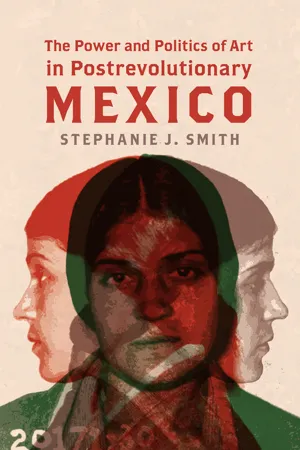
Stephanie J. Smith brings Mexican politics and art together, chronicling the turbulent relations between radical artists and the postrevolutionary Mexican state. The revolution opened space for new political ideas, but by the late 1920s many government officials argued that consolidating the nation required coercive measures toward dissenters. While artists and intellectuals, some of them professed Communists, sought free expression in matters both artistic and political, Smith reveals how they simultaneously learned the fine art of negotiation with the increasingly authoritarian government in order to secure clout and financial patronage. But the government, Smith shows, also had reason to accommodate artists, and a surprising and volatile interdependence grew between the artists and the politicians.
Involving well-known artists such as Frida Kahlo, Diego Rivera, and David Alfaro Siqueiros, as well as some less well known, including Tina Modotti, Leopoldo Méndez, and Aurora Reyes, politicians began to appropriate the artists’ nationalistic visual images as weapons in a national propaganda war. High-stakes negotiating and co-opting took place between the two camps as they sparred over the production of generally accepted notions and representations of the revolution’s legacy—and what it meant to be authentically Mexican.
- 292 pages
- English
- ePUB (mobile friendly)
- Available on iOS & Android
eBook - ePub
The Power and Politics of Art in Postrevolutionary Mexico
About this book
Information
Topic
HistoireSubtopic
Art généralTable of contents
- Cover
- Title Page
- Copyright
- Dedication
- Contents
- List of Illustrations
- Acknowledgments
- Introduction: Imagining a Red Path Forward
- Chapter One: Art and the Creation of Mexico’s Communist Party, 1919–1930
- Chapter Two: The Gendering of the Cultural Revolution, 1919–1934
- Chapter Three: Trotsky in Mexico: Artists United, Artists Divided, 1930–1940
- Chapter Four: Revolutionary Women in the New Society, 1930–1954
- Chapter Five: Revolutionary Printmakers: LEAR and the TGP, 1934–1957
- Epilogue: Returning Home, 1952–1974
- Notes
- Bibliography
- Index
Trusted by 375,005 students
Access to over 1.5 million titles for a fair monthly price.
Study more efficiently using our study tools.
Frequently asked questions
Yes, you can cancel anytime from the Subscription tab in your account settings on the Perlego website. Your subscription will stay active until the end of your current billing period. Learn how to cancel your subscription
No, books cannot be downloaded as external files, such as PDFs, for use outside of Perlego. However, you can download books within the Perlego app for offline reading on mobile or tablet. Learn how to download books offline
Perlego offers two plans: Essential and Complete
- Essential is ideal for learners and professionals who enjoy exploring a wide range of subjects. Access the Essential Library with 800,000+ trusted titles and best-sellers across business, personal growth, and the humanities. Includes unlimited reading time and Standard Read Aloud voice.
- Complete: Perfect for advanced learners and researchers needing full, unrestricted access. Unlock 1.5M+ books across hundreds of subjects, including academic and specialized titles. The Complete Plan also includes advanced features like Premium Read Aloud and Research Assistant.
We are an online textbook subscription service, where you can get access to an entire online library for less than the price of a single book per month. With over 1.5 million books across 990+ topics, we’ve got you covered! Learn about our mission
Look out for the read-aloud symbol on your next book to see if you can listen to it. The read-aloud tool reads text aloud for you, highlighting the text as it is being read. You can pause it, speed it up and slow it down. Learn more about Read Aloud
Yes! You can use the Perlego app on both iOS and Android devices to read anytime, anywhere — even offline. Perfect for commutes or when you’re on the go.
Please note we cannot support devices running on iOS 13 and Android 7 or earlier. Learn more about using the app
Please note we cannot support devices running on iOS 13 and Android 7 or earlier. Learn more about using the app
Yes, you can access The Power and Politics of Art in Postrevolutionary Mexico by Stephanie J. Smith in PDF and/or ePUB format, as well as other popular books in Histoire & Art général. We have over 1.5 million books available in our catalogue for you to explore.