Who are we, and where do we come from? The fundamental drive to answer these questions is at the heart of Finding Your Roots, the companion book to the PBS documentary series seen by 30 million people. As Harvard scholar Henry Louis Gates Jr. shows us, the tools of cutting-edge genomics and deep genealogical research now allow us to learn more about our roots, looking further back in time than ever before. Gates’s investigations take on the personal and genealogical histories of more than twenty luminaries, including United States Congressman John Lewis, actor Robert Downey Jr., CNN medical correspondent Sanjay Gupta, President of the “Becoming American Institute” Linda Chavez, and comedian Margaret Cho. Interwoven with their moving stories of immigration, assimilation, strife, and success, Gates provides practical information for amateur genealogists just beginning archival research on their own families’ roots, and he details the advances in genetic research now available to the public. The result is an illuminating exploration of who we are, how we lost track of our roots, and how we can find them again.
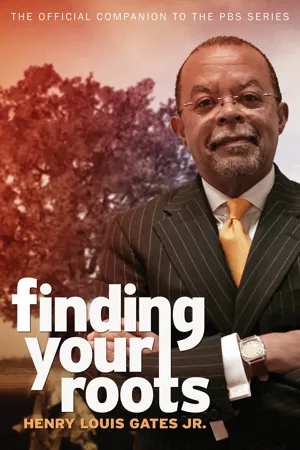
- 352 pages
- English
- ePUB (mobile friendly)
- Available on iOS & Android
eBook - ePub
About this book
Information
Chapter One: Genetic Gumbo
It’s often been said that people in New Orleans don’t just tell history; they do history. You can see it everywhere in the Big Easy. The streets seem to vibrate with tradition, from the second-line parades originating in Tremé, the oldest African American neighborhood in the country, to the brass bands and twenty-four-seven parties on Bourbon Street in the French Quarter, to the dazzling array of Cajun and Creole cooking that continues to make the Crescent City one of the most exciting laboratories for culinary fusion in the world. The diversity of the people of New Orleans, a trading post that changed hands twice between the French and Spanish before joining the United States via the Louisiana Purchase, is as striking as their resilience, especially in the weeks and months following Katrina, among the most devastating hurricanes in memory. Capturing New Orleans’s personality and pride—its exuberance and defiance—is the cheer emanating from any open-air bar when the city’s beloved Saints score a touchdown: “Who Dat?”
Pulsating through this port city along the Mississippi River are the rhythms of jazz. A fusion of African and European musical influences, these intimate cultural and personal exchanges have characterized New Orleans since slavery. It is the city’s musical form of gumbo, and in the venerable old jazz clubs that fill the Vieux Carré (French Quarter), musicians tell the story of New Orleans through their songs, solos—and improvisations.
Native sons Branford Marsalis and Harry Connick Jr. share an enduring connection to New Orleans, and to each other, as well as a passion for the marvelous music that was born there. Taken together, the stories we found about their pasts illuminate the complicated history of race in one of America’s most beloved cities.
Talking with these exceptional musicians who have been immersed in New Orleans jazz for their whole lives, I began to wonder where musical gifts come from. Some people believe musical talent is part of the cultural DNA, something you pick up on the streets. Others believe musical talent is genetic: like perfect pitch and rhythm, it’s passed down through generations.
Perhaps we will be able to find some answers on the branches of each musician’s family tree. How have Branford’s and Harry’s ancestors, both known and unknown, influenced who they are today?
Branford Marsalis (b. 1960)
Born in Breaux Bridge, Louisiana, on August 26, 1960, Branford Marsalis is perhaps best known as the original bandleader for Jay Leno’s Tonight Show. But he’s also one of the most respected musicians of his generation. He is the eldest son of the so-called first family of jazz. Father Ellis is both a pianist and a gifted teacher—among his students was Harry Connick Jr.—while younger brothers Wynton, Delfeayo, and Jason are all acclaimed jazz musicians themselves. I had heard that Branford Marsalis had deep musical roots in New Orleans stretching back generations. I assumed, because his father is such an accomplished jazz musician himself, that those roots were all on his father’s side. A visit to Ellis and Dolores Marsalis’s New Orleans home shed light on some surprising information about the origins of their sons’ musical talent.
“A lot of people think it came from my side, which it did not,” Ellis told us. “There was nobody on my side of the family that I even heard of that performed, even sang. Didn’t even sing in the church. … Now, on Dolores’s side, there’s several musicians, lots of them.”
Dolores Ferdinand was born in 1937 in New Orleans into a family that Branford described as Creole. After spending the day in New Orleans and asking three or four different people to define Creole for me, and coming up with at least as many different answers, I asked Branford what he meant by Creole. Where did the culture first arise? He gave me a less-than-objective, thoroughly enjoyable, and essentially true history lesson:
“What it really is, quite simply, is that because France was a really cool place to live and England wasn’t, when they said, ‘We want to put all you on a boat and go for two months on the seas and you might die; we’re going to send you somewhere and give you a piece of land,’ they’re like, ‘Anything’s better than this; I’m in.’ The French were like, ‘Why would I give this up to go on a boat?’ So the English colonies were swelling with people. And militarily that was a problem for France, because they didn’t have enough soldiers, and they couldn’t get people to come to New Orleans or to the Louisiana Territory. Napoleon solves the problem by developing the Napoleonic Codes. Whereas in the English system one drop of blood meant you were black, the French version was one drop of blood meant you were French, much like in South Africa, where there was a middle culture that was established. In South Africa they call them the Coloreds, and in Louisiana they were called the Creoles.”
Originally the term “Creole” was actually used to describe a white person of European descent born in the New World—white, not mixed race. After a time, in New Orleans, it came to mean a person was French and Spanish. Finally, the mulattoes—people with black and white ancestry—appropriated the term as “Creoles of color,” and this is the meaning that has remained. The color line in Creole society was severe. To put this in a musical context, Creoles were not inviting the very dark-skinned Louis Armstrong to play in their parlors. Race has always been socially constructed in a very complex way in New Orleans.
French society, Branford said, was benevolent toward the Creoles. “There were schools, orchestras, which is one of the reasons why, when you hear the early New Orleans music, almost all of the clarinet players are light-skinned blacks. They’re Creoles with names like Sidney Bechet and Barney Bigard and Alphonse Picou. My mother’s people are part of that culture.”
Branford calls his mother the “quintessential New Orleans woman. They tell you what they’re thinking right off the bat.” The same was true of her approach to her sons’ playing. “She doesn’t play music, but she has a great ear for music,” Branford said. “She knows when we’re playing good—and she definitely knows when we’re playing bad.” And, like the New Orleans woman Branford described, she has never hesitated to tell her son the truth. “She came to one of my gigs about ten years ago. She said, ‘Did y’all rehearse before y’all played?’ I said, ‘No, we didn’t rehearse.’ She goes, ‘This is a damn shame. You all got paid to rehearse. Y’all should be ashamed of yourselves.’ I mean, we were raggedy that night, too. Whereas a lot of people would say, ‘It’s just so great to see my children on stage,’ she was like, ‘Y’all sucked.’ She knows when she hears it.” That no doubt comes from being a part of a family steeped in music.
Dolores’s relatives were no ordinary musicians. Some were jazz innovators, part of New Orleans musical royalty. Wellman Braud, a pioneering jazz bassist famous for playing with Duke Ellington, was the younger brother of Branford’s maternal great-grandmother, Helen Braud, born in June 1881 in St. James Parish, Louisiana. In the 1900 census for the parish, Helen, described as black, is listed alongside her eight siblings.
Wellman brought a sound to music that hadn’t existed before. “He was probably the first guy to employ the walking bass line, because before him, the acoustic bass was just taking the place of the tuba. The tuba was the instrument that kept the rhythm in those military bands that went bump, bump, bump, bump, bump, bump, bump, bump, bump, bump, bump, bump. And then the bass players were doing it.” Branford paused and continued: “I think he’s the first one that started, when the music started to subtly shift, started walking, boong, doong, doong, doong, the walking bass line. I think Wellman was the first.”
Interestingly, some members of the Braud family retained the French spelling Breaux (as in the name of Branford’s birthplace, Breaux Bridge), although the family was almost entirely English speaking. While members of Branford’s mother’s family considered themselves Creole, they would not describe the Marsalises that way. As has so often been the case in African American culture, skin color was a determining factor in status. The lighter the skin, the higher the social standing. Branford described one of his mother’s brothers as a “proud Creole.” “They just thought they were the bee’s knees,” he said, “and they would not have included us, and I felt no real desire to join that crew.”
Branford is also related on his mother’s side to the Dejean and Eugene families, two New Orleans music dynasties. Harold Dejean was a great saxophonist who re-formed the Olympia Brass Band in 1958. A half century before, the Olympia Brass Band had been incredibly popular, but it disbanded around World War I. Other members of the Olympia Brass Band included Wendell Eugene and Leroy Braud, no doubt distant cousins on Branford’s mother’s line.
In addition to the Dejeans and Eugenes, Branford’s mother had said that her Braud family was related to the great New Orleans clarinetist Alphonse Picou. We couldn’t find an actual blood link to him, but, ironically, our search for Picou turned up an astonishing piece of Branford’s personal history that allowed us to take him deep into his mother’s family tree. In this case the crucial clue was a court document that dated from 1894, two years before Plessy v. Ferguson made “separate but equal” the law of the land. The document details the assault and battery complaint that the colored cigar maker Alfred Picou filed against John Joseph Learson. “In his affidavit,” the file read, “Alfred Picou says that he saw John Joseph Learson on Bayou Road and Villere Street and asked to introduce him to some of his friends. In response to this invitation, John Joseph called Alfred Picou an old rascal. Alfred seemed to be offended by this remark and words were exchanged. The two men continued on their way until a few minutes later, John Joseph Learson struck Alfred Picou with some sort of object from behind in the back of the head of the Plaintiff.”
In our quest to find a link between Dolores Marsalis and Alphonse Picou, we had discovered Branford’s great-great-grandfather was the man at the other end of the stick, so to speak: John Joseph Learson. His was a life history that would lead us to a time before the Civil War.
Searching for genealogical records that predate the Civil War can be profoundly difficult for African American people. This was a time when most African Americans were slaves, a people without names, identified only as “Negro” on slave rolls. For most of us, it’s a black hole, and we have to rely on the paper record after emancipation and work backward to piece together our family history.
The most valuable document in this kind of research is the 1870 census, the first census where all African Americans were listed as people, not property, with both a first name and last. There, in the 1870 census for the Seventh Ward in New Orleans, is John Joseph Learson, born on May 13, 1851. The description of Learson’s color is intriguing: “John, 19, male, color, Mulatto.” Either John himself or the census taker assumed that he was of mixed race because of the way he looked.
This was not particularly surprising to Branford, who had long suspected that he had white ancestry. In his mother’s family, there was a widely talked-about white, French great-great-grandmother. No one knew her name, but they suspected she was in their family tree somewhere. Branford always felt the mixed ancestry of his mother’s family was written on their faces.
“The Brauds, man, they could pass for high society in Cuba—light-skinned, gray eyes, straight hair,” Branford said. Branford has a darker complexion than do these relatives, but he saw that ancestry in himself as well. “When the sun would come up, when I was fifteen or sixteen, in the middle of all the Black Power stuff, all these little blond hairs would come out on my arm. It was clear,” he said. “They don’t show up by mistake. I mean, there’s some stuff there.”
Most African Americans have some European ancestry somewhere on their family tree, but almost none of us can identify our white ancestors by name. To try and discover why Branford’s great-great-grandfather was described as a mulatto, we searched for the name of Learson’s father in the 1850 census. Astonishingly, we found it.
Most black people can get back only as far as the 1870 census—and only if they’re very lucky. Here was another generation of Branford’s family: John Reinhardt Learson. His race was left blank—blank in America means white—but next to his name it says “Germany.”
It is something of a miracle to have such clear documentation of the name of a black person’s white ancestor. For example, I know I’m descended from a black slave named Jane Gates, my great-great-grandmother. Jane had five children with the same white man, but she took the secret of his identity to her grave. I am still searching for his name today.
But in this case, we had found the white ancestor’s name; that left us the task of finding the black ancestor’s name—a woman we assumed was a slave. The thought of this relationship didn’t shock Branford at all. “I always knew that we are descendants of slaves. There’s no way to deny it. That’s how we got here.”
Still, finding Branford’s third great-grandmother was no small undertaking. Before emancipation in 1865, the birth, death, and marriages of slaves were not part of any official record. So if Learson did father a child with a slave, finding the identity of that woman would be virtually impossible. Greg Osborn, a researcher at the New Orleans Public Library, helped us pore over historical documents left behind by Branford’s relatives, systematically searching through the archives and visiting cemeteries all over New Orleans to record names from old gravestones.
The document we needed was buried deep, but Osborn found it. It was an 1851 birth certificate of John Reinhardt Learson’s son, John Joseph Learson. On it was the name of the child’s mother, the very woman for whom we were searching: Branford’s third great-grandmother. Alongside her name—Myrte Valentin—was the unexpected description, “Free woman of color.”
Branford’s third great-grandmother Myrte, who had a son with the white immigrant from Germany, wasn’t a slave at all. Nor did this appear to be a coercive relationship in any way. John Reinhardt Learson (original spelling Lurson) owned no slaves and fathered each of Myrte’s seven children. Each one bore his surname. Someone much closer to Branford bears his name as well: his brother Wynton’s middle name is Learson. Branford had known it was a name from his mother’s side of the family, but never the story behind it.
Branford is one of the very few African Americans descended from black people who were free before the Civil War. Fewer than 10 percent of us can make that claim. On his mother’s family tree are two generations of free Negroes before the Civil War even starts.
“It certainly allows for a head start,” Branford said, struck by the information about his ancestors. “He was a noble man, clearly, to do that in those times. But if it was going to happen in America, it would happen in Louisiana, and New Orleans specifically. This was one of those places where, if that’s what you wanted to do, that’s what you would do.”
That is the popular image of old New Orleans anyway: a freewheeling place where colorblindness and creativity reigned and differences were celebrated instead of condemned. For a time, free people of color shared some of the same freedoms as white people. They could own land; they published their own newspapers; they attended their own schools. My colleague at Harvard, Walter Johnson, has studied and written about New Orleans history extensively. I asked him: how free was free? Were there degrees of freedom, or were these free people of color as free as white people in New Orleans? “I think ‘degrees of freedom’ is a good phrase,” Johnson replied. “It would be a mistake to imagine the city of New Orleans as a multicultural paradise. And over time, there are limitations placed on free people of color in New Orleans. After 1830 it’s officially illegal for free people of color to move to the state of Louisiana.”
Whatever rights free people of color had, they were continually being chipped away. “Free people of color have to carry their papers,” Johnson continued. “They can be stopped on the street and made to prove out their identity. A lot of these are working class. They’re what today we might call the working poor.”
While the free people of color in New Orleans were freer than slaves, legally they were anything but the white man’s equal, and this carried heavier burdens than their designation implied. Perhaps a more apt phrase would have been the “somewhat free people of color.”
For all of our amazing discoveries on Branford’s mother’s side, we wanted to look into his father’s past as well. To most Americans, the name Marsalis is practically synonymous with both jazz and New Orleans. But where does it come from? The stories that Branford had heard—that Marsalis is a Dutch name and comes from a plantation in Summit, Mississippi—are absolutely true. Any black person born with the name Marsalis around Summit, Mississippi, was most likely a former slave of a Dutch plantation owner named Peter Marsalis.
Ellis Marsalis Sr., Branford’s grandfather, was a descendant of one of these slaves. Born in Summit on April 16, 1908, he looms large in Branford’s memories of his childhood. As a young man, Ellis Sr. left Mississippi for New Orleans, unlike many African Americans of his generation who had chosen to move North. “Most people never leave the place where they live,” Branford said. “So the only places he could have logically gone were Memphis or New Orleans. New Orleans was certainly a lot more attractive at that time than Memphis was.” New Orleans, Branford explained, had an established mercantile class that didn’t really exist in other places, and where it did exist—in a place like Tulsa, Oklahoma, for example—it was often put down violently. “New Orleans was a place where they could get their slice of the American pie and not have to worry about people who are embittered by their success burning their stuff down,” Branford said.
After working as a hearse driver for the Duplain Rhodes Funeral Home, in 1936 Ellis Sr. became one of the first black owner-managers of an Esso gas station in the entire country. (Esso is now Exxon.) To be a business owner in the Deep South during Jim Crow could not have been easy, but Ellis Sr. didn’t talk to Branford much about his past. “My paternal grandfather was a very unsentimental fellow,” Branford said. “I think that was his coping mechanism for living in the segregated South. He just went from day to day and didn’t look back.”
In 1943 the United States was involved in two wars overseas, while at home Jim Crow laws were still strictly enforced. As a result, virtually all of the hotels and motels in the South and the North were for whites only. Ellis Marsalis Sr. was a man of vision, renovating a barn on his property into a place for prominent black people to stay when they were passing through New Orleans. That was the first version of the Marsalis Motel, which later became the Marsalis Mansion. The list of luminaries who spent the night there is mind-boggling: Martin Lut...
Table of contents
- Cover Page
- Finding Your Roots
- Copyright Page
- Dedication
- Contents
- Foreword
- Chapter One: Genetic Gumbo
- Chapter Two: The Long Arc of Freedom
- Chapter Three: What’s in a Name?
- Chapter Four: Redemption
- Chapter Five: The Children of Abraham
- Chapter Six: From the Old World to the New
- Chapter Seven: Shadows
- Chapter Eight: Crossings
- Chapter Nine: Neither Slave nor Free
- Chapter Ten: In the Footsteps of Conquistadors
- Acknowledgments
- Index
Trusted by 375,005 students
Access to over 1.5 million titles for a fair monthly price.
Study more efficiently using our study tools.
Frequently asked questions
Yes, you can cancel anytime from the Subscription tab in your account settings on the Perlego website. Your subscription will stay active until the end of your current billing period. Learn how to cancel your subscription
No, books cannot be downloaded as external files, such as PDFs, for use outside of Perlego. However, you can download books within the Perlego app for offline reading on mobile or tablet. Learn how to download books offline
Perlego offers two plans: Essential and Complete
- Essential is ideal for learners and professionals who enjoy exploring a wide range of subjects. Access the Essential Library with 800,000+ trusted titles and best-sellers across business, personal growth, and the humanities. Includes unlimited reading time and Standard Read Aloud voice.
- Complete: Perfect for advanced learners and researchers needing full, unrestricted access. Unlock 1.5M+ books across hundreds of subjects, including academic and specialized titles. The Complete Plan also includes advanced features like Premium Read Aloud and Research Assistant.
We are an online textbook subscription service, where you can get access to an entire online library for less than the price of a single book per month. With over 1.5 million books across 990+ topics, we’ve got you covered! Learn about our mission
Look out for the read-aloud symbol on your next book to see if you can listen to it. The read-aloud tool reads text aloud for you, highlighting the text as it is being read. You can pause it, speed it up and slow it down. Learn more about Read Aloud
Yes! You can use the Perlego app on both iOS and Android devices to read anytime, anywhere — even offline. Perfect for commutes or when you’re on the go.
Please note we cannot support devices running on iOS 13 and Android 7 or earlier. Learn more about using the app
Please note we cannot support devices running on iOS 13 and Android 7 or earlier. Learn more about using the app
Yes, you can access Finding Your Roots by Henry Louis Gates Jr. in PDF and/or ePUB format, as well as other popular books in History & North American History. We have over 1.5 million books available in our catalogue for you to explore.