In this first history of Arab American activism in the 1960s, Pamela Pennock brings to the forefront one of the most overlooked minority groups in the history of American social movements. Focusing on the ideas and strategies of key Arab American organizations and examining the emerging alliances between Arab American and other anti-imperialist and antiracist movements, Pennock sheds new light on the role of Arab Americans in the social change of the era. She details how their attempts to mobilize communities in support of Middle Eastern political or humanitarian causes were often met with suspicion by many Americans, including heavy surveillance by the Nixon administration. Cognizant that they would be unable to influence policy by traditional electoral means, Arab Americans, through slow coalition building over the course of decades of activism, brought their central policy concerns and causes into the mainstream of activist consciousness.
With the support of new archival and interview evidence, Pennock situates the civil rights struggle of Arab Americans within the story of other political and social change of the 1960s and 1970s. By doing so, she takes a crucial step forward in the study of American social movements of that era.
eBook - ePub
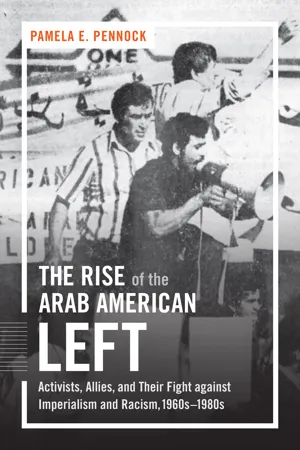
The Rise of the Arab American Left
Activists, Allies, and Their Fight against Imperialism and Racism, 1960s–1980s
- 328 pages
- English
- ePUB (mobile friendly)
- Available on iOS & Android
eBook - ePub
The Rise of the Arab American Left
Activists, Allies, and Their Fight against Imperialism and Racism, 1960s–1980s
About this book
Information
PART ONE: THE IMPACT OF THE 1967 ARAB-ISRAELI WAR ON ARAB AMERICAN ORGANIZING AND THE AMERICAN LEFT
1: Progressive Activism after the June War
The Association of Arab American University Graduates
Two principal Arab American organizations, the Arab National League and the Institute of Arab American Affairs, had dissolved by 1950, but in the early 1950s the Organization of Arab Students of the United States and Canada (OAS) established chapters at many North American universities. As discussed in chapter 2, from its inception the OAS was political and secular in nature and promoted nationalism and socialism in Arab societies.1 Along with the mainly foreign students in the OAS, many Arab Americans were inspired by Gamal Abdel Nasser’s pan-Arab movement in the 1950s and 1960s. Transnational politics were kept alive in these years by a minority of Arab Americans who remained attentive to Palestine, a commitment that was further encouraged by recent immigrant arrivals who brought a keen awareness of Arab national issues.2
Thus, the political consciousness that would coalesce in the wake of the June War was not wholly new. Nevertheless, many Arab Americans remember 1967 as marking a critical turning point for the Arab diaspora. The establishment of the Association of Arab American University Graduates (AAUG) that year occurred against a backdrop of renewed organizational activity among Arab Americans. Of all the groups that mobilized Arab Americans’ political sentiments in the 1960s and 1970s, the most visible with the most avowedly secular and pan-Arab foundation was the AAUG. In its radical advocacy of Palestinian nationalism, the nonsectarian AAUG quickly became the most influential organization on the Arab American Left.
IN JUNE 1967, Israel, with support from the United States, launched a preemptive strike against Arab troops who were massed on its borders in an apparent prelude to attack. Within a week, Israel had not only crushed the Egyptian, Syrian, and Jordanian forces but had captured sizable new swaths of Arab territory and displaced hundreds of thousands more Palestinians from their homes, adding to the already massive refugee population created by the 1948 Arab-Israeli War. The Arab-Israeli War of June 1967 was a devastating defeat for the Arab powers. While Israelis experienced a boost in power and morale, and enthusiasm for Zionism swelled throughout the Jewish diaspora, unity among Egypt, Syria, and Jordan collapsed. Both Gamal Abdel Nasser’s leadership and the idea of pan-Arab nationalism were largely discredited in the eyes of most Arabs. In this difficult period of defeat and disillusionment, the Palestinian resistance movement became radicalized. In the newly occupied territories of the West Bank and Gaza Strip and especially in their bases inside Jordan, Palestinian resisters regrouped and vowed to undermine Israel with armed struggle to liberate all of Palestine and achieve Palestinians’ right of return.3
The main Palestinian resistance group in this period was al-Fatah (the Palestinian National Liberation Movement), led by Yasser Arafat. Formed in 1959 by Palestinian exiles in the diaspora, Fatah believed that, to carry out genuine self-determination, Palestinians themselves must be at the forefront of the liberation struggle.4 After the 1967 war, Fatah gained control of the Palestine Liberation Organization (PLO), and Arafat became the PLO’s leader.5 The PLO, an umbrella organization that encompassed many political groupings, coordinated the guerrilla resistance to Israel. It also struggled against neighboring Arab nations, first Jordan and then Lebanon, whose leaders sought to repress militant Palestinian activity within their territory. By the early 1970s, the PLO was advocating a one-state solution to the Palestinian question.6
The June War, the surge of the Palestinian resistance movement, and a subsequent war between Israel and Arab nations in October 1973 all galvanized Arab Americans and encouraged them, within both newly created and long-established organizations, to mobilize on behalf of Palestinian liberation. As one AAUG member characterized the impact of the 1967 war, the Arab defeat provided a “jolt” that caused Arab Americans who had arrived decades earlier to become more intimately connected with their identity as Arabs and the politics of “the Arab condition.” According to AAUG leader Naseer Aruri, this awakening involved a realization that Americans were ignorant of Arab issues and viewpoints and a recognition that Arab Americans lacked “a forum from which to correct the information gap.” Rashid Bashshur, a founding AAUG member, felt that the war “left the vast majority among us with a deep sense of deep frustration with the lame Arab response intellectually, militarily and politically as well as the lack of fairness in the U.S. media, the double standard of American policy, and the slanted public opinion.” To Arabs throughout the diaspora who had advocated Arab nationalism in the 1950s and 1960s, the devastating loss represented a victory not only of U.S.-backed Israeli imperialism but also of conservative Arab regimes over the progressive tide in the Middle East.7
As the most significant and influential of the organizations founded shortly after the 1967 war, the AAUG was comprised of a select group of Arab Americans who formulated a sense of ethnic identity, fostered community solidarity, and practiced progressive and transnational politics. While it was not the only pan–Arab American political organization established in the wake of the war, the AAUG was distinguished by its commitment to an antiracist, anti-imperialist analysis of Arab world problems and its adherence to an ideological orientation aligned with the global Left. The association’s intellectual influence would outlast the organization itself.
The founding of the AAUG in the immediate aftermath of the 1967 war was a major advancement in Arab American organizing. The association was unique as an activist organization, for although it was a progressive group that represented an ethnic minority in the United States, it restricted its membership to college graduates in that community.8 The AAUG’s influence was most significant in its practice of activist scholarship that promoted an Arab, and usually leftist, perspective. This mission, as well as the AAUG’s academic bent, was not unlike the political culture of the early New Left which largely originated and flourished within universities and among graduate students and professors. As historian Kevin Mattson demonstrates in his book Intellectuals in Action: The Origins of the New Left and Radical Liberalism, 1945–1970, activist scholars involved in endeavors such as the journal Studies on the Left continually grappled with the question, “What role should intellectuals play in effecting political change?” Their answer was that intellectuals should define a different kind of political engagement, one that provoked political change by engaging the American public in “deliberative and democratic” exchanges that provided citizens with the knowledge to confront the power structure. They intended their lectures and publications to be “forums for alternative politics,” and the “teach-in” became an important tool in their activist approach to effecting change.9 Arab American professionals and intellectuals at the forefront of the AAUG similarly participated in this tradition of the larger American Left (and its subset, the New Left) and likewise believed they had a responsibility to promote political progress by cultivating truthful understanding in the public sphere. This ambitious, idealistic undertaking made the AAUG the most important organization in the emerging Arab American Left. However, also like the wider Left, the maintenance of an intellectual stance and the use of largely academic discourse limited its audience and efficacy, instead fostering insularity.10
Although its main focus was solving Arab world conflicts, the AAUG also addressed issues faced by Arabs in America. By attempting to counter what its members saw as rampant misinformation about Arabs in American discourse, the organization confronted the heightened stereotyping and discrimination that many Arab Americans faced in the period after the 1967 war. The AAUG fostered a sense of Arab ethnic identity and pride across different generations and nationalities of Arab Americans at the same time that it helped integrate them into the American political arena and connect with organizations and leaders representing other American minority groups and positions.
The AAUG positioned its advocacy in the frameworks of the American and global anti-imperialist Left. Its aim was to show Americans that Zionism was a form of colonialism rather than a legitimate expression of Jewish nationalism, which many Americans presumed it to be. Year after year its members passed resolutions and produced literature supporting the Palestinian resistance movement led by the PLO and the formation of a single secular and democratic state in Palestine. Furthermore, the AAUG championed socialist nationalism and gender equality throughout the Arab world and saw the movement for Palestinian liberation as the vanguard of a wider transformation in the region. AAUG activists understood these as “people’s struggles” emblematic of revolutionary movements throughout the Third World and regularly declared, as articulated in a typical resolution, “support for and solidarity with all other deprived and oppressed peoples everywhere struggling for their human rights.”11 One member, Ghada Hashem Talhami, later asserted: “Perhaps, the greatest success of the association was the establishment of the Palestine issue as the central question of the Arab liberation struggle, as well as one of the Third World’s premier conflicts. The association helped elevate the Palestinian struggle to the status of a premier universal human rights issue.”12 This ideological position impelled AAUG leaders to reach out to eminent Third World leaders throughout the late 1960s and 1970s in a quest for solidarity and support. Although the AAUG’s progressive focus on Palestinian and Arab world revolution in the context of global anti-imperialism served as the linchpin that mobilized Arab Americans in the organization, after several years of bitter conflicts between Arab nations, its transnational orientation also created friction among its members who hailed from different Arab states, disputes that became increasingly divisive by the 1980s and contributed to the organization’s decline.
The Landscape of Arab American Organizations in the 1960s and 1970s
Although it would become the most significant, it is important to note that the AAUG was not the only organization devoted to promoting Arab perspectives in the United States. The other major Arab American organization established in the period between the 1967 and 1973 Arab-Israeli Wars was the National Association of Arab Americans (NAAA). In contrast to the AAUG, the NAAA intended to be explicitly political. Established in 1972, it was registered as a political lobbyist organization based in Washington, D.C., and sought to promote an “even-handed” U.S. policy toward the Middle East that would preserve Arab, Israeli, and American interests. Comprised mainly of Arab Americans who had come to the United States earlier in the twentieth century and dominated by prominent Arab American businessmen, many of whom were members of the Republican Party, the NAAA tended to promote more moderate positions than did the AAUG, marked by its advocacy of coexistence with Israel at its pre-1967 borders. Furthermore, its political style was decidedly less radical. It eschewed associations with leftist and minority activists in America and aimed to be the Arab counterpart to the American Israel Public Affairs Committee (AIPAC).13 In its first few years, the NAAA did not make a major impact, and according to political activist Gregory Orfalea, who later worked for the NAAA, the organization was “not well-known by the community it claimed to serve.”14
In addition to the pan-Arab AAUG and NAAA, numerous organizations existed at various points in the mid- to late twentieth century that specifically represented Palestinian Americans. Before the 1960s, most Palestinian groups in the United States had been small and narrow in scope, usually focused on village-based networks. The American Federation of Ramallah, founded in 1959, functioned mainly as a cultural and charitable organization for the thousands of Palestinians who had immigrated to the United States from the (then) largely Christian city of Ramallah, near Jerusalem in the West Bank. According to Rabab Abdulhadi, in the 1960s the federation “deliberately seemed nonpolitical on the surface,” and although the federation preserved private expressions of Palestinian identity, it tried to blend into the “melting-pot” orientation dominant in American society. But over the course of the 1970s, the organization became more overtly political and nationalist in orientation, as well as more open in displays of Palestinian cultural heritage. Abdulhadi attributes the more public and political practices of “Palestinianness” to “the expanded U.S. space for oppositional and alternative Arab and Palestinian expressions.” One marker of the organization’s politicization in the 1970s was the appendage of “Palestine” to its title.15
Several other Palestinian American organizations were explicitly political from the beginning. The Arab American Congress for Palestine (AACP), founded in 1965 with chapters in Washington, D.C., Detroit, Chicago, and Los Angeles, was devoted to promoting American understanding of the Palestinian cause. It never attracted a substantial membership, and according to George Khoury, briefly a member of Detroit’s AACP, it suffered from domination by recently arrived older Palestinian men whose political imagination was limited and whose public relations strategies were inadequate.16 Additional Palestinian organizations with a nationalist political bent sprung up around the country after the 1967 war, such as the Palestine Committee in Boston, the Palestine House in Washington, D.C., and the Democratic Committee for Palestine in New York City.17 A leftist pro-Palestinian newspaper, Free Palestine, was based in Washington, D.C., and edited by AAUG leader Abdeen Jabara in the early 1970s, although it was officially unaffiliated with the AAUG.18 Many organizations with a humanitarian purpose also emerged in the few years following the 1967 war, chiefly to provide aid to Palestinian refugees. These included the United Holy Land Fund, originally based in Detroit, and the Palestine Arab Fund, based on the West Coast.19 Other important sites for Arab and Palestinian American political communion were the Arab community centers that formed in several U.S. cities in the 1970s, such as Dearborn, Chicago, and San Francisco, where a bookstore specialized in Arabic leftist books. (Chapter 6 features an analysis of the Arab community center ACCESS in Dearborn.)20
Arab Americans affiliated with cultural and religious organizations also expressed political positions on Palestine and other Arab world issues during these years, though like the NAAA the stance of these groups was generally more moderate than that of the AAUG. The Midwest Federation of American Syrian-Lebanese Clubs, an organization that had traditionally concentrated on social and cultural activities, started to become more overtly political in the early 1970s. Its 1973 convention featured workshops about Arab American political influence and protection of Arab American civil rights, and in 1974 the federation, led by president Minor George, declared its support for the PLO. When the Cleveland chapter of the federation awarded its Distinguished Service Award to Frank Maria, a moderate Arab American leader active in the Antiochian Orthodox Archdiocese of North America, Maria gave an address in which he sharply criticized America’s support for Israel and called on federation members to be more politically involved.21 Furthermore, the Antiochian Orthodox Christian Archdiocese, to which many S...
Table of contents
- Cover Page
- Title Page
- Copyright Page
- Contents
- Illustrations
- Acknowledgments
- Introduction
- Part One: The Impact of the 1967 Arab-Israeli War on ARAB American Organizing and the American Left
- Part Two: A Hostile Climate for Activism
- Part Three: Americanization of Activism: Local Organizing and National Integration
- Conclusion
- Notes
- Bibliography
- Index
Trusted by 375,005 students
Access to over 1.5 million titles for a fair monthly price.
Study more efficiently using our study tools.
Frequently asked questions
Yes, you can cancel anytime from the Subscription tab in your account settings on the Perlego website. Your subscription will stay active until the end of your current billing period. Learn how to cancel your subscription
No, books cannot be downloaded as external files, such as PDFs, for use outside of Perlego. However, you can download books within the Perlego app for offline reading on mobile or tablet. Learn how to download books offline
Perlego offers two plans: Essential and Complete
- Essential is ideal for learners and professionals who enjoy exploring a wide range of subjects. Access the Essential Library with 800,000+ trusted titles and best-sellers across business, personal growth, and the humanities. Includes unlimited reading time and Standard Read Aloud voice.
- Complete: Perfect for advanced learners and researchers needing full, unrestricted access. Unlock 1.5M+ books across hundreds of subjects, including academic and specialized titles. The Complete Plan also includes advanced features like Premium Read Aloud and Research Assistant.
We are an online textbook subscription service, where you can get access to an entire online library for less than the price of a single book per month. With over 1.5 million books across 990+ topics, we’ve got you covered! Learn about our mission
Look out for the read-aloud symbol on your next book to see if you can listen to it. The read-aloud tool reads text aloud for you, highlighting the text as it is being read. You can pause it, speed it up and slow it down. Learn more about Read Aloud
Yes! You can use the Perlego app on both iOS and Android devices to read anytime, anywhere — even offline. Perfect for commutes or when you’re on the go.
Please note we cannot support devices running on iOS 13 and Android 7 or earlier. Learn more about using the app
Please note we cannot support devices running on iOS 13 and Android 7 or earlier. Learn more about using the app
Yes, you can access The Rise of the Arab American Left by Pamela E. Pennock in PDF and/or ePUB format, as well as other popular books in History & North American History. We have over 1.5 million books available in our catalogue for you to explore.