Spin Control, originally published in 1992, chronicles the development of the powerful White House Office of Communications and its pivotal role in molding our perception of the modern presidency. In this new edition, John Maltese brings his analysis up to date with a chapter detailing the media techniques of the Bush administration, the 1992 presidential campaign (including the use of talk shows like 'Larry King Live'), and the early Clinton administration.
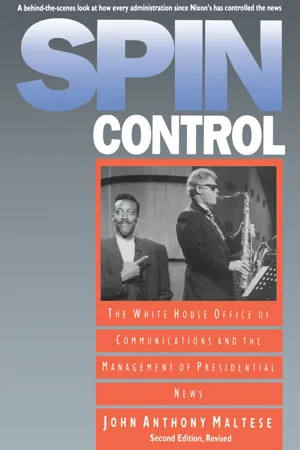
eBook - ePub
Spin Control
The White House Office of Communications and the Management of Presidential News
- 335 pages
- English
- ePUB (mobile friendly)
- Available on iOS & Android
eBook - ePub
Spin Control
The White House Office of Communications and the Management of Presidential News
CHAPTER ONE
INTRODUCTION
Congressman Dick Cheney leaned back in his chair and swung his feet up onto his desk. He was in a good mood. In a few hours he would leave for the White House where President George Bush would introduce him to reporters as the president’s nominee for secretary of defense. President Bush wanted the announcement to be a surprise, so Cheney was going about his morning schedule as usual. I happened to be part of it—one of the occasional string of academics who passed through Cheney’s office to ask questions about his experiences in government. That morning we were talking about Cheney’s tenure as White House chief of staff for President Gerald R. Ford.
My allotted time was running out, and our conversation drifted from specifics about the Ford administration to more general issues of presidential-press relations. To have an effective presidency, Cheney reminded me, the White House must control the agenda. An essential element of that control, he explained, is the ability to maintain discipline within the administration itself. Any appearance of disunity among the president’s ranks will be seized upon by the media as an opportunity for a story—one that will undermine the president’s agenda.1
Communications experts often note that the media are preoccupied with conflict. By the media’s own definition, news is drama, and drama thrives on conflict.2 As an example, Cheney pointed out that conflict between policymakers over the implementation of the federal budget makes for a much more interesting story than one that concentrates on the dry details of the budget itself—even though the dry details of the budget are ultimately more important. Besides, he added, conflict is easier for reporters to cover: “It’s much easier for them, for example, to get into covering and focusing upon an alleged personnel clash between the secretary of defense and the secretary of state over what the arms control policy is going to be than it is to talk about the policy itself, which most of them don’t understand.”3
As a result of the media’s preoccupation with conflict, good-faith debate within the administration is sometimes depicted as serious dissension among the ranks. Furthermore, stories about real conflicts increase the tension between those at odds and make the president look like a poor manager.4 To maintain control of the public agenda, then, the White House must not only minimize exposure of internal conflict but also aggressively promote the messages that it wants conveyed to the American people. Bluntly put, the White House must attempt to manipulate media coverage of the administration. “That means that about half the time the White House press corp is going to be pissed off,” Cheney continued, “and that’s all right. You’re not there to please them. You’re there to run an effective presidency. And to do that, you have to be disciplined in what you convey to the country. The most powerful tool you have is the ability to use the symbolic aspects of the presidency to promote your goals and objectives. You’re never going to get anywhere if you let someone step on your lead, or if you step on your lead yourself.” That means you’ve got to control what information you put out, he emphasized. “You don’t let the press set the agenda. The press is going to object to that. They like to set the agenda. They like to decide what’s important and what isn’t important. But if you let them do that, they’re going to trash your presidency.”5
The responsibility for doing just what Cheney was talking about rests with the White House Office of Communications. That office is charged with long-term public relations planning, the dissemination of the “line-of-the-day” to officials throughout the executive branch, and the circumvention of the White House press corps through the orchestration of direct appeals to the people (appeals that are often carefully targeted to particular constituencies in specific media markets). The goal is to set the public agenda, to make sure that all parts of the presidential team (the White House staff, cabinet officers, and other executive branch officials) are adhering to that public agenda, and to aggressively promote that agenda through a form of mass marketing. Focus groups and polling data are used to fashion presidential messages; sound-bites are written into the public pronouncements of the president and his underlings to articulate those messages; public appearances are choreographed so that the messages are reinforced by visual images; and the daily line is enforced to prevent the articulation of conflicting messages. “Surrogate speakers” take the messages to local constituencies through speaking tours while local media markets are penetrated by means of direct satellite interviews with administration officials and are co-opted by the distribution of editorial memos explaining administration policy and by camera-ready graphs and articles, “radio actualities” (or audio press releases), and briefings for local reporters and editorial writers.
The ultimate goal is to influence—to the extent possible—what news will appear in the media about the administration and its policies. Originally associated with political campaigns, such tactics were perfected by Richard Nixon in his 1968 bid for the presidency. In a scathing account of the campaign, Joe McGinniss called Nixon’s tactics “the selling of the president.”6 But Nixon brought the tactics with him to the White House. As Nixon aide Charles Colson said, “Nixon had a fetish about [trying to] dominate the news from the government.” The president was especially successful in 1972—the year of his triumphant visits to China and the Soviet Union and his landslide reelection. Colson added that in 1972, the White House came “as close to managing the news as you can do.” Daily public-opinion polls helped to determine “what issues were sensitive with the public” so that “you could tell one night how people were reacting to things, and the next morning back off or intensify what you wanted to say with almost simultaneous polling.”7
It was Nixon who created the White House Office of Communications, and every president after him has ultimately felt compelled to embrace it. Quite simply, what seemed so shocking to McGinniss and others in the 1968 campaign is now common practice—not only in campaigns but also in day-to-day governance. Nixon’s techniques were followed most successfully by the administration of Ronald Reagan, which copied the Nixon practice of a tightly regimented line-of-the-day coupled with limited press access and direct appeals to the people. Again, polling data helped to formulate the line, and efforts were made to see that certain stories dominated the news. Television was paramount to Reagan (as it was to Nixon), and the White House set up a tracking system of network newscasts to see how many minutes were devoted to each of the stories that the White House was promoting. Based on that tracking system, the White House modified its efforts to communicate its stories more effectively.8
The White House embrace of public relations techniques has corresponded with an increasing dependence on public support for the implementation of presidential policy. No longer does public support merely elect presidents. Now public support is a president’s most visible source of ongoing political power. More than ever before, presidents and their surrogates take messages directly to the people in an attempt to mold mandates for policy initiatives. A strategy of presidential power based on such appeals is known as “going public.”9 As defined by Samuel Kernell, this understanding of presidential power assumes that the elite bargaining community that implements policy is neither as isolated from public pressure nor as tightly bound together by established norms of elite behavior as it used to be.10 As a result, policymakers are increasingly susceptible to the influence of public opinion.11 A key to presidential power, then, is the ability to harness (or manufacture) that opinion. The result is a sort of unending political campaign.12
All of this is a far cry from what this country’s founders expected. Scholars of the presidency, such as Jeffrey Tulis, remind us that before this century, popular presidential rhetoric was largely proscribed because it was thought to “manifest demagoguery, impede deliberation, and subvert the routines of republican government.”13 That approach reflected the founders’ fear of “pure” or “direct” democracy. Although the founders felt that public consent was a requirement of republican government, they nonetheless felt that the processes of government should be insulated from the whims of public opinion. Thus, they attempted to instill deliberation in government through such things as indirect elections, separation of powers, and an independent executive. In short, the now commonplace practice of direct public appeals was shunned during the nineteenth century because it went against the existing interpretation of the constitutional order.
Over time, however, the source of presidential power shifted from narrowly defined constitutional underpinnings to a broader plebiscitary base.14 This shift placed a new set of institutional demands on presidents. Initially, presidents responded to the new demands by forging a professional relationship with reporters as a means of reaching the people. Theodore Roosevelt began the practice of meeting regularly with reporters (often during his late-afternoon shave). He even provided a room for them in the newly built executive office wing of the White House.15 Later, Woodrow Wilson established regularly scheduled presidential press conferences. The new system of presidential-press relations was perfected by Franklin D. Roosevelt, who formally created the White House Press Office. FDR coupled the institutionalization of the Press Office with his own repartee with reporters, a skill that he used with magnificent effect at his informal biweekly press conferences. There was strict control over how reporters could use material from press conferences (as there had been from the start of the new presidential-press relationship), but the system—as Kernell points out—was one of “hard news, openly conveyed.”16
The growth of the broadcast media altered that relationship. Most noticeably, it eroded the intimacy. Presidents were no longer as dependent on reporters to convey their views to the public. Radio and television became a direct means of reaching the masses. Even presidential press conferences came to be used more to meet the people than to meet the press when the practice of televising them “live” began in 1961.
As presidents became more adept at taking their message directly to the people—thereby performing an end run around intermediary interpreters—reporters became less willing to accept the strict “ground rules” that presidents had once proffered for access. In the process, the adversarial aspects of the presidential-press relationship were emphasized. The reliance on unfiltered public appeals that reflected the new strategy of going public raised new institutional demands. Those demands were filled by the White House Office of Communications.
It is important to note that the functions of the Office of Communications are very different from those of the White House Press Office. Rather than targeting local media outlets, the Press Office caters almost exclusively to the needs of Washington-based reporters who frequent its domain on a regular basis. Rather than coordinating the news flow from the entire executive branch, the Press Office is primarily concerned with providing information from the White House itself. And rather than engaging in long-term public relations management, the Press Office seldom moves beyond the short-term goal of disseminating the news of the day and responding to reporters’ queries. Thus, whereas the Press Office is primarily reactive, the Office of Communications is primarily proactive.
This study of the Office of Communications is largely about how the White House attempts to control the public agenda by making presidential news. It also serves as an example of how modern presidents have attempted to increase their control over the executive branch and the policies of government by placing more power in the hands of the White House staff.17 Just as presidents in the earlier part of this century came to use the Bureau of the Budget as a central clearinghouse of legislation—a means of asserting presidential (rather than departmental) judgments, choices, and priorities in molding a legislative package under executive auspices—presidents today have come to use the Office of Communications as a means of asserting control over the communications agenda of the executive branch.18
From the White House perspective, control of the agenda is an essential component of successful policy-making. But such manipulation can raise serious problems from the point of view of democratic theory. For instance, it has eviscerated our presidential campaigns of much of their content. Now it is threatening to do the same to day-to-day government. Style is substituted for substance. Complicated issues are transformed into simple slogans and slick sound-bites. The very real threat is that our ideal of a bold and deliberative government will be dashed by timid, self-interested policymakers who shy away from responsibility for their actions and delude themselves and their constituents with their own symbolic spectacle.
Although the Office of Communications was not established until 1969, some of its functions had been carried out informally in earlier administrations. For instance, Dwight D. Eisenhower’s press secretary, James Hagerty, made a point of coordinating the federal government’s public relations operations through informal meetings between himself and departmental public information officers.19 Some felt that this sort of liaison was not enough. In 1954, Robert Humphreys suggested to President Eisenhower the creation of a structure much like the Office of Communications.20 Humphreys, who was then publicity director of the Republican National Committee, had been active in Eisenhower’s public relations efforts during the 1952 campaign.21 But Eisenhower did not act on Humphreys’s proposal, nor did John ...
Table of contents
- Cover Page
- SPIN CONTROL
- Copyright Page
- Dedication
- CONTENTS
- ACKNOWLEDGMENTS
- CHAPTER ONE INTRODUCTION
- CHAPTER TWO ORIGINS OF THE OFFICE OF COMMUNICATIONS
- CHAPTER THREE THE NIXON YEARS
- CHAPTER FOUR THE NIXON YEARS
- CHAPTER FIVE THE FORD YEARS
- CHAPTER SIX THE CARTER YEARS
- CHAPTER SEVEN THE REAGAN YEARS
- CHAPTER EIGHT THE BUSH AND CLINTON YEARS
- APPENDIX
- NOTES
- BIBLIOGRAPHY
- INDEX
Trusted by 375,005 students
Access to over 1.5 million titles for a fair monthly price.
Study more efficiently using our study tools.
Frequently asked questions
Yes, you can cancel anytime from the Subscription tab in your account settings on the Perlego website. Your subscription will stay active until the end of your current billing period. Learn how to cancel your subscription
No, books cannot be downloaded as external files, such as PDFs, for use outside of Perlego. However, you can download books within the Perlego app for offline reading on mobile or tablet. Learn how to download books offline
Perlego offers two plans: Essential and Complete
- Essential is ideal for learners and professionals who enjoy exploring a wide range of subjects. Access the Essential Library with 800,000+ trusted titles and best-sellers across business, personal growth, and the humanities. Includes unlimited reading time and Standard Read Aloud voice.
- Complete: Perfect for advanced learners and researchers needing full, unrestricted access. Unlock 1.5M+ books across hundreds of subjects, including academic and specialized titles. The Complete Plan also includes advanced features like Premium Read Aloud and Research Assistant.
We are an online textbook subscription service, where you can get access to an entire online library for less than the price of a single book per month. With over 1.5 million books across 990+ topics, we’ve got you covered! Learn about our mission
Look out for the read-aloud symbol on your next book to see if you can listen to it. The read-aloud tool reads text aloud for you, highlighting the text as it is being read. You can pause it, speed it up and slow it down. Learn more about Read Aloud
Yes! You can use the Perlego app on both iOS and Android devices to read anytime, anywhere — even offline. Perfect for commutes or when you’re on the go.
Please note we cannot support devices running on iOS 13 and Android 7 or earlier. Learn more about using the app
Please note we cannot support devices running on iOS 13 and Android 7 or earlier. Learn more about using the app
Yes, you can access Spin Control by John Anthony Maltese in PDF and/or ePUB format, as well as other popular books in Politics & International Relations & American Government. We have over 1.5 million books available in our catalogue for you to explore.