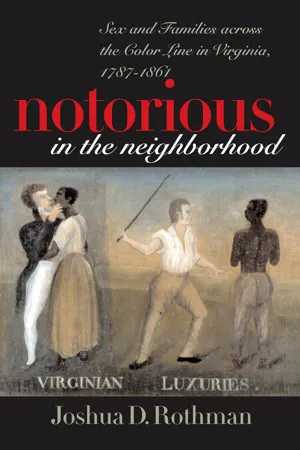
Laws and cultural norms militated against interracial sex in Virginia before the Civil War, and yet it was ubiquitous in cities, towns, and plantation communities throughout the state. In Notorious in the Neighborhood, Joshua Rothman examines the full spectrum of interracial sexual relationships under slavery — from Thomas Jefferson, Sally Hemings, and the intertwined interracial families of Monticello and Charlottesville to commercial sex in Richmond, the routinized sexual exploitation of enslaved women, and adultery across the color line. He explores the complex considerations of legal and judicial authorities who handled cases involving illicit sex and describes how the customary toleration of sex across the color line both supported and undermined racism and slavery in the early national and antebellum South.
White Virginians allowed for an astonishing degree of flexibility and fluidity within a seemingly rigid system of race and interracial relations, Rothman argues, and the relationship between law and custom regarding racial intermixture was always shifting. As a consequence, even as whites never questioned their own racial supremacy, the meaning and significance of racial boundaries, racial hierarchy, and ultimately of race itself always stood on unstable ground — a reality that whites understood and about which they demonstrated increasing anxiety as the nation’s sectional crisis intensified.
eBook - ePub
Notorious in the Neighborhood
Sex and Families across the Color Line in Virginia, 1787-1861
- 358 pages
- English
- ePUB (mobile friendly)
- Available on iOS & Android
eBook - ePub
Notorious in the Neighborhood
Sex and Families across the Color Line in Virginia, 1787-1861
About this book
Information
1 Thomas Jefferson, Sally Hemings, James Callender, and Sex across the Color Line under Slavery
The sexual relationship between Thomas Jefferson and Sally Hemings was not an isolated or even an unusual case in Virginia before the Civil War. Sexual contact between masters and slaves specifically and whites and blacks generally was commonplace in Virginia and in all slaveholding states. Because few professional historians have believed the Jefferson-Hemings story until recently or admitted publicly that they did, however, the relationship has never been thoroughly assessed in terms of its larger social context. James Callender, for example, was an angry, bitter, and cynical man who made a career out of invective and character assassination. He ruthlessly, viciously, and often crudely ravaged anyone unfortunate enough to be caught in his journalistic sights, and contemporaries and historians alike have found him an easy target for attacks on both his personal and professional practices. Consequently, amid their zeal to defend Jefferson, scholars typically have dismissed Callender’s reports as categorically unreliable. Instead of undertaking any serious effort to assess Callender’s claims and their origins, they have brushed them aside as the libelous rants of a scandal-mongering, drunken, and disgruntled office seeker. Historian John Chester Miller, for example, wrote that “Callender made his charges against Jefferson without fear and without research. . . . [H]e never made the slightest effort to verify the ‘facts’ he so stridently proclaimed. It was ‘journalism’ at its most reckless, wildly irresponsible, and scurrilous. Callender was not an investigative journalist; he never bothered to investigate anything.”1
Similarly, instead of reading Jefferson’s sexuality in the context of interracial sex in his place and time, historians have primarily written about the “Sage of Monticello” in this regard only in context of himself. Most notably, scholars have relied heavily on the “character defense” to refute the story of Jefferson’s relationship with Hemings. By this rationale, Jefferson was by turns too much a racist, too much a gentleman, too much a master of his own passions, or too devoted to his white family to have engaged in sexual intercourse with a female slave. Such a rhetorical posture has always consisted more of assertion than evidence, and scholars who convinced themselves that they “knew” Jefferson by extensively studying him have frequently and stubbornly discounted alternative readings of available historical evidence that conflicted with their position. Take, for example, the response of some of the most prominent Jefferson historians to Fawn Brodie’s brave if sometimes hypersentimental and overpsychologized presentation of evidence for the Jefferson-Hemings relationship in her 1974 biography, Thomas Jefferson: An Intimate History. Dumas Malone referred to Brodie’s work as a “mishmash of fact and fiction . . . not history as I understand the term,” and insisted that to him “the man she describes in her more titillating passages is unrecognizable.” Merrill Peterson, meanwhile, hardly deigned to admit that Brodie had evidence for her case at all, writing that he saw “no need to charge off in defense of Jefferson’s integrity when we have no solid grounds for doubting it.”2
To reach a more realistic understanding of Jefferson and Hemings’s relationship, it must be understood in terms of the larger patterns of master-slave sexual associations in Virginia. Such relationships ranged from acknowledged affairs that lasted for a lifetime, produced many children, and were familial in every sense but a legally recognized one to brutal acts of rape and sexual assault where slave owners showed the inhumanity for which slavery was notorious among its opponents. The available historical evidence on the relationship between Jefferson and Hemings indicates that it fell along, rather than at either end of, this spectrum. Their association was rooted in a complicated, evolving, and sometimes contradictory set of power relationships—a concatenation of calculation and trust, practicality and affection, coercion and consent. As the couple’s children together grew older, Jefferson neither embraced nor rejected his enslaved family. Instead, he adhered to the conventions of propriety those of his class and time were expected to follow.
James Callender’s publication of the Jefferson-Hemings connection and his motivations also deserve reassessment, for two reasons. First, Callender’s avowed campaign of hostility toward Jefferson illustrates perfectly why and when knowledge of sexual affairs across the color line went from being common knowledge in particular communities to public knowledge available to anyone. For much of the five years before Callender printed his allegations about Jefferson’s sexual life in the newspaper, the journalist championed Jefferson and believed in turn that the president supported his career. Only when their relationship soured did Callender look into rumors about Jefferson’s involvement with Sally Hemings, publishing them as a vindictive act of revenge for perceived wrongs. Callender used the partisan newspaper as his sword, but the thrust against Jefferson was purely personal. Second, on rereading Callender’s articles it becomes clear that his reportage was remarkably accurate and well researched, if purposefully sensationalistic. Even examining the few inaccuracies in Callender’s articles points to the extent of social knowledge about Jefferson and Hemings in Albemarle County and among the Virginia gentry long before anything about the couple appeared in the press. James Callender was a lot of things, but he was not usually a liar. When he ran the Jefferson-Hemings story in 1802, he believed it to be the most damaging information he had on the president, and he hoped it would ruin Jefferson’s political career. He knew Jefferson’s supporters would deny it, but he wanted to be certain they could not refute it, and he repeatedly dared them to do so. They never did.
In short, the relationship between Thomas Jefferson and Sally Hemings and how and why it became news must be historicized. To do so requires awareness not only of the particular parties involved but of the social and cultural environments in which the two made decisions about their sexual affairs. The Jefferson-Hemings story has remained in the minds of Americans for two hundred years, serving—as is often the case when Thomas Jefferson is involved—as a metaphor for contemporary attitudes toward race, slavery, the origins of the republic, and the nation’s “Founding Fathers.” Currently, the story fascinates because it encapsulates growing public awareness of a multiracial nation and a shared cultural heritage, significant factors under consideration in the popular effort to predict the sociological course of the next century. Surely something weighted with such meaning deserves more than stereotypes about forbidden love or monstrous exploitation.3
Sally Hemings was thirteen or fourteen years old when she boarded a ship with eight-year-old Mary (Maria) Jefferson in May 1787. Eventually arriving in Paris, the girls joined Thomas Jefferson and his eldest daughter Martha (Patsy). Jefferson, then serving as America’s minister to France, had sent for Mary after his youngest daughter, Lucy, died of whooping cough in Virginia. Hemings had been selected by Francis Eppes, Jefferson’s relative and Mary’s caretaker in her father’s absence, despite Jefferson’s request that an older slave accompany Mary, one who had already been exposed to smallpox.4 Hemings was inoculated and she stayed in France as Mary Jefferson’s personal attendant, but the European trip also served as the occasion of Hemings’s reunion with her older brother James, who was already living with Jefferson while training to be a chef. According to Madison Hemings’s recollection of his mother’s story, by the time Thomas Jefferson returned to Monticello in December 1789 with his daughters and the two Hemingses, Sally Hemings was already pregnant with her owner’s child.5
Sally Hemings did not have to return to Virginia with Jefferson at all. Slavery would not be formally abolished in French law until 1794, but consistently from at least the sixteenth century almost any slave brought into France by a French colonist or a foreign visitor could acquire his or her freedom by petitioning a French admiralty court. Hemings (and her brother, for that matter) would have had to procure a lawyer to represent her, but as historian Sue Peabody notes, there were numerous eighteenth-century French lawyers, especially in Paris, who either sought out freedom causes or took them on without pay. Between 1755 and 1790, every single slave, 154 in total, who brought a cause for freedom to the Admiralty Court of France eventually won his or her case. Sally Hemings could not simply assert her freedom and become free in France, but she surely could have gained emancipation with a small amount of effort.6
If she needed any incentive beyond freedom itself to convince her to remain in France, Hemings’s experiences abroad certainly provided it. She traveled, she began to learn a foreign language and seamstressing skills, she wore elegant clothing when accompanying Mary Jefferson in society, and sometimes she earned a monthly salary. During her twenty-six-month stay overseas, Sally Hemings received greater exposure to the possibilities of life as a free person than almost any plantation slave in Virginia would get in a lifetime.7 Hemings, in fact, seems to have seriously considered remaining in France. At first, she refused to go back to Monticello, but before leaving France she and Jefferson made an arrangement. As her son Madison recounted, in exchange for her return Jefferson offered Sally Hemings “extraordinary privileges, and made a solemn pledge that her children should be freed at the age of twenty-one years. In consequence of his promise, on which she implicitly relied, she returned with him to Virginia.”8
Thomas Jefferson wrote his Notes on the State of Virginia just a few years before he and Sally Hemings began having a sexual relationship. In the Notes, Jefferson expressed horror when considering the possibility of free African Americans and whites living together in the same nation, a theme he returned to repeatedly over the course of his adult life. Afraid simultaneously of blacks taking violent revenge for slavery and of white “blood” becoming somehow tainted by sexual intermixture with what he believed to be a significantly inferior race of people, Jefferson concluded that if slaves were to go free, blacks and whites would have to remain “as distinct as nature has formed them.” Jefferson professed to believe in the immorality of slavery and the need for emancipation but felt that ideally, freed slaves would be sent to their own separate country at some unspecified future date, “colonized to such place as the circumstances of the time should render most proper.”9 How Jefferson may have tried to reconcile his stated philosophy with his sexual practices is considered further below. First, however, it is necessary to examine how and why Jefferson even entered into an interracial sexual relationship and the conditions under which that relationship was designed to continue on returning to the United States.
In 1789 Jefferson was a widower, his wife Martha having died in 1782 after complications from childbirth. According to Edmund Bacon, Jefferson’s overseer between 1806 and 1822, the slaves present when Martha Jefferson died used to tell Bacon’s wife that Mrs. Jefferson said “she could not die happy” if she knew her children might someday have a stepmother. Thomas Jefferson took her hand and “promised her solemnly that he would never marry again.”10 Israel Jefferson, who had been enslaved at Monticello, confirmed in his 1873 recollection that “it was a general statement among the older servants at Monticello, that Mr. Jefferson promised his wife, on her death bed, that he would not again marry.”11 Jefferson never did remarry, but seven years after his wife’s death he was still only forty-six years old. He must have begun to consider the possibility that he would want to have sexual relations again. It was not uncommon for bachelor and widowed Virginia slave owners in particular to have sexual relationships with female slaves. Though surely he knew of other comparable cases, Jefferson needed only to look to his father-in-law John Wayles for an example. The thrice-widowed Wayles was, after all, also Sally Hemings’s father, having been sexually involved for at least a dozen years with Betty Hemings, one of his own slaves, until his death in 1773.12 As an enslaved woman whom he knew would be impossible to marry, who was said to be beautiful, and who may have resembled Jefferson’s deceased wife given that she was her half sister, Sally Hemings was a perfect match for Jefferson’s needs.13
The reality that the Jefferson-Hemings relationship was in part rooted in sexual gratification calls for a discussion of the possibility that Sally Hemings was coerced into her relationship with Jefferson. In the early national and antebellum South, many if not most incidents of interracial sexual intercourse can only be described as rapes. Perpetrators of these abuses expressed power and contempt rather than sexuality or affection, and a perusal of both contemporary and twentieth-century slave narratives amply demonstrates that enslaved women lived in a state of constant anxiety that they could be victimized by the sexual predations of white men.14 Southern state laws dictating that children of African Americans followed the servile status of their mothers, an economic system encouraging profiteering from bartering in human property, gendered double standards demanding the protection of white female chastity even while winking at male sexual conquest, and racial stereotypes pointing to black female sexual salacity all helped produce an environment in which white men could violate slave women and suffer few if any consequences. White anxieties and insecurities about maintaining absolute domination over their slave population coexisted with these economic, legal, and cultural factors, making sexual violence as basic and integral a tool of the American slave regime as the whip, one productive of both physical damage and psychological devastation.15
No evidence exists to indicate that Thomas Jefferson ever physically forced himself on Sally Hemings. That the couple continued to have sexual relations over at least an eighteen-year span (Hemings gave birth to her last child in 1808) after coming back to the United States discourages such a suggestion, but even if their relationship was not founded on sexual assault, that hardly discounts the possibility that Jefferson coerced Hemings in other ways. When Jefferson and Hemings negotiated her return from France, complicated considerations were at play, all of which point to the reality that when it came to sexual relationships between masters and slaves, even if rape in its conventional understanding was not an issue, the line between coercion and consent could often be a blurry one.
Sally Hemings had some leverage when she and Jefferson discussed the terms under which she would return to Monticello. Because Hemings could have likely freed herself in France she knew that even without any sexual entanglements, Jefferson had to make her some sort of offer if he wanted her back in Virginia. That the couple had—or even if they had not yet but wished to—become sexually involved only enhanced Hemings’s negotiating power. It meant that if Jefferson wanted to continue their affair after leaving France, he wanted Hemings to return with him for much more than performing the usual domestic tasks of a slave. At what point Jefferson and Hemings established the terms of their relationship is unknown. If their discussion postdated the discovery of Hemings’s pregnancy, then she also carried Jefferson’s child who, depending on his ideas about the couple’s future, would be seen by Jefferson as either a familial or a financial addition, or both. Whatever the case, Sally Hemings was in the unusual position of being an enslaved woman with some legally supportable claim to ownership of her ...
Table of contents
- Cover Page
- Notorious in the Neighborhood
- Copyright Page
- Dedication
- Contents
- Illustrations
- Acknowledgments
- Introduction
- 1 Thomas Jefferson, Sally Hemings, James Callender, and Sex across the Color Line under Slavery
- 2 Notorious in the Neighborhood
- 3 The Church and the Brothel Are Only Separated by a Pane of Glass
- 4 The Strongest Passion That Can Possibly Aggitate the Human Mind
- 5 To Be Freed from Thate Curs and Let at Liberty
- 6 Let There Be but Two Races among Us
- Epilogue
- Notes
- Bibliography
- Index
Trusted by 375,005 students
Access to over 1.5 million titles for a fair monthly price.
Study more efficiently using our study tools.
Frequently asked questions
Yes, you can cancel anytime from the Subscription tab in your account settings on the Perlego website. Your subscription will stay active until the end of your current billing period. Learn how to cancel your subscription
No, books cannot be downloaded as external files, such as PDFs, for use outside of Perlego. However, you can download books within the Perlego app for offline reading on mobile or tablet. Learn how to download books offline
Perlego offers two plans: Essential and Complete
- Essential is ideal for learners and professionals who enjoy exploring a wide range of subjects. Access the Essential Library with 800,000+ trusted titles and best-sellers across business, personal growth, and the humanities. Includes unlimited reading time and Standard Read Aloud voice.
- Complete: Perfect for advanced learners and researchers needing full, unrestricted access. Unlock 1.5M+ books across hundreds of subjects, including academic and specialized titles. The Complete Plan also includes advanced features like Premium Read Aloud and Research Assistant.
We are an online textbook subscription service, where you can get access to an entire online library for less than the price of a single book per month. With over 1.5 million books across 990+ topics, we’ve got you covered! Learn about our mission
Look out for the read-aloud symbol on your next book to see if you can listen to it. The read-aloud tool reads text aloud for you, highlighting the text as it is being read. You can pause it, speed it up and slow it down. Learn more about Read Aloud
Yes! You can use the Perlego app on both iOS and Android devices to read anytime, anywhere — even offline. Perfect for commutes or when you’re on the go.
Please note we cannot support devices running on iOS 13 and Android 7 or earlier. Learn more about using the app
Please note we cannot support devices running on iOS 13 and Android 7 or earlier. Learn more about using the app
Yes, you can access Notorious in the Neighborhood by Joshua D. Rothman in PDF and/or ePUB format, as well as other popular books in History & North American History. We have over 1.5 million books available in our catalogue for you to explore.