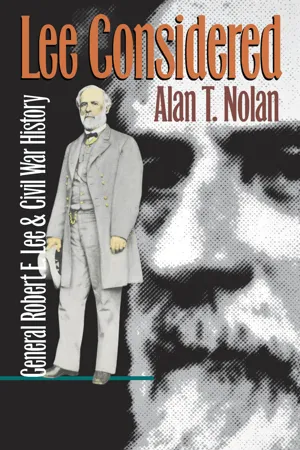
Of all the heroes produced by the Civil War, Robert E. Lee is the most revered and perhaps the most misunderstood. Lee is widely portrayed as an ardent antisecessionist who left the United States Army only because he would not draw his sword against his native Virginia, a Southern aristocrat who opposed slavery, and a brilliant military leader whose exploits sustained the Confederate cause.
Alan Nolan explodes these and other assumptions about Lee and the war through a rigorous reexamination of familiar and long-available historical sources, including Lee’s personal and official correspondence and the large body of writings about Lee. Looking at this evidence in a critical way, Nolan concludes that there is little truth to the dogmas traditionally set forth about Lee and the war.
- 243 pages
- English
- ePUB (mobile friendly)
- Available on iOS & Android
eBook - ePub
About this book
Information
Chapter One
The Mythic Lee
The American Civil War, Walt Whitman’s “strange sad war,” is the most profoundly tragic experience of American history. Another poet, Robert Penn Warren, has gone as far as to say, “The Civil War is, for the American imagination, the great single event of our history. Without too much wrenching, it may, in fact, be said to be American history.”1 As a consequence, it is often difficult for Americans to think about the war with objectivity or detachment. Instead, it is defined in our consciousness by the clichés with which historians and the purveyors of popular culture have surrounded it: the troublesome abolitionists, the brothers’ war, Scarlett and Tara, the faithful slave, the forlorn Confederate soldier, the brooding Lincoln, High Tide at Gettysburg, the bloody Grant, the Lost Cause, and the peerless Robert E. Lee. These images, each laden with emotion, are in our bones. Surely it is time for us to stand back, however, and look at the war free of these clichés and the traditions of the Blue and the Gray. We should at last be in a position to do so.
In 1909 Woodrow Wilson wrote, “The Civil War is something which we cannot even yet uncover in memory without stirring embers which may spring into a blaze.”2 Today, more than eighty years later, Wilson’s statement is not entirely inapplicable. But despite the genuinely long shadow of the Civil War and despite Wilson’s warning, things have in fact changed in the United States. Three changes in particular should permit a new consideration of the war.
In the first place, the event is now remote in time. Today’s Americans are not the children or even the grandchildren of the participants; the inhabitants of the North and the South can forgive each other and forgive themselves for the war and its preliminaries and aftermath. Second, because of the passage of time and because of the explosion in communications and transportation, people North and South are well through the period of “binding up the nation’s wounds.” We now share a national culture, and there is no longer a social need to perpetuate the clichés. Third, racial attitudes – as one might expect in light of the role of slavery in the war – underlie many of the clichés; and although very far from ideal, racial attitudes have changed markedly in recent decades.
In his presidential address to the American Historical Association, Samuel Eliot Morison spoke to the question of the function of history and the role of the historian:
For almost 2500 years, in the Hebraic-Hellenic-Christian civilization that we inherit, truth has been recognized as the essence of history. . . . The fundamental question is: “What actually happened, and why?” . . . After his main object of describing events “simply as they happened,” [the historian’s] principal task is to understand the motives and objects of individuals and groups . . . and to point out mistakes as well as achievements by persons and movements. (Emphasis in original.)3
We may, at last, be able to carry out these obligations in regard to the Civil War.
One of the central figures of the war was Gen. Robert E. Lee. Indeed, in our collective consciousness he looms almost as the figure of the war, rivaled only by Abraham Lincoln. There is little need to belabor the fact of Lee’s heroic, almost superhuman, national stature, which has steadily enlarged since the war years. Writing in 1868, Fanny Dowling described Lee as “bathed in the white light which falls directly upon him from the smile of an approving and sustaining God.”4 The image is, of course, that of a saint. William Garrett Piston remarks accurately that during the 1870s Southern publicists “set Robert E. Lee on the road to sainthood.”5 By 1880 this process had advanced considerably. John W. Daniels of Gen. Jubal A. Early’s staff could write, “The Divinity in his bosom shone translucent through the man, and his spirit rose up to the Godlike.”6
The apotheosis of Lee is not confined to the generation that immediately followed the war. Speaking in 1909, Woodrow Wilson said that Lee was “unapproachable in the history of our country.” In 1914 Douglas Southall Freeman told us that “noble he was; nobler he became.”7 In 1964 Clifford Dowdey titled a chapter in his study of the Seven Days “The Early Work of a Master.” Writing in 1965 about the same campaign, Dowdey told of Lee’s emergence as “a people’s god.”8 According to Piston, for “Dowdey the Civil War was a passion play, with Lee as Christ.”9 Thomas L. Connelly summed up the situation when in 1977 he wrote that Lee “became a God figure for Virginians, a saint for the white Protestant South, and a hero for the nation . . . who represented all that was good and noble.”10 Other books have dealt with the development of the Lee tradition: Connelly’s The Marble Man, Piston’s Lee’s Tarnished Lieutenant, and Gaines M. Foster’s 1987 study Ghosts of the Confederacy all trace its evolution. This book examines the tradition. It asks whether the tradition is historical.
Born in 1807, a Virginia aristocrat of the plantation society, Lee graduated with great distinction from the United States Military Academy in 1829. He married Mary Custis, the daughter of Martha Washington’s grandson, George Washington Parke Custis, who was also George Washington’s adopted son. The marriage produced four daughters – Agnes, Annie, Mary, and Mildred – and three sons – George Washington Custis Lee, Robert Edward Lee, Jr., and William Henry Fitzhugh (“Rooney”) Lee, all of whom were to serve in the Confederate army. General Lee’s continuous and distinguished service in the United States Army included action in the Mexican War and the superintendency at West Point from September 1, 1852, to March 31, 1855. He was considered the protégé of Gen. Winfield Scott, the country’s most distinguished soldier and general-in-chief of the United States Army at the outbreak of the Civil War. These facts are well known. Indeed, because so much has been written about Lee, it is tempting to believe that nothing more need be said for we already know all about him.
To be sure, professional historians and other writers have not neglected Lee. In 1950 Marshall W. Fishwick, professor of history at Washington and Lee University, wrote what was essentially a critical bibliographic essay on writings about Lee. Published in the Virginia Magazine of History and Biography under the telltale title “Virginians on Olympus II, Robert E. Lee: Savior of the Lost Cause,” the article discussed the literature prior to 1950. Since Fishwick’s catalog, additional biographical materials have appeared regularly, including eight major works: Gray Fox by Burke Davis (1956); Lee after the War by Fishwick (1963); Lee by Clifford Dowdey (1965); Robert E. Lee, a two-volume work, by Margaret Sanborn (1966 and 1967); Lee – The Last Years by Charles Bracelen Flood (1981); Lee and Grant by Gene Smith (1984); Robert E. Lee by Manfred Weidhorn (1988); and The Generals by Nancy Scott Anderson and Dwight Anderson (1988).11
Despite all the attention devoted to him, Lee remains a sort of historical anomaly, a major figure of history who has somehow been immune from the analyses and evaluations that are the conventional techniques of history. This immunity has two aspects. In the first place, almost all of those who have written about Lee have accepted him entirely on his own terms; whatever he has said about events or about himself, his actions and his reasons, is taken as fact. Thus Freeman tells us there was no need “to attempt an ‘interpretation’ of a man who was his own clear interpreter.”12 In the second place, Lee’s biographers do not ask some of the conventional historians’ questions about the man: were his actions rational? was he wise? what was the ethical import of his conduct? In most of the writing about Lee, there is nothing to suggest that these questions are even appropriate.
Both in being accepted on his own terms and in not being subjected to conventional historical questions Lee is unique. No other actor in the drama of Western history has enjoyed such immunity: from Caesar to Napoleon to Roosevelt, they have been questioned far more closely and judged far more strictly than Lee. In the case of Lee, history’s inquiry is unaccountably curtailed. If he said something was so, it is accepted as so. Analysis of his activities stops with a determination that he did what he thought was right. Having established this motivation, ordinarily because Lee himself said it was his motivation, history stands mute.
As a consequence of Lee’s immunity, there exists an orthodoxy, a dogmatism, in the writing about him. The dogmas pertain not only to the general himself. They also extend to the context of his life and to the causes, conduct, and consequences of the Civil War. Finally, they define the character of Lee’s contemporaries and adversaries. Lee’s biographers begin and end their accounts on the basis of a set of uniform premises, either express or implied. These premises are neither examined nor proved; they are presupposed. The result is that, although the writers tend to outdo each other in describing Lee’s virtuous qualities and heroic actions, the same Lee story is told again and again. Further, with each retelling, the stated and unstated premises of that story become more deeply embedded in what purports to be the history of the Civil War.
The paradigm of the historical treatment of Lee and his times is the monumental and highly influential biography written by Douglas Southall Freeman of Virginia and published in four volumes during the 1930s. All biographies since have relied on and are plainly marked by Freeman’s. Marvelously researched, the work is a wholly adulatory account of Lee’s life. After setting forth every favorable fact and appealing story that could be reported and rationalizing any act that might be questioned, Freeman states this conclusion: “Robert E. Lee was one of the small company of great men in whom there is no inconsistency to be explained, no enigma to be solved. What he seemed, he was – a wholly human gentleman, the essential elements of whose positive character were two and only two, simplicity and spirituality.” Freeman also says that everything related to Lee as a person “is easily understood.”13 Presumably relying on Freeman, The Oxford Companion to American History contains a statement that perfectly reveals the extent of Lee’s historical immunity: he was “a great and simple person. His character offers historians no moral flaws to probe. Whichever choice of allegiance Lee made would have been right.”14 In other words, what he stated as a fact is a fact and there is no need to question his acts according to conventional historical criteria; whatever he did was bound to be right. This is typical of most of the writing about Lee.
People do not, as a general rule, like for their heroes or historical theories to be reexamined. In a different context, Herbert Butterfield chided the Whig historians for “still patching the new research into the old story.” We are all more comfortable with the “old story.” It should, therefore, be said at the outset that to examine the actions and motives of General Lee with a critical eye is to understand him rather than to diminish him. The purpose of this book is to analyze certain aspects of the Lee of tradition, to consider whether the mythic Lee is the real Lee, and to evaluate Lee and the events of his life in a larger philosophical context. This is surely appropriate. The historical process is not, after all, a neutral process. It does not permit the leader unilaterally to define the issues of his life. Nor does it simply accept the leader’s answers to those issues.
Stephen Vincent Benét was correct when he called Lee “a riddle unread.” To state this point more literally, Lee is a riddle because he has not been “read” in the same way that other historical figures have been. This book purports to read him in just that way with regard to certain major aspects of his life. It examines the mythic Lee in a conventional historical way. There is no dearth of materials to read. Lee wrote extensively about his thoughts and actions, and his writings have been mined by others many times. The period of the Civil War is well documented in primary sources. Applying the conventional techniques of the historian, free of the restrictions of the traditional Lee doctrine, what do these materials really tell us?
The conviction that underlies this study is that, because of the prevalence and strength of the Lee tradition, Lee has not in fact been considered. This book is not, therefore, a re-consideration. Its object is to look behind the dogmas to consider Lee in the light of the historical record. The reader may judge whether there is “no inconsistency to be explained, no enigma to be solved” and whether Lee is “easily understood.”
Chapter Two
Lee and the Peculiar Institution
“Lee had no sympathy . . . for . . . slavery,” according to The Oxford Companion to American History. The Illustrated Encyclopedia of the Civil War, published in 1986, states that he was “personally opposed to slavery.”1 The 1989 edition of the Encyclopaedia Britannica identifies him as “a disbeliever in slavery,” and the authors of a 1988 book, The Generals, report that one of the reasons why Mary Custis consented to marry Lee was because he shared “her anti-slavery sentiments.” According to the same authors, prior to the war Lee “had supported for thirty years the liberation of black men and women,” an assertion they support only by citing Lee’s 1856 letter to this wife, which will be discussed later in this chapter.2
On February 17, 1866, General Lee appeared before a subcommittee of the Joint Congressional Committee on Reconstruction inquiring into “the condition of the states which formed the so-called Confederate States of America” so as to make recommendations to Congress regarding Reconstruction. Having been sworn, he testified at length. Along the way he stated: “I have always been in favor of emancipation – gradual emancipation.” Douglas Southall Freeman, echoing Lee’s statement, avows that Lee “had believed steadfastly in gradual emancipation.”3
The tradition that Lee was opposed to slavery is a principal strand in the image of Lee as a tragic hero, fighting for the South in a war that was all about the abolition or the survival of slavery. Clearly, Americans would want a national h...
Table of contents
- Cover Page
- Lee Considered: General Robert E. Lee and Civil War History
- Copyright Page
- Dedication
- Contents
- Preface
- Chapter One The Mythic Lee
- Chapter Two Lee and the Peculiar Institution
- Chapter Three Lee Secedes
- Chapter Four General Lee
- Chapter Five Those People – The Magnanimous Adversary
- Chapter Six The Price of Honor
- Chapter Sevan Lee after the War
- Chapter Eight The Lee Tradition and Civil War History
- Appendix A Lee’s Letter of January 11, 1865, Concerning the Institution of Slavery
- Appendix B Lee’s Letter of February 25, 1868, Concerning His Resignation and the Virginia Commission
- Appendix C An Army Commander’s Authority to Surrender
- Notes
- Bibliography of Works Cited
- Index
Trusted by 375,005 students
Access to over 1.5 million titles for a fair monthly price.
Study more efficiently using our study tools.
Frequently asked questions
Yes, you can cancel anytime from the Subscription tab in your account settings on the Perlego website. Your subscription will stay active until the end of your current billing period. Learn how to cancel your subscription
No, books cannot be downloaded as external files, such as PDFs, for use outside of Perlego. However, you can download books within the Perlego app for offline reading on mobile or tablet. Learn how to download books offline
Perlego offers two plans: Essential and Complete
- Essential is ideal for learners and professionals who enjoy exploring a wide range of subjects. Access the Essential Library with 800,000+ trusted titles and best-sellers across business, personal growth, and the humanities. Includes unlimited reading time and Standard Read Aloud voice.
- Complete: Perfect for advanced learners and researchers needing full, unrestricted access. Unlock 1.5M+ books across hundreds of subjects, including academic and specialized titles. The Complete Plan also includes advanced features like Premium Read Aloud and Research Assistant.
We are an online textbook subscription service, where you can get access to an entire online library for less than the price of a single book per month. With over 1.5 million books across 990+ topics, we’ve got you covered! Learn about our mission
Look out for the read-aloud symbol on your next book to see if you can listen to it. The read-aloud tool reads text aloud for you, highlighting the text as it is being read. You can pause it, speed it up and slow it down. Learn more about Read Aloud
Yes! You can use the Perlego app on both iOS and Android devices to read anytime, anywhere — even offline. Perfect for commutes or when you’re on the go.
Please note we cannot support devices running on iOS 13 and Android 7 or earlier. Learn more about using the app
Please note we cannot support devices running on iOS 13 and Android 7 or earlier. Learn more about using the app
Yes, you can access Lee Considered by Alan T. Nolan in PDF and/or ePUB format, as well as other popular books in History & Military Biographies. We have over 1.5 million books available in our catalogue for you to explore.