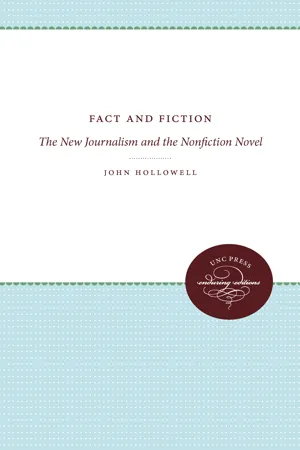
Journalists and novelists responded to the pervasive social changes of the 1960s in America with a variety of experiments in nonfiction. Those who have praised the vitality of the new journalism have seen it as a fusion of the journalist’s passion for detail and the novelist’s moral vision. Hollowell presents a critically sharp portrait of what the new journalists and novelists are doing and why. The author concludes that future writing will further obscure the difference between fact and fiction.
Originally published in 1977.
A UNC Press Enduring Edition — UNC Press Enduring Editions use the latest in digital technology to make available again books from our distinguished backlist that were previously out of print. These editions are published unaltered from the original, and are presented in affordable paperback formats, bringing readers both historical and cultural value.
- 204 pages
- English
- ePUB (mobile friendly)
- Available on iOS & Android
eBook - ePub
About this book
Information
1
NOVELISTS AND THE NOVEL IN A TIME OF CRISIS
There is no more fiction or nonfiction—only narrative. -E. L. DOCTOROW, in an acceptance speech for the best novel of 1975, awarded by the National Book Critics Circle
THE DOMINANT MOOD of America in the 1960s was apocalyptic. Perpetual crisis seemed in many ways the rule. Throughout the decade the events reported daily by newspapers and magazines documented the sweeping changes in every sector of our national life and often strained our imaginations to the point of disbelief. Increasingly, everyday “reality” became more fantastic than the fictional visions of even our best novelists. When a twisted assassin fired upon the presidential motorcade in Dallas in November of 1963, events that seemed before beyond our wildest fantasies became a part of everyday reality.
A killer in a tower shot randomly into a crowd and slaughtered a dozen people. In New York a young woman was stabbed to death in full view of thirty-eight witnesses who did nothing. As American involvement in Vietnam heightened, young people on college campuses banded together in radical and often violent demonstrations against the government. When the gains of the nonviolent Civil Rights movement did not end poverty and racial discrimination, angry black people burned and looted the urban ghettos that confined them. Perhaps more than at other times in American history, public events were bewildering, chaotic, almost random, and without meaning.
Even more important were changes in life-style and in the values and attitudes of Americans that appeared fundamental and comprehensive. The drug culture. The sexual revolution. The age of Aquarius. Such phrases became the watchwords to describe basic changes affecting every area of our national life. Young people and minority groups sought radical solutions to their problems and rejected, at least in part, the American dream of material success. Turning their backs on wealth and work they found meaningless, college students were attracted to communal living, Eastern religions, and consciousness-altering drugs. By the mid-sixties, political groups of every stripe had developed as individuals sought alternative solutions to the problems that beset society. Brightly colored clothing and long hair reflected a new freedom in personal style from the conservatism of the past. Whatever these pervasive changes in the social fabric of America might augur for the future, it was apparent that comprehensive changes in our consciousness and in the patterns of our national life were occurring. And like many of the rest of us, American novelists were confused.
I
Although the social ferment of the sixties revived old dilemmas and imposed special demands on writers of fiction, it also generated new possibilities. Many of the popular books of the last decade reflect an increased concern for social issues and an awareness of the individual’s relationship to an explosive social history. Brooding about the sweeping changes in social values, mores, and life-styles, some of our best novelists complained about the difficulty of writing fiction at all in a period in which daily events seemed to preempt the possibilities of the novelist’s imagination. Many novelists, in fact, temporarily turned away from the creation of fiction toward forms of social commentary, documentary, and a vigorous kind of reportage. The American novelist’s preoccupation with the rush and frenzy of events in the sixties diverted the impulse for fiction into the special kind of journalism that is the subject of this book.
One significant direction the new writing took was toward documentary forms, eyewitness reports, and personal and confessional narratives. The work of certain novelists, as well as that of certain journalists, reflects an unusual degree of self-consciousness about the writer’s role in society and the unique character of American life. Many novelists confronted directly in their works the problem of writing fiction in such an era, since literature, like the American experiment of democracy itself, seemed to rest on such a precarious foundation. If anarchy reigned, the argument might have gone, then written literature itself was threatened with disruption or extinction.
While such fears now seem highly exaggerated, the social pressures on novelists and the novel form were to many observers unprecedented. Perhaps it is a common tendency of a nation to find its historical situation unique and unparalleled, and during the sixties this apocalyptic fervor pervades much of our best writing. The familiar arguments about “the death of the novel” were revived with a new kind of validity. The most frequently cited difficulty for writers of fiction was that of defining just what “social reality” was. Everyday events continually blurred the comfortable distinctions between reality and unreality, between fantasy and fact. In a society so fluid and so elusive, the creation of social realism seemed continually to be upstaged by current events. Philip Roth expressed the frustration of many novelists of his generation in a 1961 article:
The American writer in the middle of the 20th century has his hands full in trying to understand, then describe, and then make credible much of the American reality. It stupefies, it sickens, it infuriates, and finally it is even a kind of embarrassment to one’s own meager imagination. The actuality is continually outdoing our talents, and the culture tosses up figures almost daily that are the envy of any novelist.1
Roth’s complaint about the competition of fiction with the events broadcast daily by the news media reverberated in public statements by other novelists, and was often reflected in fiction itself. In “The Man Who Studied Yoga,” an ambitious prologue to a projected eight-part novel, Norman Mailer’s protagonist Sam Slovoda is himself a frustrated writer. In an early sequence of the story, the narrator reports Sam’s difficulty in writing realistically: “Marvin asks Sam if he has given up on his novel, and Sam says, Temporarily.’ He cannot find a form, he explains. He does not want to write a realistic novel, because reality is no longer realistic.”2 This perceived unreality of contemporary life and the problems it poses for the novelist is, of course, nothing new in American literature. Even our earliest novelists—Cooper, Hawthorne, and to an extent, Melville— complained that American society did not offer the depth and stability of cultural materials to sustain a national literature. In a 1966 paper Norman Mailer succinctly summarized this viewpoint:
[American social realism] was a literature which grappled with a peculiarly American phenomenon—a tendency of American society to alter more rapidly than the ability of its artists to record that change. .. . The American phenomenon had to do with the very rate of acceleration. It was as if everything changed ten times as fast in America, and this made for extraordinary difficulty in creating a literature.3
Since the beginnings of the novel in the eighteenth century, of course, it has periodically become fashionable for critics to speak of the form’s imminent death. In a 1923 essay T. S. Eliot declared that the novel had ended with Flaubert and with James. At about the same time, Spanish critic Ortega y Gasset formulated a particularly influential argument in “Notes on the Novel.”4 Ortega pointed to what he called the increasing dehumanization of art in industrialized society, and went on to proclaim that the novel was dying since it had been cut off from the middle-class roots that had originally fostered its development. In metaphors comparing the source of fiction to a mine of ore, Ortega suggested that the plots and techniques available to novelists would soon become exhausted. Although contemporary critic Louis Rubin, Jr., vehemently disagrees with the conclusion that the novel is dying, he has nonetheless ironically summarized the argument: “The novel was a nineteenth-century phenomenon which depended for its life on the breakdown of the traditional class structure, and now that the class structure is permanently fluid, . . . there is no place for the novel.”5
Since about the mid-fifties, the arguments of Eliot and Ortega have been endorsed in varying degrees by influential modern critics. Some have found the suggestion of the novel’s death to be exaggerated, but have nonetheless agreed that certain possibilities for fictional realism and certain possibilities of language are reaching exhaustion. In a provocative collection of essays entitled Waiting for the End (1964), Leslie Fiedler declares that if the novel dies two root causes will be paramount: “First because the artistic faith that sustained its writers is dead, and second because the audience-need it was invented to satisfy is being better satisfied otherwise.”6
A 1967 article by John Barth called “The Literature of Exhaustion” is indicative of what Fiedler terms the writer’s lack of faith. Barth argues persuasively that what is significant is not whether the novel is dead, but why so many writers feel as if it were:
Literary forms certainly have histories and historical contingencies, and it may well be that the novel’s time as an art form is up, as the “times” of classical tragedy, grand opera, or the sonnet sequence came to be. No necessary cause for alarm in this at all, except perhaps to certain novelists, and one way to handle such a feeling might be to write a novel about it. Whether historically the novel expires or persists seems immaterial to me: if enough writers and critics feel apocalyptic about it, their feeling becomes a considerable cultural fact, like the feeling that Western civilization, or the world, is going to end rather soon.7
In terms of the audience need traditionally fulfilled by the novel, Fiedler means that movies and television have supplanted the novel’s cognitive function as “news” or “the portrait of provincial life.” Marshall McLuhan’s series of prophetic books have reinforced this viewpoint in even more emphatic terms. In The Gutenberg Galaxy (1962) and Understanding Media (1964), McLuhan speculates that Western man, who was traditionally visually oriented and bound to print media, has switched his “sensory balance” from the eye to the ear. Now Western man, according to McLuhan, is attuned to the drumbeat of television and film and is unconsciously bound to a new worldwide unity—“the global village.” Despite the fact that McLuhan’s speculations are not founded upon empirical research, his conclusions provided new ammunition to those who argued that the traditional audience for fiction was turning elsewhere. More than that, McLuhan’s theories undermined further the novelist’s artistic faith in himself and his medium.
What began as the American novelist’s plaintive cry about the pressures on the writing of fiction has, in recent years, been increasingly endorsed by literary critics and social historians. One unmistakable trend to emerge from the writing of the fifties and sixties has been the growing popularity and significance of nonfiction. This, too, has diverted the writer’s impulse away from fiction. In an influential review of sociologist David Riesman’s The Lonely Crowd, Lionel Trilling praised the book’s literary quality and suggested that the novel’s traditional function of examining morals and manners was being better served by the social sciences. Similarly, Commentary editor Norman Podhoretz argued in 1958 that the most interesting writing done in the fifties was not fiction, but the frequently confessional and autobiographical essays to be found between magazine covers.8 Podhoretz singled out for praise the “discursive prose” of such writers as Isaac Rosenfeld and James Baldwin. The magazine article, Podhoretz predicted, would become the prevailing art form in America. Novelists who must compete with the electronic media for fame and dollars, would become too impatient to suffer the long incubation periods required by fiction. They would opt instead, said Podhoretz, for the success and immediate fame afforded them by magazine journalism.
The celebration of the rise of nonfiction in recent years led quite naturally to a fierce critical backlash. In a 1965 article entitled “Who’s Killing the Novel?,” Robert Brustein charged that critics like Podhoretz were actually hastening the decline of the novel by making it increasingly difficult for the young writers who might revitalize fiction to publish their work. Even worse, the preference for nonfiction over fiction constituted the subversion of the public taste. Yahoos like Podhoretz who consciously promoted “the article as art,” Brustein concluded, would usher in an era of philistinism.9
Somewhere between such celebration and such contempt for the increasing popularity of nonfiction lies a less hysterical middle ground. Clearly, the novel did not die in the mid-sixties; too many well-written novels dispute this claim. Yet the demands placed upon novelists, both in terms of audience need and the importance of alternative media, were real and felt pressures. And it was clear that at least certain conventions of social realism, as well as certain possibilities of language and technique, were less well suited to the radically different character of the American reality.
The growing popularity of nonfiction in recent decades is apparent from even the most cursory review of magazine trends. Until about the forties, in fact, magazines printed about one-third non-fiction and two-thirds fiction. By the mid-sixties, however, this proportion had nearly reversed itself.10 Similarly, a perusal of bestseller lists for the last decade reveals a concomitant rise in memoirs, confessions, autobiographies, and a host of “how-to” books by psychologists, doctors, and others. Even contemporary poetry shows a similar tendency toward autobiographical and confessional themes. Although these trends do not foreshadow the death of fiction, the increasing proportion of nonfiction reflects a new confrontation with public statements and social issues.
Certain shared assumptions that have previously bound novelists together do appear to be on the decline. Novelists writing today, for example, seem less willing to make assumptions about what “reality” is. The familiar technique of authorial omniscience has declined in recent novels, perhaps implying a reluctance to affirm the Godlike knowledge that the technique implies. The contradictory impulses to be found in recent fiction make critical affirmations about the values and techniques it embodies practically impossible. Yet Marcus Klein’s introductory statement in The American Novel since World War II is illustrative of the antithetical directions in recent fiction:
In the years since the end of World War II the novel in America has been: nihilistic, existential, apocalyptic, psychological; it has withdrawn from social considerations; it has been radical and conservative. In form it has been loosely picaresque, it has returned to its beginnings in myth, it has been contrived with a cunningness of technique virtually decadent, it has been purely self-reflexive and respondent to its own development. And the novel has died.11
In an important way, the lack of a clear direction in postwar fiction reflects a period of transition and experimentation in a variety of narrative forms. Certain conventions and techniques of traditional realism have declined, but this does not imply the imminent demise of fiction. Rather we have entered a period of widespread literary experimentation in which a variety of forms coexist side by side.
2
The ferment of social change of the last decades, and the exhaustion of certain forms of fiction that have dominated the novel since World War II, have created new opportunities for writers. One of the most interesting responses has been the creation of hybrid ...
Table of contents
- Cover Page
- Title Page
- Copyright Page
- Dedication Page
- Contents
- Preface
- Acknowledgments
- 1. Novelists and the Novel in A Time of Crisis
- 2. The Development of A “New” Journalism
- 3. Promotion and Publicity: The Reporter as Star
- 4. Truman Capote’s “Nonfiction Novel”
- 5. Mailer’S Vision: “History as A Novel, the Novel as History”
- 6. Life in Edge City: Wolfe’S New Journalism
- 7. Postscript
- Notes
- Bibliography
- Index
Trusted by 375,005 students
Access to over 1.5 million titles for a fair monthly price.
Study more efficiently using our study tools.
Frequently asked questions
Yes, you can cancel anytime from the Subscription tab in your account settings on the Perlego website. Your subscription will stay active until the end of your current billing period. Learn how to cancel your subscription
No, books cannot be downloaded as external files, such as PDFs, for use outside of Perlego. However, you can download books within the Perlego app for offline reading on mobile or tablet. Learn how to download books offline
We are an online textbook subscription service, where you can get access to an entire online library for less than the price of a single book per month. With over 1.5 million books across 990+ topics, we’ve got you covered! Learn about our mission
Look out for the read-aloud symbol on your next book to see if you can listen to it. The read-aloud tool reads text aloud for you, highlighting the text as it is being read. You can pause it, speed it up and slow it down. Learn more about Read Aloud
Yes! You can use the Perlego app on both iOS and Android devices to read anytime, anywhere — even offline. Perfect for commutes or when you’re on the go.
Please note we cannot support devices running on iOS 13 and Android 7 or earlier. Learn more about using the app
Please note we cannot support devices running on iOS 13 and Android 7 or earlier. Learn more about using the app
Yes, you can access Fact and Fiction by John Hollowell in PDF and/or ePUB format, as well as other popular books in Languages & Linguistics & Journalism. We have over 1.5 million books available in our catalogue for you to explore.