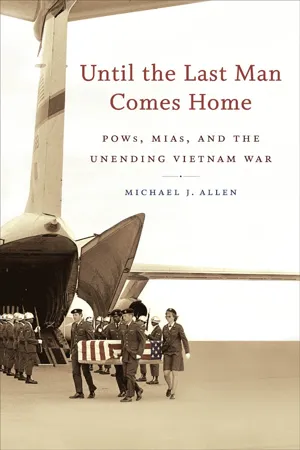
Fewer Americans were captured or missing during the Vietnam War than in any previous major military conflict in U.S. history. Yet despite their small numbers, American POWs inspired an outpouring of concern that slowly eroded support for the war. Michael J. Allen reveals how wartime loss transformed U.S. politics well before, and long after, the war’s official end.
Throughout the war’s last years and in the decades since, Allen argues, the effort to recover lost warriors was as much a means to establish responsibility for their loss as it was a search for answers about their fate. Though millions of Americans and Vietnamese took part in that effort, POW and MIA families and activists dominated it. Insisting that the war was not over “until the last man comes home,” this small, determined group turned the unprecedented accounting effort against those they blamed for their suffering. Allen demonstrates that POW/MIA activism prolonged the hostility between the United States and Vietnam even as the search for the missing became the basis for closer ties between the two countries in the 1990s. Equally important, he explains, POW/MIA families' disdain for the antiwar left and contempt for federal authority fueled the conservative ascendancy after 1968. Mixing political, cultural, and diplomatic history, Until the Last Man Comes Home presents the full and lasting impact of the Vietnam War in ways that are both familiar and surprising.
- 448 pages
- English
- ePUB (mobile friendly)
- Available on iOS & Android
eBook - ePub
About this book
Information
1
Go Public
The Construction of Loss
On 27 November 1965 the National Liberation Front (NLF) announced the release of Sergeants George Smith and Claude McClure in “response to the friendly sentiments of the American people against the war in South Vietnam,” specifically the March on Washington for Peace in Vietnam scheduled for later that day. “With sympathy and support of all strata of American people and progressive people the world over,” NLF chairman Nguyen Huu Tho proclaimed in the radio announcement of their release, “we are sure to realize our just goal and win complete victory.” With high hopes for the “brilliant success” of the March for Peace, Tho sent Smith and McClure across the border and into Cambodia, ending their two-year ordeal as prisoners of war. Upon reaching the Cambodian capital of Phnom Penh, the returnees were greeted by a cable from the antiwar group Students for a Democratic Society (SDS) telling them “millions of Americans support you. Help us tell the truth about Vietnam.”1
“I want to tell people the truth about Vietnam,” echoed Smith at the pair’s first press conference three days later. Asked “how will you do that?” he replied, “I will join the peace movement.” “I didn’t have any idea what the peace movement really was,” he later admitted, “but they had somehow influenced my release, so they sure as hell weren’t the bad guys.” Neither, he and McClure made clear, were their former captors. “The Vietcong treated us very well,” McClure insisted, before adding that “the United States has nothing to gain from the war in Vietnam.” “I have known both sides,” agreed Smith, “and the war in Vietnam is of no interest to the United States.” Military officials dismissed their words as evidence of “brainwashing,” a charge McClure denied, before quietly releasing the returnees with less than honorable general discharges. While a repentant McClure eventually returned to the army, though not to Vietnam, Smith denounced the war until the last Americans were withdrawn, publishing his antiwar memoir in 1971.2
Front-page news at the time, this episode is now largely forgotten, obscured by the striking outpouring of concern for imprisoned and missing Americans in the war’s final years and its aftermath.3 American POWs and MIAs dominated public discussion of the Vietnam War after 1968 and played a central role in political debates and international diplomacy concerning the war’s end. “The wounded, the dying, and the dead went virtually unnoticed,” Jonathan Schell recalled in his 1975 history of the war’s end, as “attention was focused on the prisoners of war.” Along with their missing-in-action counterparts, captive Americans “became the objects of a virtual cult” as “many people were persuaded that the United States was fighting in Vietnam in order to get its prisoners back.” According to Schell, and most other observers at the time and since, this preoccupation could be attributed above all to President Richard Nixon. “With the encouragement of the White House,” he reported, “a remarkable movement began to grow up around the issue of the prisoners of war.” “Following the president’s lead, people began to speak as though the North Vietnamese had kidnapped four hundred Americans and the United States had gone to war to retrieve them.”4
Schell presented no real proof for this analysis; none was needed. After Watergate, Americans were inclined to believe that the disgraced former president was capable of anything. Well before Schell’s The Time of Illusion appeared, consensus had emerged that Nixon deserved the credit or blame for virtually every significant development in American life between his 1968 election and his 1974 resignation, particularly anything that featured or intensified outrage, enmity, and fear as the POW issue did. Since early in Nixon’s first term, supporters had credited him with publicizing the plight of POWs while detractors accused him of exaggerating their numbers and misery in order to prolong the war.
The balance between these camps shifted toward greater cynicism once Nixon resigned, but the tendency to ascribe public concern for POWs to the former president only intensified as the conviction that he was a liar and a cheat was borne out by the archival record. H. Bruce Franklin was the first to use official sources to examine the origins of the POW/MIA issue in his landmark study M.I.A. or Mythmaking in America, which argued that “the fate of American prisoners did not become a major public issue until the spring of 1969” when “the incoming Nixon administration decided to make the American prisoners and missing a major issue” to serve “as an indispensable device for continuing the war.” Neil Sheehan popularized this idea in a 1993 piece for the New Yorker. “To buy time and divert attention from the fact that instead of ending the war he was trying to win it,” he wrote, “Nixon launched a campaign to focus public hatred on the Vietnamese for holding American prisoners.” By dint of repetition, this interpretation became conventional wisdom. “Having inherited an unpopular and frustrating war,” Arnold Isaacs reiterated, Nixon “decided that recovering American prisoners of war was one policy goal that might sustain public sympathy and support.” “As a public relations strategy, the POW campaign was ultimately successful,” Jeffrey Kimball concluded, as “the demand for a quick release of POWs deflected attention from the real purposes of Nixon’s strategy while creating ‘deep emotional support’ for the war.” Robert Schulzinger called POWs “Nixon’s trump card in the domestic political debate over Vietnam.” More recently, Edwin Martini argued that “conservative forces in American society conspired with the incoming Nixon administration to conjure up an issue that would provide justification for Nixon’s escalation of the war,” while Natasha Zaretsky characterized “the POW publicity campaign” as a “manic and defensive attempt on the part of the Nixon administration to deflect attention away from revelations about American war conduct.”5
Scholars have emphasized Nixon for good reason. The archival record makes clear how hard Nixon and his staff worked to turn concern for POWs to their own ends. Yet current scholarship cannot explain or even accommodate the release of Smith and McClure, when Vietnamese communists, American peace activists, and antiwar POWs used American captivity to seek an end to the war, not its continuation, years before Nixon took office. Nor can it account for the dozens more American captives the Vietnamese released before the 1973 Paris peace agreement, over half of whom were freed before Nixon’s inauguration, often directly into the hands of the antiwar movement.6 Its disregard for Vietnamese and local grassroots actors with diverse, often competing agendas leads to an unnecessarily cramped view of POW/MIA politics and its place in the Vietnam War and after.
Rather than invent public concern for POWs and MIAs, Nixon tried to thwart a campaign initiated elsewhere which used that concern to undermine support for the war. Vietnamese communists, antiwar activists, POW and MIA families, even POWs themselves publicized the plight of American prisoners before Nixon, and each redoubled their efforts once he entered the fray. Their motives varied and changed over time, but many who participated in POW/MIA activism did so to end the war and mitigate its violence. Opponents of the war used POW imprisonment and the uncertainty surrounding MIAs, along with the anguish of their families, to press for the one thing that could end their suffering—U.S. withdrawal. Nixon’s intervention muddied this message, but it did not unite Americans behind his policies. To the contrary, it generated mounting pressure to trade withdrawal for the prisoners’ return. That pressure did not end the war, but it frustrated Nixon’s ambitions and revealed deep disillusionment with the war among its presumed supporters.
Overemphasizing Nixon’s role, scholars have confused support for POWs with support for Nixon, just as he hoped when he seized on the POW issue. Such a view flies in the face of evidence that concern over American captives intensified as support for the war declined. This chapter reexamines the “massive and sustained outpouring of sympathetic concern, protest, and entreaty” that emerged on behalf of American POWs and MIAs during the war.7 I argue that this outpouring was a way for Americans to voice their concerns about the war without condemning those who fought it. Recognizing concern for POWs as a form of indirect protest against the war suggests the complicated ways in which doubts about the war manifested themselves in domestic politics and in diplomatic negotiations to end the war. It also prompts, even necessitates, a reassessment of the postwar POW/MIA issue that is the subject of later chapters.
GO PUBLIC
Most accounts trace the origins of public concern for POWs and MIAs to a May 1969 news conference where Defense Secretary Melvin Laird complained that although “the North Vietnamese have claimed that they are treating our men humanely,” there was “clear evidence that this is not the case.” The enemy had “never identified the names of all the U.S. prisoners whom they hold,” Laird insisted, nor allowed the “free exchange of mail between the prisoners and their families.” He closed with a call for “the prompt release of all American prisoners,” which soon became a staple at the Paris Peace Talks.8
The news conference marked the beginning of the Go Public campaign, which officials hoped would “marshal public opinion” in support of POWs and their advocates in the new Nixon administration.9 But Laird’s briefing garnered “less attention than its authors hoped,” according to the Pentagon’s official history of POW/MIA policy.10 The Chicago Tribune, for instance, buried its coverage on page fifteen, where it noted “renewed demands” that “the United States long has sought.” “As far back as 1966,” it reminded readers, elder statesman “W. Averell Harriman publicly threatened American retaliation if the prisoners were mistreated.”11
In fact, the history of American prisoners in Southeast Asia dated back to World War II, when the League for the Independence of Vietnam, or Viet Minh, rescued Allied pilots shot down over Vietnam and returned them to U.S. authorities in China. Viet Minh leader Ho Chi Minh repatriated the pilots to curry favor with U.S. officials while his lieutenants publicized such initiatives. The February 1945 edition of Vietnam Independence promised that “whoever saves American pilots will be generously rewarded by the Viet Minh,” and dramatic reenactments spread the word throughout the region. Though the fate of these fliers was hardly foremost on the minds of most Americans amid the bloody world war, U.S. officials rewarded their return by making Ho Chi Minh an OSS agent and supplying his forces with arms and equipment.12
A decade later, with the Viet Minh on the verge of winning national independence, Vietnamese forces captured five Americans sent to assist the French in their doomed bid to retain Indochina. Seized while swimming near Danang in June 1954, the Americans spent ten weeks in Viet Minh custody while the Geneva Accords that ended the first Indochina War were finalized. Upon their release, their captors broadcast their confession over the radio. “Since our capture we slowly came to realize American intervention in the Indochina war was against peoples fighting resolutely for independence,” they professed in language that was likely written for them. “Had we realized the truth beforehand, we would not have agreed to come to this country.”13 Their repudiation of U.S. involvement in Vietnam was the first of many such statements American prisoners would make—voluntarily and involuntarily—over the next two decades.
These early instances of American captivity in Indochina reveal a Vietnamese leadership attuned to the political dynamics of imprisonment. President Ho Chi Minh, Premier Pham Van Dong, Defense Minister Vo Nguyen Giap, Secretary General Truong Chinh, Secretary General Le Duan, Foreign Minister Xuan Thuy, Foreign Minister Nguyen Thi Binh, politburo member Le Duc Tho, NLF chairman Nguyen Huu Tho, and nearly every other high-ranking official who led the fight for Vietnamese independence spent time in colonial prisons, an experience central to their radicalization and organization.14 Having experienced prison’s power, these former victims of imprisonment became its masters as U.S. escalation in Vietnam led to growing numbers of American POWs. Three dozen Americans were captured in Vietnam and Laos by the end of 1964. By the end of 1965 that number exceeded 100. Over 100 more Americans wer...
Table of contents
- Cover Page
- Until the Last Man Comes Home
- Copyright Page
- Dedication
- Epigraph
- Contents
- Illustrations
- Introduction
- 1 Go Public
- 2 For Us the War Still Goes On
- 3 As It Has in the Past
- 4 Fullest Possible Accounting
- 5 The Wilderness Years
- 6 Highest National Priority
- 7 Not to Close the Door, but to Open It
- Conclusion
- Notes
- Bibliography
- Acknowledgments
- Index
Trusted by 375,005 students
Access to over 1.5 million titles for a fair monthly price.
Study more efficiently using our study tools.
Frequently asked questions
Yes, you can cancel anytime from the Subscription tab in your account settings on the Perlego website. Your subscription will stay active until the end of your current billing period. Learn how to cancel your subscription
No, books cannot be downloaded as external files, such as PDFs, for use outside of Perlego. However, you can download books within the Perlego app for offline reading on mobile or tablet. Learn how to download books offline
Perlego offers two plans: Essential and Complete
- Essential is ideal for learners and professionals who enjoy exploring a wide range of subjects. Access the Essential Library with 800,000+ trusted titles and best-sellers across business, personal growth, and the humanities. Includes unlimited reading time and Standard Read Aloud voice.
- Complete: Perfect for advanced learners and researchers needing full, unrestricted access. Unlock 1.5M+ books across hundreds of subjects, including academic and specialized titles. The Complete Plan also includes advanced features like Premium Read Aloud and Research Assistant.
We are an online textbook subscription service, where you can get access to an entire online library for less than the price of a single book per month. With over 1.5 million books across 990+ topics, we’ve got you covered! Learn about our mission
Look out for the read-aloud symbol on your next book to see if you can listen to it. The read-aloud tool reads text aloud for you, highlighting the text as it is being read. You can pause it, speed it up and slow it down. Learn more about Read Aloud
Yes! You can use the Perlego app on both iOS and Android devices to read anytime, anywhere — even offline. Perfect for commutes or when you’re on the go.
Please note we cannot support devices running on iOS 13 and Android 7 or earlier. Learn more about using the app
Please note we cannot support devices running on iOS 13 and Android 7 or earlier. Learn more about using the app
Yes, you can access Until the Last Man Comes Home by Michael J. Allen in PDF and/or ePUB format, as well as other popular books in History & Asian History. We have over 1.5 million books available in our catalogue for you to explore.