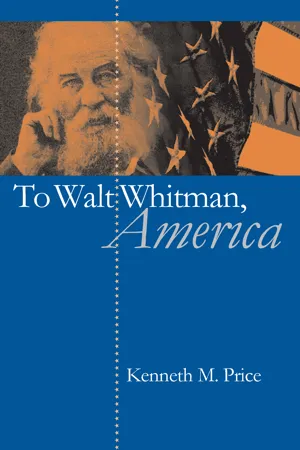
Walt Whitman “is America,” according to Ezra Pound. More than a century after his death, Whitman’s name regularly appears in political speeches, architectural inscriptions, television programs, and films, and it adorns schools, summer camps, truck stops, corporate centers, and shopping malls. In an analysis of Whitman as a quintessential American icon, Kenneth Price shows how his ubiquity and his extraordinarily malleable identity have contributed to the ongoing process of shaping the character of the United States.
Price examines Whitman’s own writings as well as those of writers who were influenced by him, paying particular attention to Whitman’s legacies for an ethnically and sexually diverse America. He focuses on fictional works by Edith Wharton, D. H. Lawrence, John Dos Passos, Ishmael Reed, and Gloria Naylor, among others. In Price’s study, Leaves of Grass emerges as a living document accruing meanings that evolve with time and with new readers, with Whitman and his words regularly pulled into debates over immigration, politics, sexuality, and national identity. As Price demonstrates, Whitman is a recurring starting point, a provocation, and an irresistible, rewritable text for those who reinvent the icon in their efforts to remake America itself.
- 192 pages
- English
- ePUB (mobile friendly)
- Available on iOS & Android
eBook - ePub
To Walt Whitman, America
About this book
Information
Chapter 1: Whitman in Blackface
I come back to Walt Whitman.
What in the hell happened to him.
Wasn’t he a white man?
What in the hell happened to him.
Wasn’t he a white man?
—June Jordan1
In 1998, Toni Morrison declared that Bill Clinton was our first black president. Or at least, she clarified, he was blacker than any person who would be elected in our lifetimes. Morrison noted that he “displays almost every trope of blackness: single-parent household, born poor, working-class, saxophone-playing, McDonald’s-and-junk-food-loving boy from Arkansas.”2 In the ensuing controversy some wondered if Morrison’s tropes themselves were not racist. The columnist Clarence Page observed, however, that many people missed Morrison’s point: “Clinton knows how it feels to be an outsider and he has used that knowledge to connect emotionally and intellectually with others who felt the same way.”3 This purported ability to connect may account for the steady support Clinton received from the black community despite a mixed record on racial matters. Just as Clinton knew what it was to be an outsider (and benefited from that knowledge), so, too, did Whitman, who articulated an expansive sense of community from a position both “in and out of the game.”
A close look at Whitman and race reveals a complicated record. The exceptionally strong egalitarian and inclusive impulse guiding his life’s work, Leaves of Grass, is periodically disrupted by moments of insensitivity and racism. These shortcomings occur both early and late in his career, and both within Leaves of Grass and outside of it. Despite these lapses, we find widespread admiration of Whitman over a long period of time and from a distinguished group of African American writers including, among others, Kelly Miller, James Weldon Johnson, Langston Hughes, Jean Toomer, Richard Wright, June Jordan, Gloria Naylor, Yusef Komunyakaa, and Cornel West. A remark by William James—“a man has as many social selves as there are individuals who recognize him and carry an image of him in their minds”—reminds us of the extent to which “Whitman” exists as an identity created nearly as much by his commentators as by the poet himself.4 On the issue of race, especially, people have partly found and partly created what they needed in Whitman based on their own dispositions and circumstances. Ronald Takaki, for example, quotes Whitman at the end of In a Different Mirror, his multicultural history of the United States, to highlight the attractive possibilities of a harmonious diversity. Notwithstanding Whitman’s personal contradictions, entangled in larger cultural contradictions, he is typically remembered for his capacious and loving record of American life in all its teeming, earthy, extraordinary complexity. His work holds out the promise of renovation based on new bonds and crossings, providing a glimpse of something other than the racial separation marking so much of U.S. history (and continuing in present settings from high school cafeterias to urban neighborhoods across the country). Separatism, at times a useful means in the struggle for equality, has appeal as an ultimate goal for some multicultural theorists. But a less atomistic and essentialist goal remains vital for many, a goal based on fluid and cross-culturally enriched identities. Accordingly, many African American intellectuals have found Whitman’s inclusive, future-oriented project a useful point of departure.
Whitman’s cultural positioning may further explain why many African American writers have responded favorably to him. He was both privileged and not, an Anglo male but also a sexual minority, a person with roots in the working class, and a writer whose book was banned.5 African Americans have been intrigued by a poet whose reputation was significantly shaped by nineteenth-century debates, when commentary ranged from rapturous appreciation to disgusted rejection. Some nineteenth-century commentators, naive or disingenuous, mistook the persona for the person and emphasized Whitman’s claim that he was rude, uneducated, lusty, and vulgar. Frequently, these commentators turned his own rhetoric against him and insisted that he was disqualified as a poet—and all the more as a national spokesman—because he was a sexual, religious, and even subhuman outsider. They described Whitman as bestial, judged him to be insane, suggested that he should commit suicide, urged that he be publicly whipped, called him a “satyr,” and tarred him as “Caliban,” Prospero’s half-human slave, son of the witch Sycorax and a devil and symbol of base and lustful urges.6 They employed an array of tropes to depict him as an outsider in his own land. They made him, as it were, black.
THE SPACE BETWEEN MASTERS AND SLAVES
Whitman began his career at a time when many white performers were appearing in blackface, some of whom the poet himself witnessed. Nineteenth-century commentators, disturbed by Whitman’s violation of codes of gentility, strove to further tar him by associating him with black men and with widely popular New York minstrel shows.7 Some of their descriptions of Whitman amounted to caricature, but they could claim that they took their cue from the poet himself, who repeatedly explored cross-racial identifications.
Occasionally Whitman asserted these racial crossings directly, as when he declares, in the initial poem of Leaves of Grass (1855), “I am the hounded slave,” and at other times the crossings were made more indirectly. Whitman’s cross-racial identifications are important in two primary ways. First, these racial crossings illustrate how Whitman, as was common in working-class antebellum white male culture, constructed a sense of manhood partly through appropriating black masculinity.8 Eric Lott has noted that such appropriations of black masculinity typically involved a complex mixture of both admiration and fear, of both yearning toward and warding off, and of both love and loathing.9 Second, Whitman’s racial crossings enable us to situate his work within a rhetorical field significantly shaped by the approach of middle-class white abolitionists to the question of race. Whitman, rarely radical in his antislavery positions, nonetheless shared with these abolitionists a reliance on sympathy in addressing racial slavery.
Whitman was at his most progressive in the years leading up to 1855 and somewhat more conservative thereafter, though unevenly and unpredictably so. He was more daring on racial issues in his manuscripts than in more polished work, as jottings and drafts from approximately 1850–56 reveal. This material was unknown to African Americans in the nineteenth century and remains inadequately studied even today, but I focus on these manuscripts because they help highlight and explain some contradictory elements in Whitman’s better known works and because they clarify his overall thought and the forces shaping it.
In composing the first two editions of Leaves, Whitman made clear that he regarded racial slavery as a fundamental threat to what he perceived as the country’s historical mission to promote freedom and equality. The poet who once penned the motto “No nation once fully enslaved ever fully recovered its liberty” recognized the ideologically contradictory position of the United States as a slave-owning democracy.10 Despite this perception, his commitment to freedom was stronger than his commitment to equality across ethnic and racial lines. Given his national poetic ambitions, it is not surprising that slavery and freedom reside together in Leaves of Grass, uneasily enmeshed, at the heart of things.11
In one of his earliest notebooks, “Talbot Wilson”—long thought to date from 1847 but now understood to be from about 1854—Whitman broke into free verse in the manner of Leaves of Grass.12 After asserting that he is the poet of the masters and the poet of the slaves, he projects himself into the highly charged space between masters and slaves, both dangerous and erotic:
I am the poet of slaves,
and of the masters of slaves
I am the poet of the body
And I am
I am the poet of the body
And I am the poet of the soul
The I go with the slaves of the earth are mine, and equally with
the equally with the masters are equally mine
And I will stand between
the masters and the slaves,
And I e Entering into both and
so that both shall understand
me alike.13
Whitman occupies and transforms the cultural space of violation. He underscored the stakes at issue in another notebook from this period: “what real Americans can be made out of slaves? What real Americans can be made out of the masters of slaves?”14 Whitman’s idea of America, a goal rather than an achieved condition, was based on an inclusive and exalted commonality, the “divine average.” Masters and slaves were ill-suited to this notion of America not because of whiteness or blackness but because of the polarized qualities—despotism and debasement, authority and dependence—characteristic of slavery itself. In his notebook lines, Whitman seeks to enter slave and master to identify with them, to grasp their meaning and circumstances. Convinced of the inseparability of the body and the body politic, and attempting to offset the effects of rape and the white fathering of property on enslaved women, Whitman strives to remake penetration as a vehicle for purification. His metaphor conveys suggestions of both transgression and transformation, preparing us for the twist at the end: the result of Whitman entering others is not his understanding of them but their understanding of him. The insistence that master and slave should adopt his view can be regarded as imperious arrogance. But if we merely scold Whitman for presumptuousness we may miss a key point. At a time when abolitionists were deeply committed to intersubjectivity and described it as a white mobility as opposed to black stasis, Whitman grants the power of identification to both master and slave. This is extremely unusual for the antebellum period, when sympathetic mobility was reserved as a particular racial privilege as white abolitionists sought to establish rich human inwardness through flirtations with inward merging. Typically, a corresponding ability was not granted to black subjects. In abolitionist literature it is the white sympathetic onlooker who is inwardly transformed, not—as Whitman has it—both white and black, both slave and master.15
Despite the key passage above granting black subjects sympathetic mobility, Whitman’s more common approach was to explore white racial crossing. The “Talbot Wilson” notebook, recently recovered by the Library of Congress after being missing for decades, deserves extensive quotation because, in the flickering, not quite visible movement between its leaves, we can sense the birth of Whitman’s poetic sensibility. At the opening of a sequence of passages that contribute to the first published version of “The Sleepers,” Whitman indulges in a male fantasy of size and plenitude.
I held more than I thought
I did not think I was big
enough for so much exstasy
Or that a touch could
take it all out of me.16
This unpromising mixture of wishfulness and bravado is suddenly recognized as something extraordinary when read in conjunction with what follows. That is, this male fantasy is associated culturally and psychologically with the succeeding notebook leaf, treating black rage, revenge, and empowerment. On that succeeding leaf, Whitman launches into a speech in the slave’s voice, though readers may hear Whitman, the slave, or both of them. Importantly, in this notebook...
Table of contents
- Cover Page
- To Walt Whitman, America
- Copyright Page
- Dedication
- Contents
- Acknowledgments
- Introduction
- Chapter 1: Whitman in Blackface
- Chapter 2: Edith Wharton and the Problem of Whitmanian Comradeship
- Chapter 3: Transatlantic Homoerotic Whitman
- Chapter 4: Xenophobia, Religious Intolerance, and Whitman’s Storybook Democracy
- Chapter 5: Passing, Fluidity, and American Identities
- Chapter 6: Whitman at the Movies
- Notes
- Index
Trusted by 375,005 students
Access to over 1.5 million titles for a fair monthly price.
Study more efficiently using our study tools.
Frequently asked questions
Yes, you can cancel anytime from the Subscription tab in your account settings on the Perlego website. Your subscription will stay active until the end of your current billing period. Learn how to cancel your subscription
No, books cannot be downloaded as external files, such as PDFs, for use outside of Perlego. However, you can download books within the Perlego app for offline reading on mobile or tablet. Learn how to download books offline
Perlego offers two plans: Essential and Complete
- Essential is ideal for learners and professionals who enjoy exploring a wide range of subjects. Access the Essential Library with 800,000+ trusted titles and best-sellers across business, personal growth, and the humanities. Includes unlimited reading time and Standard Read Aloud voice.
- Complete: Perfect for advanced learners and researchers needing full, unrestricted access. Unlock 1.5M+ books across hundreds of subjects, including academic and specialized titles. The Complete Plan also includes advanced features like Premium Read Aloud and Research Assistant.
We are an online textbook subscription service, where you can get access to an entire online library for less than the price of a single book per month. With over 1.5 million books across 990+ topics, we’ve got you covered! Learn about our mission
Look out for the read-aloud symbol on your next book to see if you can listen to it. The read-aloud tool reads text aloud for you, highlighting the text as it is being read. You can pause it, speed it up and slow it down. Learn more about Read Aloud
Yes! You can use the Perlego app on both iOS and Android devices to read anytime, anywhere — even offline. Perfect for commutes or when you’re on the go.
Please note we cannot support devices running on iOS 13 and Android 7 or earlier. Learn more about using the app
Please note we cannot support devices running on iOS 13 and Android 7 or earlier. Learn more about using the app
Yes, you can access To Walt Whitman, America by Kenneth M. Price in PDF and/or ePUB format, as well as other popular books in Literature & Modern History. We have over 1.5 million books available in our catalogue for you to explore.