- 288 pages
- English
- ePUB (mobile friendly)
- Available on iOS & Android
eBook - ePub
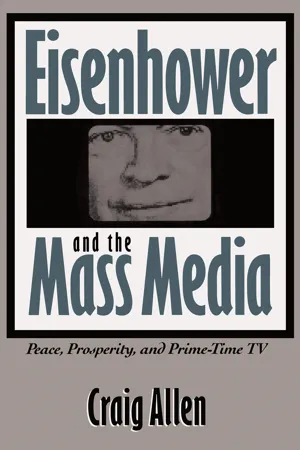
About this book
A UNC Press Enduring Edition — UNC Press Enduring Editions use the latest in digital technology to make available again books from our distinguished backlist that were previously out of print. These editions are published unaltered from the original, and are presented in affordable paperback formats, bringing readers both historical and cultural value.
Information
Topic
StoriaSubtopic
Storia nordamericana1 FIVE-STAR DEBUT IN WAR, NEW STAGE IN 1953
Many of the details of good communication, if not the components of an effective public relations effort, were known to Eisenhower at a very young age. As a teenager in Abilene, Kansas, Eisenhower gained his opportunity to enter West Point after rallying the town’s civic leaders into a letter-writing campaign on his behalf. When his athletic career at West Point was shortened by injury, he became a cheerleader for the Army football team. In World War I, Eisenhower yearned to be near the action. Yet the talents his superiors recognized were those not of a fighter but of a teacher, coach, and motivator. Because he had trained hundreds of troops for combat in the First World War but had never seen the battlefield himself, Eisenhower saw his Army career pointed toward oblivion. Nevertheless, as Stephen Ambrose observed, these early experiences had already put Eisenhower on the unique track that carried him to prominence in World War II.1
Because of World War II, Eisenhower was the twentieth century’s link in a chain of figures that included George Washington, Andrew Jackson, William Harrison, Zachary Taylor, and Ulysses S. Grant: military leaders who attained the nation’s highest office through the public zeal for wartime success. Yet as World War II unfolded, few were predicting that Eisenhower would sit atop the pyramid when the hostilities ended. While others advanced in line commands, Eisenhower’s career was confined to staff positions, from which he reluctantly but actively accumulated years of knowledge in the intricacies of government, industrial mass production, cost-benefit ratios, weapons development, and worker-soldier morale. Eisenhower’s talents for organizing, lobbying, leading discussion, motivating both civilian and military factions, and conceiving a “big picture” grew enormously. World War II still needed generals of the Grant variety, but its mobilized, bureaucratized, multinational dimensions required an Eisenhower even more. He had been a staff colonel when the Germans drove the Allies out of Europe at Dunkirk in 1940. He was the supreme Allied commander when Allied forces reclaimed the continent four years later.
World War II required something else that was new: a military leader who could inspire not only soldiers but also the domestic civilian population, on which depended the mobilization effort. Both Franklin Roosevelt and wartime Chief of Staff George Marshall had recognized this need, and they knew Eisenhower was especially qualified to fill it. Eisenhower’s instincts as a communicator thus help explain his rapid rise in the military, something so meteoric that many continued to attribute it to a quirk of fate. Actually, Eisenhower’s ascension to high military command had been quarterbacked, and no person had called more of the plays than his younger brother, Milton. If luck determined any part of Eisenhower’s fortune, it arrived not in the 1940s but in 1929, when he began an extended tour of duty as a staff officer in Washington, D.C., eventually becoming assistant to Chief of Staff Douglas MacArthur. Milton Eisenhower had just moved to Washington also and had begun a meteoric rise of his own as an administrator and director of public information at the Depression-era Department of Agriculture. Although shaped by the driving presence of MacArthur, Eisenhower was influenced more strongly by his brother, one of the first wizards of agency public relations at the dawn of the “big government” era. For seven years, the two Eisenhowers shared each detail of their careers in a relationship that would remain as close as that between John and Robert Kennedy.
Dwight Eisenhower was justifiably intrigued by his brother’s work, not just its large scale and forward look but its recurring evidence that things got done when public opinion flowed in the right direction. Milton supervised one of the largest press services in government and as early as 1930 had pioneered the use of national radio broadcasts for the issuing of public statements.2 Most impelling to Dwight was Milton’s Midas touch in cultivating the many newspaper reporters who, like the bureaucrats, converged on Washington during the New Deal. Milton did this on the job with candor and after hours with parties, cookouts, and get-togethers. Dwight regularly attended these affairs and, although only an Army major, grew to be well connected with many notable members of the national press, who knew him then as “Milton’s brother.”3
Milton Eisenhower also cultivated Roosevelt, and the mutual admiration between these two men enabled Milton to bring his brother’s talents to the attention of those in the White House. Milton’s closeness to Roosevelt started taking a historic turn shortly after Pearl Harbor, when FDR put Milton in charge of the study that led to the creation of the Office of War Information. Milton’s blueprint for the OWI did everything but name his brother as Allied commander. It maintained that the government should not use war to usurp outlets of mass communication but, as in peacetime, should fill these outlets with public relations. The landmark recommendations of the study were the concepts of decentralization and diversion from the mass-produced propaganda tactics used in World War I by the Creel Committee. Accordingly, Milton proposed that much wartime information emanate from the battlefield, entrusted to leaders exposed to the processes of communication and sensitive to public reaction on the home front.4 Roosevelt concurred with Milton, aware that the terms “radio chat,” “news release,” and “press management,” while figures of speech to most generals and admirals, were concrete concepts to the elder Eisenhower. FDR was also aware that typical military figures associated victory strictly with firepower; few were inclined to conceive of “politics” as a bigger factor and express, as Eisenhower did, that “only public opinion does win wars.”5
Eisenhower’s handling of public communications as Allied commander was practically identical to the approach he advanced as president. Eisenhower realized that his most urgent responsibilities were not in the area of public information. Firmly believing in the fruits of a well-tended public dialogue, though, he delegated this duty not randomly, to a person whose name merely appeared on a seniority list, but to someone he had handpicked. Eisenhower sought a figure who was half publicist, half adviser, capable of winning public relations battles with flair and imagination, but above all loyal to the philosophies and decisions of the leadership.
The first Eisenhower “right arm” was Harry Butcher, a lieutenant commander in the Naval Reserve who drew some quizzical comment in military circles when Eisenhower plucked him out of the Navy in 1942 for service at Army headquarters. Yet Butcher’s appointment, like Eisenhower’s, was based on great logic. Butcher had been part of the Eisenhower milieu in Washington during the 1920s and 1930s; as an editor of a nationally circulated farm magazine important to the USDA, Butcher had been a focus of Milton’s overtures to the press before professional courtesies turned into intimate friendships with Milton and Dwight. Butcher increasingly brought new media insights to the Eisenhowers as he too rose, initially at CBS News as its first bureau chief in Washington and later as a CBS vice president, a post he held at the outbreak of World War II. Butcher’s principal duty at Allied headquarters was to serve as liaison between Eisenhower and the contingent of war correspondents. His goal was facilitating what proved an emblem of Eisenhower’s wartime activity: the appearance, in Butcher’s terms, of “complete frankness and trust” with the press.
Eisenhower seized an opportunity to win the press over in his first major public news conference. Held in London in July 1942, it was long remembered by those who attended. Butcher had arrived just days before, greeted by the war correspondents with a bill of particulars that targeted unfair reporting restrictions and several staff members who, they maintained, “looked with ‘disdain’ upon newspapermen and their work.” The American reporters were particularly irate because their British counterparts were subject to much looser censorship policies. Informed by Butcher of this situation, Eisenhower began the news conference with some opening remarks, and before the correspondents had a chance to voice a single additional complaint, he had detailed a speeding up of censorship screenings and other procedures that put the Americans and British on more equal terms. “You blokes,” he told the U.S. reporters, “are my first concern.” CBS correspondent Ed Murrow, a former colleague of Butcher and a spearhead of the complaints, announced that “Ike made a grand impression.”6 This perception persisted throughout the war, largely because Butcher constantly ran this sort of interference. Butcher’s presence during the war was a cornerstone of many future events because he was the model for what later emerged in Jim Hagerty, Eisenhower’s White House press secretary.
Eisenhower’s first experiences in controlling his own channels of communication also foreshadowed the future. During the war, Eisenhower was cognizant that people back home were for the first time encountering an American war on the radio and in talking motion pictures. He was not content to promote his sensitivity and instill a positive wartime outlook exclusively through press cultivation. Butcher’s diaries from this period reveal elaborate preparations for numerous headquarters-designed media ventures, including Eisenhower’s radio broadcast, expertly timed just hours after the Normandy invasion.7 Although the primary target audiences of this broadcast and others were Europeans, efforts were taken to ensure that Eisenhower was also seen and heard in the United States. One of the most interesting Butcher schemes took shape as the Allies advanced toward Germany in late 1944: his plan was to use telephone lines and shortwave radio to beam across the Atlantic descriptions of the final battles, and Eisenhower’s reactions, live from the scene.8 While this idea was technically unfeasible, it represented the “think big” media planning that Eisenhower greatly fancied. Americans nonetheless had repeated opportunities to hear Eisenhower’s voice on the radio in recorded form. In addition, Eisenhower appeared in at least a dozen newsreels produced in 1944 and 1945 by the U.S. Army Pictorial Service and even provided a voice-over for a half-hour Army film that described the U.S. crossing of the Rhine River two months before the European war ended.9 These films were seen widely in movie theaters across the United States.
Long before the war was over, Eisenhower was a figure well known to most Americans. Yet it was not so much the words Eisenhower conveyed but rather his demeanor in communicating that did the most to establish his public acclaim. Eisenhower expedited the end of the conflict because he did not compete with the many U.S. and British field commanders for the personal fame and distinction that the war would carry as a prize. MacArthur, Eisenhower’s supervisor through much of the prewar period, had been an influential reverse role model. “The flashy, publicity-seeking type of adventurer can grab the headlines and be a hero in the eyes of the public,” Eisenhower wrote in his diary in December 1942, “but he simply can’t deliver the goods in high command.”10 Secure in his command and thus willing to let other generals have the glory, Eisenhower communicated and behaved in unassuming ways. Pomp and circumstance were usually absent from the newsreels in which Eisenhower appeared, and he seldom appeared in military regalia. Most of the time, Eisenhower looked and talked more like an enlisted soldier than an officer. The result was a public sensation when he returned to the U.S. after VE Day. Eisenhower’s magnanimity brought public honor to his achievements; as historian Alonzo Hamby wrote, “In contrast to the regal MacArthur, he built an image as a plain-living, plain-speaking democrat . . . [and] emerged over more brilliant generals as the great hero of World War II.”11
Eisenhower’s popular appeal continued while he served as head of the Joint Chiefs of Staff after the war. He wrote in his diary in March 1947, “By this time I thought that a soldier (unless he deliberately sought public notice) would be forgotten and left alone to do his job, whatever it might be.”12 In fact, Eisenhower did seek public notice after the war and did not disdain to polish his image. Both parties wanted him as a presidential candidate in 1948, a prospect President Harry Truman discussed with Eisenhower as early as 1945.13 In 1946, Eisenhower abruptly terminated his twenty-year association with Butcher and began preparations on a wartime memoir when he failed to block Butcher’s publication of the official headquarters diaries; in these diaries, Butcher had recorded several occasions when Eisenhower impugned the British.14 Largely to expunge this blight from his reputation, Eisenhower accepted numerous postwar speaking engagements, particularly between 1948 and 1950. During this time he was president of Columbia University, where one of his specialties, in his words, was “public relations.” Academic figures at Columbia wondered about the school’s leadership as Eisenhower traveled extensively around the country, speaking to every conceivable group and organization. In St. Louis on Labor Day 1949, Eisenhower drew much attention in the news media when he digressed from soldier talk and complained about the excesses of liberalism and an “ever-expanding federal government”; his lesson on what he called a moderate “middle way” was a pretext and springboard for his entry into the next presidential campaign.15
While Eisenhower remained in the public eye after the war, in private he was learning still more about the inner workings of the American mass media. His residence in New York made him a magnet for eminent figures in the communications field who deeply admired him as a military leader and, now, as a public figure. Eisenhower formed close associations with William Paley of CBS; David Sarnoff of NBC; Henry Luce of Time, Inc.; and Bruce Barton and Ben Duffy of BBDO, the world’s second-largest advertising agency. Sigurd Larmon of Young and Rubicam, the third-largest agency, assumed a special status. Larmon became one of Eisenhower’s closest personal friends, joining a group that referred to itself as “the gang.” Eisenhower had as much respect for these media figures as they had for him. Just as Eisenhower was awed by the production capacity and human ingenuity in the defense plants and industrial facilities he had visited, he was similarly captivated by the enormity and potential of the nation’s mass media establishment. Eisenhower appreciated not just the corporate orientation of the mass media but also its professional end. He never cared too much about the technical and engineering breakthroughs that were changing the media. He did, however, relate to the techniques of verbal and visual communication and was drawn to media specialists who could employ them for great public effect.
Through the late 1940s, the public heard from Eisenhower in print, on the radio, in newsreels and, now, on television. Eisenhower’s World War II memoir, the best-selling book Crusade in Europe (1948), spun off into a TV series the following year; many episodes featured on-camera and narrated segments that he had recorded. During this period David Levy of Young and Rubicam, on temporary duty as a Navy lieutenant assigned to the radio division of the Treasury Department, became Eisenhower’s first regular media consultant. In preparing a series of broadcast appeals that urged public support for the Marshall Plan, Levy recalled in Eisenhower not only natural on-air abilities but also a striking level of openness to direction and criticism. “I debated with him over content,” Levy explained, but as for his delivery, “Eisenhower did what we told him to do.” Vanity was one reason Eisenhower accepted this professional advice, according to Levy. Of greater concern, though, were details “beyond his control” that might reduce the impact of what he had to say.16
When Eisenhower took a leave from Columbia to serve in Paris as commander of NATO (the North Atlantic Treaty Organization), many of the print and broadcast associates he left behind in New York became leaders of the Citizens for Eisenhower movement t...
Table of contents
- Cover Page
- EISENHOWER AND THE MASS MEDIA
- Copyright Page
- Dedication
- CONTENTS
- ACKNOWLEDGMENTS
- INTRODUCTION
- 1 FIVE-STAR DEBUT IN WAR, NEW STAGE IN 1953
- 2 THE BUSINESS OF PERSUASION, 1954
- 3 CIRCUMVENTING THE PRESS, 1953–1955
- 4 CHANNELING MODERN REPUBLICANISM, 1954–1955
- 5 NO BARNSTORMING, 1955–1956
- 6 MEDIA WHIPPING THE DEMOCRATS, 1955–1956
- 7 CONVENTIONS A GOP REDEFINITION, AUGUST 1956
- 8 TELEVISION VERSUS THE NEW AMERICA, FALL 1956
- 9 STATIC FROM HOME AND ABROAD, 1957–1959
- 10 DROPPING THE TORCH, 1960
- 11 A HERO’S IMAGE FULFILLED, AFTER 1960
- CONCLUSION
- NOTES
- BIBLIOGRAPHY
- INDEX
- SERIES
Trusted by 375,005 students
Access to over 1.5 million titles for a fair monthly price.
Study more efficiently using our study tools.
Frequently asked questions
Yes, you can cancel anytime from the Subscription tab in your account settings on the Perlego website. Your subscription will stay active until the end of your current billing period. Learn how to cancel your subscription
No, books cannot be downloaded as external files, such as PDFs, for use outside of Perlego. However, you can download books within the Perlego app for offline reading on mobile or tablet. Learn how to download books offline
Perlego offers two plans: Essential and Complete
- Essential is ideal for learners and professionals who enjoy exploring a wide range of subjects. Access the Essential Library with 800,000+ trusted titles and best-sellers across business, personal growth, and the humanities. Includes unlimited reading time and Standard Read Aloud voice.
- Complete: Perfect for advanced learners and researchers needing full, unrestricted access. Unlock 1.5M+ books across hundreds of subjects, including academic and specialized titles. The Complete Plan also includes advanced features like Premium Read Aloud and Research Assistant.
We are an online textbook subscription service, where you can get access to an entire online library for less than the price of a single book per month. With over 1.5 million books across 990+ topics, we’ve got you covered! Learn about our mission
Look out for the read-aloud symbol on your next book to see if you can listen to it. The read-aloud tool reads text aloud for you, highlighting the text as it is being read. You can pause it, speed it up and slow it down. Learn more about Read Aloud
Yes! You can use the Perlego app on both iOS and Android devices to read anytime, anywhere — even offline. Perfect for commutes or when you’re on the go.
Please note we cannot support devices running on iOS 13 and Android 7 or earlier. Learn more about using the app
Please note we cannot support devices running on iOS 13 and Android 7 or earlier. Learn more about using the app
Yes, you can access Eisenhower and the Mass Media by Craig Allen in PDF and/or ePUB format, as well as other popular books in Storia & Storia nordamericana. We have over 1.5 million books available in our catalogue for you to explore.