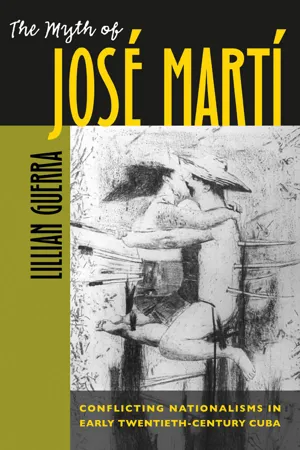
Focusing on a period of history rocked by four armed movements, Lillian Guerra traces the origins of Cubans' struggles to determine the meaning of their identity and the character of the state, from Cuba’s last war of independence in 1895 to the consolidation of U.S. neocolonial hegemony in 1921. Guerra argues that political violence and competing interpretations of the “social unity” proposed by Cuba’s revolutionary patriot, José Martí, reveal conflicting visions of the nation — visions that differ in their ideological radicalism and in how they cast Cuba’s relationship with the United States.
As Guerra explains, some nationalists supported incorporating foreign investment and values, while others sought social change through the application of an authoritarian model of electoral politics; still others sought a democratic government with social and economic justice. But for all factions, the image of Martí became the principal means by which Cubans attacked, policed, and discredited one another to preserve their own vision over others'. Guerra’s examination demonstrates how competing historical memories and battles for control of a weak state explain why polarity, rather than consensus on the idea of the “nation” and the character of the Cuban state, came to define Cuban politics throughout the twentieth century.
eBook - ePub
The Myth of José Martí
Conflicting Nationalisms in Early Twentieth-Century Cuba
- 328 pages
- English
- ePUB (mobile friendly)
- Available on iOS & Android
eBook - ePub
About this book
Information
NOTES
Abbreviations
| AIHC | Archivo del Instituto de Historia de Cuba (Archive of the Institute of History of Cuba), Havana |
| AMCH | Archivo del Museo de la Ciudad de la Habana (Archive of the Museum of the City of Havana) |
| ANC | Archivo Nacional de Cuba (National Archive of Cuba), Havana |
| APC | Archivo Provincial de Cienfuegos (Provincial Archive of Cienfuegos) |
| CRJOF | Caso Referente a Juan O’Farrill (Court Records for Juan O’Farrill) |
| HSSCT | Harvard Summer School for Cuban Teachers |
| HUA | Harvard University Archives |
| OC | Obras completas (Complete Works) |
| PRC | Partido Revolucionario Cubano (Cuban Revolutionary Party) |
| RG | Record Group |
| USNA | United States National Archives, Washington, D.C. |
Introduction
1 “Del Presidente de la República,” El Fígaro, February 26, 1905, 103.
2 Santí, “Thinking through Martí,” 67 - 68; Ronda Varona, “On How to Read Martí’s Thought,” 85 - 86; Saumell-Muñoz, “Castro,” 97 - 109; Ripoll, José Martí and “Falsification of José Martí”; Kirk, José Martí.
3 Estrade, José Martí, 19 - 20.
4 Faber, “Beautiful”; Helg, “La Mejorana Revisited”; Ferrer, Insurgent Cuba, 112 - 16, 122 - 38; Ramos, Divergent Modernities, 187 - 212, 251 - 64; Rotker, American Chronicles, 1 - 30.
5 Saumell-Muñoz, “Castro,” 105.
6 del Río et al., Texto de la Ley que Glorifica el Apóstol . . . , June 15, 1921.
7 Martí to Manuel Mercado, May 18, 1895, in Martí, OC, 4:169 - 70.
8 See Pérez, Cuba between Empires; Hidalgo de Paz, Cuba; and Barcia Zequeira, Élites y grupos de presión.
9 Doty, Mythography, 7 - 8.
10 Ibid., 25.
11 Ibid., 26.
12 Ibid., 14.
13 Ibid., 25.
14 See Knight, Slave Society in Cuba; Paquette, Sugar Is Made with Blood; and Martínez Alier, Marriage, Class and Colour.
15 See Chaffin, Fatal Glory.
16 Ferrer, “Esclavitud, ciudadanía y los límites”; Scott, Slave Emancipation in Cuba, esp. 45 - 62 and 111 - 24; Abad, Barcia, and Loyola, Historia de Cuba II; Cepero Bonilla, Raúl Cepero Bonilla, 80 - 171.
17 Ferrer, “Social Aspects of Cuban Nationalism” and Insurgent Cuba, 15 - 89. 18 . Hevia Lanier, El Directorio Central; Howard, Changing History, esp. 122 - 209.
19 Casanovas, Bread or Bullets!, 127 - 221.
20 See Healy, United States in Cuba; LeRiverend, La república; Pérez, Cuba under the Platt Amendment, Cuba: Between Reform and Revolution, and Cuba between Empires; and Ibarra, Cuba.
21 Pérez, On Becoming Cuban, esp. 7 - 13, 345 - 53.
22 See Zanetti, Cautivos de la reciprocidad; Ibarra, Prologue to Revolution; and Pérez de la Riva et al., eds., La república neocolonial.
23 Helg, Our Rightful Share; Ferrer, Insurgent Cuba; de la Fuente, Nation for All; Iglesias, Las metáforas del cambio.
24 Renan, “What Is a Nation?,” 19.
25 Chatterjee, “Whose Imagined Community?,” 214 - 15.
26 Gellner, Nations and Nationalism; Hobsbawm, Nations and Nationalism since 1870.
27 Anderson, Imagined Communities.
28 Mallon, Peasant and Nation, 5.
29 Ibid., 4 - 20.
30 “De Haiti. La visita del Delegado,” “La Sociedad Literaria,” “El Delegado en New York,” Patria, November 1, 1892, 2.
31 Gertrudis Van Cortlandt Hamilton’s three-part series “Las Damas Norte-Americanas” in Patria, February 3, 6, and 10, 1897, page 3 of each edition. See also the following articles in Patria: “Acuerdos del Senado del Estado de Nueva York” and “Acuerdos de la Legislatura de Nebraska,” February 6, 1897, 2; “El señor Pierra en Ohio,” February 13, 1897, 2 - 3; “El banquete del Lincoln Club,” February 24, 1897, 2; and “George Washington y Cuba,” February 27, 1987, 1.
32 “24 de Febrero de 1897,” Patria, February 24, 1897, 1; “Segundo aniversario,” ibid., February 27, 1897, 2; the commemorative edition of Patria on the second anniversary of Martí’s death, May 19, 1897, 1 - 3.
33 “Efemerides del Cuartel General del Ejército Libertador de Cuba. Biografía y Diario de la Guerra del Brigadier de Estado Mayor Vicente Pujals Puente,” in ANC, Fondo Donativos y Remisiones, Caja 612, Signatura 20, 43 - 44. The manuscript is typed and was edited by the author’s son, Santiago Pujals Cancino, in Santiago de Cuba, 1917. It was apparently never published. See also Valdés Domínguez’s Diario de Soldado, 2:84 - 87; and Enrique Collazo’s letter to his wife in Tampa cited in “De Cuba Libre,” La República Cubana, October 8, 1896, 10.
34 Wenceslao Galvez, “EL,” Cuba y América, May 15, 1897, 16. Emphasis added.
35 For examples, see “Homenaje de gratitud. A los cuatro caudillos de la Revolución cubana,” and “A los mártires cubanos. Credo,” in La nueva lira criolla, 53, 163.
36 See Foner, Spanish-Cuban-American War; and Pérez, Cuba between Empires.
37 Casanovas, Bread or Bullets!, 6.
Chapter One
1 . Casanovas, Bread or Bullets!, 10 - 11.
2 Bonilla to Juan Gualberto Gómez, June 8, 1899, in ANC, Fondo Adquisiciones, Caja 13, Signatura 575, 5 - 7.
3 Fernández Retamar, Calibán, 3 - 45; Ette, José Martí.
4 Ferrer, Insurgent Cuba, 121 - 24.
5 Ibid., 4, 122 - 28.
6 Ibid., 1 - 12, 112 - 69.
7 See A. Guerra, Martí y los negros; Ortiz, Martí y las razas; Stabb, “Martí and the Racists”; Fornet Betancourt, “José Martí”; Fernández Retamar, Calibán, 27; and Pérez, “Approaching Martí.”
8 Carbonell to Tomás Estrada Palma, July 30, 1896, in ANC, Fondo PRC, Caja C-3, No. 733, 1 - 2.
9 Hevia Lanier, El Directorio Central, 39 - 53.
10 Zacharie de Baralt, El Martí que yo conocí, 51 - 52.
11 Delgado, “Martí en Cayo Hueso,” 73.
12 Poyo, “With All and for the ...
Table of contents
- Table of Contents
- List of Tables
- ENVISIONING CUBA
- Title Page
- Copyright Page
- Acknowledgements
- Introduction
- ONE - Mystic, Messiah, and Mediator
- TWO - Revolutionizing Cuba Libre, Civilizing the Manigua, 1895 - 1898
- THREE - Cuba Libre in Crisis
- FOUR - From Revolution to Involution
- FIVE - Political Violence, Liberal Revolution, and the Martyrdom of Martí, ...
- SIX - Perceiving Populism in a U.S. Imperial Context
- SEVEN - Dependent Nationalisms, the Stillbirth of the Republic, and Struggles ...
- CONCLUSION
- NOTES
- BIBLIOGRAPH Y
Trusted by 375,005 students
Access to over 1.5 million titles for a fair monthly price.
Study more efficiently using our study tools.
Frequently asked questions
Yes, you can cancel anytime from the Subscription tab in your account settings on the Perlego website. Your subscription will stay active until the end of your current billing period. Learn how to cancel your subscription
No, books cannot be downloaded as external files, such as PDFs, for use outside of Perlego. However, you can download books within the Perlego app for offline reading on mobile or tablet. Learn how to download books offline
Perlego offers two plans: Essential and Complete
- Essential is ideal for learners and professionals who enjoy exploring a wide range of subjects. Access the Essential Library with 800,000+ trusted titles and best-sellers across business, personal growth, and the humanities. Includes unlimited reading time and Standard Read Aloud voice.
- Complete: Perfect for advanced learners and researchers needing full, unrestricted access. Unlock 1.5M+ books across hundreds of subjects, including academic and specialized titles. The Complete Plan also includes advanced features like Premium Read Aloud and Research Assistant.
We are an online textbook subscription service, where you can get access to an entire online library for less than the price of a single book per month. With over 1.5 million books across 990+ topics, we’ve got you covered! Learn about our mission
Look out for the read-aloud symbol on your next book to see if you can listen to it. The read-aloud tool reads text aloud for you, highlighting the text as it is being read. You can pause it, speed it up and slow it down. Learn more about Read Aloud
Yes! You can use the Perlego app on both iOS and Android devices to read anytime, anywhere — even offline. Perfect for commutes or when you’re on the go.
Please note we cannot support devices running on iOS 13 and Android 7 or earlier. Learn more about using the app
Please note we cannot support devices running on iOS 13 and Android 7 or earlier. Learn more about using the app
Yes, you can access The Myth of José Martí by Lillian Guerra in PDF and/or ePUB format, as well as other popular books in History & Latin American & Caribbean History. We have over 1.5 million books available in our catalogue for you to explore.