Though understandably preoccupied with the immediate problems of the Great Depression, the generation of economists that came to the forefront in the 1930s also looked ahead to the long-term consequences of the crisis and proposed various solutions to prevent its recurrence. Theodore Rosenof examines the long-run theories and legacies of four of the leading members of this generation: John Maynard Keynes of Great Britain, who influenced the New Deal from afar; Alvin Hansen and Gardiner Means, who fought over the direction of New Deal policy; and Joseph Schumpeter, an opponent of the New Deal. Rosenof explores the conflicts that arose among long-run theorists, arguing that such disputes served eventually to set the stage for the emergence and domination of a short-run Keynesian approach to economic policy that collapsed under the impact of 1970s stagflation. Tracing the subsequent revival of long-run theories, Rosenof demonstrates their relevance to an understanding of the economy’s problems over the past quarter-century and to the current debate over public policy.
Originally published in 1997.
A UNC Press Enduring Edition — UNC Press Enduring Editions use the latest in digital technology to make available again books from our distinguished backlist that were previously out of print. These editions are published unaltered from the original, and are presented in affordable paperback formats, bringing readers both historical and cultural value.
eBook - ePub
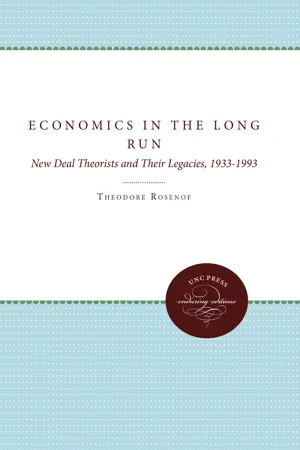
Economics in the Long Run
New Deal Theorists and Their Legacies, 1933-1993
- 240 pages
- English
- ePUB (mobile friendly)
- Available on iOS & Android
eBook - ePub
About this book
Information
Part One
The New Deal Era
The Great Depression of the 1930s was an event of cataclysmic proportions, affecting not only the United States but also Europe and the wider world. Economists had been accustomed to previous depressions, or “panics,” as they were earlier styled, but the crisis of this decade was a disaster of far greater magnitude than any that had gone before. It was the depth and persistence of the economic collapse which caused some analysts to conclude that this depression was in some basic respects different and that it was of epochal significance compared with its predecessors. It was this response to the Great Depression which resulted in interpretations that viewed the crisis in long-run or secular terms.
There were at the time, and continued to be thereafter, disputes as to whether the depression originated in America and spread outward or whether essentially European developments, linked to the impact and aftermath of World War I, also afflicted America. But there could be no question as to the depression’s extraordinary worldwide consequences. With the collapse of international trade, nations moved increasingly toward solutions to the crisis based on domestic policy, relegating international cooperation to the sidelines, especially after participants failed to reach agreement at the 1933 World Monetary and Economic Conference in London. Most dramatic, the depression led to the rise and triumph of Nazism in Germany and hence to the Second World War.
Within the United States there existed a wide array of interpretations of the depression. To some analysts, it was essentially part of the “natural” or “cyclical” rhythm of a capitalist economy, now aggravated by “outside” or “external” factors. The culprits here included the destructive effects of World War I, disastrous monetary decisions by the Federal Reserve Board, and the devastating impact of the 1930 Hawley-Smoot tariff. All these were blamed for turning a cyclical decline into a secular catastrophe. This was true, in its own fashion, of President Herbert Hoover’s analysis. Rejecting a secular view of the depression’s origins, Hoover, during his administration and throughout his long life, continued to insist that flaws in the domestic economy were relatively minor, European developments jolted the basically healthy American system, and it was the election of 1932 and the ensuing New Deal that undermined business confidence and caused the depression to persist. The Hoover administration’s antidepression policies, accordingly, were mild: initially it urged business to maintain wage standards and purchasing power and then insisted on government budgetary rigor so as to encourage the business confidence that would lead to renewed private investment and consequent recovery. The more innovative Reconstruction Finance Corporation was accepted by Hoover only with great reluctance.
The continued descent of 1932 belied Hoover’s expectation and assurance of a timely return to “normal” conditions. Similarly, it contradicted the prevailing wisdom of the 1920s that “business cycles” were merely oscillations within a rhythmical pattern and led to an early readjustment via the economic “mechanism.” The way was now open to heterodox concepts and proposals, such as those advanced during the 1932 campaign by Franklin D. Roosevelt’s “Brains Trust.” Along with an array of other approaches, including work relief spending and monetary manipulation, the basic thrust of the early New Deal was structural. Despite the passage of reciprocity treaties, it was also domestic. The collapse of international cooperation and world trade in the early 1930s was not to be rectified until victory in World War II. The key initiatives of the early New Deal, the National Recovery Administration (NRA) and the Agricultural Adjustment Administration (AAA), were consistent with the institutional diagnosis that the economy’s underlying problems were structural in nature and that only structural reorganization and planning could resolve them. The NRA, it was anticipated, would lead the way to recovery through intra-industry agreements (or “codes”) that would set “fair” wage and hour standards, increase workers’ purchasing power, and stimulate reemployment. Simultaneously, AAA would undertake to “adjust” burgeoning agricultural production through agreements with farmers in the basic commodity areas—a domestic focus as distinct from the proposals of the 1920s to stimulate exports. This, it was anticipated, would increase farmers’ prices and incomes. Although the AAA was a qualified success, with agricultural recovery under way by the mid-i930s and with farmers increasing their purchases from industry, the NRA did not work as New Dealers had hoped. Code authorities, essentially dominated by the leading corporations of each industry, engaged too often in restrictive practices, with price increases canceling out wage hikes. Despite much initial hoopla, disillusion set in, brickbats were hurled by antitrusters, and many came to see the NRA as a millstone around the administration’s neck. The question was whether to revamp the NRA or abandon a structural planning approach. As it turned out, dispatched by a Supreme Court decision in 1935, the once ballyhooed NRA was never resurrected (although pieces of it were, notably labor and wage-and-hour legislation). Other policies, particularly work relief spending, nonetheless helped to bring about a steady, if limited, recovery by the mid-thirties and led to Roosevelt’s electoral triumph of 1936.
In the wake of 1936, preoccupied with court reform and persuaded that recovery would now be self-sustaining, Roosevelt reduced “emergency” work relief spending. Disaster ensued. The limited recovery of 1933–37 became the sharp recession—within the depression—of 1937–38. While critics blamed New Deal policies for the collapse, the administration remained in intellectual confusion and policy disarray for months, split among those who stressed business confidence and budgetary restraint (shades of the hapless Hoover), those who stressed structural problems and structural solutions (whether a new, improved planning mechanism or an antitrust effort), and, increasingly, those who stressed public spending. With the association of the business confidence formula with Hooverian futility and structural planning formulas with the unlamented NRA, the administration’s spenders carried the day. Work relief spending, after all, was linked to the 1933–37 recovery, and its curtailment to the 1937–38 recession. But spending’s conceptual underpinnings were changing: whereas earlier spending was designed for the “emergency”—to “prime the pump,” in the lexicon of the time—public spending was now increasingly viewed as a permanent addition to an economy suffering from “secular stagnation.” Further, the structural accompaniment to spending was no longer that of planning but rather an antitrust revival that continued into the early 1940s.
Spending was of overwhelmingly greater importance for the future, but it was eclipsed in the public eye for a time by the antitrust crusade of Thurman Arnold, the flamboyant former law school dean and best-selling author. Hailing originally from Wyoming, making his way to the citadels of the Northeast via West Virginia, Arnold first achieved national re-known with The Symbols of Government (1935) and The Folklore of Capitalism (1937). Satirizing the “folklore” of laissez-faire capitalism while outlining a public philosophy for the emergent New Deal, Arnold dismissed the antitrust tradition as an antiquated and opportunistic hobby of politicians. Shortly after, he became head of the Antitrust Division of the Department of Justice. Arnold, however, was no old-fashioned moralist denouncing bigness per se. He was a legal craftsman attacking “bottlenecks” in the operation of the modern economy. Antitrust could thus be seen as a pre-1929, preplanning, and indeed archaic structural solution, but it could now also be seen as a useful public policy tool in a world of large corporations: it would seek to discipline rather than to dissolve them, analogous in its own way to the concepts of Gardiner Means. As such a tool antitrust could complement more comprehensive macroeconomic approaches. Arnold was no economist, of course, and his own run wound down and eventually folded with American involvement in World War II. Large corporations that were producing for the national defense, it was argued, should not be “harassed” by this late-blooming New Dealer. Here, as elsewhere, as Roosevelt put it, “Dr. New Deal” had to give way to “Dr. Win-the-War.”
Antitrust had experienced its last hurrah at center stage. Bursting forth in the late nineteenth century, prominent in the policy debates of the Progressive Era of the early twentieth century, it continued post-Arnold in a distinctly secondary role, with antitrusters performing as technicians in comprehensive conceptual and policy frameworks set by others. In broader ways as well, the New Deal had intellectual and policy roots in earlier progressive reform, most basically in the idea that government should be used to address economic and social problems not remediable through and even exacerbated by the private economy. The Progressive Era, which had arisen in part out of the depression of the 1890s, second only to that of the 1930s in severity, withered on the impact of World War I and the apparent prosperity and “normalcy” of the 1920s. As the economy plunged after 1929, however, a more critical and reform-minded attitude reemerged. Afflicted by the depression and building on the progressive reform legacy, Americans became more willing to modify inherited social and economic ideas and policies. The depression thus provided the political opportunity for New Dealers not only to address the immediate emergency but also to effect permanent improvements. Out of this came social security old-age pensions, unemployment compensation, and federal bank deposit insurance. Moreover, a basic belief deeply embedded by the depression experience took lasting hold: never again should government stand by passively and allow society to sink into an abyss such as that of 1929–32. The return of boom times brought some return of pre-1929 euphoria. Old ideas made a partial comeback. But the basic idea of security stuck.1
1
The Focus on Structure
Institutionalism was rooted in late-nineteenth- and early-twentieth-century intellectual challenges to economic orthodoxy and was reflected particularly in the work of Thorstein Veblen, among others.1 Its emphasis on the importance of structure in terms of analysis and proposed solutions was evidenced in the pronouncements of its formulators. Walton Hamilton, who in 1919 proclaimed an “institutional economics,” stressed the need to study “those neglected institutions which exercise a controlling influence over our economic life.”2 In 1932 John Maurice Clark declared that institutionalists did not believe in abstract choices “between pure competition and pure monopoly, or between pure private business and pure socialism.”3 This attitude of openness appeared to fit the upheaval of the Great Depression and the promise of reform offered by the forthcoming New Deal.
Institutionalists also advanced the “Veblenian dichotomy,” the basic notion that whereas technology produced economic advancement, business, concerned with profit, often restrained growth via its control over the productive process. That is, although “industry” brought forth production, “business” held it back when profit was not in sight.4 Institutional economists of the early depression years reflected this influence when they maintained that the crisis was primarily due to corporate decisions based on considerations of profit and loss. Focused particularly on the role of the large corporation in relation to the economy as a whole, they held that institutions, as distinct from “external” forces, and the economy’s basic structure, as distinct from “accidental” factors, explained the collapse. They adhered to the proposition that large-scale business had in good measure replaced small-scale competition as the preponderant organizational feature of the modern industrial economy and that, along with its positive benefits, business concentration had created excessive private economic power that required a larger offsetting role for government.5 They were characteristically suspicious of proposals for “planning” that emanated from corporate business, proposals that were, they feared, geared to restriction rather than to expansion—in Veblenian terms, to “business” rather than to “industry.” Instead, institutional economists favored structural planning with a larger public input, planning designed to cause individual corporate decisions to be made in a way consistent with overall economic stability and growth.6
Structurally oriented economists prominent in the early New Deal, ensconced particularly in the Roosevelt administration’s Department of Agriculture and National Resources Committee, included Rexford G. Tugwell, Mordecai Ezekiel, and Gardiner C. Means, among others. These economists accepted the idea that technological advance required large-scale industrial organizations. They therefore stood steadfastly in opposition to the antitrust tradition. They also believed, however, based on their study of the economic system in terms of its interconnected operation as a whole, that certain features of the management of large corporations had introduced disruptive changes into the economy, especially by way of price and wage policy. Excessively high prices and low wages, whatever their perceived immediate benefit to individual firms, contributed to a failure of demand and a downward economic spiral. The depression, to them, was not simply a sudden occurrence but was rooted in long-run institutional and structural changes in the economy, and its solution required major changes in public policy and governments role. The development of “private planning” geared to narrowly conceived interests of particular firms now required the corrective use of public planning.7
In 1931, on the eve of publication of The Modern Corporation and Private Property, the most influential study in this tradition, coauthor Adolf A. Berle wrote that the crux of the economic problem lay in “the great corporate structure.”8 He later noted of imbalances between the economy’s productive capacity and its follow-through that in this regard the observation of the “cynical economist . ...
Table of contents
- Cover Page
- Economics in the Long Run
- Copyright Page
- Dedication
- Contents
- Acknowledgments
- Introduction
- Part One The New Deal Era
- Part Two Boom Times to Troubled Times
- Epilogue
- Notes
- Index
Trusted by 375,005 students
Access to over 1.5 million titles for a fair monthly price.
Study more efficiently using our study tools.
Frequently asked questions
Yes, you can cancel anytime from the Subscription tab in your account settings on the Perlego website. Your subscription will stay active until the end of your current billing period. Learn how to cancel your subscription
No, books cannot be downloaded as external files, such as PDFs, for use outside of Perlego. However, you can download books within the Perlego app for offline reading on mobile or tablet. Learn how to download books offline
Perlego offers two plans: Essential and Complete
- Essential is ideal for learners and professionals who enjoy exploring a wide range of subjects. Access the Essential Library with 800,000+ trusted titles and best-sellers across business, personal growth, and the humanities. Includes unlimited reading time and Standard Read Aloud voice.
- Complete: Perfect for advanced learners and researchers needing full, unrestricted access. Unlock 1.5M+ books across hundreds of subjects, including academic and specialized titles. The Complete Plan also includes advanced features like Premium Read Aloud and Research Assistant.
We are an online textbook subscription service, where you can get access to an entire online library for less than the price of a single book per month. With over 1.5 million books across 990+ topics, we’ve got you covered! Learn about our mission
Look out for the read-aloud symbol on your next book to see if you can listen to it. The read-aloud tool reads text aloud for you, highlighting the text as it is being read. You can pause it, speed it up and slow it down. Learn more about Read Aloud
Yes! You can use the Perlego app on both iOS and Android devices to read anytime, anywhere — even offline. Perfect for commutes or when you’re on the go.
Please note we cannot support devices running on iOS 13 and Android 7 or earlier. Learn more about using the app
Please note we cannot support devices running on iOS 13 and Android 7 or earlier. Learn more about using the app
Yes, you can access Economics in the Long Run by Theodore Rosenof in PDF and/or ePUB format, as well as other popular books in History & North American History. We have over 1.5 million books available in our catalogue for you to explore.