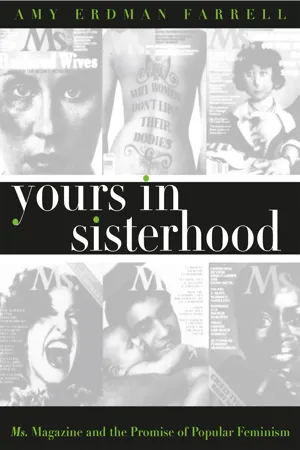
In the winter of 1972, the first issue of Ms. magazine hit the newsstands. For some activists in the women’s movement, the birth of this new publication heralded feminism’s coming of age; for others, it signaled the capitulation of the women’s movement to crass commercialism. But whatever its critical reception, Ms. quickly gained national success, selling out its first issue in only eight days and becoming a popular icon of the women’s movement almost immediately.
Amy Erdman Farrell traces the history of Ms. from its pathbreaking origins in 1972 to its final commercial issue in 1989. Drawing on interviews with former
editors, archival materials, and the text of Ms. itself, she #examines the #magazine’s efforts to forge an oppositional politics within the context of commercial culture.
While its #status as a feminist ##and# mass media magazine gave Ms. the power to move in circles unavailable to smaller, more radical feminist periodicals, it also created competing and conflicting pressures, says Farrell. She examines the complicated decisions made by the Ms. staff as they negotiated the multiple — frequently incompatible — demands of advertisers, readers, and the various and changing constituencies of the feminist movement.
An engrossing and objective account, Yours in Sisterhood illuminates the significant yet difficult connections between commercial culture and social movements. It reveals a complex, often contradictory magazine that was a major force in the contemporary feminist movement.
- 248 pages
- English
- ePUB (mobile friendly)
- Available on iOS & Android
eBook - ePub
About this book
Information
Topic
Scienze socialiSubtopic
GiornalismoCHAPTER 1
Like a Tarantula on a Banana Boat The Origins of Ms. Magazine
In a 1972 review of Ms., Onka Dekkers, a writer for the feminist periodical off our backs, pinpointed the unique nature of this new magazine for women:
Ms. is making feminist converts of middle class heathens from academia to condominium ville. A slick, reputable looking magazine breaks down defenses and lets the word worm its way into the brain. Ms. is almost in violation of Truth in Packaging laws. There is a female mind-set on those glossy pages slipping into American homes concealed in bags of groceries like tarantulas on banana boats. Curious girl children will accidentally discover feminism in Ms. the way we stumbled onto sex in our mother’s Ladies’ Home Journal. ... In the August issue of Ms. Del Martin and Phyllis Lyons matter of factly explain how ladies do it together. That paragraph alone could revolutionize slumber parties for generations.1
As Dekkers so ingeniously explained, Ms. promised to maintain its place on news racks, grocery store counters, and coffee tables while offering a feminist message. In this sense, Ms. was the quintessential reformist endeavor, for it attempted to transform the institutions and industries of advertising and women’s magazines, to work within consumer culture. Rather than eschewing advertisers’ dollars, it sought to reform their messages and to use their money to communicate a political message. Rather than rejecting the format of the women’s magazine, it attempted to create a magazine for the “new woman” out of the genre. It promised readers that there was no need to reject Madison Avenue, or the pleasures of consumer culture, in order to identify oneself as a feminist. For activists like Onka Dekkers, its greatest promise — indeed, its revolutionary promise—was that it could potentially weaken women’s resistance to feminism and make them rethink the stereotypical images they had previously known in mainstream media.
While activists like Dekkers applauded Ms.’s attempt to create a popular feminism, the commercial matrix in which Ms. existed, which prioritized profit and marketability, threatened to undercut the revolutionary possibilities inherent in the creation of Ms. Many women in the early 1970s resisted this threat by moving outside the mainstream publishing industry and beginning their own alternative periodicals. These activists believed, in the words of author Audre Lorde, that the “master’s tools will never dismantle the master’s house.”2 These activists wanted to dismantle the house, not to rebuild it, which, they argued, is what a mass circulation feminist magazine was attempting to do. In contrast, the founders of Ms. attempted to create a new house with the master’s tools. Ms. magazine worked to disrupt cultural hegemony from the inside, to fashion a new representation of women, and of women’s magazines, within the context and the constraints of the commercial market. The strength of this “new magazine for women” was its ability to be both a women’s magazine, which had a place on the battlefield of existing women’s magazines, and a resource within the women’s movement, a mass circulation text that could connect women to a national community of feminism. This dual identity, of course, was also its weakness, for the price exacted by the commercial market to maintain legitimacy and solvency often seemed to exceed what was gained by capturing a position on those newsstands. The hopes for revolutionary change that Ms. represented—as well as the fears that it inspired—originated with the birth of the magazine itself and the movement that generated it.
The Resurgence of Feminism
At the time when Ms. began, a resurgence of the women’s movement had already been going on for nearly a decade, challenging the cultural and political restrictions of the feminine mystique. While most historians would date the birth of a widespread women’s movement in the late 1960s, the stirrings of change had begun earlier. In 1960, President Kennedy appointed Esther Peterson, the former recreation director of Bryn Mawr Summer School for Women Workers, to the Women’s Bureau. Peterson pushed for the creation of the Presidential Commission on the Status of Women, to be chaired by Eleanor Roosevelt. In 1963, the commission’s report came out, assessing the quality of women’s lives and the existence of extensive discrimination and women’s “double burden” in the economy, the family, and the legal system. Two concrete results emerged from this report: the civil service was not to discriminate in hiring on the basis of sex, and the Equal Pay Act of 1963 mandated that workers performing the same job must be paid on an equal pay scale. Perhaps more importantly, however, was the activism the Presidential Commission initiated among a whole generation of professional women. Within a year of the report, most states had established women’s commissions, which went on to compile their own more localized studies and to lobby at state and national levels against discrimination.3
Representative Martha Griffiths propelled the women’s movement forward even more when she pushed to have added to Title VII of the Civil Rights Act the category of “sex” in addition to race, creed, and national origin. While many of her congressional colleagues snickered over the apparent absurdity of protecting rights on the basis of sex, Griffiths forcefully lobbied and won enough votes to pass the act with the word “sex” added. As a result, the Equal Employment Opportunity Commission (EEOC), established by the act, immediately began receiving grievances from women. Significantly, however, the commission failed to respond to complaints, and even passed loopholes allowing newspapers to continue the practice of advertising jobs by sex. The concern that many delegates brought to the 1966 Third National Conference of State Commissions on the Status of Women about the eeoc’s lack of action changed to outrage when they realized that the conference would allow no resolutions or official discussion concerning the problem. According to oral histories from the time, during the final lunch of the conference, the angry whispers among delegates turned to action when Betty Friedan called upon her colleagues to form an organization that would fight the inertia of the EEOC. Women each donated a $5 membership fee on the spot, and thus was born the National Organization for Women. At the same meeting, Friedan drafted the new organization’s statement of purpose, which emphasized the need for parity between men and women: “To take action to bring women into full participation in the mainstream of American society now, assuming all the privileges and responsibilities thereof in truly equal partnership with men.”4
By the time Ms. began publishing, women had won a number of legal and legislative victories, thanks to the work of NOW and its offshoot, the Women’s Equity Action League, formed in 1968 to focus on legal and economic issues affecting women. The National Women’s Political Caucus, established in 1971 by Bella Abzug, Betty Friedan, Representative Shirley Chisholm, Gloria Steinem, and others, also increased the visibility and participation of women in political circles. Most significantly, after fifty years of lobbying by feminists, the Equal Rights Amendment finally passed both the House and the Senate. Supported by both the Republican and Democratic Parties, twenty-two of the needed thirty-five states had ratified the ERA by the end of the year. (The battle to win the ERA had not yet been won, of course. Indeed, the first decade of Ms.’s life was marked by the ongoing struggle to pass the amendment. It was finally defeated in 1982.) Title IX of the Educational Amendments of the Civil Rights Act also passed, barring sexual discrimination in any educational program receiving federal funding, a law that would hold particular significance for the future of women’s sports. Barbara Jordan of Texas and Elizabeth Holtzman of New York were elected to the House of Representatives, soon to become major figures in the Watergate impeachment hearings. Shirley Chisholm ran for the Democratic presidential ticket, with Frances “Sissy” Farenthold as her running mate; their defeat did not lessen the impact they made on a nation never before confronted with an all-female ticket or a black presidential candidate. Women’s rights seemed to be supported as a matter of “common sense” in Congress. Representative Bella Abzug, for instance, spoke of 1972 as a “watershed year. We put sex discrimination provisions into everything. There was no opposition. Who’d be against equal rights for women? So we just kept passing women’s rights legislation.”5
While the growth of national organizations like the National Women’s Political Caucus and the National Organization for Women signaled obvious expansion within what has become known as the “egalitarian” wing of the movement, these organizations focused primarily on battling discrimination in legal and economic circles, not in creating a grassroots movement. Soon after the founding of NOW, however, a new social movement began to ferment, one that engaged women on the basis of their daily lives and experiences. These women challenged not only legal and economic restrictions to women’s freedom but also the very definitions of womanhood, femininity, marriage, and sexuality, anything that constituted the reality of women’s lives and existence. Initiated by a cohort of women younger for the most part than those involved in NOW or the NWPC, these women were mostly white, middle-class, and well educated. Many had been active in the Civil Rights and/or student Left movement of the 1960s, such as the Student Nonviolent Coordinating Committee (SNCC) or Students for a Democratic Society (SDS), where they had honed their organizational skills and gained experience organizing women in poor or urban communities. By the middle of the sixties, however, both these movements proved less hospitable to women, as the Civil Rights movement moved toward an ideology of Black Power, one that emphasized separatism and the centrality of black manhood, and the student movement began to emphasize primarily the antidraft movement, which positioned men as the heroic resisters and women as their helpmates.6 Women involved in these movements increasingly began to recognize the subordinate role they played in these movements and to analyze the way their own oppression was structured into the fight for others’ liberation. Stokely Carmichael’s by now infamous remark that the “position of women is prone,” when he was asked to comment on the role of women in SNCC, came to represent the unwillingness of most men in the New Left and Civil Rights movement to support, or even to recognize the validity of, women’s growing discontent.7
By 1967, a number of women’s liberation groups had independently sprung up across the country in response to the anger women felt at their roles in leftist organizations or at their lives as housewives and mothers. By 1970, the mass media (and the FBI, as Ms. would report in the late 1970s!) had begun to report on the phenomenon of “women’s liberation.” The activities of the bigger, more radical groups such as Redstockings, New York Radical Women, and the Chicago Women’s Liberation Union received the most media attention, stemming in large part from the “zap actions” that these groups performed to highlight the oppression women faced: the hexing of Wall Street, the speakouts where women told their own stories about illegal abortions or rape, the demonstration against the 1968 Miss America Beauty Pageant. Scholar Rivka Polatnick points out that African American women participated in this early stage of feminist activism, though the media and historical scholarship has largely ignored them. The Mount Vernon/New Rochelle (New York) group of black women, for instance, mostly from the lower working class or on welfare, fought against sexism within the black movement and racism in the larger world, forcefully articulating the political roots of their individual problems, the importance of their roles as mothers, and their right to reproductive self-determination through access to the pill.8 By the early 1970s, the women’s movement had also established itself in cultural and academic circles: Sisterhood Is Powerful Robin Morgan’s anthology of writings from the women’s movement came out in 1970, the same year that Kate Millett published her best-selling Sexual Politics and that the first women’s studies courses were offered in colleges and universities. In 1972, Marge Piercy published her feminist novel Small Changes, the Feminist Press began circulation of the Women’s Studies Newsletter, and the Cal Arts Feminist Art Program in Los Angeles designed the Womanhouse, an abandoned house “decorated” by feminist artists with jarring murals and displays.9
Perhaps most importantly in terms of the wildfire spread of a national women’s movement was the growth and explosion of consciousness-raising groups. These groups could be formed and could meet anywhere—in an office, a neighbor’s house, a church basement—and they formed the basis for the essential grassroots activity of the movement. At the foundation of these groups was the act of consciousness-raising, the dynamic conversations that started at the point of women’s personal experiences and left no aspect of female existence unexamined. Most central to these conversations was the point of view that the personal is political; that is, one’s own personal life is politically structured with inherent power struggles. Moreover, as women began to talk to each other they began to recognize connections among their disparate experiences, a larger pattern that framed many of their lives, and, in particular, their problems. Women began to see themselves as part of a sisterhood, and, because women could fight in solidarity with one another, they began to recognize that, in the words of writer and activist Robin Morgan, “sisterhood was powerful.”
As the women’s liberation movement took hold, many of the new activists wanted to stay connected to the economic and racial struggles that had propelled them into activism in the first place. They saw gender oppression as one part of, perhaps more important or perhaps less important, the oppressions people faced within a racist and capitalist society. These activists viewed skeptically any emphasis on the ways that women differed from men, whether culturally or biologically, as women’s “difference” had historically been used as a weapon to keep women in a subordinate place. Other activists, however, rejected in particular the economic analysis that framed much of the New Left, seeing gender as the primary problem from which racial and economic oppression resulted. These activists felt comfortable emphasizing the ways women differed culturally and biologically from men; their analysis was central to an understanding of “women as a group,” which would provide the basis for much feminist activism surrounding rape, violence against women, eating disorders, and other “women’s issues” in the 1970s and 1980s. As we are to see very clearly in the history of Ms., however, this significant emphasis on the sisterhood of all women would prove to be a complex issue, as it legitimated much of the activism of the new women’s movement but also raised difficult questions about which women stood as the “norm” of the group, and how women were to deal with and understand differences among themselves.10
Feminist Media History
Whatever differences characterized the women who made up the early women’s movement (and there were many), what connected many of them was an anger that they targeted at the mass media. Beginning with the publication of Betty Friedan’s The Feminine Mystique in 1963, many activists pointed to the way that mainstream media, in particular women’s magazines, had perpetuated stereotypical images of women as housewives, mothers, and brainless consumers interested only in pleasing the men in their lives. Simultaneously, they also recognized the power of the media to define the women’s movement for the American public; at its most extreme, the media could either...
Table of contents
- Cover Page
- Title Page
- Copyright Page
- Dedication
- Contents
- Acknowledgments
- Introduction
- Chapter 1. Like a Tarantula on a Banana Boat: The Origins of Ms. Magazine
- Chapter 2. Self-Help and Sisterhood: Ms. in the 1970s
- Chapter 3. This Side of Combat Boots: Ms. in the 1980s
- Chapter 4. Readers Writing Ms.
- Chapter 5. A Change of Skin or a Change of Heart?: Ms. in Transition, 1987-1989
- Conclusion Imagining a Popular Feminism
- Notes
- Bibliography
- Index
Trusted by 375,005 students
Access to over 1.5 million titles for a fair monthly price.
Study more efficiently using our study tools.
Frequently asked questions
Yes, you can cancel anytime from the Subscription tab in your account settings on the Perlego website. Your subscription will stay active until the end of your current billing period. Learn how to cancel your subscription
No, books cannot be downloaded as external files, such as PDFs, for use outside of Perlego. However, you can download books within the Perlego app for offline reading on mobile or tablet. Learn how to download books offline
Perlego offers two plans: Essential and Complete
- Essential is ideal for learners and professionals who enjoy exploring a wide range of subjects. Access the Essential Library with 800,000+ trusted titles and best-sellers across business, personal growth, and the humanities. Includes unlimited reading time and Standard Read Aloud voice.
- Complete: Perfect for advanced learners and researchers needing full, unrestricted access. Unlock 1.5M+ books across hundreds of subjects, including academic and specialized titles. The Complete Plan also includes advanced features like Premium Read Aloud and Research Assistant.
We are an online textbook subscription service, where you can get access to an entire online library for less than the price of a single book per month. With over 1.5 million books across 990+ topics, we’ve got you covered! Learn about our mission
Look out for the read-aloud symbol on your next book to see if you can listen to it. The read-aloud tool reads text aloud for you, highlighting the text as it is being read. You can pause it, speed it up and slow it down. Learn more about Read Aloud
Yes! You can use the Perlego app on both iOS and Android devices to read anytime, anywhere — even offline. Perfect for commutes or when you’re on the go.
Please note we cannot support devices running on iOS 13 and Android 7 or earlier. Learn more about using the app
Please note we cannot support devices running on iOS 13 and Android 7 or earlier. Learn more about using the app
Yes, you can access Yours in Sisterhood by Amy Erdman Farrell in PDF and/or ePUB format, as well as other popular books in Scienze sociali & Giornalismo. We have over 1.5 million books available in our catalogue for you to explore.