This critical interpretation of the origins of modern fiction follows the transformation of the picaresque novel over four centuries through the literature of Spain, France, England, Germany, Russia, and the United States. Blackburn uses for the first time the resources of myth criticism to demonstrate how the picaresque masterpieces of the Spanish Golden Age founded a narrative structure that was continued by Defoe, Smollett, Melville, Twain, and Mann.
Originally published in 1979.
A UNC Press Enduring Edition — UNC Press Enduring Editions use the latest in digital technology to make available again books from our distinguished backlist that were previously out of print. These editions are published unaltered from the original, and are presented in affordable paperback formats, bringing readers both historical and cultural value.
eBook - ePub
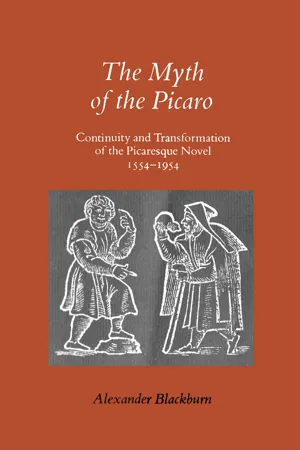
The Myth of the Picaro
Continuity and Transformation of the Picaresque Novel, 1554-1954
- 277 pages
- English
- ePUB (mobile friendly)
- Available on iOS & Android
eBook - ePub
The Myth of the Picaro
Continuity and Transformation of the Picaresque Novel, 1554-1954
About this book
Information
1: Introduction
Since the birth of the modern novel more than four hundred years ago, the myth of the picaro has been a continuous part of fiction, though often in modified form and frequently as an implied polarity to the literature of unity and love. The major literary genre of modern centuries thus not only has a recognizable birth but also has always contained within itself both the distant, undifferentiated human past and a creative present that continues to tell a story of social disorder and psychic disintegration.
The origin of most literary forms remains obscured in antiquity. We conjecture possibilities from magnificent survivors. What epics came before Gilgamesh and The Iliad, what tragedies before Job and Prometheus, are known to us as but shadows, but even were they solidly known, that knowledge would not lead to an understanding of the modern novel. Homer was not first to sing tales, nor Aeschylus to write plays, nor the author or authors of Genesis to compose Creation poems. Man’s power of imagination is so great that we may presume the existence of many a mute, inglorious Milton before Babylon. Yet even if our knowledge were to expand to make known the entire course of culture, there will still be a mystery, for the story of literature has its ubi sunt.
The first novelists created their readers, and we are still among them. Although, as a literary form, the novel is notoriously mixed with folk tales and history, epic and romance, drama, lyric, sermons, letters, biographies, and so forth, although there is no single Platonic form by which novelistic fiction may be measured, although, in short, no one is absolutely sure what a novel is beyond its being a prose narrative of length and of realistic import, there is nonetheless a historical moment when the novel—call it a modern novel, a conscious art of narration—differentiates itself from all the literature preceding it and gives similar shape thereafter to literary creations.
That moment, beyond any doubt, occurred in Spain in the first half of the sixteenth century. For a long time, of course, there have been American and European scholars who could not or would not peek over the Pyrenees. Consequently, literary nationalism has made some heavy weather concerning the rise of the novel. A prevalent belief, for example, is that the first real novels are English of the eighteenth century. According to this belief, Spanish novels are subgeneric primitives like Lazarillo de Tormes or embarrassing monuments like Don Quixote. However generously their art or tradition are acclaimed, Spanish novels have usually received, outside Spain, less than their due recognition as the first modern novels. Of course, the heyday of printing technology and, more important, of the European bourgeoisie, both significant for the rise of the novel, occurred in the eighteenth century. But it does not follow that the novel is exclusively an art form devoted to the middle class and rooted in capitalist economics. Nor does it follow that the “great tradition” of the English novel is then “the” greatest, greater than the Spanish, the French, the German, certainly greater than the American, and only overshadowed, apparently by an act of God, by the Russian. To be sure, the English novelists from Defoe to Dickens to Conrad and Lawrence, including the Irishman Joyce and the American James, form a tradition of the great, but the critical attempt to equate the English novel with the novel suffers from a lack of focus. To place the novel’s authentic origin in Spain in the sixteenth century does, I hope, extend our awareness of a subtle literary art.
Surveying the origin of novelistic fiction, we begin to see nuclear themes that for their elucidation require the resources of myth criticism. Yet, perhaps fortunately, there is no generally agreed-upon definition to apply to all instances of myth in art and literature. As Francis Fergusson writes, “One of the most striking properties of myths is that they generate new forms . . . in the imaginations of those who try to grasp them.”1 Hence we cannot lay hands on a single myth prior to its imaginative embodiments. For Plato, the first known user of the term, mytho-logia meant no more than the telling of stories. Indeed, for many, myth means stories that are Greek—something like the Greek tales of Theseus and the Minotaur, or Odysseus and the Cyclops, or Oedipus and Jocasta. Yet, classicist G. S. Kirk warns, “The truth is that Greek myths provide no better an instance of what myths quintessentially are than any other extensive cultural set.” Although we may have been brought up to regard Greek myths “as composing a paradigmatic system that can be used as a central point of reference for the whole study of mythology,”2 anthropologists and ethnologists have recorded different sets of myths from other cultures, some of them possessed of qualities without Greek parallel. Myth, then, may mean a story from any number of cultures including—to anticipate my argument—the culture of the recent West.
If myth is not confined to a particular cultural set, neither is it a category restricted to particular kinds of tales. A myth does not have to be about gods and men, about centaurs, titans, or Moby Dicks. A myth does not have to be about popular fantasies and superstitions, nor does it have to be related to rituals, although undoubtedly some of the oldest myths reveal such connections. For example, in the myth of the Divine King who was killed annually and was reborn in the person of his successor, a six-thousand-year-old Near Eastern ritual for ensuring the well-being of the community has vast literary and religious implications. But an ever-living, ever-dying god, a Christ figure, “hero of a thousand faces,” gives form and meaning only to some stories, not to all. Furthermore, myth and religion are not necessarily twin aspects or parallel manifestations of the same psychic condition, although certainly some myths such as the story of Tristan and Iseult do convey religion’s intensity of feeling of the immanent and transcendent divine mystery. Finally, myths are more than folk tales with their reflection of simple social situations, their fantasy and freely developing, often crude narrative designs.
Myths, in short, are both sacred and secular tales that yet may have a serious underlying purpose or, as Kirk calls it, an “imaginative or introspective urge.”3
In this study I am concerned with myth in two senses: first as a timeless and placeless universal story, second but primarily as a creative narrative structure. In the first sense, already too well known from Freud’s and Jung’s studies of the parallelism of dream and myth to require demonstration, myth is an elementary idea or archetype continuous with the whole history of man and thus capable of developing spontaneously, along traditional lines, wherever mankind lives, dreaming. Obviously, any theory about the spiritual unity of the human race, what James Joyce calls “the grave and constant in human experience,”4 may arrest and free the mind at its depths. The mythological archetype, cutting across boundaries of time and culture, functions to awake the sleeping consciousness to the profound mystery and order of the universe. As John B. Vickery declares in his introduction to Myth and Literature, “The ability of literature to move us is profoundly due to its mythic quality, to its possession of mana, the numinous, or the mystery in the face of which we feel an awed delight or terror at the world of man. The real function of literature in human affairs is to continue myth’s ancient and basic endeavor to create a meaningful place for man in a world oblivious to his presence.” The myth critic, he explains, “isolates latent elements, which, like those of dreams, possess the force that vitalizes the manifest pattern.”5
The archetype of the first sense of the myth in the picaresque novels is the trickster, as I shall show. To identify a veiled source of vitality, buried roots reaching down into deepest springs of being, however, scarcely discriminates between mythic and aesthetic dimensions. To consider a work a repository of some mythological archetype may violate the integrity of that work as literature. Therefore the myth critic must prepare analysis of structure. Each work is treated as individually and culturally unique, of its moment, reflecting its own time. At one level, a historical approach is called for. At another level, myth criticism comes into play by determining the underlying structure of a basic narrative, recognizing not just a more or less static archetype (such as trickster) but the dynamic “creative mythology” (as Joseph Campbell calls it) of the individual work. An author may not have been consciously aware of the underlying structure. For example, the use of myth by writers of the Middle Ages seems to have been unconscious in the great majority of instances, so that a journey-quest pattern in, say, Sir Gawain and the Green Knight surfaces because of an allegorical method of emotional exploration rather than as the conscious symbolic method of a Joyce, Eliot, and Yeats.6 Whatever the degree of an author’s consciousness of a mythic structure, the critic who discerns myth functioning at the narrative core may be able to illuminate the work of art as art, not removing our gaze from a temporal creation but bringing us to closer perception of imaginative forces acting in it.
Thus, I will argue, the idea of the picaresque novels is not exhausted by reference to trickster myth, interesting as that is as an account both of spontaneous transmission and of the attractiveness, to authors and readers, of an otherwise austere kind of story. The other, deep-down myth of the picaro, a myth containing continuity and transformation through various works and cultures for four centuries, is to be sought in narrative structures rather than in apparent content.
I am not proposing an absolute guide for identifying and defining a picaresque novel. The very existence of a literary genre such as the picaresque presupposes certain recognizable characteristics of content and technique. Let the hero be an orphan, let him relate his adventures in a more or less sardonic manner, let him wander into delinquency, and so forth—and we are orbiting in the picaresque galaxy. For genre, that may be enough, or almost. What seems to be needed is some distinction between genre and myth. That is, if picaresque genre may be viewed as traditional model or conventional pattern, then let us view picaresque myth, as Claudio Guillen declares, “as an essential situation or significant structure derived from the novels themselves.”7 Whereas both genre and myth assume continuities, those of genre are more concerned with technical characteristics, those of myth more concerned with cultural characteristics. Thus, technically considered according to genre, the picaresque novel has its central tradition in certain Spanish narratives but thereafter becomes a subgenre of the modern novel, a tributary of increasingly casual impact and significance. Although useful, the genre approach finally leaves readers and critics sprawling before the probable truth of the proposition that picarism is the contemporary, post-World War II ethos of Western culture. From genre we turn to myth, and suddenly the myth of the picaro expresses and shapes, through the participation of readers who understand themselves in a correlative way, a story that is culturally conspicuous, however infrequently or incompletely imitated.
At no period of literary history is the principle of the integrity of the individual work more demanding of the critic than in the West since the middle of the twelfth century. For the recent West, as opposed to the primitive, Oriental, and early Occidental worlds, has been a period where, in Joseph Campbell’s words,
an accelerating disintegration has been undoing the formidable orthodox tradition. . . and with its fall, the released creative powers of a great company of towering individuals have broken forth: so that not one, or even two or three, but a galaxy of mythologies—as many, one might say, as the multitude of its geniuses—must be taken into account in any study of the spectacle of our own titanic age. . . . [In] the fields of literature, secular philosophy, and the arts, a totally new type of non-theological revelation, of great scope, great depth, and infinite variety, has become the actual spiritual guide and structuring force of the civilization.8
On this overriding cultural fact of modern centuries, the displacement of traditional authority by individual experience, Campbell’s words in Creative Mythology deserve still further quotation:
In the context of a traditional mythology, the symbols are presented in socially maintained rites, through which the individual is required to experience, or will pretend to have experienced, certain insights, sentiments, and commitments. In what I am calling “creative” mythology, on the other hand, this order is reversed: the individual has had an experience of his own—of order, horror, beauty, or even mere exhilaration—which he seeks to communicate through signs; and if his realization has been of a certain depth and import, his communication will have the value and force of living myth—for those, that is to say, who receive and respond to it of themselves, with recognition, uncoerced.9
The presence of a creative mythology in the new literary form of the novel in sixteenth-century Spain is accordingly to be expected. Only a profound spiritual reorientation such as that described by Campbell can account for the emergence of new nuclear themes in the picaresque, themes of individual alienation from and loneliness within a coercive and chaotic social order.
The novel-making human spirit of the sixteenth century and thereafter perceives the highest objective truth ultimately in the form of its own experiential activity, rather than in the deterministic reality of orthodox belief. But what kind of experience of the human spirit in the sixteenth century is meant? There is a historical correlative to the fictive experience rendered in certain Spanish novels of picaresque kind. This historical correlative is found in the biography of Fernando de Rojas (1476?-1541), author of La Celestina (1499), a novelistic drama that in art of characterization through mutual interaction is equal to comparison to a Shakespearean play of a century later. A sketch of Rojas’s life leads to an understanding of the first novels, their design and tone, for which the student of fiction stands indebted to Stephen Gilman’s recent publication, The Spain of Fernando de Rojas: The Intellectual and Social Landscape of “La Celestina.”10
Rojas was a Renaissance man but also what was called in Spain a converso, a Christian of Jewish origin—a person who might have abandoned one faith without gaining another, a potentially lost soul skeptical of traditional dogma and morality. He was a member of a caste subject to intense scorn and suspicion, forced into a marginal position within his world, and reacting to persecution in a number of characteristic ways, among them cultivation of irony. The converso situation held the possibility of a counterculture or community of those experienced or conditioned enough to relish the hidden import of the ironist’s language. While the category of converso must be used cautiously, because the forcibly converted Jews were just as Spanish as were the Old Christians, the circumstances in which lived and wrote a Rojas, whose father and father-in-law were both condemned by the Inquisition, cannot be ignored. Between 1485 and 1501 in Toledo alone over seven thousand converso artisans, professional men, merchants, and city officials were permanently dishonored (publicly reconciled, jailed, or executed) by the Inquisition; and there is documentary evidence that when Rojas was perhaps twelve years old his father was arrested, imprisoned, tried, found guilty, and in all likelihood executed by fire in an auto-de-fé. Rojas graduated in law at Salamanca between 1497 and 1500 and thereafter, like many a converso, gained at least an outward form of respectability. But he was, one deduces with certainty, an artist acutely aware of his inner apartness from the society in which he grew up and, precariously, survived. His life and art constitute a mode of escape from desperation.
The facts of Rojas’s life reveal certain spiritual conditions that could give rise to the picaresque novel. Time and again the con-verso paradox of being at the center of society and also on its margin gives thematic form to early modern novels as it does to La Celestina.11
Of course, I am talking of a historical correlative, not theorizing about racial or ethnic origins for the Spanish novels. That Shakespeare wrote passionate sonnet...
Table of contents
- Cover Page
- The Myth of the Picaro
- Copyright Page
- Dedication
- Contents
- Foreword
- 1: Introduction
- 2: The Soul’s Dark Journey
- 3: The Conversion of the Natural Man
- 4: The Symbolic Confidence Man
- 5: The Tragicomedy of Self Creation
- Notes
- Bibliography
- Index
- Series
Trusted by 375,005 students
Access to over 1.5 million titles for a fair monthly price.
Study more efficiently using our study tools.
Frequently asked questions
Yes, you can cancel anytime from the Subscription tab in your account settings on the Perlego website. Your subscription will stay active until the end of your current billing period. Learn how to cancel your subscription
No, books cannot be downloaded as external files, such as PDFs, for use outside of Perlego. However, you can download books within the Perlego app for offline reading on mobile or tablet. Learn how to download books offline
Perlego offers two plans: Essential and Complete
- Essential is ideal for learners and professionals who enjoy exploring a wide range of subjects. Access the Essential Library with 800,000+ trusted titles and best-sellers across business, personal growth, and the humanities. Includes unlimited reading time and Standard Read Aloud voice.
- Complete: Perfect for advanced learners and researchers needing full, unrestricted access. Unlock 1.5M+ books across hundreds of subjects, including academic and specialized titles. The Complete Plan also includes advanced features like Premium Read Aloud and Research Assistant.
We are an online textbook subscription service, where you can get access to an entire online library for less than the price of a single book per month. With over 1.5 million books across 990+ topics, we’ve got you covered! Learn about our mission
Look out for the read-aloud symbol on your next book to see if you can listen to it. The read-aloud tool reads text aloud for you, highlighting the text as it is being read. You can pause it, speed it up and slow it down. Learn more about Read Aloud
Yes! You can use the Perlego app on both iOS and Android devices to read anytime, anywhere — even offline. Perfect for commutes or when you’re on the go.
Please note we cannot support devices running on iOS 13 and Android 7 or earlier. Learn more about using the app
Please note we cannot support devices running on iOS 13 and Android 7 or earlier. Learn more about using the app
Yes, you can access The Myth of the Picaro by Alexander Blackburn in PDF and/or ePUB format, as well as other popular books in Literature & Literary Criticism. We have over 1.5 million books available in our catalogue for you to explore.