In this political history of twentieth-century Mexico, Gladys McCormick argues that the key to understanding the immense power of the long-ruling Partido Revolucionario Institucional (PRI) is to be found in the countryside. Using newly available sources, including declassified secret police files and oral histories, McCormick looks at large-scale sugar cooperatives in Morelos and Puebla, two major agricultural regions that serve as microcosms of events across the nation. She argues that Mexico’s rural peoples, despite shouldering much of the financial burden of modernization policies, formed the PRI regime’s most fervent base of support.
McCormick demonstrates how the PRI exploited this support, using key parts of the countryside to test and refine instruments of control — including the regulation of protest, manipulation of collective memories of rural communities, and selective application of violence against critics — that it later employed in other areas, both rural and urban. With three peasant leaders, brothers named Rubén, Porfirio, and Antonio Jaramillo, at the heart of her story, McCormick draws a capacious picture of peasant activism, disillusion, and compromise in state formation, revealing the basis for an enduring political culture dominated by the PRI. On a broader level, McCormick demonstrates the connections among modern state building in Latin America, the consolidation of new forms of authoritarian rule, and the deployment of violence on all sides.
eBook - ePub
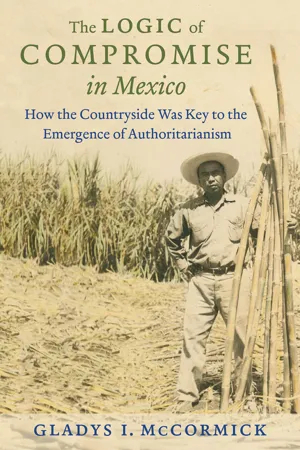
The Logic of Compromise in Mexico
How the Countryside Was Key to the Emergence of Authoritarianism
- 300 pages
- English
- ePUB (mobile friendly)
- Available on iOS & Android
eBook - ePub
The Logic of Compromise in Mexico
How the Countryside Was Key to the Emergence of Authoritarianism
About this book
Information
Chapter One: The Promise of Cardenismo in Rural Morelos
In the summer of 1952, sociologists Henrik Infield and Koka Freier visited several ejidos (communal land-holdings) in Mexico as part of the U.S.-based Group Farming Research Institute’s study of cooperative farming.1 After visiting collective and individual ejidos in Michoacán and Sonora, they concluded that Mexico’s form of cooperative farming produced uneven economic results. In their words, “we found splendid progress along with dismal stagnation, within the same area and under virtually identical conditions.”2 Near the end of their journey, they visited Lázaro Cárdenas at his home in Michoacán. The former president assured them that “there was no doubt in his mind … that sooner or later all agriculture of Mexico would be managed cooperatively, through and by ejidos.”3 That Cárdenas continued to vest hope in the ejido, nearly two decades after implementing his version of communally held agrarian reform and after subsequent administrations had done everything they could to dilute the power of the ejidos, demonstrates the ideological power behind the venture. It is this idealism, as well as the many contradictions that followed the implementation of the ejidos in the 1920s and 1930s, that this chapter explores.
The chapter outlines three complementary narratives. The first maps the changing social landscape of Morelos in the period leading up to Cárdenas’s time in office. It traces the origins of these changes from the colonial period through the tumultuous nineteenth century to explain what gave rise to one of Morelos’s most distinctive features in the twentieth century: Zapatismo’s search for agrarian justice. Though Zapata’s popular base extended through much of south-central Mexico, Morelos was undoubtedly the cradle of his movement. The profound violence witnessed in Morelos during the decade-long revolution left a lasting imprint on state-society relations. In contrast to neighboring regions, such as Puebla, Guerrero, and Oaxaca, which experienced rampant antiagrarian violence in the post-1920s period, Morelos remained peaceful because Zapatismo destroyed the power of landowners to prevent agrarian reform.4 It also formalized a framework of long-standing peasant activism that empowered rural peoples, many of whom were veterans of Zapata’s army, and forced federal government officials to recognize their place in state-formation processes. Eventually, however, as Cárdenas assumed the presidency in 1934, flaws in agrarian reform programs, demographic upheavals, and internal divisions inside rural communities set up a looming crisis in Morelos. The area became a harbinger for what was to come more generally in later decades as the governing regime extended its control to other parts of rural Mexico.
The second narrative thus concerns the postrevolutionary government’s efforts in Morelos to tackle the ravages of the 1910 revolution and to reinforce its dominance in a region that was home to many of the conflict’s veterans. As Cárdenas assumed the presidency in 1934, rural Morelos appeared on the brink of a crisis. The influx of migrants into Morelos divided communities into those with land and those without access to land. Flaws in the agrarian reform program, including disorganized distribution and poor-quality land, worsened by the Great Depression, meant that rural poverty continued to be an acute problem. With this context in mind, the president’s policies sought to modernize the Mexican countryside and, in particular, key areas such as Morelos by advancing a paradigm of progress through rural economic development that seemed at odds with traditional agrarian society. He reconciled this contradiction between this policy and his commitment to the welfare of rural people by expanding the ejido system and developing large-scale collective ventures, such as the cooperatives. These ventures acted as an extension of the welfare state, targeting rural people excluded from the benefits of agrarian reform and lending institutional continuity to the broader ejido framework.5 The large-scale sugar cooperative that Cárdenas set up in Morelos, moreover, carried a heavy symbolic weight because it was premised on fulfilling Emiliano Zapata’s promise of social justice, equality, and access to land—a promise that drove many rural peoples to take up arms in the 1910 revolution and that remained largely unfulfilled by the 1930s.
The third narrative explores the place of the sugar industry in the state’s plan for a modern, post-Depression Mexico. The 1910 revolution in this area, as Paul Hart writes, “represented an exceptional episode marked by extreme violence, but it was also part of a longer process of adaptation and resistance to the commercialization of agriculture and the transition from self-sufficient peasants into dependent workers.”6 This shift meant that Morelos’s rural peoples went from relying on subsistence agriculture through the cultivation of maize to the much more market-dependent model of sugar production. Because the market networks supporting sugar subjected communities to state oversight, this section tracks the creation of strongly differentiated peasant and worker categories. The creation of these categories exposed inherent contradictions in federal planners’ vision for rural Mexico and set up an exclusionary system that denied the promise of modernization to many rural people. The chapter concludes by arguing that sugar-production cooperatives were emblematic of the most industrialized and technologically sophisticated forms of agriculture emerging in the 1930s. Precisely because the sugar-production cooperatives married industrial and traditional forms of agrarian life, they act as a microcosm of what was happening elsewhere in rural Mexico.
The Roots of Agrarian Transformation
To the newcomer, southern Morelos appears today less attractive than the lush terrain of the northern reaches near Tepoztlán and Cuernavaca or the stunning colonial mining community of Taxco, just across the border in the state of Guerrero. This sense of inhospitality is only heightened during the dry season of the zafra, which lasts from November to May, when the light green fields of sugarcane spit smoke and ash into the air as seasonal laborers cut and process the cane. Not only is southern Morelos desertlike in its appearance during these months, but the constant and oppressive smoke also makes it difficult to breathe and renders everything a gray-brown color. Yet, this image takes on a different meaning when observed as a backdrop to the Emiliano Zapata sugar mill and its tumultuous history. The imposing smokestack emblazoned with the name of the revolutionary hero dominates the town of Zacatepec and is visible for miles around. The large bust of Lázaro Cárdenas guarding the mill’s entrance further reminds the observer of this region’s place in history and the legacy of one of Mexico’s most popular and progressive presidents. Both the bust and the smokestack convey a sense of hope, frozen in time, a reminder of the many possibilities such an enormous venture might have yielded for the region.
To begin this story, this chapter first looks at the origins of the Cooperative Society of Ejidatarios and Workers of the Emiliano Zapata Sugar Mill. By the 1950s, the enterprise was among the largest of Mexico’s seventy-five sugar mills, receiving sugarcane from more than fifty ejidos, with more than six thousand members and a budget larger than that of the state government. The millions of pesos financing this budget came from the sale of sugar to the federal government’s clearinghouse for national distribution and, to a lesser extent, from federal subsidies. Not only did the cooperative’s budget cover the salaries of hundreds of white- and blue-collar workers operating its offices and sugar mill; it also financed the factory’s upkeep, local hospitals, schools, a technical college, roadways, and other regional development projects. The cooperative’s main expenditure, however, was the purchase of sugarcane from thousands of peasants throughout the region. While the cooperative produced approximately 21,000 tons of sugar during its first zafra in 1938 and 1939, this number increased to more than 60,000 tons by the early 1950s.7 The production of this much sugar involved enormous effort from the surrounding communities, which made it one of Morelos’s largest employers. Because the mill stood as part of a large-scale cooperative for more than fifty years—from its inauguration in 1938 until its semiprivatization in 1992—it played a part in the personal lives of most of the region’s inhabitants. Since the venture was first discussed in 1935, through the years when its smokestack and Cárdenas’s bust symbolized the revolution’s promises, to its failure in the long run, the story of the cooperative reveals the nature and impact of state-led industrialization on rural development.
The contours of mid-twentieth-century agricultural developments, labor systems, and class relationships in rural Morelos had a long historical trajectory that began when Hernán Cortes introduced sugar production to the area in 1530. As Ward Barrett recounts, sugar production in this region of Mexico “borrowed” technology and labor systems from earlier experiments with the crop in the Caribbean and largely remained unchanged throughout the colonial period.8 Sugar brought with it the creation of large-scale haciendas (landed estates) that depended on the labor of indigenous peoples and, after the abolition of indigenous slavery in 1542, imported African slaves. However, the increasing expense of slaves drove owners of landed estates to replace these labor systems with free-wage arrangements with both indigenous and mestizo peoples in the area.9 These arrangements also included access to small plots of land to grow corn and other subsistence crops to guarantee their survival.10 For rural communities, sugar production was closely tied to a colonial project that, while intent on exploiting peasants, allowed them to retain forms of autonomy within their communities.
Nevertheless, this system underwent a radical transformation in the aftermath of independence in the early nineteenth century. While the colonial state had acted as a mediator between the hacendados and the communities, no such institution took its place after independence in 1820.11 Some rural communities, such as those in the highlands of Puebla, were able to maintain a degree of autonomy because of local and regional power brokers like Manuel and his son, Juan Francisco Lucas.12 This was not the case in Morelos. The power vacuum generated much more conflict between hacendados and peasants, especially with the expansion of sugar production promoting even more exploitative labor systems.13 Unfettered demands on their labor thus drove peasants to further resent their marginalized position. The Porfiriato—the thirty-five years when Porfirio Díaz ruled Mexico at the close of the nineteenth century—only worsened this resentment because increased demand for sugar production for export markets fueled land grabbing.14 Driven from their lands, peasants could no longer depend on subsistence agriculture for their survival and now turned to seasonal wage-labor relationships.15 As long as the haciendas could absorb these newly landless peasants, the export-oriented model continued despite its polarizing effect on society and heavy human cost. This system was so successful that, at the dawn of the 1910 revolution, Morelos was the country’s number one producer of sugar with twenty-six mills accounting for 30 percent of national production.16 However, a drop in demand for sugar in 1908 and 1909 led hacendados to lay off peasants, which drove rural communities to mobilize.17
The mobilizations on the eve of the 1910 revolution were not unprecedented. Rural communities had a long track record of challenging their exploitation using any means at their disposal. Although these efforts, such as spikes in banditry against those benefiting from the exploitation of rural peoples, tended to stay within local confines, they were connected to broader popular struggles, especially at moments of extreme crisis.18 These moments triggered major adjustments in the area’s political economy and opened up the field for new forms of negotiation, new actors, and new relationships of power to emerge and challenge long-standing practices. As Florencia Mallon shows, Morelos was a hotbed of agrarian radicalism in the mid-nineteenth century.19 With the background of the U.S.-Mexican War, the ensuing liberal revolution, and the French intervention, the peoples of Morelos began to encounter the meaning of both federalism and liberalism. While federalism heralded a return to traditional practices and municipal autonomy, many of Morelos’s peasants negotiated alliances with liberal elites because liberalism promised effective political representation, access to land, and the rights of citizenship. Once the dust settled in the second half of the 1860s and the need for the elites to forge coalitions with the popular classes passed, victorious liberal leaders reneged on their promises and proceeded to politically marginalize Morelos’s rural peoples. Despite this defeat, these rural peoples used their experience to elaborate an even more coherent popular political agenda, which melded the rights of citizenship with the promise of land distribution. As Emiliano Zapata showed, they had this more mature agenda in mind at the start of the 1910 revolution.20
Although independence and the liberal revolution failed to improve the situation for Morelos’s communities, the 1910 revolution suggested the possibility of a different outcome because of Emiliano Zapata’s tenacious call for the return of land to peasants and the rejection of export-oriented agriculture. Ove...
Table of contents
- Cover Page
- Halftitle Page
- Title Page
- Copyright Page
- Dedication
- Contents
- Acknowledgments
- Abbreviations
- Introduction
- Chapter One: The Promise of Cardenismo in Rural Morelos
- Chapter Two: The Limits of Cardenismo: The Emergence of Rubén Jaramillo
- Chapter Three: The Logic of Compromise: The Forgotten Tale of Antonio Jaramillo
- Chapter Four: Undoing of Rural Autonomy: The Rise and Fall of Porfirio Jaramillo
- Chapter Five: A Laboratory for State-Sponsored Violence, 1952–1958
- Chapter Six: Taking History Forward: The Institutionalization of Authoritarianism, 1958–1962
- Chapter Seven: Searching for New Heroes, 1962 and Beyond
- Conclusion
- Notes
- Bibliography
- Index
Trusted by 375,005 students
Access to over 1.5 million titles for a fair monthly price.
Study more efficiently using our study tools.
Frequently asked questions
Yes, you can cancel anytime from the Subscription tab in your account settings on the Perlego website. Your subscription will stay active until the end of your current billing period. Learn how to cancel your subscription
No, books cannot be downloaded as external files, such as PDFs, for use outside of Perlego. However, you can download books within the Perlego app for offline reading on mobile or tablet. Learn how to download books offline
Perlego offers two plans: Essential and Complete
- Essential is ideal for learners and professionals who enjoy exploring a wide range of subjects. Access the Essential Library with 800,000+ trusted titles and best-sellers across business, personal growth, and the humanities. Includes unlimited reading time and Standard Read Aloud voice.
- Complete: Perfect for advanced learners and researchers needing full, unrestricted access. Unlock 1.5M+ books across hundreds of subjects, including academic and specialized titles. The Complete Plan also includes advanced features like Premium Read Aloud and Research Assistant.
We are an online textbook subscription service, where you can get access to an entire online library for less than the price of a single book per month. With over 1.5 million books across 990+ topics, we’ve got you covered! Learn about our mission
Look out for the read-aloud symbol on your next book to see if you can listen to it. The read-aloud tool reads text aloud for you, highlighting the text as it is being read. You can pause it, speed it up and slow it down. Learn more about Read Aloud
Yes! You can use the Perlego app on both iOS and Android devices to read anytime, anywhere — even offline. Perfect for commutes or when you’re on the go.
Please note we cannot support devices running on iOS 13 and Android 7 or earlier. Learn more about using the app
Please note we cannot support devices running on iOS 13 and Android 7 or earlier. Learn more about using the app
Yes, you can access The Logic of Compromise in Mexico by Gladys I. McCormick in PDF and/or ePUB format, as well as other popular books in History & Mexican History. We have over 1.5 million books available in our catalogue for you to explore.