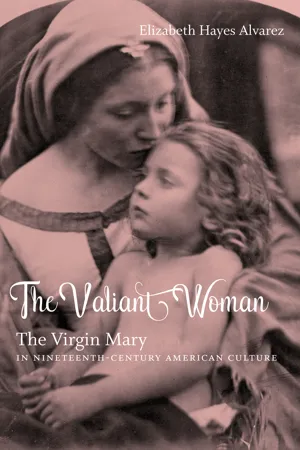
Nineteenth-century America was rife with Protestant-fueled anti-Catholicism. Elizabeth Hayes Alvarez reveals how Protestants nevertheless became surprisingly and deeply fascinated with the Virgin Mary, even as her role as a devotional figure who united Catholics grew. Documenting the vivid Marian imagery that suffused popular visual and literary culture, Alvarez argues that Mary became a potent, shared exemplar of Christian womanhood around which Christians of all stripes rallied during an era filled with anxiety about the emerging market economy and shifting gender roles.
From a range of diverse sources, including the writings of Anna Jameson, Anna Dorsey, and Alexander Stewart Walsh and magazines such as The Ladies' Repository and Harper’s, Alvarez demonstrates that Mary was represented as pure and powerful, compassionate and transcendent, maternal and yet remote. Blending romantic views of motherhood and female purity, the virgin mother’s image enamored Protestants as a paragon of the era’s cult of true womanhood, and even many Catholics could imagine the Queen of Heaven as the Queen of the Home. Sometimes, Marian imagery unexpectedly seemed to challenge domestic expectations of womanhood. On a broader level, The Valiant Woman contributes to understanding lived religion in America and the ways it borrows across supposedly sharp theological divides.
eBook - ePub
The Valiant Woman
The Virgin Mary in Nineteenth-Century American Culture
- 256 pages
- English
- ePUB (mobile friendly)
- Available on iOS & Android
eBook - ePub
About this book
Information
Topic
Theology & ReligionSubtopic
Christian DenominationsChapter One: The Immaculate Conception of the Blessed Virgin Mary
Conflict and Conversation, 1854–1855
O Mother! I could weep for mirth, Joy fills my heart so fast;
My soul to-day is heaven on earth, O could the transport last!
I think of thee, and what thou art, Thy majesty, thy state;
And I keep singing in my heart—Immaculate! Immaculate!
But brethren, it is not enough, in such a day as this, to abjure what is false; we are taught by an apostle, that we ought also, to “contend earnestly for the faith once delivered to the saints.”… There are good men, among Romanists,… Now then let us be prepared to show them “the good old paths.”
On December 8, 1854, Pope Pius IX declared the Immaculate Conception of the Blessed Virgin Mary—her exemption, at the moment of her conception, from the inheritance of original sin—to be the faith of the Catholic Church. The newspaper Univers of Paris declared: “Two hundred Bishops were present. Never has such a multitude been seen. Rome is intoxicated with joy.”1 American newspapers widely reprinted these pithy lines in the following weeks and months alongside accounts of the ceremony and the celebrations, explanations of the doctrine, and with equal frequency, Protestant denunciations of it.
Witnesses described the ceremony as emotionally powerful: the pontiff raised the question of Mary’s conception, waited for confirmation by the Holy Spirit, and then, with visible tears and a cracking voice, declared the Immaculate Conception of the Blessed Virgin Mary to be dogma of the Church. The proclamation received thunderous applause during which attendants raised Pius IX, seated in his chair, onto their shoulders and carried him to the Chapel of the Virgin. There, he placed a jewel-encrusted crown on a beautifully adorned statue of Mary. After the ceremony, the Basilica of St. Peter was lit with an estimated six thousand tallow and turpentine lamps to produce a “scene of splendor probably nowhere equaled… indescribable.”2 As the building receded into the evening darkness, it became “perfectly invisible, while the immense mass seemed as if it were constructed of lights.”3 Processions and jubilation followed in the streets of Rome, and cities throughout the world celebrated into the night.
THE IMMACULATE CONCEPTION declaration—the proclamation of a doctrine already widely embraced by Catholics—was welcomed by American Catholics, but provoked vehement reactions from Protestants. The move of the doctrine to dogma amplified an intractable theological disagreement between Protestants and Catholics and was perceived by both groups as a bold and unapologetic assertion of Catholic Mariology. In countless articles and editorials, Protestant critics decried both the content of the doctrine and its mode of pronouncement. Some Protestant theologians, familiar with the historical arguments for and against the doctrine, engaged its complex theology; however, most objected to it on three main grounds: it grew out of Catholic tradition more than biblical witness; it was decided by papal fiat, not free religious debate; and most important, it seemed to place a female figure, Mary, on the same footing with the male Christ.
Catholic veneration of the saints, and of Mary in particular, had long been an area of theological discord and, more pointedly, a target for anti-Catholic propagandists who painted devotional practices as idolatry. But because the beleaguered pope made a grand gesture using a Marian doctrine to assert his spiritual authority, he moved Marian devotion even more to the fore. The declaration placed her figure at the center of the Church’s identity in a changing world. Such a visible endorsement of Catholic Mariology reinforced the divergence between Catholic and Protestant attitudes toward Mary. However, Protestants did not simply give up using Marian imagery; instead, arguments over her were heated. The declaration reignited a contention for the right to use and define her role in Christianity that would continue into the early years of the twentieth century.
In response to the declaration, Protestants not only denounced Catholic Mariology but also publicly reflected on and clarified Mary’s appropriate role in Christianity. Many more articles on Mary were published in these years than in previous decades. In these articles, Protestants articulated their beliefs about Mary and objected to her place in Catholicism, often focusing on her sex and her role as an exemplar of womanhood and motherhood. I examine the challenges to American gender norms triggered by the declaration in chapter 2; here, I look closely at other pervasive themes that arose in these writings. The Immaculate Conception declaration accentuated the distinctive and, for many Protestants, unfamiliar aspects of Catholic Marian theology. The three most prevalent critiques of the declaration—that it was an authoritarian “binding” of Catholic minds, that it was “innovative,” and that it contributed to an overshadowing of Jesus by Mary—were distinct expressions of already prevalent nativist tropes. Protestants feared the political and social implications of escalating Catholic immigration, so debates with or about Catholics were often about the right to control and define American identity. The charge of authoritarianism, therefore, was driven by Protestant anxieties about papal control over Catholics, particularly about the opinions, behavior, and votes of foreign-born Catholics. The charge of innovation was also tied to fears of papal power. It was often expressed as an objection to the Catholic Church’s claim to have the authority to teach (“decide”) doctrine, which Protestants contrasted to the authority of a (supposedly unitary) “plain reading” of the Bible. Finally, the charge of Mary’s overprominence was tied to fears about Catholic transgression of (again, supposedly unitary) American gender, family, and sexual norms.4 Protestants used these themes to portray Catholics as intrinsically outside “Christian” and “American” categories.
Immaculate Conception: History, Context, and Reactions
A feast day honoring Mary’s “conception” and later her “immaculate conception” originated in the East by the seventh century and spread throughout Europe.5 The objections of early twelfth-century abbot, Marian devotee, and theologian St. Bernard of Clairvaux that the feast lacked ancient precedent and was doctrinally misleading slowed its progress.6 In response to his arguments, the feast was abolished or renamed the feast of the “conception” of Mary, rather than the “immaculate conception” in some areas. This semantic distinction accomplished little, however, because holding a feast to celebrate Mary’s conception (not merely her birth or her life) presupposed some set of miraculous circumstances surrounding it. The Church’s endorsement or censure of the feast prompted theological reflection on the merit and status of the doctrine. In the thirteenth century, prominent theologians—including Dominicans St. Albert the Great and St. Thomas Aquinas, and Franciscan St. Bonaventure—contended against it on theological grounds. The Dominican order, taking their cue from Aquinas’s opposition, followed suit. However, among the doctrine’s defenders was the great Franciscan scholar John Duns Scotus, whose writings formed a basis for the Franciscan order’s committed support. Eventually, the European universities, beginning with the University of Paris in 1497, each decided in favor of the Immaculate Conception doctrine and required scholars to take oaths defending it. During the following centuries, theological subtleties were clarified and debates became timeworn as learned opinion coalesced in favor of the doctrine. This mounting support culminated in Pope Clement XI’s 1708 decision to elevate the feast to one of obligation for the universal Church. However, papal support for the feast was not equivalent to propagation of the doctrine, and individual theologians, particularly Dominicans, exercised their freedom to oppose it. The dispute between Dominicans and Franciscans over the Immaculate Conception persisted. The longstanding divide was repeatedly (and gleefully) recounted in American periodicals in the decades before the declaration brought the issue to the fore, leaving American Protestants with an inaccurate sense of Catholic disunity on a subject that there was actually very little disagreement about.7
When Pius IX decided to officially resolve the question of Mary’s conception, he took a unique and radical course of action. In 1849, while exiled in Gaeta during a period of extreme political unrest that many supposed would weaken his leadership, he issued the encyclical Ubi Primum, announcing his resolve to decide the Immaculate Conception question and requesting the prayers and advice of bishops worldwide.8 It was widely recognized that the encyclical was not actually an open inquiry, but the first step in the formalization of the doctrine into dogma. A large majority of bishops replied with enthusiastic support for the doctrine. Their responses affirmed their endorsement of Mary’s exemption from original sin, but it was clear they were also formal assertions of loyalty to the pontiff in exile. Only fifty of the six hundred or so bishops who responded to the encyclical expressed reservation, with some calling the doctrine undefinable or, more commonly, politically inopportune. Of these, only a handful actually withheld endorsement. All American bishops and prominent American theologians supported the doctrine. The bishop of Philadelphia, John Neumann, and the archbishop of New York, John Hughes, were particularly vocal promoters.9
When Pius IX called the convention in Rome to decide the question, it was largely understood to be a formality. The form of the convention was new; because it was not an ecumenical council and had no official avenue of representation, the assembled bishops formed an audience rather than a decision-making body. Two Jesuit theologians, Fathers Giovanni Perrone and Carlo Passaglia, wrote the main text of what would become the solemn proclamation, Ineffabilis Deus. Several attending bishops were asked to review and contribute to the prewritten proclamation, and minor changes were made, but no opportunity to debate the question was provided.
The most significant Catholic opponent of the doctrine was the French priest Abbé M. Laborde of Lectoure, who traveled to Rome to formally protest the proclamation and there was questioned and detained. His protest was not officially acknowledged. Laborde’s account of his experience in Rome was widely publicized in the United States, and his book, The Impossibility of the Immaculate Conception as an Article of Faith, detailing his opposition to the doctrine, was published in the United States, France, and England and reissued in several editions during the next decade. Protestant critics of the declaration quoted it liberally and promoted it as evidence of Catholic disunity. The Church Review, for example, celebrated it as “one of the most remarkable books of the day” because it showed that even a “learned Papist who adheres religiously to the doctrine of Papal Supremacy” was willing to sacrifice his career to protest “the new popish infidel dogma” that was “ruinous to the case of faith.” The review asserted that other Catholics would surely join with Laborde and that he “will not stand alone.”10 Laborde’s book was placed on the Index Librorum Prohibitorum, the Vatican’s List of Forbidden Books.11
While the convention clearly was not an ecumenical council, some bishops advised that an assembly of bishops should stand with the pope when he made the pronouncement, to signal their support and consent. However, the pope chose to stand alone. It was immediately apparent that the proceedings had implications beyond Mariology. The pope had declared doctrine solely on his own authority, he spoke alone, and his declaration was received without challenge by the bishops of the Church. The Univers of Paris epitomized the event in the widely reprinted line: “Peter arises, he speaks, he commands, he is victor.”12 The New York Evangelist quoted a Vatican propaganda office pamphlet conveying the significance of the mode of the pronouncement: “The Holy See is about to exercise its highest prerogative of infallibility, and the occurrence of so rare an event must necessarily engage the attention of the whole civilized world.”13 It certainly commanded the attention of Americans. While the aftermath of the Kansas-Nebraska Act and the formation of the Republican Party dominated the news in a country less than a decade away from the eruption of civil war, U.S. press coverage of the Immaculate Conception proclamation was surprisingly extensive. Media stories expressed particular concern about increased papal power, at least over religious matters.
In an apostolic letter written after the convention, Pius IX clarified the implications of his action. He explained that, as pope, he had sufficient authority to define dogma without a general council and that the replies he received to Ubi Primum not only supported the Immaculate Conception but also the exercise of his papal prerogative to declare dogma. The bishops, he wrote, “entreated of Us with a common voice that the Immaculate Conception of the Virgin should be defined by Our supreme judgment and authority.”14 Emphasizing the legitimacy of such papal authority, Pius continued: “We resolved that We should no longer delay to sanction and define, by Our supreme authority, the Immaculate Conception of the Virgin.”15
American Catholics were buoyed both by the means and the content of the declaration, while Protestants denounced it as an unreasonable assertion of papal power. The New York Times framed the issue for readers unfamiliar with Catholic institutional structures: “It is a cardinal doctrine of the Catholic… that infallibility necessarily resides… in the Church; but there is an old difference of opinion as to where precisely, in the Church, that quality of prerogative is lodged. Some maintain that it vested only in general councils; others that the See of Rome also may appropriate it.”16 Protestants did not agree that the Catholic Church was infallible in any part, but many Protestant denominations accepted the early ecumenical councils as authoritative and, despite rejecting the authority of later councils, sided with conciliar rather than papal control over dogma.17 The Times article concluded with a quotation from a French bishop, who boldly announced: “Holy Father! Thou hast not only decided the Immaculate Conception—thou has decided thine own infallibility.”18 Sixteen years later, that implication was fully realized when the doctrine of papal infallibility, the pope’s right to pronounce dogma apart from an ecumenical council, was affirmed at the First Vatican Council (1869–70).
American coverage of the doctrine and its proclamation was biased and often misleading. Journalists and editors especially mocked the exuberance of Catholics and their hopes for spiritual renewal. “You will hear by this mail that Europe in general, and Rome in particular, is ‘intoxicated with joy,’” wrote a correspondent for the New York Daily Times: “Now, joy is certainly better than brandy to be intoxicated with; however, I don’t like drunkards in any shape, and so I must protest against my being counted in the number comprised in the collective expression of ‘Europe.’ I am not at all intoxicated with anything, however the Pope may declare, for such is the telegraphed reason of such an uncommon inebriety—‘the immaculate conception of the Virgin.’ But, then, you will say, I am an heretic. Just so, and I accept my lot, come what will.”19 Jokingly appropriating the term “heretic,” the correspondent used his minority status as a non-Catholic in France to reinforce his readers’ privileged majority status as Protestants in the United States, while interpreting Catholic unity and celebration as collective delusional hedonism. While the tone of the report was entertaining and sardonic, the writer reinforced a “Protestant voice” of measured rationalism against an imagined Catholic emotionalism.
The French correspondent for the Independent likewise described the European reaction for American readers, writing:
No one now is regarded as a good Roman Catholic who denies the future dogma; indeed it seem...
Table of contents
- Cover Page
- Title Page
- Copyright Page
- Dedication
- Contents
- Illustrations
- Acknowledgments
- Halftitle Page
- Introduction
- Chapter One: The Immaculate Conception of the Blessed Virgin Mary: Conflict and Conversation, 1854–1855
- Chapter Two: The Immaculate Conception and the Elevation of the Feminine, 1855–1860s
- Chapter Three: The WOMAN Highly Blessed: Marian Art and Anna Jameson’s “Great Hope,” 1850s–1870s
- Chapter Four: Revitalizing Church and Culture: The Marian Heroines of Anna Dorsey and Alexander Stewart Walsh, 1880s–1890s
- Chapter Five: Queen of Heaven and Queen of the Home: Mary and Models of Domestic Queenship, 1880s–1900
- Epilogue: The Immaculate Conception Proclamation Semicentennial, 1904
- Notes
- Bibliography
- Index
Trusted by 375,005 students
Access to over 1.5 million titles for a fair monthly price.
Study more efficiently using our study tools.
Frequently asked questions
Yes, you can cancel anytime from the Subscription tab in your account settings on the Perlego website. Your subscription will stay active until the end of your current billing period. Learn how to cancel your subscription
No, books cannot be downloaded as external files, such as PDFs, for use outside of Perlego. However, you can download books within the Perlego app for offline reading on mobile or tablet. Learn how to download books offline
Perlego offers two plans: Essential and Complete
- Essential is ideal for learners and professionals who enjoy exploring a wide range of subjects. Access the Essential Library with 800,000+ trusted titles and best-sellers across business, personal growth, and the humanities. Includes unlimited reading time and Standard Read Aloud voice.
- Complete: Perfect for advanced learners and researchers needing full, unrestricted access. Unlock 1.5M+ books across hundreds of subjects, including academic and specialized titles. The Complete Plan also includes advanced features like Premium Read Aloud and Research Assistant.
We are an online textbook subscription service, where you can get access to an entire online library for less than the price of a single book per month. With over 1.5 million books across 990+ topics, we’ve got you covered! Learn about our mission
Look out for the read-aloud symbol on your next book to see if you can listen to it. The read-aloud tool reads text aloud for you, highlighting the text as it is being read. You can pause it, speed it up and slow it down. Learn more about Read Aloud
Yes! You can use the Perlego app on both iOS and Android devices to read anytime, anywhere — even offline. Perfect for commutes or when you’re on the go.
Please note we cannot support devices running on iOS 13 and Android 7 or earlier. Learn more about using the app
Please note we cannot support devices running on iOS 13 and Android 7 or earlier. Learn more about using the app
Yes, you can access The Valiant Woman by Elizabeth Hayes Alvarez in PDF and/or ePUB format, as well as other popular books in Theology & Religion & Christian Denominations. We have over 1.5 million books available in our catalogue for you to explore.