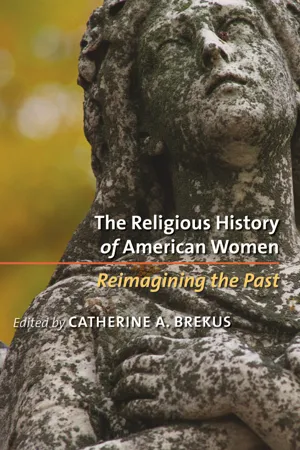
More than a generation after the rise of women’s history alongside the feminist movement, it is still difficult, observes Catherine Brekus, to locate women in histories of American religion. Mary Dyer, a Quaker who was hanged for heresy; Lizzie Robinson, a former slave and laundress who sold Bibles door to door; Sally Priesand, a Reform rabbi; Estela Ruiz, who saw a vision of the Virgin Mary — how do these women’s stories change our understanding of American religious history and American women’s history?
In this provocative collection of twelve essays, contributors explore how considering the religious history of American women can transform our dominant historical narratives. Covering a variety of topics — including Mormonism, the women’s rights movement, Judaism, witchcraft trials, the civil rights movement, Catholicism, everyday religious life, Puritanism, African American women’s activism, and the Enlightenment — the volume enhances our understanding of both religious history and women’s history. Taken together, these essays sound the call for a new, more inclusive history.
Contributors:
Ann Braude, Harvard Divinity School
Catherine A. Brekus, University of Chicago Divinity School
Anthea D. Butler, University of Rochester
Emily Clark, Tulane University
Kathleen Sprows Cummings, University of Notre Dame
Amy Koehlinger, Florida State University
Janet Moore Lindman, Rowan University
Susanna Morrill, Lewis and Clark College
Kristy Nabhan-Warren, Augustana College
Pamela S. Nadell, American University
Elizabeth Reis, University of Oregon
Marilyn J. Westerkamp, University of California, Santa Cruz
- 352 pages
- English
- ePUB (mobile friendly)
- Available on iOS & Android
eBook - ePub
About this book
Information
Topic
Theology & ReligionSubtopic
North American History 1
Puritan Women, Spiritual Power, and the Question of Sexuality
Marilyn J. Westerkamp
In this chapter, Marilyn Westerkamp draws on the insights of both women’s history and gender history to enrich our understanding of Puritanism, one of the most researched topics in American religious history. Since hundreds of books have been published about Puritan theology, politics, and piety, it may be hard to imagine that women’s history can offer any new perspectives. But as Westerkamp shows, women’s history adds new individuals and episodes to the history of Puritanism; it raises new questions about how Puritan theology shaped everyday life, including childrearing, family responsibilities, and death; it reveals that male clergy tried to establish orthodoxy by labeling witchcraft, heresy, and dissent as “feminine” deviance; and it leads scholars to central questions about religion, gender, and power.
When Perry Miller published Orthodoxy in Massachusetts (1936), followed by the breathtaking two-volume New England Mind (1939, 1956), he charted the course for Puritan studies and, in the process, transformed historical understanding of Puritan New England.1 Before Miller, New England had been seen as an exceptional, unpleasant place characterized by intolerance, theocracy, and hypocrisy—the New England of Nathaniel Hawthorne’s Scarlet Letter. Miller redeemed the Puritans and their colonies, reconstructing their worldview and their theology while recognizing their complexity, dedication, and focus upon the divine. Encountering anxious men seemingly plagued with ideological contradictions, Miller untangled the contradictions and argued that the Puritans’ intellectual system was a logically constructed network of scientific, theological, and philosophical views. Miller’s Puritans were men of high principle and commitment who strove to create a godly community in the New World.
Yes, Miller’s Puritans were men. Very few women appeared in his narrative, his analysis, or his notes. In fact, when reading Miller’s New England Mind, one gets the impression that women were singularly unimportant, even in crises that lesser scholars might argue revolved around women. In Miller’s productive years, when high school students read the literary canon, the best-known Puritan woman may indeed have been Hester Prynne. Of course, Anne Hutchinson ran a close second and Mary Dyer a distant third, followed by Anne Bradstreet, first published poet in British America, but judged sadly derivative and unimaginative. And, of course, there were Abigail Williams, Elizabeth Proctor, and Rebecca Nurse, all of whom, though actual persons, probably owed their fame to Arthur Miller’s The Crucible.
Let me note, for the record, that in dealing with the Antinomian crisis of 1636-37, Miller preferred to focus upon four Johns and two Thomases,2 rendering Hutchinson peripheral to an orthodoxy debate about salvation, free grace, and human endeavor. In his consideration of the 1650s and 1660s, when the Quakers, women and men, were undermining the strength of the magistracy, Miller devoted far greater attention to the Half-Way Covenant, a debate among the clergy about the terms of membership in the church. (To this day, many professors plague students with the esoterica surrounding the Half-Way Covenant while failing to notice that the Puritans actually tortured and executed Quakers during these same years.) Finally, Miller more or less ignored the shake-up of the 1690s, when several young women, with the assistance of their elders, managed to ignite a witch scare across Massachusetts during which 185 people were accused of witchcraft—26 were convicted, 19 were executed (most of them women), and 1 was pressed to death.
In this fashion Perry Miller set the agenda for understanding what was and was not significant to Puritan studies. With two possible exceptions, historians did not incorporate women into the story until the mid-1980s, when women’s history finally reached back into the early centuries.3 Thus at its most basic level, women’s history has provided inclusivity. Anne Hutchinson, whose trials before the colonial assembly and the Church of Boston ended a major social, political, and theological conflict during the first decade of settlement, has returned to a central role in the story of the Antinomian crisis.4 And Anne Bradstreet has been rediscovered and found to be more than a derivative and second-class poet. However, inclusion should take historians beyond some “great women” counterpoint. Consider, for example, the case of Marmaduke Mathews.
In May 1649, Marmaduke Mathews, minister at Hull, was called before the General Court of Massachusetts to answer for “severall erroneous expressions, others weake, inconvenient, and unsafe.” Although admonished and officially separated from his congregation, Mathews continued preaching, using “other unsafe, offensive expressions.” The government warned the congregation at Malden “not to proceed to the ordination of Mr. Mathewes . . . yett, contrary to all advice, and the rule of Gods word, as also the peace of the churches, the church of Malden hath proceeded to the ordination of Mr Mathewes.” Two years later, the General Court, finding all parties recalcitrant, fined Mathews £10 and the town of Malden £50. In the end, Mathews did deliver some form of confession, not as complete as had been hoped, but accepted nonetheless. Neither fine, however, was remitted, for the court considered it had experienced a great amount of trouble clearing up this incident. 5 Compared with the magnitude of previous conflicts, this seems a minor incident. It is interesting that the town appears to have been in collusion with its heterodox minister—Malden, as well Mathews, was chastised. Also significant, however, is a petition from the women of Malden, who explained that “god in great mercie to our souls as we Trust hath after many prayers Indeavors & long wayting brought Mr. Mathews Among us & putt him into the worke of the Ministrie.” Through his “pious life & labour the Lord hath Afforded [the town] Many Saving convictions . . . and Consolations.” 6 The town had been spiritually bereft, the women shared the longing, and they claimed benefit from this minister, implicitly asserting their participation in the life of the congregation and the colony.
In all of its unimportance—just another tale of Massachusetts government trouncing upon a town of upstarts and asserting the right of the state to determine orthodoxy—this little story reveals a central feature of Puritanism, namely, the explicit involvement of women. While historians have found that from at least the seventeenth century onward women provided the core membership in most Christian organizations, the institutions themselves expected women to sit quietly in pews, to be guided by male ministers or priests and leading laymen. Women’s beliefs and activities have been teased out of official minutes, texts, and reactions recorded by men. Among Puritans, however, women as individuals pursued their own spiritual journeys and participated in the life of their congregations. Although Puritan leaders certainly preferred that women sit quietly in the pews, and although Puritan women may have frequently spoken through husbands, fathers, or male church elders, they did sometimes speak for themselves, and their voices were heard and heeded.
This extension of spiritual power to women was a key aspect of Puritan culture. Mary Oliver, for example, was imprisoned, fined, put in stocks, and threatened with the whip before she was permitted to leave the colony forever. Initially cited for her complaints about church membership, later accusations included “contemning the ordinance of God” and proclaiming that the governor was unjust, corrupt, and a wretch. Rather than brush her off as an insignificant, middling-class woman, the magistrates issued increasingly harsh sentences as they failed to silence her criticisms or extricate themselves from her argument.7 Anne Hutchinson caused a problem not because she spoke out and criticized the ministers, but because her spiritual gifts were recognized and admired, leading people, women and men, to grant her speech authority. Historians of women are becoming wary of what might be called the system’s trap. Before reconstructing and analyzing the systematic efforts and strategies used by Puritan leaders to silence women like Hutchinson, historians must recognize that Hutchinson was making a lot of noise and attracting a significant following of men and women. Leaders did not simply excommunicate and ignore her; they acknowledged her power and demonstrated their own fear when they threw her out of the colony.
From this perspective, the inclusion of individual women in the historical reconstruction of Puritanism is essential if historians hope to comprehend the complexities of this spiritual movement. And historians might go further and investigate the nature of women’s experiences as Puritans in more general terms. Turning to women in this way pushes scholars to envision Puritanism as multivalent at the popular level. Of course, for the past twenty years, historians have granted that Puritanism per se, even New England Puritanism, was not a monovocal system, but one comprising multiple theologies and practices that were debated and processed.8 Women’s religious history travels farther along this pathway. While scholars have found a gender dichotomization of spirituality to be increasingly simplistic, explorations of the experiences of women as women may provide alternative pieces of Puritan spirituality.
To explore such possibilities, what would happen if Anne Dudley Bradstreet displaced John Winthrop or Thomas Shepard as the quintessential Puritan? She, too, arrived on board the Arbella with Winthrop; she was the daughter of one governor and wife of another. She lived to be sixty and bore eight children; seven survived her. In Ipswich and, later, Andover, Massachusetts, she had responsibility for a large household of children and servants, often as the primary authority figure, since her husband was frequently absent from home serving in the colony assembly. Amid her ordinary duties, Bradstreet also composed an interesting sort of personal journal through poetry. One set of verses engaged conventional themes with conventional rhythms and language and was judged worthy of publication by contemporary standards. However, a second group, not intended for publication, contemplated the crises and blessings of her own life. Of a radically different quality and nature, these verses reflected a depth of emotion and personal engagement that made for intimate, touching, and, undoubtedly, better poetry. While it is unclear who the intended audience was—perhaps no one aside from herself—the verses read like spiritual self-reflection, not unlike the diaries of Michael Wigglesworth or Thomas Shepard. The texts enable historians to explore the particular anxieties and experiences of a Puritan woman through the prism of her religious world.
Bradstreet experienced complex, contradictory feelings over childbearing. While she undoubtedly participated in the gracious female community of birthing, she, like other women, grimly accepted the possibility of death. A woman might die giving birth to her first child, or a woman who had lived through eight pregnancies might not survive the ninth. Any woman facing childbirth was likely to have known more than one woman who had died giving birth.9 Moreover, in the seventeenth century, most women had suffered the death of at least one infant, and some lost half their children at birth.10 Healthy Puritans frequently spoke in general terms about death looming over everyone, but no healthy Puritan was more aware of mortality than an expectant woman. As she neared the end of one pregnancy, Bradstreet wrote a farewell poem to her husband.11 In later poems she memorialized a daughter-in-law who died in childbirth as well as three grandchildren who died before reaching the age of four.
Within Bradstreet’s mourning for her three-year-old grandchild, Anne, her grief is joined to guilt and self-recrimination at her own selfish sorrow.
I knew she was but a withering flower,
That’s here today, perhaps gone in an hour; . . .
More fool then I to look on that was lent
As if mine own, when thus impermanent.
And again, she counters her own pain at the loss of her grandchild Elizabeth, aged eighteen months, with her ultimate Puritan faith.
Blest babe, why should I once bewail thy fate,
Or sigh thy days so soon were terminate,
Sith thou art settled in an everlasting state .12
Among the most revealing of these poems on death is her memorial to her daughter-in-law, who died in childbirth. According to the poem, Mercy Bradstreet was twenty-eight; she had previously had four children, three of whom died. This fifth child died within a week of the mother’s death. Bradstreet expressed grief for herself and her son, who “hath lost both tree and fruit.” Yet the verses also reveal a cosmology that enabled her to process these losses. Mercy was at peace, “All freed from grief (I trust) among the blest;” and one child remained to bring joy and comfort. Bradstreet finished the poem with a faithful encouragement to her son to trust in God.
Cheer up, dear son, thy fainting bleeding heart,
In Him alone that caused all this smart;
What though thy strokes full sad and grievous be,
He knows it is the best for thee and me.13
Bradstreet’s strong connection to her family was revealed in these private poems, more than half of which explicitly focused upon children, grandchildren, and her husband. Like Margaret Winthrop, whose letters always expressed acceptance of divine providence, Bradstreet tempered her love for spouse Simon with resignation to his magisterial duties and to God’s will. But also like Winthrop, anxiety and longing came through: “If two be one, as surely thou and I, / How stayest thou there, whilst I at Ipswich lie?”14 For as concerned as she was with her family, Bradstreet’s writings did not neglect herself. Ten poems responded to her own illnesses, providing opportunities to explore not fears as much as the expectation of death and salvation. She lamented the pain and tedium of illness and regretted her husband’s absence, “but my God, who never failed me, was not absent but helped me and graciously manifested his love to me.”15 Such trust in God is prevalent throughout these writings where complaints about sickness and hardship were balanced with an understanding of God’s purpose in this providence: “[God] hath never suffered me long to sit loose from Him. . . . I have no sooner felt my heart out of order, but I have expected correction for it, which most commonly hath been upon my own person in sickness . . . sometimes on my soul, in doubts and fears of God’s displeasure. . . . Sometimes He hath smote a child with a sickness, sometimes by losses in estate. . . . I have found them the times when the Lord hath manifested the most love to me.”16
Br...
Table of contents
- Table of Contents
- Title Page
- Copyright Page
- Dedication
- Introduction
- 1 - Puritan Women, Spiritual Power, and the Question of Sexuality
- 2 - Revelation, Witchcraft, and the Danger of Knowing God’s Secrets
- 3 - Hail Mary Down by the Riverside
- 4 - Sarah Osborn’s Enlightenment
- 5 - Beyond the Meetinghouse
- 6 - Unrespectable Saints
- 7 - Women’s Popular Literature as Theological Discourse
- 8 - The “New Woman” at the “University”
- 9 - Faith, Feminism, and History
- 10 - “Are You the White Sisters or the Black Sisters?”
- 11 - Engendering Dissent
- 12 - Little Slices of Heaven and Mary’s Candy Kisses
- Acknowledgements
- Selected Readings
- Contributors
Trusted by 375,005 students
Access to over 1.5 million titles for a fair monthly price.
Study more efficiently using our study tools.
Frequently asked questions
Yes, you can cancel anytime from the Subscription tab in your account settings on the Perlego website. Your subscription will stay active until the end of your current billing period. Learn how to cancel your subscription
No, books cannot be downloaded as external files, such as PDFs, for use outside of Perlego. However, you can download books within the Perlego app for offline reading on mobile or tablet. Learn how to download books offline
Perlego offers two plans: Essential and Complete
- Essential is ideal for learners and professionals who enjoy exploring a wide range of subjects. Access the Essential Library with 800,000+ trusted titles and best-sellers across business, personal growth, and the humanities. Includes unlimited reading time and Standard Read Aloud voice.
- Complete: Perfect for advanced learners and researchers needing full, unrestricted access. Unlock 1.5M+ books across hundreds of subjects, including academic and specialized titles. The Complete Plan also includes advanced features like Premium Read Aloud and Research Assistant.
We are an online textbook subscription service, where you can get access to an entire online library for less than the price of a single book per month. With over 1.5 million books across 990+ topics, we’ve got you covered! Learn about our mission
Look out for the read-aloud symbol on your next book to see if you can listen to it. The read-aloud tool reads text aloud for you, highlighting the text as it is being read. You can pause it, speed it up and slow it down. Learn more about Read Aloud
Yes! You can use the Perlego app on both iOS and Android devices to read anytime, anywhere — even offline. Perfect for commutes or when you’re on the go.
Please note we cannot support devices running on iOS 13 and Android 7 or earlier. Learn more about using the app
Please note we cannot support devices running on iOS 13 and Android 7 or earlier. Learn more about using the app
Yes, you can access The Religious History of American Women by Catherine A. Brekus in PDF and/or ePUB format, as well as other popular books in Theology & Religion & North American History. We have over 1.5 million books available in our catalogue for you to explore.