Mastered by the Clock is the first work to explore the evolution of clock-based time consciousness in the American South. Challenging traditional assumptions about the plantation economy’s reliance on a premodern, nature-based conception of time, Mark M. Smith shows how and why southerners — particularly masters and their slaves — came to view the clock as a legitimate arbiter of time. Drawing on an extraordinary range of eighteenth- and nineteenth-century archival sources, Smith demonstrates that white southern slaveholders began to incorporate this new sense of time in the 1830s. Influenced by colonial merchants' fascination with time thrift, by a long-held familiarity with urban, public time, by the transport and market revolution in the South, and by their own qualified embrace of modernity, slaveowners began to purchase timepieces in growing numbers, adopting a clock-based conception of time and attempting in turn to instill a similar consciousness in their slaves. But, forbidden to own watches themselves, slaves did not internalize this idea to the same degree as their masters, and slaveholders found themselves dependent as much on the whip as on the clock when enforcing slaves' obedience to time. Ironically, Smith shows, freedom largely consolidated the dependence of masters as well as freedpeople on the clock.
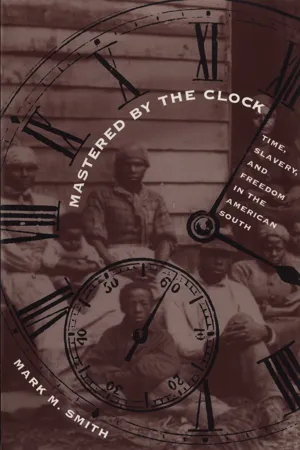
- 328 pages
- English
- ePUB (mobile friendly)
- Available on iOS & Android
eBook - ePub
About this book
Information
Notes
ABBREVIATIONS
- Am. Sl.
- The American Slave: A Composite Autobiography. Edited by George P. Rawick, 1st and 2d series, 19 vols., continuously numbered (Westport, Conn.: Greenwood Press, 1972); 1st supplement series, 12 vols. (Westport, Conn.: Greenwood Press, 1977); 2d supplement series, 10 vols. (Westport, Conn.: Greenwood Press, 1979).
- AWD
- American Women’s Diaries (Southern Women) (New Canaan, Conn.: Readex Film Products, 1993)
- DBR
- De Bow’s Review
- DU
- Duke University, William R. Perkins Library, Manuscript Department, Durham, N.C.
- FR
- Farmers’ Register
- LC
- Library of Congress, Manuscript Division, Washington, D.C.
- MESDA
- Museum of Early Southern Decorative Arts, Research Center, Winston-Salem, N.C.
- RASP
- Kenneth M. Stampp, ed. Records of Ante-Bellum Southern Plantations from the Revolution through the Civil War. Part 1 (15 microfilm reels); series A, part 2 (26 microfilm reels); series F, part 2 (16 microfilm reels); series J, part 2 (41 microfilm reels), (Frederick and Bethesda, Md.: University Publications of America, 1985).
- RB
- Rose Bud, or Youth’s Gazette
- SCDAH
- South Carolina Department of Archives and History, Columbia, S.C.
- SCHS
- South Carolina Historical Society, Charleston, S.C.
- SCL
- South Caroliniana Library, University of South Carolina, Columbia, S.C.
- SHC
- Southern Historical Collection, Manuscript Department, Wilson Library, University of North Carolina at Chapel Hill, N.C.
- So. Ag.
- Southern Agriculturalist, and Register of Rural Affairs
- So. Cab.
- Southern Cabinet
- So. Cult.
- Southern Cultivator
- So. Pl.
- Southern Planter
- So. Ro.
- Southern Rose/Southern Rosebud
- SPF
- Southern Planter and Farmer
- TF
- Tennessee Farmer
- VHS
- Virginia Historical Society, Richmond, Va.
INTRODUCTION
1. Olmsted, Cotton Kingdom, 158, 190. The specifics of his latter observation are not without foundation. About eighty years later, former slave Martha Spence Bunton recalled, “About twelb o’clock de men would unhitch de mules, and wait fo’ us.” See Am. Sl., supp. ser. 2, vol. 2, Texas narrs., pt. 1, 521.
2. Thrift, “Owners’ Time and Own Time,” 57. On the evolution of an industrial-urban nineteenth-century time consciousness in these countries see Thompson, “Time, Work-Discipline”; Behagg, “Controlling the Product”; Gutman, “Work, Culture, and Society”; Hensley, “Time, Work, and Social Context in New England”; Davison, Unforgiving Minute; Atkins, The Moon Is Dead!; and her “‘Kafir Time.’”
3. Although he does not make the comparative point, Martin Bruegel notes a rural time consciousness in the Hudson Valley after the 1830s especially. See his “‘Time That Can Be Relied Upon.’” For the comparative analysis see Mark M. Smith, “Old South Time in Comparative Perspective.” Whether rural British laborers remained impervious to clock time is unclear. It appears that as long as the indigenous peoples of Natal and Australia remained in their rural environment, an environment where cultural values about time dictated that they appeal to naturally defined time, they were able to resist the efforts of European colonizers to convert them to time discipline and clock-defined time. See, too, Hall, Dance of Life, 3–4; Atkins, The Moon Is Dead!, 95; Davison, Unforgiving Minute, 8–9, 27–31.
4. See, for example, the perceptive remarks in Adam, Timewatch, esp. 86–91. For an excellent review of how Karl Marx, Max Weber, Werner Sombart, Gustav Bilfinger, Lewis Mumford, Marc Bloch, and Yves Renouard, among others, have variously dealt with clock consciousness and its relationship to modernity, see Dohrn-van Rossum, History of the Hour, 8–15.
5. Consult esp. Le Goff, “Merchant’s Time and Church’s Time in the Middle Ages”; Thrift, “Owners’ Time and Own Time.”
6. Landes, Revolution in Time. See also the discussion in Rezsoházy, “Concept of Social Time,” esp. 31–32.
7. See, for example, Genovese and Fox-Genovese, Fruits of Merchant Capital; Genovese, Roll, Jordan, Roll.
8. See esp., Oakes, Ruling Race. The main positions in the debate, at least by the mid-1970s, are usefully reviewed in Wallerstein, “American Slavery and the Capitalist World Economy.” A broader and more recent review is Merrill, “Putting ‘Capitalism’ in Its Place.”
9. This position is best stated in Fogel and Engerman, Time on the Cross.
10. As wonderfully argued in Genovese, Slaveholders’ Dilemma.
11. Ibid.
12. See Nyland, “Capitalism and the History of Worktime Thought,” 516. See, too, the summary by Lane, “Meanings of Capitalism.” For a historian who conflates the premodern with the preclassical arguments of George Fitzhugh, for example, see Wenzel, “Pre-Modern Concepts.” Genovese himself has written that “no one would argue that a strong dose of capitalism did not exist in the South. The argument turns on the proportions and their significance.” A modern time consciousness was both preponderant and significant in the Old South. Quotation from Genovese, “Marxian Interpretations of the Slave South,” 119. Much has been written on the relationship of slavery to capitalism. Useful theoretical statements may be found in Miles, Capitalism and Unfree Labour; Padgug, “Problems in the Theory of Slavery”; and, more generally, Danilova, “Controversial Problems of the Theory of Precapitalist Societies.” Of the more useful attempts to characterize southern planters, one is by Shearer Davis Bowman, who, borrowing Jürgen Kocka’s distinction, suggests that planters were capitalists but not modern industrial ones. With regard to clock time in the South, however, the formulation breaks down not least because industrial time and southern agricultural time were more similar than they were distinct. For further details see Bowman, Masters and Lords, 95–96, 100. See, too, Post, “American Road to Capitalism.” In many respects, it might be more useful to follow through with Bowman’s formulation of describing various capitalisms and conceive of the Old South as embracing what I have elsewhere termed plantation capitalism. See Mark M. Smith, “Time, Slavery and Plantation Capitalism.”
13. On sympathetic views of the laborer and his acquisitive nature before 1750 as well as for vestiges of mercantilist views after, see Coates, On the History of Economic Thought, 1:63–85, 159–85. Also useful, if not altogether in agreement with Coates, is the classic by Furniss, Position of the Laborer. For a detailed examination of the American context, see Crowley, This Sheba, Self. Thomas R. Dew and Thomas Cooper, especially, ranked among the qualified fans of Smithian political economy. The more representative views of George Fitzhugh, however, remained steadfastly opposed. See Shore, Southern Capitalists, esp. 24–29.
14. On incentives under slavery see, generally, Fogel and Engerman, Time on the Cross. More recent work by econometricians suggests that the whip was masters’ preferred tool to induce labor. See Crawford, “Punishments and Rewards.” For arguments that the two systems of incentive and coercion were not mutually exclusive, however, see Fogel, “Moral Aspects.” I do not wish to minimize the racial aspect of southern slavery but merely aim to highlight how inextricable race and class were to southern planters. While masters often deemed blacks to be incapable of hard, independent work, they also shared the pre-Smithian conviction that all workers were slothful. I can think of no better short illustration of this than the observations of one South Carolina planter whose assessment of emancipation was typical of the general distrust of all laboring classes. In 1866 he wrote: “I determined that negroes like white people would work only from necessity.” Quoted in Foner, Nothing but Freedom, 83, and esp. 15. Generally, consult the wise words in Fields, “Slavery, Race and Ideology.”
15. Quoted in Nguyen, “Spatialization of Metric Time,” 36; McKendrick, “Josiah Wedgewood and Factory Discipline.”
16. Brody, “Time and Work,” esp. 38–39.
17. On various discipline and incentive systems in an industrial context, see Gregory Clark, “Factory Discipline,” esp. 128–37. That the northern wage fine for tardiness had its rough equivalent in the southern whip, see Mark M. Smith, “Old South Time in Comparative Perspective.” For parallel developments involving race and class see the trenchant essay by Cooper, “Colonizing Time,” esp. 210, 222, 229, 238–40.
18. On the shared class interests of both groups, see Lynd, “On Turner, Beard, and Slavery”; and the evidence in Sinha, “Counter-Revo...
Table of contents
- Cover Page
- Mastered by the Clock
- Copyright Page
- Dedication
- Contents
- Illustrations
- Figures
- Tables
- Acknowledgments
- Introduction
- I Times Democratic
- II Taming Time’s Pinions, Weaving Time’s Web
- III Apostles of Progress, Agents of Time
- IV Master Time, 1750–1865
- V Time in African American Work and Culture
- VI New South, Old Time
- Epilogue
- Appendix
- Notes
- Bibliography
- Index
Trusted by 375,005 students
Access to over 1.5 million titles for a fair monthly price.
Study more efficiently using our study tools.
Frequently asked questions
Yes, you can cancel anytime from the Subscription tab in your account settings on the Perlego website. Your subscription will stay active until the end of your current billing period. Learn how to cancel your subscription
No, books cannot be downloaded as external files, such as PDFs, for use outside of Perlego. However, you can download books within the Perlego app for offline reading on mobile or tablet. Learn how to download books offline
Perlego offers two plans: Essential and Complete
- Essential is ideal for learners and professionals who enjoy exploring a wide range of subjects. Access the Essential Library with 800,000+ trusted titles and best-sellers across business, personal growth, and the humanities. Includes unlimited reading time and Standard Read Aloud voice.
- Complete: Perfect for advanced learners and researchers needing full, unrestricted access. Unlock 1.5M+ books across hundreds of subjects, including academic and specialized titles. The Complete Plan also includes advanced features like Premium Read Aloud and Research Assistant.
We are an online textbook subscription service, where you can get access to an entire online library for less than the price of a single book per month. With over 1.5 million books across 990+ topics, we’ve got you covered! Learn about our mission
Look out for the read-aloud symbol on your next book to see if you can listen to it. The read-aloud tool reads text aloud for you, highlighting the text as it is being read. You can pause it, speed it up and slow it down. Learn more about Read Aloud
Yes! You can use the Perlego app on both iOS and Android devices to read anytime, anywhere — even offline. Perfect for commutes or when you’re on the go.
Please note we cannot support devices running on iOS 13 and Android 7 or earlier. Learn more about using the app
Please note we cannot support devices running on iOS 13 and Android 7 or earlier. Learn more about using the app
Yes, you can access Mastered by the Clock by Mark M. Smith in PDF and/or ePUB format, as well as other popular books in History & North American History. We have over 1.5 million books available in our catalogue for you to explore.