eBook - ePub
The New Encyclopedia of Southern Culture
Volume 24: Race
- 320 pages
- English
- ePUB (mobile friendly)
- Available on iOS & Android
eBook - ePub
The New Encyclopedia of Southern Culture
Volume 24: Race
About this book
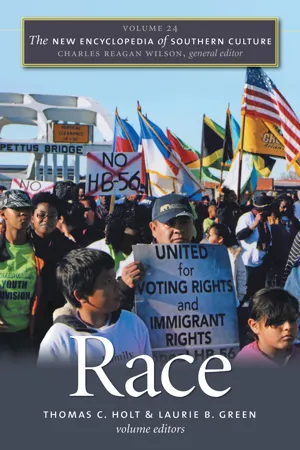
There is no denying that race is a critical issue in understanding the South. However, this concluding volume of The New Encyclopedia of Southern Culture challenges previous understandings, revealing the region’s rich, ever-expanding diversity and providing new explorations of race relations. In 36 thematic and 29 topical essays, contributors examine such subjects as the Tuskegee Syphilis Study, Japanese American incarceration in the South, relations between African Americans and Native Americans, Chinese men adopting Mexican identities, Latino religious practices, and Vietnamese life in the region. Together the essays paint a nuanced portrait of how concepts of race in the South have influenced its history, art, politics, and culture beyond the familiar binary of black and white.
Information
Print ISBN
9781469607238
9781469607221
Subtopic
African American StudiesRACE AND CULTURE IN AN EVER-CHANGING SOUTH
The general editors have chosen a passage from Absalom, Absalom! for the epigraph to introduce these volumes on southern culture, suggesting thereby that our enduring image of the American South is best captured in the fiction of William Faulkner. Faulkner portrays a place, as C. Vann Woodward once suggested, long haunted by a very un-American memory of defeat, a sense of social failure, a lost innocence. Enveloping his tales is the fear that the South’s best days are in the past, a past that yet haunts and constrains the present, a past that’s “not even past.” The South’s story, then, cannot be simply told; it must be unraveled, strand-by-strand. Indeed, the very rhythm of Faulkner’s storytelling evokes at times an image one often finds in the popular imaginary: the South is an insular, bounded space, a world closed and relatively homogeneous.
In reality, however, Faulkner’s mythic South is a far more nuanced and complex world than its conventional image, with a complicated racial landscape that a simple black and white palette cannot capture. At the center of Faulkner’s Absalom, Absalom! saga, of course, are the relations between its black and white inhabitants, with the sins of slavery laying heavily on southern white consciences, not because of its brutality and exploitation of labor—which continued under new forms of labor control well into the 20th century—but because of the shame and confusion of the “miscegenated” bodies and cultures left in its wake. At the story’s margins, however, are the descendants of Native Americans, some of them forcibly relocated along a Trail of Tears from the Southeast. Their blood flows in the veins of his black and white characters alike, and their dispossession forms a half-remembered episode in the region’s guilty past. Faulkner’s South also has links to the Caribbean, prefiguring in fiction the flow of people and ideas in real life that would challenge the region’s ostensibly strict social separation of black and white. Upon second sight, then, Faulkner’s South is not closed and insular but open, not bounded and homogeneous but overlapping and diverse. Viewed from that perspective, the region’s racial past and future look very different.
More than a quarter century ago, historian Ira Berlin warned that our understanding of African American life and history was unduly limited by “a static and singular vision” of its dynamics and complexity, when in fact the black experience evolved divergently in different times and spaces. His argument for a revised perspective on black life, one attentive to its spatially and temporally “specific social circumstances and cultural traditions,” applies with equal force to studies of the South as a whole and to its racial dynamics in particular. The essays in this volume underscore Berlin’s charge that we must take serious account of time and space in our efforts to comprehend how ideas about racial difference have shaped the region’s past and present. They make clear that the South is not simply biracial but multiracial, and has been so since the 17th and 18th centuries, when European settlers first deployed captive African labor to exploit confiscated Native American land. They show how a rich, ever-expanding racial diversity has nourished the social and material roots of the South’s proud cultural heritage—of story and song, of architecture and art, of manners and cuisines. They suggest that the region’s political, social, and economic history cannot be fully comprehended without taking account of this past and this present.
Susan O’Donovan elaborates how slavery—the institutional foundation of southern life and culture and of their racial scaffolding—evolved differently in the various subregions of the South and at different historical moments. The South’s racial and labor relations varied over time and space, reflecting the historically specific demographic configurations of its black, white, and red inhabitants, as well as the diversity of the southern economy that evolved. The South and its race relations must be understood in this broader, more dynamic context: that from the beginning the region has been defined by and formed in relation to other slave regimes in the Americas and around the bell curve of the Atlantic slave trade that peaked in the late 18th century; by trade relations with European nations and their Caribbean colonies, both before and after slave emancipation; and by the specific geopolitical interests that all these relationships produced. The South was not and could never be, as the popular imagination would have it, an undifferentiated place, frozen in time.
Focusing on New Orleans as a simultaneously unique and exemplary case, Shannon Dawdy and Zada Johnson reveal how an ostensibly insular southern world had in fact long been open to influences from the larger Atlantic World. Indeed, as their entry and other entries in this volume will show, from the beginning the region was shaped and reshaped by crosscurrents of peoples, ideas, and institutions. Slavery and the slave trade dictated the course of those crosscurrents over the South’s first two and a half centuries, during which black bondage was the core institution around which much of the region’s law, labor, polity, and social life revolved. It was slavery that initially knit the South into the international economic and cultural complex formed by other slave societies in the southern hemisphere, especially in the Caribbean. Sharing similarities in climate, economy, and cultural development, New World slave societies developed similar interests, confronted similar political forces, and evolved similar ideologies of rule and social order. Thus, while “peculiar” in comparison to its northern and middle Atlantic compatriots, the South was not exceptional among its neighbors in the southern Atlantic. It is not surprising, then, that southerners looked to annex Cuba when their farther westward continental expansion seemed thwarted, or that defeated Confederates immigrated to Mexico and Brazil after the Civil War.
Fed by the Atlantic slave trade for all but 50 years of its first two and a half centuries, the South’s population mix and cultural life—for blacks and whites alike—was in constant flux as new Africans poured in and their new owners remade the southern physical and social landscape in order to exploit their labor power. Given that overseas trade was essential to the plantation economy, moreover, southern ports—dotting a coastline stretching from Baltimore to Galveston, the longest in the continental United States—were openings to the world. Through these openings poured goods, people, and, occasionally, revolutionary ideas. Notwithstanding determined efforts to suppress challenges to the racial regime, therefore, the antislavery pamphlets of David Walker or the republican ideas of Haitian and Cuban refugees found their way through those openings.
For all these reasons, British colonies in the lower South manifested from the start a demographic profile and a legal and economic character more typical of the Caribbean and Latin American slave societies than the Chesapeake or northern colonies; and this produced similarities in their political cultures and social arrangements, not least of which was the relative acceptance and allocation of social space to a mixed-race population (as Faulkner shows so graphically in Absalom, Absalom!). The long and porous sea border on the southern Atlantic opened the South to repeated waves of diverse political and economic refugees from the Caribbean basin and, on occasion, invited southern planters to dream of expansion into the Caribbean. All in all, the region knew a dynamism and openness thoroughly at odds with its more conventional image of timelessness and homogeneity.
Moon-Ho Jung’s essay alerts us to the South’s historic links to the Pacific World as well as to the Atlantic, despite the absence of a port on America’s western coast. Like most New World planters, white southerners looked to Asian laborers to replace their former slaves in the early years following the Civil War and slavery’s destruction. The indentured laborers they brought from southern China never satisfied the planters’ fantasies of docile “guest workers” who would stake no claims to economic justice or citizenship, however. Like black freedpeople, Asians came to call the South “home.” They formed families and communities, and some of them mixed socially and biologically with southern blacks, whites, Creoles, and Native Americans. Southern census takers and neighbors were never quite certain how to classify these families racially, so they were all identified simply as “Chinese” until Jim Crow laws forced them onto one or the other side of the biracial spectrum.
This 19th-century Asian beachhead was relatively small and inconsequential to the broader development of the southern economy and society at the time, but it prefigured the pattern of the South’s 20th-century engagement with the Pacific World and a future immigration and settlement pattern that would eventually transform the South’s cultural and racial makeup. From Japan to Vietnam, 20th-century wars in the Pacific drew the United States into intense and continuing involvements with Asian nations and peoples, some of whom made their way to the southern states. Several of the places of wartime incarceration of Japanese American citizens were located in the South—namely, in Arkansas, Texas, and Louisiana—from which many of the menfolk were inducted into segregated military units. Three decades later, American military interventions in Southeast Asia resulted in thousands of displaced persons seeking refuge in southern states. New communities sprang up in Louisiana and Texas, where climate, occupational opportunities, and a welcoming Catholic Church encouraged Vietnamese refugees to settle. As a result, the Gulf Coast is now home to more than 200,000 Southeast Asians (Vietnamese, Cambodian, Laotian) alone, and there were a total of at least 2.3 million Asians scattered across the South by the beginning of the new millennium in 2000. By the early 21st century, peoples of Asian origin had become a ubiquitous presence in southern interior cities and towns—running hotels, restaurants, and other small businesses and building churches, suburban enclaves, and shopping centers—and, in a throwback to the 19th century, sometimes working for manufacturers intent on disrupting union solidarity by employing a presumably docile, non-English-speaking labor force.
The growth of the South’s Asian population is impressive, but the expansion and dispersion of the Latino population is undoubtedly the driving force in the region’s late 20th-century racial transformation. Between 1980 and 2000, the South’s Latino population increased from 4.3 million to 11 million. By the second decade of the new century, their numbers had swelled to 16.4 million. Equally impressive was their far-greater dispersion across the region. Instead of 9 out of 10 being concentrated in Florida and Texas, as had been the case in 1980, Latinos were scattered throughout the southern states in urban and rural areas and occupations.
Although the growing presence of Latinos in many areas of the Old South is new, Spanish-speaking peoples and territories have shaped southern history from the beginning. Imperial Spain’s presence in Florida, along the Gulf Coast, and in Louisiana profoundly influenced the nation’s and the region’s colonial and early national history. The refuge that Native Americans and escaped African and African American slaves found in Spanish territories left deep impressions on each of those peoples’ cultures, including the cultural interactions and alliances between them that contact promoted. The Latino imprint would grow broader and deeper after the Mexican War of 1846 and the annexation of Texas, both of which were promoted by southern expansionists seeking to build a more impregnable slave empire. Not only did territorial expansion forever blur the regional boundary between South and West; it also provided a rehearsal of a multiracial South, as black labor and brown labor were marshaled to tame the new frontier. With the development of large-scale agriculture in south Texas after World War I, southern plantation–style relations between growers and laborers took on new forms in the context of cross-border migrations by Mexican laborers, which were alternately facilitated and shut down by an expanding border patrol. Like African Americans in states to Texas’s east, people of Mexican origin in south Texas were confronted by the threat of racial violence in addition to segregation. Though lacking the legal mandate for Jim Crow generally inscribed in the constitutions of the southeastern states, the segregation of Mexican Americans in Texas was just as thorough.
The 21st-century legacy of the South’s westward expansion is a far more complex racial situation than the conventional biracial paradigm can account for. The ostensibly “solid” political South now cloaks a social, cultural, and political diversity and complexity that is almost certain to find expression eventually in a new southern political regime. The recent hostility to Mexican immigrants in the southern interior is but a harbinger of that very different political future, since Latino population growth will inevitably change not only the South’s political calculus but its racial discourse as well. It is possible, however, that the South’s rapidly evolving racial demography will also produce more complex political alliances—ones in which black may ally with brown, or brown with white, or even black with white. The 2007 election in Louisiana of a governor and a congressman of Asian descent and conservative politics suggests something of the uncertain trajectory that a reframed political landscape in a multiracial South might take.
With the question “Where did the Asian sit on the segregated bus?” Leslie Bow frames an intriguing perspective on how demographic transformations have challenged, changed, and reinforced southern racial hierarchies. At times, Asians were bystanders to a humiliation directed solely at blacks; at other times they were its victims; and at yet others their status was indeterminate. It was not the first nor the last time that a racial regime built to justify the subordination of black labor had trouble assimilating a nonwhite people of a different origin and history. Mexican Americans, armed with treaty rights and legally classified as white, presented similar problems early on. Similarly, southern Jews, as Allison Schottenstein shows, often had trouble finding their place within the southern racial classification system, the nature of their inclusion or exclusion from whiteness varying sharply from one era to the next.
The problem of finding a place to sit or stand in the racial order has been no less difficult for the racialized victims of that order. At various times, Mexican Americans and Asian Americans have benefited from their legal designation as “white,” notwithstanding their racial denigration more generally. Yet struggles by different groups in the civil rights era to secure the Fourteenth Amendment guarantee of equal protection under the law further illuminate the racial complexity of the South. Guadalupe San Miguel informs us that Mexican Americans in Houston, influenced by the Chicano Movement, declared that they were “Brown, not White,” after the school district in 1970 responded to a court desegregation order by placing whites in one school and African Americans and Mexican Americans—still classified as white—in another. Meanwhile, southern labor struggles have sometimes led African American workers to object to the competition from rapidly growing Latino and immigrant Southeast Asian, Caribbean, and Central American workforces in many southern manufacturing and food-processing plants. And, thus far, the success of politicians of Asian descent has been more likely than not to come at the expense of African American or Latino citizens. All of this suggests that racial lines may as easily be hardened as softened in a multiracial South. Far from auguring an inevitable break with the South’s racist legacy, therefore, the rupture of the biracial paradigm could simply presage new lines of color and newly separate communities. It remains, then, an open question whether the racial geography of this latest New South will look more like the formerly all-black neighborhood in east New Orleans that is now an amicably mixed community of African Americans and Vietnamese or more like the separate enclaves developing in other southern cities.
The ongoing demographic transformation of the 21st-century South suggests an ironic twist on Faulkner’s trenchant observation: “The past is never dead. It’s not even past.” Much like the region itself, southern race relations were never as static, bounded, and monochrome as typically represented. From the start, a growing mixed-race population challenged fixed black-white boundaries, in law as well as in social relations. In southern households, slave masters, unable to master their own desires, produced claimants to their property and white privilege, fostering in the process a far more complex and contested racial landscape. In southern courtrooms, white-skinned slaves sued for their freedom, making hash of the notion that “race” was indelibly marked on the bodies or in the behavior of human beings. These claimants were not the last to make manifest the fact that race was something performed as well as seen. Julia Schiavone Camacho’s entry shows that the racial masquerades white-skinned slaves used to escape bondage were echoed in the hilarious send-up Chinese workers deployed to cross the U.S.-Mexican border in the early 20th century. Donning ponchos and sombreros and mumbling a few words of Spanish or singing traditional ballads, Chinese men passed themselves off as Indian or Mexican.
On the Mexican side of the border, these same Chinese created an even more complex racial identity, taking Mexican wives and fathering mixed-race children. As merchants and skilled tradesmen, they helped build their adopted nation’s economy, only to be victimized once again by anti-Chinese riots and pogroms during and following the Mexican Revolution. Consequently, they found themselves once again attempting to cross the border, but this time i...
Table of contents
- Cover Page
- The New Encyclopedia of Southern Culture Volume 24: Race
- Copyright Page
- Epigraph
- CONTENTS
- GENERAL INTRODUCTION
- INTRODUCTION
- RACE AND CULTURE IN AN EVER-CHANGING SOUTH
- INDEX OF CONTRIBUTORS
- INDEX
Trusted by 375,005 students
Access to over 1.5 million titles for a fair monthly price.
Study more efficiently using our study tools.
Frequently asked questions
Yes, you can cancel anytime from the Subscription tab in your account settings on the Perlego website. Your subscription will stay active until the end of your current billing period. Learn how to cancel your subscription
No, books cannot be downloaded as external files, such as PDFs, for use outside of Perlego. However, you can download books within the Perlego app for offline reading on mobile or tablet. Learn how to download books offline
Perlego offers two plans: Essential and Complete
- Essential is ideal for learners and professionals who enjoy exploring a wide range of subjects. Access the Essential Library with 800,000+ trusted titles and best-sellers across business, personal growth, and the humanities. Includes unlimited reading time and Standard Read Aloud voice.
- Complete: Perfect for advanced learners and researchers needing full, unrestricted access. Unlock 1.5M+ books across hundreds of subjects, including academic and specialized titles. The Complete Plan also includes advanced features like Premium Read Aloud and Research Assistant.
We are an online textbook subscription service, where you can get access to an entire online library for less than the price of a single book per month. With over 1.5 million books across 990+ topics, we’ve got you covered! Learn about our mission
Look out for the read-aloud symbol on your next book to see if you can listen to it. The read-aloud tool reads text aloud for you, highlighting the text as it is being read. You can pause it, speed it up and slow it down. Learn more about Read Aloud
Yes! You can use the Perlego app on both iOS and Android devices to read anytime, anywhere — even offline. Perfect for commutes or when you’re on the go.
Please note we cannot support devices running on iOS 13 and Android 7 or earlier. Learn more about using the app
Please note we cannot support devices running on iOS 13 and Android 7 or earlier. Learn more about using the app
Yes, you can access The New Encyclopedia of Southern Culture by Thomas Cleveland Holt, Laurie B. Green, Thomas Cleveland Holt,Laurie B. Green,Charles Reagan Wilson, Charles Reagan Wilson in PDF and/or ePUB format. We have over 1.5 million books available in our catalogue for you to explore.