eBook - ePub
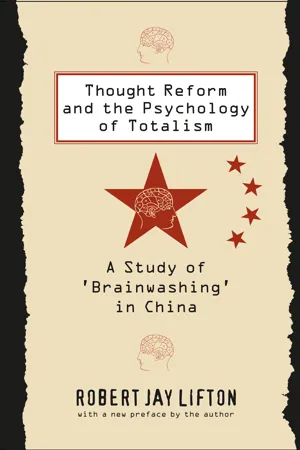
Thought Reform and the Psychology of Totalism
A Study of 'brainwashing' in China
- 524 pages
- English
- ePUB (mobile friendly)
- Available on iOS & Android
eBook - ePub
About this book
Informed by Erik Erikson's concept of the formation of ego identity, this book, which first appreared in 1961, is an analysis of the experiences of fifteen Chinese citizens and twenty-five Westerners who underwent "brainwashing" by the Communist Chinese government. Robert Lifton constructs these case histories through personal interviews and outlines a thematic pattern of death and rebirth, accompanied by feelings of guilt, that characterizes the process of "thought reform." In a new preface, Lifton addresses the implications of his model for the study of American religious cults.
Information
Topic
StoriaSubtopic
Storia cinesePART ONE
THE PROBLEM
How intoxicating to feel like God the Father and to hand out definitive testimonials of bad character and habits.
Albert Camus
Only simple and quiet words will ripen of themselves. For a whirlwind does not last for the whole morning. Nor does a thundershower last the whole day. Who is their author? The heaven and earth. Yet even they cannot make such violent things last. How much more true this must be of the rash endeavors of man.
Lao Tze
CHAPTER 1
WHAT IS “BRAINWASHING”?
When confronted with the endless discussion on the general subject of “brainwashing,” I am sometimes reminded of the Zen Buddhist maxim: “The more we talk about it, the less we understand it.” The confusion begins with the word itself, so new and yet already so much a part of our everyday language. It was first used by an American journalist, Edward Hunter, as a translation of the colloquialism hsi nao (literally, “wash brain”) which he quoted from Chinese informants who described its use following the Communist takeover.)1
“Brainwashing” soon developed a life of its own. Originally used to describe Chinese indoctrination techniques, it was quickly applied to Russian and Eastern European approaches, and then to just about anything which the Communists did anywhere (as illustrated by the statement of a prominent American lady who, upon returning from a trip to Moscow, claimed that the Russians were “brainwashing” prospective mothers in order to prepare them for natural childbirth). Inevitably, the word made its appearance closer to home, sometimes with the saving grace of humor (New Yorker cartoons of children “brainwashing” parents, and wives “brainwashing” husbands), but on other occasions with a more vindictive tone—as when Southern segregationists accused all who favor racial equality (including the United States Supreme Court) of having been influenced by “left-wing brainwashing”; or equally irresponsible usages by anti-fluoridation, anti-mental health legislation, or anti-almost anything groups leveled against their real or fancied opponents.
Then there is the lurid mythology which has grown up about it: the “mysterious oriental device,” or the deliberate application of Pavlov’s findings on dogs. There is also another kind of myth, the claim that there is no such thing, that it is all just the fantasy of American correspondents.
Finally, there is the more responsible—even tortured—self-examination which leads professional people to ask whether they in their own activities might not be guilty of “brainwashing”: educators about their teaching, psychiatrists about their training and their psychotherapy, theologians about their own reform methods. Opponents of these activities, without any such agonizing scrutiny, can more glibly claim that they are “nothing but brainwashing.” Others have seen “brainwashing” in American advertising, in large corporation training programs, in private preparatory schools, and in congressional investigations. These misgivings are not always without basis, and suggest that there is a continuity between our subject and many less extreme activities; but the matter is not clarified by promiscuous use of the term.
Behind this web of semantic (and more than semantic) confusion lies an image of “brainwashing” as an all-powerful, irresistible, unfathomable, and magical method of achieving total control over the human mind. It is of course none of these things, and this loose usage makes the word a rallying point for fear, resentment, urges toward submission, justification for failure, irresponsible accusation, and for a wide gamut of emotional extremism. One may justly conclude that the term has a far from precise and a questionable usefulness; one may even be tempted to forget about the whole subject and return to more constructive pursuits.
Yet to do so would be to overlook one of the major problems of our era—that of the psychology and the ethics of directed attempts at changing human beings. For despite the vicissitudes of brainwashing, the process which gave rise to the name is very much a reality: the official Chinese Communist program of szu-hsiang kai-tsao (variously translated as “ideological remolding,” “ideological reform,” or as we shall refer to it here, “thought reform”) has in fact emerged as one of the most powerful efforts at human manipulation ever undertaken. To be sure, such a program is by no means completely new: imposed dogmas, inquisitions, and mass conversion movements have existed in every country and during every historical epoch. But the Chinese Communists have brought to theirs a more organized, comprehensive, and deliberate—a more total—character, as well as a unique blend of energetic and ingenious psychological techniques.
The Western world has heard mostly about “thought reform” as applied in a military setting: the synthetic bacteriological warfare confessions and the collaboration obtained from United Nations personnel during the Korean War. However, these were merely export versions of a thought reform program aimed, not primarily at Westerners, but at the Chinese people themselves, and vigorously applied in universities, schools, special “revolutionary colleges,” prisons, business and government offices, labor and peasant organizations. Thought reform combines this impressively widespread distribution with a focused emotional power. Not only does it reach one-fourth of the people of the world, but it seeks to bring about in everyone it touches a significant personal upheaval.
Whatever its setting, thought reform consists of two basic elements: confession, the exposure and renunciation of past and present “evil”; and re-education, the remaking of a man in the Communist image. These elements are closely related and overlapping, since they both bring into play a series of pressures and appeals—intellectual, emotional, and physical—aimed at social control and individual change.
The American press and public have been greatly concerned about this general subject, and rightly so. But too often the information made available about it has been sensationalist in tone, distorted because of inadequate knowledge, or obscured by the strong emotions which the concept of brainwashing seems to arouse in everyone. Its aura of fear and mystery has been more conducive to polemic than to understanding.
Still the vital questions continue to be asked: Can a man be made to change his beliefs? If a change does occur, how long will it last? How do the Chinese Communists obtain these strange confessions? Do people believe their own confessions, even when false? How successful is thought reform? Do Westerners and Chinese react differently to it? Is there any defense against it? Is it related to psychotherapy? to religious conversion? Have the Chinese discovered new and obscure techniques? What has all this to do with Soviet Russia and international Communism? with Chinese culture? How is it related to other mass movements or inquisitions, religious or political? What are the implications for education? For psychiatric and psychoanalytic training and practice? For religion? How can we recognize parallels to thought reform within our own culture, and what can we do about them?
It was with these questions on my mind that I arrived in Hong Kong in late January, 1954. Just a few months before, I had taken part in the psychiatric evaluation of repatriated American prisoners of war during the exchange operations in Korea known as Big Switch; I had then accompanied a group of these men on the troopship back to the United States.2 From the repatriates’ descriptions of what they had experienced, I pieced together a great deal of information about Chinese Communist confession and re-education techniques, and was convinced that this process raised some basic human issues; but the expediencies of the military situation made it difficult to study them with the necessary depth and thoroughness. I thought then that the most important questions might best be approached through work with people who had been “reformed” within China itself.
Yet I had not come to Hong Kong with any clear intention of carrying out this detailed research. I had planned only a brief stopover on my way from Tokyo back to the United States after having lived in the Far East for almost two years, serving as an Air Force psychiatrist in Japan and Korea. But plans can be changed; and such change is sometimes an expression of an inner plan not yet consciously understood by the planner himself. Thus as long as I was in Hong Kong, I decided to make a few inquiries into a subject that seemed so important.
As soon as I did, I discovered that a number of Western scholars and diplomats there had also been asking themselves these questions. They had been shocked by the effects of indoctrination programs applied on the Chinese mainland. They told me of Western missionaries who, after having made lurid “espionage” confessions in prison, arrived in Hong Kong deeply confused about what they believed; of young Chinese students violating the most sacred precepts of their culture by publicly denouncing their parents; of distinguished mainland professors renouncing their “evil” past, even rewriting their academic books from a Marxist standpoint. My Western acquaintances had been both troubled and fascinated by these events, and welcomed my interest in the problem. At my request, they arranged for me to meet a few people like the ones they had described.
The impact of these first encounters was not something one readily forgets: an elderly European Bishop leaning forward in his hospital bed, so deeply impressed with the power of the prison thought reform program he had just experienced that he could only denounce it as “an alliance with the demons”; a young Chinese girl, still shaken from the group hatred that had been turned upon her at a university in Peking, yet wondering if she had been “selfish” in leaving.
I realized that these two people had both been through China’s most elemental thought reform programs; and that these programs were much more powerful and comprehensive than the modifications which had been applied to United Nations’ troops in Korea. I also realized that Hong Kong offered a unique opportunity for the study of thought reform, although, surprisingly enough, no one was taking advantage of it. I sought a means of remaining there to undertake prolonged and systematic research into the process; and with the help of two research grants, my stay was extended into seventeen months of stimulating psychiatric investigation.
CHAPTER 2
RESEARCH IN HONG KONG
Hong Kong was no ordinary setting for psychiatric research. Many problems arose, some of which I could anticipate, and others which I had to deal with as I went along, but all of which required approaches departing considerably from usual psychiatric protocol. The basic task was to locate people who had been put through intensive reform experiences and communicate with them in meaningful emotional depth. For I felt that this was the best way to study the psychological features and human effects of the reform process. I was not investigating “mental disease” or patterns of neurosis; I was studying individual strengths, as well as vulnerabilities.
I soon found out that those who had undergone this experience fell into two broad groups: Western civilians reformed in prisons, and Chinese intellectuals who had undergone their reform in universities or in “revolutionary colleges.” In both groups, it immediately became clear that intensive work with relatively few people was much more valuable than superficial contacts with many. Thought reform was a complex personal experience, destructive of personal trust; it took time for a subject—especially in an environment as full of suspicion as Hong Kong—to trust me sufficiently to reveal inner feelings of which he was not necessarily proud. And with Chinese subjects this was intensified by the East Asian cultural pattern of saying (as both a form of propriety and a means of personal protection) what one thinks the listener wishes to hear. For the first few sessions, Chinese were particularly likely to offer an elaboration of anti-Communist clichés; only weeks or months later would they reveal the true conflicts stimulated by Communist reform.
The twenty-five Westerners and fifteen Chinese subjects whom I interviewed all had experiences which came under the thought reform category. But I could not ignore differences in the two groups, both differences in the type of programs to which they had been exposed, and in their cultural and historical backgrounds. These differences were important factors in my conduct of the research and in the evaluation of the material, and I have also taken them into account in the book’s organization: Part II deals only with Western subjects, Part III only with Chinese, and Part IV with a consideration of the basic problems raised by thought reform in general.
Most Chinese subjects were more or less permanent residents of Hong Kong, having left mainland China for reasons often associated with a negative response to thought reform. I was able to interview some very soon after their arrival, but the majority had come to Hong Kong a few years before (between 1948 and 1952) when the first great wave of thought reform was at its height, and it was still not too difficult for educated people to leave China. As refugee intellectuals, many supported themselves through work with press and publishing associations, while others received some form of aid from philanthropic and religious groups. I found it best to approach them, always indirectly and always by means of personal introduction, through members of these various Hong Kong organizations. Work with Chinese subjects was invariably complicated—because of problems of language and culture, and because of their difficult life situation (matters which will be discussed more in Part III)—but at the same time it was extremely rewarding. Their life stories revealed much about the history of contemporary China, and their responses taught me a great deal about Chinese character, all of which was of vital importance for understanding thought reform itself. I was able to maintain relationships with them over long periods of time, some for more than a year; I tried to see them frequently at first (two or three half-day or even full-day sessions per week) and then at weekly, bi-weekly, or monthly intervals. As I do not speak Chinese, it was necessary for me to use an interpreter with eleven of the fifteen subjects; the other four spoke fluent English because they had studied either in the West or with Western teachers in China. I was surprised at the emotional depth that could be achieved in these three-way relationships. Much depended on the intelligence and sensitivity of my two regular interpreters (one of them a Western-trained social scientist) and upon my developing with them an effective style of collaborative interviewing.
The rhythms of work with Western subjects were entirely different. For them, Hong Kong was not a home but an interlude. They would arrive fresh from a grueling prison ordeal, generally remain in the colony from one to four weeks, and then embark for Europe or America. Friends, professional associates, or consular officials would greet them and take care of them; confused as they usually were, they needed assistance. They were also fearful and suspicious, which made it necessary for me to approach them through the people in whom they had greatest confidence, and again on the basis of personal introductions. In order to be able to do this, I made myself and my work known among Western diplomatic, religious, and business groups in Hong Kong. The arrival of a Westerner who had been a prisoner in China was always announced in the Hong Kong newspapers, and I was usually able to set up a first meeting almost immediately.
My arrangements with all subjects were highly flexible, varying with the circumstances of each case. When possible, I had them come to my office-apartment; but it was frequently necessary for me to visit Westerners in homes or mission houses where they were staying, or in hospitals where they were convalescing. I insisted only upon the opportunity to conduct the interview in privacy; although even on this point I had to make one exception when a priest, because of his fears, requested that a colleague remain in the room during our talks.
I tried to spend as much time as possible with each Westerner during his brief stay in Hong Kong; but this time varied greatly, and depended upon the subject’s availability, the special features of his case, and my own schedule at the time. Generally, once we had begun, the subject was as eager as I to work intensively together. I averaged a total of about fifteen to twenty hours with each; with some I spent more than forty hours over several months, and in one or two cases, we had just a single interview. A session might last anywhere from one to three hours. Thus, a typical relationship with a Western subject consisted of eight or nine two-hour interviews over a period of eighteen to twenty days.
With most of the Westerners, communication was intense and intimate. Although the majority were Europeans, there was no language problem because English was the lingua franca for Westerners in China, and all of them spoke it fluently. Most were under great inner pressure to talk about their experiences; they poured out their stories without hesitation, even if they withheld certain details until later interviews. Some of them, as we shall see, were afraid of people, suspicious of me, or reluctant to reveal what they had done in prison; but in almost all cases, the need to unburden themselves overcame inhibiting factors.
When I had introduced myself and told them a little about my research study (self-identification about profession and affiliations was extremely important in this environment), I would begin to ask them questions about their prison experience—if indeed, they had not already begun to tell me about it. I tried to cover this experience in great detail, at the same time following the general psychoanalytic principle of encouraging the subject to associate freely without interruption. What impressed me most about the material was its immediacy: just a matter of days from their reform ordeal, these men and women still carried with them its entire atmosphere. They had not yet had time to place any distance between themselves and their experiences, or to initiate the distorting reconstructions which eventually occur after any stress situation. (I was to appreciate this immediacy more fully after I encountered such reconstructions during follow-up visits—Chapters 10–12—with many of them in Europe and America three and four years later.) The freshness of the data was tremendously helpful in conveying the actual emotional currents of thought reform.
Why did these subjects originally agree to see me? What was their incentive for taking part in the study? Many, who were in a rather confused state, seemed merely to be following the suggestions of people taking care of them. Some told me that they wanted to make a contribution to the systematic study of the thought reform problem, in order to help future victims, or to combat an evil. Others said quite frankly that they welcomed the chance to talk over their experiences with a professional person who had some knowledge of this subject, thus acknowledging their need for a greater understanding of their ordeals. Whether stated openly or not, this therapeutic factor became increasingly important with almost every Western subject (and with many Chinese as well) during the course of the interviews. Mostly I listened and wrote, but I did—when they expressed interest—discuss with them such ...
Table of contents
- Cover Page
- Thought Reform and the Psychology of Totalism
- Copyright Page
- Dedication
- CONTENTS
- PREFACE: TO THE UNIVERSITY OF NORTH CAROLINA PRESS EDITION
- PREFACE
- PART ONE THE PROBLEM
- PART TWO PRISON THOUGHT REFORM OF WESTERNERS
- PART THREE THOUGHT REFORM OF CHINESE INTELLECTUALS
- PART FOUR TOTALISM AND ITS ALTERNATIVES
- APPENDIX A:CONFESSION DOCUMENT
- NOTES
- INDEX
Trusted by 375,005 students
Access to over 1.5 million titles for a fair monthly price.
Study more efficiently using our study tools.
Frequently asked questions
Yes, you can cancel anytime from the Subscription tab in your account settings on the Perlego website. Your subscription will stay active until the end of your current billing period. Learn how to cancel your subscription
No, books cannot be downloaded as external files, such as PDFs, for use outside of Perlego. However, you can download books within the Perlego app for offline reading on mobile or tablet. Learn how to download books offline
Perlego offers two plans: Essential and Complete
- Essential is ideal for learners and professionals who enjoy exploring a wide range of subjects. Access the Essential Library with 800,000+ trusted titles and best-sellers across business, personal growth, and the humanities. Includes unlimited reading time and Standard Read Aloud voice.
- Complete: Perfect for advanced learners and researchers needing full, unrestricted access. Unlock 1.5M+ books across hundreds of subjects, including academic and specialized titles. The Complete Plan also includes advanced features like Premium Read Aloud and Research Assistant.
We are an online textbook subscription service, where you can get access to an entire online library for less than the price of a single book per month. With over 1.5 million books across 990+ topics, we’ve got you covered! Learn about our mission
Look out for the read-aloud symbol on your next book to see if you can listen to it. The read-aloud tool reads text aloud for you, highlighting the text as it is being read. You can pause it, speed it up and slow it down. Learn more about Read Aloud
Yes! You can use the Perlego app on both iOS and Android devices to read anytime, anywhere — even offline. Perfect for commutes or when you’re on the go.
Please note we cannot support devices running on iOS 13 and Android 7 or earlier. Learn more about using the app
Please note we cannot support devices running on iOS 13 and Android 7 or earlier. Learn more about using the app
Yes, you can access Thought Reform and the Psychology of Totalism by Robert Jay Lifton in PDF and/or ePUB format, as well as other popular books in Storia & Storia cinese. We have over 1.5 million books available in our catalogue for you to explore.