The Chinese Exclusion Act of 1882, which barred practically all
Chinese from American shores for ten years, was the first federal
law that banned a group of immigrants solely on the basis of race
or nationality. By changing America’s traditional policy of open
immigration, this landmark legislation set a precedent for future
restrictions against Asian immigrants in the early 1900s and
against Europeans in the 1920s.
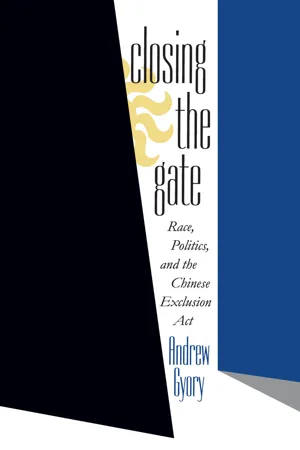
Tracing the origins of the Chinese Exclusion Act, Andrew
Gyory presents a bold new interpretation of American politics
during Reconstruction and the Gilded Age. Rather than directly
confront such divisive problems as class conflict, economic
depression, and rising unemployment, he contends, politicians
sought a safe, nonideological solution to the nation’s industrial
crisis — and latched onto Chinese exclusion. Ignoring workers'
demands for an end simply to imported contract labor, they
claimed instead that working people would be better off if there
were no Chinese immigrants. By playing the race card, Gyory
argues, national politicians — not California, not organized
labor, and not a general racist atmosphere — provided the motive
force behind the era’s most racist legislation.
- 368 pages
- English
- ePUB (mobile friendly)
- Available on iOS & Android
eBook - ePub
About this book
Information
Chapter One
The Very Recklessness of Statesmanship
Explanations for Chinese Exclusion, 1870S-1990S
I feel and know that I am pleading the cause of the free American laborer and of his children and of his children’s children.
— James G. Blaine, February 24, 1879
“Ought we to exclude them?” asked Senator James G. Blaine on February 14, 1879. “The question lies in my mind thus: either the Anglo-Saxon race will possess the Pacific slope or the Mongolians will possess it.” Championing the Fifteen Passenger Bill, a measure aimed at limiting Chinese immigration, Blaine declared on the Senate floor: “We have this day to choose . . . whether our legislation shall be in the interest of the American free laborer or for the servile laborer from China. . . . You cannot work a man who must have beef and bread, and would prefer beer, alongside of a man who can live on rice. It cannot be done.”1
With this speech, James Blaine became the nation’s foremost politician to vigorously advocate Chinese exclusion. In a widely reprinted letter to the New York Tribune a week later, he elaborated his position, calling Chinese immigration “vicious,” “odious,” “abominable,” “dangerous,” and “revolting. … If as a nation we have the right to keep out infectious diseases, if we have the right to exclude the criminal classes from coming to us, we surely have the right to exclude that immigration which reeks with impurity and which cannot come to us without plenteously sowing the seeds of moral and physical disease, destitution, and death.” Leaving no doubt as to where he stood, the Maine Republican concluded, “I am opposed to the Chinese coming here; I am opposed to making them citizens; I am opposed to making them voters.”2
As the most prominent statesman of the Gilded Age, Blaine single-handedly made racist attacks on Chinese immigrants an honorable act. His racist words in 1879 elevated the issue nationally from the streets of San Francisco to the Senate of the United States and made the cries of demagogues respectable. Blaine’s polemic broadened the issue from one affecting only the West, where 97 percent of the nation’s 105,000 Chinese immigrants lived, to one that supposedly affected the entire country, from one that generated political support from all classes on the Pacific Coast to one that might attract a single class nationwide—the working class. “There is not a laboring man from the Penobscot [River in Maine] to the Sacramento [River in California] who would not feel aggrieved, outraged, burdened, crushed, at being forced into competition with the labor and the wages of the Chinese cooly. For one, I would never consent, by my vote or my voice, to drive the intelligent workingmen of America to that competition and that degradation.” But Chinese immigration, Blaine said, involved more than the issue of class. It also affected racial harmony: “I supposed if there was any people in the world that had a race trouble on hand it was ourselves. I supposed if the admonitions of our own history were anything to us we should regard the race trouble as the one thing to be dreaded and the one thing to be avoided. . . . To deliberately sit down and . . . permit another and far more serious trouble seems to be the very recklessness of statesmanship.” As Blaine concluded, “It is a good deal cheaper . . . to avoid the trouble by preventing the immigration.” Chinese exclusion could thus minimize further racial conflict and preclude another civil war. It could also reduce class tensions. Citing the divisive national railroad strike of 1877 when “unemployed thousands . . . manifested a spirit of violence,” Blaine envisioned Chinese exclusion as a palliative measure giving working people what they wanted. “I feel and know that I am pleading the cause of the free American laborer and of his children and of his children’s children.”3
As the front-runner for his party’s nomination for president in 1880, Blaine aimed his message at two constituencies—the West Coast and workers nationwide. During three days of debate, he was the only Republican senator east of the Rocky Mountains to speak out against Chinese immigration. But he was hardly alone in his party. When the Senate passed the Fifteen Passenger Bill, which would have limited to fifteen the number of Chinese passengers on any ship coming to the United States, 11 Republicans east of the Rockies supported the measure, and in the House of Representatives, 51 Republicans joined 104 Democrats to pass the bill by a comfortable margin. By 1879, congressional support for Chinese immigration restriction was becoming broad and bipartisan. But for a presidential veto it would have become law.4
Three years later, in 1882, Congress debated the Chinese Exclusion Act, a measure far more extreme than the Fifteen Passenger Bill of 1879. Although Blaine had lost the Republican nomination to James A. Garfield in 1880, his racial and class arguments against Chinese immigration carried the day. Republican after Republican denounced the Chinese with a firmness and venom once the preserve of westerners. “Alien in manners, servile in labor, pagan in religion, they are fundamentally un-American,” thundered Representative Addison McClure (R-Ohio). “There is no common ground of assimilation,” Senator George F. Edmunds (R-Vt.) asserted, to which Senator John Sherman (R-Ohio) added, the Chinese “are not a desirable population. . . . They are not good citizens.” Invoking visceral racist images, eastern and midwestern Republicans echoed former senator Blaine. Representative George Hazelton (R-Wisc.) called the Chinese immigrant a “loathsome . . . revolting . . . monstrosity . . . [who] lives in herds and sleeps like packs of dogs in kennels.” Other congressmen likened the Chinese to rats and swarming insects whose “withering and blighting effect,” in the words of Representative Benjamin Butterworth (R-Ohio), “leave in their trail a moral desert.” They “spread mildew and rot throughout the entire community,” concluded Representative William Calkins (R-Ind.). Permit them to enter and “you plant a cancer in your own country that will eat out its life and destroy it.”5
Although condemning the Chinese on racial, cultural, and religious grounds, congressmen across the country emphasized that they favored Chinese exclusion because they favored the working person. “My chief reason for supporting such a measure,” said Representative Edwin Willits (R-Mich.), “is, that I believe it is in the interest of American labor.” Likewise, Representative Stanton Peelle (R-Ind.) backed the law “upon the ground of protection to American labor as distinguished from protection to American society.” As Edward K. Valentine (R-Nebr.) argued, “It is our opportunity to do justice to the American laborer, and injustice to no one.” Senator Henry M. Teller (R-Colo.) was blunter: “I see no other way to protect American labor in this country.” Lest anyone doubt that workers demanded the law, Representative John Sherwin (R-IU.) declared that Chinese exclusion “is a question which comes home after all to the men and women who labor with their hands, more than to anyone else. And I think we can trust them in determining it better than we can trust anyone else.”6
Senator Blaine’s endorsement of the Fifteen Passenger Bill in 1879 had given anti-Chinese racism legitimacy, and within three years a strong bipartisan consensus emerged to outlaw Chinese immigration. Scurrying to take credit for the Chinese Exclusion Act, politicians echoed Blaine in claiming to have passed the measure in response to workers’ needs and long-stated demands. Although congressional opposition to Chinese immigration had actually begun forming in the mid-1870S, its swiftness amazed many observers. “If such a bill had been proposed in either House of Congress twenty years ago,” Senator Sherman noted in 1882, “it would have been the death warrant of the man who offered it.”7 Indeed, when Congress first debated Chinese citizenship in 1870, virtually no one suggested tampering with the nation’s century-old policy of open immigration. During the next twelve years, however, Chinese exclusion would become an article of faith in both parties that would dictate political platforms and shape presidential campaigns.
The creation of Chinese immigration as a national issue and the passage of the Chinese Exclusion Act on May 6, 1882, mark a turning point in American history. It was the first immigration law ever passed by the United States barring one specific group of people because of their race or nationality. By changing America’s traditional policy of open immigration, this landmark legislation set a precedent for future restrictions against Asian immigrants in the late nineteenth and early twentieth centuries and against European immigrants in the 1920s. Despite the broad significance of the Chinese Exclusion Act, it has received remarkably little attention from historians. And much of what has been written is wrong.
Historians have ascribed two theories to explain the origins of the Chinese Exclusion Act: the California thesis and the national racist consensus thesis. The California thesis, advanced by Mary Roberts Coolidge in 1909, posits California and its working people as the key agents of Chinese exclusion. The Chinese first emigrated to America in large numbers in 1849, when, like thousands of people the world over, they joined the gold rush and raced to California. By 1852, about twenty-five thousand Chinese had arrived in Gam Saan, or Gold Mountain, as they called California, some staking claims in the mines, others working as cooks, launderers, and laborers. During the first three years, Coolidge argued, white Californians welcomed the Chinese. Called “one of the most worthy [classes] of our newly adopted citizens” by the state’s second governor, the Chinese took part in services commemorating President Zachary Taylor’s death in 1850 and marched in the parade celebrating California’s admission to the union later that year. “The China Boys will yet vote at the same polls, study at the same schools, and bow at the same altar as our own countrymen,” the San Francisco Alta California predicted in 1852. Yet long before this newspaper rolled off the press, racial hostilities had erupted in the mining camps when whites tried to drive all “foreigners”—Mexican, South American, and Chinese—from the region. Some Chinese immigrants had signed contracts in their native land to work for a set period of time at substandard wages. Miners and other Californians targeted them for abuse, and politicians exploited the situation for their own benefit. Several officials, such as Governor John Bigler and State Senator Philip Roach, denounced the Chinese and urged restrictions on their entry as early as 1852. Which came first—the anti-Chinese sentiment in the mining camps or the anti-Chinese rhetoric in the state capital—Coolidge did not say, but each fed on the other, and with miners a key voting bloc in the new state, politicians eagerly courted their support. In the course of the decade, the California legislature passed numerous discriminatory laws against the Chinese, culminating with an 1858 exclusion act. Most of these laws and others passed subsequently were declared unconstitutional by state or federal courts.8
Despite bigotry and violence directed at them by whites, Chinese immigrants kept coming to Gam Saan, their numbers augmented when the Central Pacific Railroad Company imported thousands of workers directly from China in the 1860s to build the western portion of the transcontinental railroad. “They are very trusty, they are very intelligent, and they live up to their contracts,” railroad president Charles Crocker observed, praising their “reliability and steadiness, and their aptitude and capacity for hard work.” By 1870, the census counted 49,310 Chinese in California, making up 8.5 percent of the state’s population. In San Francisco, the state’s largest city, they composed one-fourth of the population; because most Chinese immigrants were single men, they were a third of the workforce. With the decline of mining, the Chinese entered a variety of occupations, including agriculture, manufacturing, and construction, often accepting wages below those of white workers. Combined with racism—the Chinese looked different, practiced a different religion, and seemed reluctant to “assimilate” into American society—this economic competition, Coolidge argued, led white workers to oppose the Chinese, and abetted by politicians, a revived labor movement in San Francisco after the Civil War mobilized against them. Because the courts had ruled that only Congress possessed the power to restrict immigration, western politicians turned to Washington, where as early as 1867 they began introducing bills aimed at limiting Chinese immigration.9
In 1876, Democrats and Republicans locked horns in the most competitive presidential election since the Civil War and believed that the electoral votes of the West Coast could make the difference. Both parties embraced the Chinese issue and pushed for immigration restriction. Labor militancy in San Francisco kept the issue in the forefront in the late 1870s, Coolidge maintained, and the same dynamic recurred nationally in the election of 1880. By advocating anti-Chinese legislation to attract votes, national politicians pursued the identical strategy local politicians had used in California in the 1850s and 1860s. “The struggle on the part of both parties . . . to carry California became fiercer and fiercer,” Coolidge wrote, “and gave her demands for legislation a prominence in the national legislature out of all proportion to their normal value.” Coolidge blamed workers, and particularly Irish immigrants, for fanning the flames of racial hatred. “The clamor of an alien class in a single State—taken up by politicians for their own ends—was sufficient to change the policy of a nation and to commit the United States to a race discrimination at variance with our professed theories of government.”10
Although marred by class prejudice, numerous inaccuracies, and a polemical tone, Coolidge’s presentation of the California thesis has remained the dominant explanation for Chinese exclusion. Succeeding generations of historians have refined but not overturned her argument. In The Anti-Chinese Movement in California (1939), Elmer Clarence Sandmeyer offered a more scholarly and balanced account, stressing that anti-Chinese sentiment on the West Coast was not confined to workers but crossed all classes. By 1876, middle-class and conservative Californians vied with workers in opposing Chinese immigration, Sandmeyer contended, while Chinese exclusion “found strong support in the growing labor organizations of the country.” Despite these important additions, Sandmeyer essentially reaffirmed Coolidge’s thesis.11
Three decades later, Alexander Saxton provided the most sophisticated study of anti-Chinese politics. In The Indispensable Enemy: Labor and the Anti-Chinese Movement in California (1971), Saxton traces the roots of anti-Chinese sentiment to working-class ideology of the Jacksonian era. As the franchise spread to propertyless white men in the early 1800s, northern Democrats embraced an egalitarian philosophy that appealed to workers wary of class hierarchy and special privilege. In the South, Democrats (like virtually all white southerners) possessed a proslavery outlook that necessarily implied black inferiority. To win presidential elections, the Democratic Party needed both sections of the country, and northern Democrats of all classes readily accepted southern positions on slavery and race. “Workingmen alone of the northern white population came into direct competition with free Negroes,” Saxton argues, and spurred on by this economic imperative, they incorporated racial supremacy into their ideology. Republicans, on the other hand, descended from a Federalist-Whig tradition that accepted divisions in society based on class and property and, by implication, race. This acceptance of social and class distinctions contributed to a distrust of the poor and a fear of immigrants. Although seemingly patrician in origin, nativism appealed to workers who believed that foreigners threatened their jobs. As the nation expanded westward during the 1840s and 1850s, Whigs and many Democrats wanted to keep the territories free of slavery and free of blacks. Defending his proviso to ban slavery from the vast region soon to be acquired from Mexico, Representative David Wilmot (D-Pa.) stated in 1847: “I plead the cause and the rights of white freemen. I would preserve to free white labor a fair country ... where the sons of toil, of my own race and own color, can live without the disgrace which association with negro slavery brings upon free labor.” This free-soil impulse, Saxton contends, was as much antiblack as antislavery. When these three forces—“whiggishness,” nativism, and free soil—converged in the early 1850s to create the Republican Party, the goal of abolishing slavery played a small role. Only during the Civil War, when emancipation became necessary to win the war and preserve the union, did abolitionism become central to Republicans. But these changes during the Civil War and Reconstruction, Saxton claims, had little impact on white workers’ racism: “Meanwhile, thousands of Americans, including workingmen and immigrants, passed through the free-soil and unionist phases of anti-slavery without modifying their previously held attitudes toward the Negro. Not much of abolition rubbed off on them.” Saxton argues that despite their political differences, Democratic and Republican workers—the pioneers who headed west to California during and after the gold rush—carried with them a nearly identical ideological baggage steeped in racism. In California, however, they encountered not blacks but Chinese, and the transfer of their hostile attitudes from the former to the latter was a logical step, especially when they believed the Chinese posed an economic threat. In the anti-Chinese movement, Saxton concludes, racist white workers found a common foe—an indispensable enemy—that would unite them for generations.12
Like Coolidge and Sandmeyer, Saxton pinpoints 1867 as the inauguration of labor’s campaign in California against Chinese immigration. By 1870, workers and politicians statewide had made the cause their own, with Democrats and Republicans united on the issue. Saxton elaborates Sandmeyer’s claim that 1876 saw a major diffusion of anti-Chinese sentiment across class lines, as most of California’s labor organizations had collapsed during the depression in the mid-1870S. “Trade unionism in San Francisco . . . almost ceased to exist during the depression years,” Saxton writes, leaving workers “leaderless, embittered, and disorganized.” A bipartisan establishment of “respectable” citizens—employers, manufacturers, and business leaders—took the reins of the anti-Chinese movement in the centennial year. Saxton agrees with Sandmeyer that, by 1870, organized ...
Table of contents
- Cover Page
- Closing the Gate
- Copyright Page
- Dedication
- Contents
- Figures
- Acknowledgments
- Introduction
- Chapter One The Very Recklessness of Statesmanship
- Chapter Two To Fetch Men Wholesale
- Chapter Three Yan-ki vs. Yan-kee
- Chapter Four All Sorts of Tricks
- Chapter Five To Overcome the Apathy of National Legislators
- Chapter Six The Reign of Terror to Come
- Chapter Seven An Unduly Inflated Sack of Very Bad Gas
- Chapter Eight Rolling in the Dirt
- Chapter Nine An Earthquake of Excitement
- Chapter Ten No Material Difference
- Chapter Eleven The Gate Must Be Closed
- Chapter Twelve A Mere Question of Expediency
- Appendix. The Chinese Exclusion Act
- Notes
- Bibliography
- Index
Trusted by 375,005 students
Access to over 1.5 million titles for a fair monthly price.
Study more efficiently using our study tools.
Frequently asked questions
Yes, you can cancel anytime from the Subscription tab in your account settings on the Perlego website. Your subscription will stay active until the end of your current billing period. Learn how to cancel your subscription
No, books cannot be downloaded as external files, such as PDFs, for use outside of Perlego. However, you can download books within the Perlego app for offline reading on mobile or tablet. Learn how to download books offline
Perlego offers two plans: Essential and Complete
- Essential is ideal for learners and professionals who enjoy exploring a wide range of subjects. Access the Essential Library with 800,000+ trusted titles and best-sellers across business, personal growth, and the humanities. Includes unlimited reading time and Standard Read Aloud voice.
- Complete: Perfect for advanced learners and researchers needing full, unrestricted access. Unlock 1.5M+ books across hundreds of subjects, including academic and specialized titles. The Complete Plan also includes advanced features like Premium Read Aloud and Research Assistant.
We are an online textbook subscription service, where you can get access to an entire online library for less than the price of a single book per month. With over 1.5 million books across 990+ topics, we’ve got you covered! Learn about our mission
Look out for the read-aloud symbol on your next book to see if you can listen to it. The read-aloud tool reads text aloud for you, highlighting the text as it is being read. You can pause it, speed it up and slow it down. Learn more about Read Aloud
Yes! You can use the Perlego app on both iOS and Android devices to read anytime, anywhere — even offline. Perfect for commutes or when you’re on the go.
Please note we cannot support devices running on iOS 13 and Android 7 or earlier. Learn more about using the app
Please note we cannot support devices running on iOS 13 and Android 7 or earlier. Learn more about using the app
Yes, you can access Closing the Gate by Andrew Gyory in PDF and/or ePUB format, as well as other popular books in History & North American History. We have over 1.5 million books available in our catalogue for you to explore.