Before and after writing Invisible Man, novelist and essayist Ralph Ellison fought to secure a place as a black intellectual in a white-dominated society. In this sophisticated analysis of Ellison’s cultural politics, Jerry Watts examines the ways in which black artists and thinkers attempt to establish creative intellectual spaces for themselves. Using Ellison as a case study, Watts makes important observations about the role of black intellectuals in America today.
Watts argues that black intellectuals have had to navigate their way through a society that both denied them the resources, status, and encouragement available to their white peers and alienated them from the rest of their ethnic group. For Ellison to pursue meaningful intellectual activities in the face of this marginalization demanded creative heroism, a new social and artistic stance that challenges cultural stereotypes.
For example, Ellison first created an artistic space for himself by associating with Communist party literary circles, which recognized the value of his writing long before the rest of society was open to his work. In addition, to avoid prescriptive white intellectual norms, Ellison developed his own ideology, which Watts terms the 'blues aesthetic.' Watts’s ambitious study reveals a side of Ellison rarely acknowledged, blending careful criticism of art with a wholesale engagement with society.
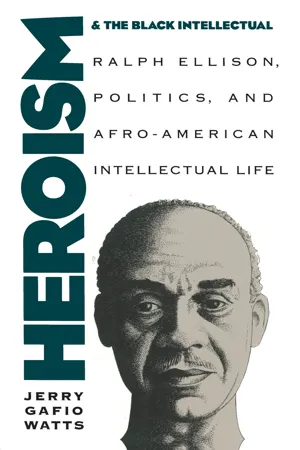
eBook - ePub
Heroism and the Black Intellectual
Ralph Ellison, Politics, and Afro-American Intellectual Life
- 170 pages
- English
- ePUB (mobile friendly)
- Available on iOS & Android
eBook - ePub
Heroism and the Black Intellectual
Ralph Ellison, Politics, and Afro-American Intellectual Life
About this book
Information
1: A CELEBRATED ARTIST AND VISUAL MAN
The name Ralph Ellison reverberates throughout contemporary Afro-American intellectual discourse. Hated or revered, Ellison is considered a formidable foe or ally. Of living Afro-American writers Ellison’s influence among his black contemporaries is unsurpassed except perhaps by Amiri Baraka and, now, Toni Morrison. He has long been a standard-bearer for black fiction writers, an imprimatur of ethnic excellence. The significance of Ellison is quite remarkable insofar as he has not been particularly prolific. Though best known as a novelist, Ellison has published only one novel in over fifty years of writing.
Ellison’s status within black arts and letters was established in 1952 with the publication of Invisible Man. Invisible Man was not immediately celebrated in all circles. As Jacqueline Covo has noted in The Blinking Eye: Ralph Waldo Ellison and His American, French, German, and Italian Critics, 1952–1971, most early reviews of the novel raised questions about its technical competence.1 Some reviewers claimed that it was poorly written. Few engaged its thesis. The brilliance of the “invisibility” theme, when coupled with Ellison’s master craftsmanship, ultimately propelled the novel to a celebrated status within most major American literary circles. Gradually Ellison rose from an unknown, poverty-stricken writer to a prominent national intellectual figure. Invisible Man was awarded the 1953 National Book Award. Ellison, the first Afro-American to receive this prestigious literary award, had indeed “arrived.” Though Richard Wright, the dean of Afro-American literature and the most celebrated black novelist of the period, was alive and writing in France, Ellison became for many the new standard of excellence for black American writing. Given the racial parochialism of the broader intellectual community, Ellison was at times relegated to a corner inhabited only by Negro writers, leading Time magazine to “honor” him by calling him the “best of all U.S. Negro writers.”2 In discussing Invisible Man, Nathan Scott has written, “It was of course, in the spring of that year that Ralph Ellison’s novel Invisible Man burst upon the scene, and the astonishing authority of its art and of the systematic vision of the world which this art expressed immediately won for the book a preeminence which in the intervening years, far from being in any way diminished, has so consolidated itself that it is today universally regarded as an established classic of modern American literature.”3 Ellison’s admirers often mention the 1965 Book Week poll of two hundred writers, critics, and editors that named Invisible Man as “the most distinguished work published in the last twenty years.”4 Even Norman Mailer, whose “quick and expensive comments” were sharply condemnatory of “most talents in the room,” wrote admiringly of Ellison,
That Ralph Ellison is very good is dull to say. He is essentially a hateful writer; when the line of his satire is pure, he writes so perfectly that one can never forget the experience of reading him—it is like holding a live electric wire in one’s hand.
... Where Ellison can go, I have no idea. His talent is too exceptional to allow for casual predictions, and if one says that the way for Ellison may be to adventure out into the difficult and conceivably more awful invisibility of the white man—well, it is a mistake to write prescriptions for a novelist as gifted as Ellison.5
A decade after the publication of Invisible Man, Ellison published a collection of essays, Shadow and Act, which revealed a brilliant critical intellect.6 The book contained previously published essays and interviews and a few new essays. The subject matter ranged from jazz musicians and gospel/blues singers to a review of Gunnar Myrdal’s An American Dilemma. It contained essays about the culture of the Negro and a condensed version of Ellison’s contribution to the now famous exchange with Irving Howe. Ellison was not only a fine fiction writer but also a precise interpreter of American literary culture and the writer’s craft. Shadow and Act contains the most comprehensive statements yet collected of Ellison’s views of Afro-American life and folk culture and their relationship to the Afro-American writer. Within some intellectual/artistic circles, this collection of essays has obtained the status of a classic, and rightly so.7 Stanley Edgar Hyman celebrated it from his central vantage point within the white literary establishment. In his review “Ralph Ellison in Our Time,” Hyman wrote, “Shadow and Act is a monument of integrity, a banner proclaiming ‘the need to keep literary standards high’. In his insight into the complexity of American experience, Ralph Ellison is the profoundest cultural critic that we have, and his hard doctrine of freedom, responsibility, and fraternity is a wisdom rare in our time.”8
In 1986 Ellison published his second collection of nonfiction essays, Going to the Territory.9 Like Shadow and Act, this collection consisted primarily of previously published material. Enduring Ellisonian themes such as the complexity of Afro-American identity, the ironies of American racial mores, and the humanizing disciplines of the arts mark this collection as an extension of Shadow and Act. Because Going to the Territory was recognizably and predictably Ellisonian in a way that the first essay collection could not have been, it did not generate the immediate and intense awe of Shadow and Act. Ellison’s reading audience had come to expect nothing less than profound and elegant writing. Going to the Territory would not disappoint them. Yet the essay collection was issued to a public punch-drunk over rumors and false announcements of the forthcoming publication of the second novel. The reception for Going to the Territory was almost anticlimactic. Still, David Bradley in his review of the collection wrote, “The essays never fail to be elegantly written, beautifully composed and intellectually sophisticated. The personality that emerges from the pages is witty, literate, endearingly modest, delightfully puckish. So much so that, while one cannot completely forgive Ellison for not writing that novel we’ve all been waiting for, one does start to wonder if we have not been waiting for the wrong thing.”10
Ellison’s staying power in Afro-American intellectual discourse has almost as much to do with his nonfictional writing on Afro-American life, culture, and politics as with Invisible Man. While Invisible Man is often recognized as an unsurpassed accomplishment in Afro-American letters, Ellison’s views concerning the identity of black Americans and his thoughts on the role of the black writer have generated heated controversies, particularly within Afro-American cultural studies.
Writing about Ellison can be an intimidating exercise. Making claims about him is difficult for fear of imprecision, and worse, prolonged rebuttals, if not from Ellison then from one of his legion of admirers. Ellison is a master of ambivalence and nuance. Not only does this make it difficult for critics to reconstruct and criticize his arguments, but it also allows Ellison to write extensively about the most commonplace occurrences in his life and endow them with extreme significance and mythic proportions. Such embellishments, he claims, are the writer’s prerogative:
For we select neither our parents, our race nor our nation; these occur to us out of the love, the hate, the circumstances, the fate, of others. But we do become writers out of an act of will, out of an act of choice; a dim, confused and ofttimes regrettable choice, perhaps, but choice nevertheless. And what happens thereafter causes all those experiences which occurred before we began to function as writers to take on a special quality of uniqueness. If this does not happen then as far as writing goes, the experiences have been misused. If we do not make of them a value, if we do not transform them into forms and images of meaning which they did not possess before, then we have failed as artists.11
At present one cannot challenge Ellison’s interpretations of his life, and no one may be able to do so as long as he is alive. A biography of Ellison remains to be written.12 Much of the significance that Ellison attributes to various experiences from his life appears both contrived and an after-the-fact assertion that sounds plausible to us precisely because we presuppose sensitivity and irony in the life of the author of a novel as impressive as Invisible Man. Are we really to believe that Ellison learned how to hunt birds from reading Hemingway?13 Perhaps, but is this not a significant tale only because it allows Ellison to romanticize the intensity of his commitment to literature—that he would literally live by the novel? That Ellison weaves fictions around his identity and the identities of other Afro-Americans is significant for our analysis insofar as the mythmaking dynamic at work throughout his nonfiction writings appropriates specific forms and embodies a peculiar sociopolitical vision.14
Ellison’s ability to impart intrigue and complexity into the most commonplace occurrences in his life is rendered even more powerful by the fact that his tales simultaneously appeal to and negate the hidden but deep-seated stereotypical racist imagery of the Negro lurking in the back of the reader’s imagination. The images he confronts have long rendered black people one-dimensional, dominated by racial concerns, and most importantly, void of irony.15 Not only is Invisible Man a protest against the fiction genre of Richard Wright and his simplification of black life, but Ellison’s description of his own life is a protest against the depiction of Wright’s life in Black Boy.
Ellison spends an enormous amount of energy controlling his public image and has been very successful at doing so. An extraordinary perfectionist, Ellison refuses to grant spontaneous interviews unless he can revise the final transcript. Yet these interviews will be marketed as if the product of spontaneous dialogue.16 Unfortunately, critics of Ellison’s work are too often more than happy to participate in this charade in exchange for the interview. Ralph Ellison is rarely caught off guard.17
In writing about Ellison, one inevitably crosses paths with literary critics who have reified him and use his objectified status and Invisible Man as proof of black artistic possibility. He has become both a symbol of black intellectual excellence and the living embodiment of black humanity and racial equality. As a result, Ellison is often explained but rarely engaged.18 His critics usually describe him and his work. Rarely do they assume the authority to engage in a critique of Ellison. To grasp this celebratory vein one need only read the treatment of Ellison in Chant of Saints or the special issue of the Carleton Miscellany dedicated to his life and work.19 Concerning the academic criticism of Ellison, one critic wrote,
It is fair to say, however, that very little of the academic critical discourse on Invisible Man is indispensable and that a great majority is canonical, in that it implicitly or explicitly examines the novel within the frameworks provided by Ellison. ... It follows that most of this critical discourse is constructive, at least implicitly idealizing, and illustrative of the accuracy of John Bayley’s observation that “the usual critical instinct is to show that the work under discussion is as coherent, as aware, as totally organized as the critic desires his own representation of it to be.”20
At present there are only a few book-length studies of Ellison in print in English. Kevin McSweeney’s Invisible Man: Race and Identity, Robert O’Meally’s The Craft of Ralph Ellison, Alan Nadel’s Invisible Criticism, and Mark Busby’s Ralph Ellison provide insightful if not occasionally overly deferential readings of Ellison. These studies are among the very few places where Ellison’s work is systematically discussed and subjected to learned critical literary assessments.21
There have been instances when Ellison’s life and work were subjected to uncivil and ad hominem attacks by critics.22 Such attacks were not infrequent during that period in Afro-American letters in which black critics advocated black nationalism and a black aesthetic. One black aesthetic critic wrote:
What may have been incisive in 1959 is cliché in 1970. What may have been an instructive allusion to white writers in the Sixties is Tomism in the Seventies. The burden that Ellison’s genius puts on his manhood (and what our racial needs required) was for him to have been a lion sui generis, not an acquiescer posing as a tiger. Black literature deserved its own references, its own standards, its own rules. Not in an aberrant denial of anything that came from white American culture, valid or otherwise, but as conscious insistence on the creating of an African-American text that derived its raison d’être from an African-American truth that exists in spite of the fact that it has never, until very recently, had a real pervasive life in the world of literature. ...
But the amplitudes of Ellison’s literary references, ensconced as they were in his mainstream mentality, did not permit this sort of aggressive, Black literary independence. All of his validities in his essays, and, in effect, in Invisible Man, are based on a white substructure. His achievement in the novel should have rendered him fre...
Table of contents
- Cover Page
- Heroism and the Black Intellectual
- Copyright Page
- Dedication
- CONTENTS
- ACKNOWLEDGMENTS
- EPIGRAPH
- INTRODUCTION
- 1: A CELEBRATED ARTIST AND VISUAL MAN
- 2: RECONCEPTUALIZING THE AFRO-AMERICAN CONDITION
- 3: THE RESPONSIBILITIES OF THE BLACK WRITER
- 4: HEROISM: AN ARTISTIC ANTIDOTE TO RACISM
- NOTES
- BIBLIOGRAPHY
- INDEX
Trusted by 375,005 students
Access to over 1.5 million titles for a fair monthly price.
Study more efficiently using our study tools.
Frequently asked questions
Yes, you can cancel anytime from the Subscription tab in your account settings on the Perlego website. Your subscription will stay active until the end of your current billing period. Learn how to cancel your subscription
No, books cannot be downloaded as external files, such as PDFs, for use outside of Perlego. However, you can download books within the Perlego app for offline reading on mobile or tablet. Learn how to download books offline
Perlego offers two plans: Essential and Complete
- Essential is ideal for learners and professionals who enjoy exploring a wide range of subjects. Access the Essential Library with 800,000+ trusted titles and best-sellers across business, personal growth, and the humanities. Includes unlimited reading time and Standard Read Aloud voice.
- Complete: Perfect for advanced learners and researchers needing full, unrestricted access. Unlock 1.5M+ books across hundreds of subjects, including academic and specialized titles. The Complete Plan also includes advanced features like Premium Read Aloud and Research Assistant.
We are an online textbook subscription service, where you can get access to an entire online library for less than the price of a single book per month. With over 1.5 million books across 990+ topics, we’ve got you covered! Learn about our mission
Look out for the read-aloud symbol on your next book to see if you can listen to it. The read-aloud tool reads text aloud for you, highlighting the text as it is being read. You can pause it, speed it up and slow it down. Learn more about Read Aloud
Yes! You can use the Perlego app on both iOS and Android devices to read anytime, anywhere — even offline. Perfect for commutes or when you’re on the go.
Please note we cannot support devices running on iOS 13 and Android 7 or earlier. Learn more about using the app
Please note we cannot support devices running on iOS 13 and Android 7 or earlier. Learn more about using the app
Yes, you can access Heroism and the Black Intellectual by Jerry Gafio Watts in PDF and/or ePUB format, as well as other popular books in Social Sciences & African American Studies. We have over 1.5 million books available in our catalogue for you to explore.