Though the Alps may appear to be a peaceful place, the famed mountains once provided the backdrop for a political, environmental, and cultural battle as Germany and Austria struggled to modernize. Tait Keller examines the mountains' threefold role in transforming the two countries, as people sought respite in the mountains, transformed and shaped them according to their needs, and over time began to view them as national symbols and icons of individualism.
In the mid-nineteenth century, the Alps were regarded as a place of solace from industrial development and the stresses of urban life. Soon, however, mountaineers, or the so-called apostles of the Alps, began carving the crags to suit their whims, altering the natural landscape with trails and lodges, and seeking to modernize and nationalize the high frontier. Disagreements over the meaning of modernization opened the mountains to competing agendas and hostile ambitions. Keller examines the ways in which these opposing approaches corresponded to the political battles, social conflicts, culture wars, and environmental crusades that shaped modern Germany and Austria, placing the Alpine borderlands at the heart of the German question of nationhood.
eBook - ePub
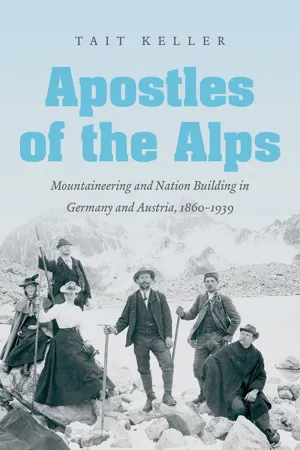
Apostles of the Alps
Mountaineering and Nation Building in Germany and Austria, 1860-1939
- 304 pages
- English
- ePUB (mobile friendly)
- Available on iOS & Android
eBook - ePub
Apostles of the Alps
Mountaineering and Nation Building in Germany and Austria, 1860-1939
About this book
Information
1: Civilizing the Crags
Urban Adventurers Modernize the Mountains
The form and the outer appearance of the mountains are caused by two factors, namely: the nature of the rocks of which they are composed, and the intensity of the forces that shaped them.
—Edouard Desor, Der Gebirgsbau der Alpen (1865)
“Wandering across glaciers has lost its harrowing repute and is now reckoned as almost humdrum,” Paul Grohmann noted with regret in 1864, “and in recent years many of the high peaks have lost their reputation of remoteness.”1 One of the founders of the Austrian Alpine Association and credited with several challenging first ascents in the Eastern Alps, Grohmann recognized that Alpinism had changed. The following year, Edward Whymper led the famed first ascent of the Matterhorn, an event that traditionally marks the end of Alpinism’s so-called golden age. By then daring mountaineers had climbed—or “conquered,” as most wrote—nearly all the major peaks across the Alpine Arc. Now came the era of mass tourism in the Alps and with it environmental change on an unprecedented scale. Solitary climbers summiting distant peaks may not have substantially altered nature, but these pioneers opened the way for larger crowds and more systemic transformations of Alpine ecologies.2 What started as a trickle of tourists and academics in the early 1860s turned into an avalanche of vacationers, investment schemes, and heavy construction projects a generation later. Though located on the fringes of empires, the Alps loomed large in the imaginations of urbanites across Germany and Austria. Voluntary civic groups, most notably the German and Austrian Alpine Association, experienced massive growth as would-be mountaineers swelled the ranks. These civic clubs transformed the landscape and tamed the heights for urban wanderers. A massive network of blazed hiking trails soon crisscrossed the peaks. Bridges, ladders, gangways across glaciers, and chiseled stairs along stone ridges provided greater access to remote places. Highly detailed maps of the Eastern Alps with climbing routes turned mysterious crags into a series of rational contour lines. Clubs published travel aids and certified tour guides to escort novices. With convenience came civilization. Construction sites dotted the peaks. Fancy chalets replaced weather-beaten huts. Through their prodigious efforts, civic mountaineering organizations transformed the economies of the Eastern Alps and changed the “fabric” of the mountains.
. . . . . . . . . . . . .
Contrary to romantic musings on pristine wilderness, the Alps had felt the human touch for millennia. Neolithic hunters, like Ötzi the Iceman, had braved the heights.3 Roman merchants once frequented the passes along the Brenner watershed. Smelting and mining in the region stretched back to late antiquity. During the medieval and early modern eras, iron ore works stood atop mountains, harnessing the wind and harvesting forests to power the forges. Miners hollowed out mountains and willfully felled trees for pit timber in the tunnels. As early as the twelfth century, local land managers raised concerns about deforestation. By the mid-nineteenth century, around the same time that civic mountaineering clubs first took shape, Alpine forests supplied nearly a quarter of the timber needs for Austria’s entire coal mining industry. Clear-cutting hindered reseeding and reduced the biodiversity of the region as monocultures of spruce pine trees replaced mixed stands. The denuded slopes raised the risk of avalanches, mudslides, and seasonal flooding.4 But dairy farmers, Senners, also took advantage of the open hillsides for grazing. In the Alpine provinces of Tyrol, Salzburg, and Carinthia, pastureland accounted for 75 percent of productive land, and most of the population worked in agriculture.5 Almost the entire social economy of mountain dwellers revolved around the Alpine meadows, the “Alp” or “Alm,” where cows, goats, and sheep found fodder.6 The sheep and goats spent their days on the upper, less fertile fields. Cows occupied the lower, lusher stretches.
Adherence to tradition and internal regulatory mechanisms did seem to maintain a somewhat homeostatic equilibrium on the farmsteads.7 Scarce resources demanded careful management. Fertile loam was precious, and Alpine cultivation and animal husbandry extended only as far as the highest meadows. The farmers followed a careful system of transhumance, rotating cattle to different portions of the pasture over the course of the summer. A village’s “Alp-master” oversaw the schedule. His task was to prevent pastures from going to ruin. In addition to supervising cattle rotation, he checked the stone walls and borders of the fields, dictated the precise day when the wild hay was ready to mow, and kept tabs on both the exact number of cows munching in the fields and their owners. Burghers of the village had the sole rights to pasture, Kuhrecht, but laws allowed a farmer to keep only as many cows in the winter as he could put to pasture in the summer, unless he paid for extra hay or owned extensive meadowland.8
Although the Alps acted more as a filter than a barrier for much of human history and were more deliberately regulated than most other landscapes, their crags were still forbidding places at the start of the nineteenth century. Even those who lived on the mountains had no love for the barren heights. Since Senners often managed several scattered land parcels located at varying altitudes, they held little interest in what lay beyond the vegetation zone. The peaks offered stone, ice, and the “vague idea of endless cold and desolation.” “Above the last green mountain terrace of rock, silent as death, sublime as eternity, looms an unknown land,” waxed one traveler in the early 1800s, “where man and the nature suited to him find no home.”9 Reaching a summit demanded exertion that was better spent elsewhere, and farmers had little incentive to climb any higher than they needed. Many high places were inaccessible anyway. The few highways skirted around hulking mountains, and most railroads avoided the rugged regions. Only the occasional mule track wound its way along the ridges. People far from the mountains had few options for reaching the Alpine frontier until industrial developments during the first half of the nineteenth century opened the way for the masses.
The onset of mass tourism in the Alps began with coal. Coal commanded central Europe’s industrial energy regime. More coal meant greater iron output, steel manufacturing, and more steam-powered machines as factories grew and mines expanded. By the mid-1860s, industrialization and urbanization were gearing into full swing across most of central Europe. The coal and metal sectors dominated Germany’s industrialization. Belching smokestacks signified progress as the country evolved into an economic behemoth. Austria’s industrial growth was not nearly as impressive as its neighbor’s but present nonetheless.10
Coal fueled trains, which in turn drove the economic boom of the 1860s. More numerous powerful locomotives required miles of steel track. The expanding web of rail lines soon laced through the Alps, opening remote valleys. Austria’s railroad network increased from just over five thousand kilometers in 1869 to more than ten thousand kilometers in 1875.11 Prior to this expansion, getting to the Eastern Alps from the north was expensive and difficult. People in Hamburg, Hannover, Bremen, or Magdeburg had an easier time traveling to Switzerland and the Western Alps than to Munich. As one traveler observed, hotel guest books in the Swiss Alps had more signatures from northern Germans than did lodges in the German Alps.12 But new tracks changed that. Distant cities now had better connections to the mountains. The Vienna-to-Munich line with connections to Linz and Salzburg was completed in 1860, the Brennerbahn opened in 1867, and the Salzburg line with connections to Zell am See and Innsbruck began operating in 1875. The Pustertalbahn, which opened 1871, traveled from Villach across Tyrol to Bolzano. Along with the Rudolfsbahn line from Ljubljana to Villach, which began operations a year later, the Salzkammergutbahn and roads over the Stelvio Pass connected the Eastern Alps to ports on the Black Sea, the Adriatic, and the North Sea. Even tourists from across the Atlantic could reach the little towns of Gmünd, Mallnitz, and Heiligenblut.13 With improved connections, journeys that once took weeks could now be accomplished in days.
Rail networks stimulated heavy industry and contributed to the construction sector’s explosive growth. Cities bulged beyond their medieval walls as their populations swelled. New factories, housing tenements, and public buildings crowded the skylines. Rail lines also provided labor mobility. Most European countries had also eased travel restrictions, increasing social movement and the flow of traffic. Migration from the countryside to the city added to the ranks of urban workers. Berlin’s population doubled from 1850 to 1871 to over 820,000. Vienna’s citizens numbered well over half a million, and Munich contained more than 170,000 residents when their Alpine clubs rose to prominence.14
The timing was no mere coincidence. Urbanization set the mountains apart from the metropolis. With prosperity came pollution. Coal fires made cities dark with smoke, soot, and grime. Foul air was the hallmark of urban centers, along with sprawl, squalor, and the lack of sanitation. The lag in waste management technology meant that most people wallowed in their own filth. Only plumes of sulfur dioxide and other chemical by-products covered the stench of open sewers. Citizens suffered. Health ailments were myriad. Horrible living situations provided a haven for infectious disease. Cholera epidemics and typhus outbreaks raged through the cramped quarters with devastating results. Cities acquired reputations as gloomy, dirty, rank, and teeming with the unwashed masses. The Alps formed a natural antithesis to the growing cityscapes across Europe. The unfiltered light of the peaks, crisp glacial air, and seemingly pristine snowfields played against the dark alleyways, suffocating atmosphere, and grimy urban existence. Visions of “empty” mountains drew those who wanted to escape the crowds and expanded the memberships of civic Alpine clubs.15
Eduard Fenzl was right when he called the Austrian Alpine Association a “child of its age” during his opening address at the club’s first official convention in November 1862.16 A respected professor of botany at the University of Vienna and the association’s first chairman, Fenzl exemplified the club’s social composition and academic orientation. His speech lasted for the better part of an hour and exalted the club’s future contributions to scientific progress and civic life. He knew his audience. With industrialization, the nineteenth century witnessed the emergence of a confident and influential bourgeoisie in Germany and Austria that steadily grew in size and strength. Economic development brought wealth, and with it the bourgeoisie exuded a sense of achievement and self-importance. The growing preponderance of bourgeois values centered on notions of progress and self-improvement was essential to the success of civic groups, especially Alpine clubs.17 Numerous voluntary associations now abounded across Germany and Austria. In the 1850s, both regimes had kept a close eye on civic clubs after the turmoil of the 1848 revolutions, and in Austria the organization of overtly political clubs was outlawed. But by the 1860s, restrictions had loosened and the number of voluntary associations grew steadily, particularly among middle-class Germans and Austrians.18 Most of them belonged to some such club or another. Membership required time and money, particularly for mountaineering clubs. Only people with disposable incomes and room for leisure could afford recreational trips to the Alps.
Railways and wealth provided the means for popular Alpinism, and city living typically the incentive, but organized Alpine tourism first began under the guises of scientific inquiry and social progress. Two men in particular embodied these drives: Eduard Suess, a professor of geology at the University of Vienna, and Franz Senn, a curate in the tiny Tyrolean village of Vent. Senn’s interest in tourism stemmed from his concern for his impoverished parishioners. He had already introduced manure and other improvements to increase harvest yields in the early 1860s, but Vent’s economic plight remained dire. Such a situation was not unusual for rural inhabitants of central Europe. Although agricultural productivity increased during the mid-1800s as agrarian science improved, new land came into cultivation, markets diversified, and seed prices dropped, most German and Austrian peasants still led hard lives.19 The Alpine regions fared particularly poorly. Mountain villages also suffered from significant depopulation during the nineteenth century when their young people sought out better, more exciting lives in the cities.
Yet what dairymen in villages like Vent had, which farmers in the Hungarian Alföld, that vast central European plain, or peasants on Junker estates in East Prussia did not, were the Alps. Vent lay to the southwest of Innsbruck, in the Ötztaler Range, among the more massive groups of the Eastern Alps. Wildspitze (3,770 m), one of the highest peaks in the region, towered nearby, providing a sense of majesty to the poor valley. Nestled on the forested floor near the confluence of the Niedertalbach and Rofenache Rivers with a view of the two largest ridges of the mountain group, Vent’s panorama was stunning. The inhabitants, however, had not always considered the view inspiring. The high summits felt oppressive. More pragmatically, erosion threatened the tenuous hold of already narrow meadows with poorer, rocky soil. Senn, known to locals as the “Glacier Priest,” realized that tourism was the key to long-term prosperity. In the years ahead, thanks partly to Senn’s efforts, the high mountains became a “veritable gold mine” for hamlets like Vent, more valuable than the meadows had ever been. “For it is the peaks,” as one tourist later observed, “and not the pastures that attract visitors from below to the Alpine glens, and these visitors leave much gold behind them.”20 But for the time being, Senn contemplated ways of generating broader interest in the Alps.
So did Eduard Suess. The young professor was well known among Alpine circles and had firsthand experience wandering in the Alps. In 1854, following a Swiss academic conference for natural scientists in St. Gallen, the twenty-three-year-old Suess and some colleagues hiked to Bregenz, located on Lake Constance about twenty miles away, and then onward over 125 miles across the Arlberg mountain range to Innsbruck. Considering that few Alpine lodges existed and that tracks for the Arlberg line, the first railroad to run east-west across the Alps from Innsbruck to Bludenz, would not be laid for another twenty-six years, the journey must have been arduous. The mountains certainly made an impression on Suess. Upon returning to Vienna, he c...
Table of contents
- Cover Page
- Apostles of the Alps
- Copyright Page
- Dedication
- Contents
- Figures
- Acknowledgments
- Note on Citations and Translation
- Abbreviations Used in the Text
- Introduction
- Part One: Opening the Alps, 1860–1918
- Part Two: Dominating the Alps, 1919–1939
- Conclusion
- Notes
- Bibliography
- Index
Trusted by 375,005 students
Access to over 1.5 million titles for a fair monthly price.
Study more efficiently using our study tools.
Frequently asked questions
Yes, you can cancel anytime from the Subscription tab in your account settings on the Perlego website. Your subscription will stay active until the end of your current billing period. Learn how to cancel your subscription
No, books cannot be downloaded as external files, such as PDFs, for use outside of Perlego. However, you can download books within the Perlego app for offline reading on mobile or tablet. Learn how to download books offline
Perlego offers two plans: Essential and Complete
- Essential is ideal for learners and professionals who enjoy exploring a wide range of subjects. Access the Essential Library with 800,000+ trusted titles and best-sellers across business, personal growth, and the humanities. Includes unlimited reading time and Standard Read Aloud voice.
- Complete: Perfect for advanced learners and researchers needing full, unrestricted access. Unlock 1.5M+ books across hundreds of subjects, including academic and specialized titles. The Complete Plan also includes advanced features like Premium Read Aloud and Research Assistant.
We are an online textbook subscription service, where you can get access to an entire online library for less than the price of a single book per month. With over 1.5 million books across 990+ topics, we’ve got you covered! Learn about our mission
Look out for the read-aloud symbol on your next book to see if you can listen to it. The read-aloud tool reads text aloud for you, highlighting the text as it is being read. You can pause it, speed it up and slow it down. Learn more about Read Aloud
Yes! You can use the Perlego app on both iOS and Android devices to read anytime, anywhere — even offline. Perfect for commutes or when you’re on the go.
Please note we cannot support devices running on iOS 13 and Android 7 or earlier. Learn more about using the app
Please note we cannot support devices running on iOS 13 and Android 7 or earlier. Learn more about using the app
Yes, you can access Apostles of the Alps by Tait Keller in PDF and/or ePUB format, as well as other popular books in History & European History. We have over 1.5 million books available in our catalogue for you to explore.