eBook - ePub
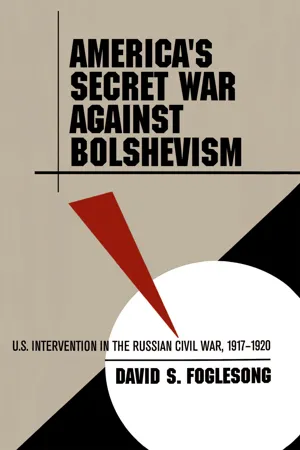
America's Secret War against Bolshevism
U.S. Intervention in the Russian Civil War, 1917-1920
- 400 pages
- English
- ePUB (mobile friendly)
- Available on iOS & Android
eBook - ePub
America's Secret War against Bolshevism
U.S. Intervention in the Russian Civil War, 1917-1920
About this book
From the Russian revolutions of 1917 to the end of the Civil War in 1920, Woodrow Wilson's administration sought to oppose the Bolsheviks in a variety of covert ways. Drawing on previously unavailable American and Russian archival material, David Foglesong chronicles both sides of this secret war and reveals a new dimension to the first years of the U.S.-Soviet rivalry. Foglesong explores the evolution of Wilson's ambivalent attitudes toward socialism and revolution before 1917 and analyzes the social and cultural origins of American anti-Bolshevism. Constrained by his espousal of the principle of self-determination, by idealistic public sentiment, and by congressional restrictions, Wilson had to rely on secretive methods to affect the course of the Russian Civil War. The administration provided covert financial and military aid to anti-Bolshevik forces, established clandestine spy networks, concealed the purposes of limited military expeditions to northern Russia and Siberia, and delivered ostensibly humanitarian assistance to soldiers fighting to overthrow the Soviet government. In turn, the Soviets developed and secretly funded a propaganda campaign in the United States designed to mobilize public opposition to anti-Bolshevik activity, promote American-Soviet economic ties, and win diplomatic recognition from Washington.
Information
1 THE DEVELOPMENT OF A WILSONIAN STYLE OF INTERVENTION
My policy regarding Russia is very similar to my Mexican policy. I believe in letting them work out their own salvation, even though they wallow in anarchy for a while.
— Woodrow Wilson, October 1918
“I hold it as a fundamental principle,” Woodrow Wilson declared in January 1915, “that every people has the right to determine its own form of government.” Addressing a crowd in Indianapolis, Wilson insisted that it was none of his business and none of their business how the people of Mexico chose their leaders. “And, so far as my influence goes,” Wilson vowed, “nobody shall interfere with them.”1
No president has spoken more passionately and eloquently about the right of self-determination. Yet no president has intervened more often in foreign countries. Wilson directed the navy to seize Veracruz in 1914, ordered U.S. forces to occupy Haiti in 1915, commanded marines to pacify the Dominican Republic in 1916, sent soldiers deep into Mexico in the same year, and dispatched military expeditions to Vladivostok and Archangel in 1918. Less blatantly, Wilson used diplomatic pressure, economic sanctions, arms embargoes, and arms shipments to influence political developments from Central America to Siberia and from the Caribbean to the Baltic.
In the face of those actions, how could Wilson believe that his policies were consistent with the principle of self-determination? Wilson’s response to the tension between intervention and self-determination emerged gradually over several decades. While he expressed deep reservations in the 1890s about aggressive action in foreign lands, by the turn of the century he became convinced that America had a mission to promote orderly self-government around the world. If presidents took care to explain how intervention abroad was in harmony with American moral values and necessary to fulfill American ideals, he realized, it could unite rather than divide the country.
Wilson’s approach evolved further in the first years of his presidency, when his perceptions of Mexican needs and American interests tempted him to intercede in insurgent Mexico. Encountering domestic and foreign criticism of both direct military invasion and inaction, Wilson and his advisors came to rely on covert action and limited, indirect methods that he insisted did not constitute “intervention.” Thus, a distinctive Wilsonian style of intervention arose—one that embodied a combination of idealistic publicity, secrecy, and circumscribed operations.
Wilson neither drifted blindly into blunders in Mexico that converted him to strict nonintervention nor mastered the use of force with surgical precision. Rather, he developed a clear conception of methods beyond conventional diplomacy but short of outright war and repeatedly resorted to them, though they were often ineffective and sometimes escaped his control with damaging consequences. His policy regarding Russia would indeed be similar to his policy toward Mexico: American actions in Mexico between 1913 and 1917 marked the development of a persistent Wilsonian way of intervention that would be evident again in Russia from 1917 to 1920.2
Development of Wilson’s Attitudes toward Intervention before 1913
During his career as a historian, Wilson repeatedly expressed repugnance at the use of military force for selfish purposes. In Division and Reunion (1893), Wilson condemned President Polk’s unconstitutional “war of ruthless aggrandizement” against Mexico, which aggravated the sectional divisions that led to the Civil War. Eight years later, in A History of the American People, Wilson again chastised the “inexcusable aggression” upon a weak neighbor. While Wilson was not categorically opposed to war, when he became president “his shame as an American over the first Mexican war, and his resolution that there should never be another such predatory enterprise” fired fierce (though sporadic and not entirely successful) efforts to control the scope and objectives of military action.3
Like rapacious wars, intrigues by greedy private interests evoked scorn in Wilson. He frowned at the way American planters in the Hawaiian Islands conspired in 1893 to “get the government into their own hands,” and he applauded when Democratic president Grover Cleveland, repudiating the “singular revolution,” withdrew an annexation treaty from the Senate. In Wilson’s view, America’s foreign relations were then “generally simple enough to require little more” than a leader’s “own natural apprehension of right and wrong to guide him.”4
As America became more entangled in world affairs in the following years, Wilson learned that while his ideal statesman would answer above all to his own moral judgment, presidents also had to listen to the increasingly powerful voices of ordinary people. When Cleveland intervened in a boundary dispute between Britain and Venezuela in 1895, Wilson initially feared the American action would “bring about a deadly war between the two branches of the Eng[lish] race,” and he maintained that Americans should not compromise their “dignity and self-respect” by assuming an anti-European “protectorate and dictatorship over South America” that would lead to “interference . . . in breach alike of international law and courtesy.” Yet Wilson changed his mind after seeing the enthusiastic popular response to Cleveland’s stand. Thrilled by the way Cleveland enlisted the support of Anglo-American public opinion, Wilson commended Cleveland’s service as the “nearest friend” of Venezuela and lauded his “assertion of the Monroe doctrine in a new aspect, with a new dignity.”5
Wilson received an even more striking lesson about how chivalrous action abroad could electrify Americans when the United States went to war in 1898, ostensibly to free Cubans from Spanish tyranny. Although Wilson suspected that politicians, sensational newspapers, and other “influences” were pursuing their own selfish interests, he became convinced of the righteousness of the Spanish-American War and rejoiced in the way it forged “a new sense of union,” healing sectional divisions. “Intervention had come,” he wrote at the turn of the century, “not for the material aggrandizement of the United States, but for the assertion of the right of the government to succor those who seemed hopelessly oppressed.” While Wilson enumerated other objectives, including freeing American trade from the hindrances of the long Spanish-Cuban conflict, he stressed the saving grace of an altruistic spirit. “The consciences of the vast majority of us are void of offense,” he declared in 1903. “We know that our pulses beat high in that war because we truly believed ourselves to be defending peoples who were trodden upon and degraded by corrupt and selfish governors.” Adopting the same attitude he would take toward Mexico and Russia later, Wilson vowed, “We kept faith with Cuba, and we mean, with God’s help, to keep faith also with the people of the Philippine Islands, by serving them and ameliorating their condition, by showing them the way to liberty without plundering them or making them our tools for a selfish end.”6
To Robert Lansing, then a Democratic activist in upstate New York, that kind of humanitarian rhetoric from the mouths of Republicans seemed “the twaddle of sentimentalists . . . only useful as an excuse to cover unjustifiable acts.” Fifteen years before he soldiered in Wilson’s campaign to make the world “safe for democracy,” Lansing worried that Republican imperialists had set America on a course of global interventionism under the pretext of a “destiny to right the wrongs of the oppressed and succor the distressed.” In a remarkable premonition of Wilsonian policy, Lansing asked: “The Republics of Central and South America are in a perennial state of revolution . . . ; why do we not commence some humane wars and give them humane government? If we adopt ‘Only for the sake of Humanity’ as the United States motto, we shall find an endless field for our operations on this globe.”7
While Lansing criticized Republicans for abandoning “the safe and conservative path” of nonentanglement laid out by George Washington, Wilson shared many of Theodore Roosevelt’s expansionist views. Like Roosevelt, Wilson believed it was impossible for America to adhere to its traditional policy of “isolation,” since the world was becoming “a single commercial community” and America’s mission to open and transform Asia was part of “Providence.” During TR’s reign, Wilson began to call himself an “imperialist.” With the closing of the western frontier Wilson believed that the United States had to be ready to use force to secure new frontiers overseas where businessmen could sell the surplus of manufactured goods. “The great East,” he explained at the turn of the century, was “the market to which diplomacy, and if need be power, must make an open way.”8
Yet Wilson was disquieted by the Rough Rider’s high-handedness. Shortly after Roosevelt surreptitiously instigated a “revolution” in Panama in 1903, Wilson ventured an oblique criticism of those who “put a private interpretation upon international law,” and worried that “if we keep on, like a big man who was bullying a little one,” the United States would provoke a violent reaction from its “victim.”9 While Roosevelt was confident that the use of American might was invariably right and that by acting in their own interest Americans would be serving humanity, Wilson was more anxious to see American assertiveness redeemed by beneficent results and more sensitive to public perceptions. Facing rising ethical criticism of his foreign actions from Congress, the press, and an attentive public, even the stout TR began to doubt the fitness of democracies for administering empires. By the time Wilson entered the White House, growing tensions over foreign policy issues between labor and capital, pacifists and militarists, and isolationists and imperialists, combined with the cultural turmoil and moral upheaval of an increasingly urban, industrial, and multiethnic society, would make consideration of popular sentiment more important than ever.10
Major Influences on Wilsonian Policy toward Mexico
Busy introducing reforms as governor of New Jersey and launching a presidential campaign in 1911 and 1912, Wilson paid little attention to a revolution against the aged Mexican dictator Porfirio Díaz that was led by an American-educated liberal landowner, Francisco Madero. The principal impression Wilson recorded focused on the “disorders” in Mexico, a “wretched, unstable place.” Colonel House had been giving Mexico more thought: in 1911 he envisioned a military occupation to “bring order out of chaos,” break the Latin American “habit of revolutions without just cause,” safeguard foreign property, and educate Mexicans “for the responsibilities of self-government.” In January 1913, though, House suggested a much more modest plan, advising president-elect Wilson that Madero was an idealistic reformer who deserved America’s sympathy and support. That idea became moot in February, shortly before Wilson entered the White House, when General Victoriano Huerta led a coup in which Madero was murdered.11
Worried that other Latin American adventurers would be emboldened to foment revolution with a Democratic administration in Washington, Wilson issued a statement that sternly warned against selfish seizures of power. He also used the occasion to outline policies that would protect American trade and investment abroad while pleasing the antimonopoly progressives who supported him at home. Seeking to distinguish his approach from the bruising “Big Stick” and degrading “Dollar Diplomacy” of his Republican predecessors, Wilson pledged “to cultivate the friendship and deserve the confidence” of Latin American republics. However, he stipulated that inter-American cooperation would be based on certain principles. Disapproving of “disorder, personal intrigue and defiance of constitutional rights,” Wilson proclaimed that the United States would pursue the universal ideal of “orderly processes of just government.” While Washington would prefer leaders “who protect private rights,” it would not intercede in foreign countries on behalf of special interests. It would seek only mutually profitable trade between the United States and Latin America that would “interfere with the rights and liberties of neither.”12
Wilson’s principles did not lead toward a noninterventionist policy. Whereas selfish British imperialism focused on preserving order and advancing trade, America had a higher calling, Wilson believed. Instead of merely “being a policeman in Mexico,” Wilson informed a journalist, he wanted to lay secure foundations for liberty.13 Mexicans would need a guiding hand along the road to democracy, Wilson and many of his advisors contended. Like Filipinos, Mexicans were childlike people who required tutoring from more mature Americans to make them fit for self-government. While some of Wilson’s advisors and many Republican critics felt he was too hesitant to spank the unruly Mexicans, his paternalistic view of Mexicans disposed him to insist “that they shall take help when help is needed.”14
Wilson suspected that Americans who owned large tracts of land and other property in Mexico were plotting to bring about intervention, and he dug in his heels against such intrigues.15 However, he felt the U.S. government did have a duty “to protect American interests in the large sense” by facilitating the expansion of non-exploitative American commerce, creating secure environments for honest investors, and fighting against exclusionary concessions to foreign firms. Those objectives required a stable Mexican government that would respect foreign property and repay foreign loans. In pursuit of his political, economic, and humanitarian goals, Wilson would pressure, threaten, and even use force against Mexican leaders.16
His first step was to try to engineer the removal of Huerta. In May 1913 Wilson briefly toyed with the idea of recognizing Huerta if he would allow free elections and retire from office. However, the idea of granting recognition to a usurper ran against Wilson’s grain. When the general defiantly clung to power, Wilson withheld diplomatic recognition in order to encourage Huerta’s opponents to remove him.17
Moral and diplomatic pressure took time to work, and Wilson was impatient to end the turmoil in Mexico. Less than two months into his presidency he began considering military intervention. As House noted in May 1913, the two of them did not believe that “intervention and war would be as bad as his Cabinet thought.” By August 1913, determined “to act as Mexico’s nearest friend,” Wilson felt that he was not “at liberty any longer to stand inactively by.”18
The situation became even more intolerable in October, when Huerta arrested the Mexican Chamber of Deputies and a new British minister to Mexico seemed to dominate Huerta’s dictatorship. Since Huerta’s government was based on force and support from British diplomats and oil interests, in Wilson’s view, American action to depose th...
Table of contents
- Cover Page
- Title Page
- Copyright Page
- Dedication
- Contents
- Acknowledgments
- Note on Dates and Russian Transliteration
- Introduction
- 1 The Development of a Wilsonian Style of Intervention
- 2 The Origins of American Anti-Bolshevism
- 3 Keeping Faith with Russia: Ambassador Boris Bakhmeteff and U.S. Efforts to Restore “Democracy”
- 4 The British Connection: American Covert Aid to Anti-Bolsheviks in South Russia, 1917–1918
- 5 American Intelligence Gathering, Propaganda, and Covert Action in Revolutionary Russia
- 6 American Intervention in Siberia, 1918–1920: The Search for Anti-Bolshevik “Nuclei” and “Strong Men”
- 7 Fighting, but Not a War: American Intervention in North Russia, 1918–1919
- 8 Food as a Weapon against Bolshevism: American “Humanitarian” Intervention in the Baltic Region, 1919
- 9 The Struggle against Intervention: Soviet Policy toward America, 1917–1920
- Conclusion
- Notes
- Bibliography
- Index
Trusted by 375,005 students
Access to over 1.5 million titles for a fair monthly price.
Study more efficiently using our study tools.
Frequently asked questions
Yes, you can cancel anytime from the Subscription tab in your account settings on the Perlego website. Your subscription will stay active until the end of your current billing period. Learn how to cancel your subscription
No, books cannot be downloaded as external files, such as PDFs, for use outside of Perlego. However, you can download books within the Perlego app for offline reading on mobile or tablet. Learn how to download books offline
Perlego offers two plans: Essential and Complete
- Essential is ideal for learners and professionals who enjoy exploring a wide range of subjects. Access the Essential Library with 800,000+ trusted titles and best-sellers across business, personal growth, and the humanities. Includes unlimited reading time and Standard Read Aloud voice.
- Complete: Perfect for advanced learners and researchers needing full, unrestricted access. Unlock 1.5M+ books across hundreds of subjects, including academic and specialized titles. The Complete Plan also includes advanced features like Premium Read Aloud and Research Assistant.
We are an online textbook subscription service, where you can get access to an entire online library for less than the price of a single book per month. With over 1.5 million books across 990+ topics, we’ve got you covered! Learn about our mission
Look out for the read-aloud symbol on your next book to see if you can listen to it. The read-aloud tool reads text aloud for you, highlighting the text as it is being read. You can pause it, speed it up and slow it down. Learn more about Read Aloud
Yes! You can use the Perlego app on both iOS and Android devices to read anytime, anywhere — even offline. Perfect for commutes or when you’re on the go.
Please note we cannot support devices running on iOS 13 and Android 7 or earlier. Learn more about using the app
Please note we cannot support devices running on iOS 13 and Android 7 or earlier. Learn more about using the app
Yes, you can access America's Secret War against Bolshevism by David S. Foglesong in PDF and/or ePUB format, as well as other popular books in Politics & International Relations & North American History. We have over 1.5 million books available in our catalogue for you to explore.