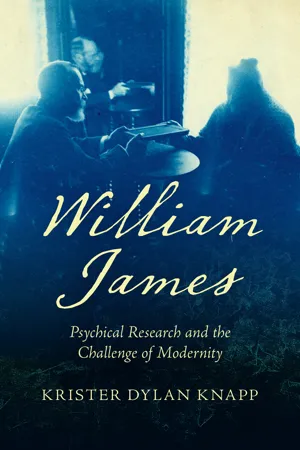
In this insightful new book on the remarkable William James, the American psychologist and philosopher, Krister Dylan Knapp provides the first deeply historical and acutely analytical account of James’s psychical research. While showing that James always maintained a critical stance toward claims of paranormal phenomena like spiritualism, Knapp uses new sources to argue that psychical research held a strikingly central position in James’s life. It was crucial to his familial and professional relationships, the fashioning of his unique intellectual disposition, and the shaping of his core doctrines, especially the will-to-believe, empiricism, fideism, and theories of the subliminal consciousness and immortality.
Knapp explains how and why James found in psychical research a way to rethink the well-trodden approaches to classic Euro-American religious thought, typified by the oppositional categories of natural vs. supernatural and normal vs. paranormal. He demonstrates how James eschewed these choices and instead developed a tertiary synthesis of them, an approach Knapp terms tertium quid, the third way. Situating James’s psychical research in relation to the rise of experimental psychology and Protestantism’s changing place in fin de siècle America, Knapp asserts that the third way illustrated a much broader trend in transatlantic thought as it struggled to navigate the uncertainties and religious adventurism of the modern age.
- 400 pages
- English
- ePUB (mobile friendly)
- Available on iOS & Android
eBook - ePub
About this book
Information
Topic
Teología y religiónSubtopic
Historia y teoría en psicologíaNotes
ABBREVIATIONS
James Family Members
- AHGJ
- Alice Howe Gibbens James (WJ’s wife)
- AJ
- Alice James (WJ’s sister)
- ARJ
- Alexander Robertson James (WJ’s youngest son)
- HJ Jr.
- Henry James Jr. (WJ’s brother, “Harry”)
- HJ Sr.
- Henry James Sr. (WJ’s father)
- HJ III
- Henry James (WJ’s first son)
- MMJ
- Margaret Mary James (WJ’s daughter)
- WJ
- William James
- WJ Jr.
- William James (WJ’s second son)
Societies and Their Publications
- ASPR
- American Society for Psychical Research
- JASPR
- Journal of the American Society for Psychical Research
- PASPR
- Proceedings of the American Society for Psychical Research
- SPR
- Society for Psychical Research
- JSPR
- Journal of the Society for Psychical Research
- PSPR
- Proceedings of the Society for Psychical Research
Primary Sources
- CWJ
- The Correspondence of William James
- ECR
- Essays, Comments, and Reviews
- EP
- Essays in Psychology
- EPHL
- Essays in Philosophy
- EPR
- Essays in Psychical Research
- ERM
- Essays in Religion and Morality
- HI
- Human Immortality
- HJL
- Henry James Letters
- JJGW
- James John Garth Wilkinson Papers
- JP
- James Papers
- LWJ
- The Letters of William James
- LWJTF
- Letters of William James and Théodore Flournoy
- PP
- The Principles of Psychology
- Prag.
- Pragmatism
- PU
- A Pluralistic Universe
- SPP
- Some Problems of Philosophy
- SUC
- The Selected Unpublished Correspondence
- WB
- The Will to Believe
- WWJ
- The Writings of William James
Secondary Sources
- TCWJ
- The Thought and Character of William James
Reference Works
- BDP
- Biographical Dictionary of Parapsychology
- CAT
- A Companion to American Thought
- DAB
- The Dictionary of American Biography
- DNB
- The Dictionary of National Biography
- DSB
- The Dictionary of Scientific Biography
- EOP
- Encyclopedia of Occultism and Parapsychology
- EPhil
- Encyclopedia of Philosophy
- PDS
- A Popular Dictionary of Spiritualism
- RE
- The Reader’s Encyclopedia
INTRODUCTION
1. Excerpted with quotations from EPR, appendix 3, “Sittings with Mrs. Piper: Kate Walsh and Baby Eliza,” 436–41. See also “Weather Report.”
2. EOP, s.v. “psychical research” and “telepathy.”
3. Ibid., s.v. “Spiritualism.”
4. WJ to Ralph Barton Perry, 9 September 1904, SUC, 348.
5. The one possible exception is Blum, Ghost Hunters. It is a very readable but journalistic account of the first generation of psychical researchers in the United States largely devoid of historical context, a conceptual framework, and an analytical argument. For an account of the scholarly literature, see my Historiographical Essay.
6. Perry, TCWJ, 2:155.
7. See Gale, Divided Self of William James; and W. Cooper, Unity of William James’s Thought, especially chap. 2. Thanks to an anonymous reader of the manuscript for pointing out the latter source and argument.
8. The impetus for my argument comes from Robert A. McDermott, who wrote, “James’s research concerning psychical phenomena may be understood as his effort to generate a tertium quid, or third position, between the equally unacceptable extremes of skepticism and uncritical acceptance.” See McDermott, introduction to EPR, xxix. While McDermott limited its applicability to psychology, my book develops a much broader notion of the concept. I am especially grateful to Howard Brick, who suggested the useful phrase “a tertiary synthesis of all dualisms.” Some psychologists, psychiatrists, and philosophers argue that F. W. H. Myers, one of James’s psychical research colleagues, took a third way approach to the study of the mind. See Kelly and Kelly et al., Irreducible Mind, esp. 62–63. I argue against this view in chap. 6. Thanks to one anonymous reader of the manuscript for pointing out this source.
9. RE, s.v. “tertium quid”; Webster’s Ninth New Collegiate Dictionary, s.v. “tertium quid”; Chadwick, Early Church, 148, 157, 192–212.
10. WJ, “Thomas Davidson: Individualist,” ECR, 89.
11. WJ to G. S. Hall, 10 October 1879, CWJ, 5:64. On James’s rejection of Hegel and his impact on philosophy in Cambridge, see Richardson, William James, 213–16.
12. WJ, “On Some Hegelisms,” WB, 216–17.
13. WJ, Prag., 28; EPhil, s.v. “pragmatism,” by H. S. Thayer.
14. Perry, TCWJ, 1:458–59.
15. For a contrasting view that argues “pure experience” formed James’s center of vision, see Bjork, Wil...
Table of contents
- Cover Page
- Title Page
- Copyright Page
- Dedication
- Contents
- Figures
- Acknowledgments
- Introduction: Tertium Quid
- I: Becoming a Psychical Researcher
- II: Practicing Psychical Research
- III: Theorizing Psychical Research
- Conclusion: Tertium Quid Redux
- Historiographical Essay
- Notes
- Bibliography
- Index
Trusted by 375,005 students
Access to over 1.5 million titles for a fair monthly price.
Study more efficiently using our study tools.
Frequently asked questions
Yes, you can cancel anytime from the Subscription tab in your account settings on the Perlego website. Your subscription will stay active until the end of your current billing period. Learn how to cancel your subscription
No, books cannot be downloaded as external files, such as PDFs, for use outside of Perlego. However, you can download books within the Perlego app for offline reading on mobile or tablet. Learn how to download books offline
Perlego offers two plans: Essential and Complete
- Essential is ideal for learners and professionals who enjoy exploring a wide range of subjects. Access the Essential Library with 800,000+ trusted titles and best-sellers across business, personal growth, and the humanities. Includes unlimited reading time and Standard Read Aloud voice.
- Complete: Perfect for advanced learners and researchers needing full, unrestricted access. Unlock 1.5M+ books across hundreds of subjects, including academic and specialized titles. The Complete Plan also includes advanced features like Premium Read Aloud and Research Assistant.
We are an online textbook subscription service, where you can get access to an entire online library for less than the price of a single book per month. With over 1.5 million books across 990+ topics, we’ve got you covered! Learn about our mission
Look out for the read-aloud symbol on your next book to see if you can listen to it. The read-aloud tool reads text aloud for you, highlighting the text as it is being read. You can pause it, speed it up and slow it down. Learn more about Read Aloud
Yes! You can use the Perlego app on both iOS and Android devices to read anytime, anywhere — even offline. Perfect for commutes or when you’re on the go.
Please note we cannot support devices running on iOS 13 and Android 7 or earlier. Learn more about using the app
Please note we cannot support devices running on iOS 13 and Android 7 or earlier. Learn more about using the app
Yes, you can access William James by Krister Dylan Knapp in PDF and/or ePUB format, as well as other popular books in Teología y religión & Historia y teoría en psicología. We have over 1.5 million books available in our catalogue for you to explore.