- 324 pages
- English
- ePUB (mobile friendly)
- Available on iOS & Android
eBook - ePub
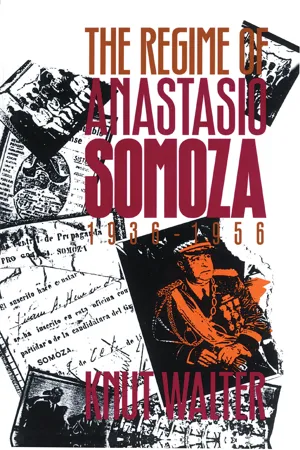
The Regime of Anastasio Somoza, 1936-1956
About this book
To many observers, Anastasio Somoza, who ruled Nicaragua from 1936 until his assassination in 1956, personified the worst features of a dictator. While not dismissing these characteristics, Knut Walter argues that the regime was in fact more notable for its achievement of stability, economic growth, and state building than for its personalistic and dictatorial features. Using a wide range of sources in Nicaraguan archives, Walter focuses on institutional and structural developments to explain how Somoza gained and consolidated power. According to Walter, Somoza preferred to resolve conflicts by political means rather than by outright coercion. Specifically, he built his government on agreements negotiated with the country's principal political actors, labor groups, and business organizations. Nicaragua's two traditional parties, one conservative and the other liberal, were included in elections, thus giving the appearance of political pluralism. Partly as a result, the opposition was forced to become increasingly radical, says Walter; eventually, in 1979, Nicaragua produced the only successful revolution in Central America and the first in all of Latin America since Cuba's.
Information
Chapter 1: Nicaraguan Society and Politics Prior to 1930
Even in a region proverbial for internal anarchy and foreign intromissions, Nicaragua stands out as an extreme case. From the days of the Spanish Conquest itself, Nicaragua was already a battleground of competing expeditions of discovery and conquest that set the basis for factional conflict during the centuries to come. One group of Spanish settlers made its home in the town of Granada, founded in 1524 by Hernández de Córdoba at the northwestern edge of Lake Nicaragua. Other Spanish conquerors, advancing south from Mexico and Guatemala, threatened Hernández de Córdoba’s control over the territory, so he sent a group of his men north to found the town of León in a move to consolidate his hold over the territory and to repel groups of Spaniards that were moving about in Honduras.1
Colonial Society and Politics
Although León became the administrative center in the territory, Granada retained a privileged social and economic position. Most of the noblemen and hidalgos in the expedition of conquest settled there because the Indian population of the province was concentrated around Granada. Furthermore, its location on the lakeshore allowed for direct transportation by water upon the Great Lake. However, Granada remained landlocked until a river route from the Great Lake to the sea was discovered in 1539.
León had access to the sea through the port of Realejo, a few miles west on the Pacific coast, which during the first century of colonial rule was an important shipbuilding and repairing facility, as well as a trading port. León was able to control the exploitation of naval stores in the forests of the Northern Highlands (the departments of Nueva Segovia and Madriz in contemporary Nicaragua) and thus supply Realejo with wood, pine tar, and resins.
While León took an early lead in productive and commercial ventures within Nicaragua, Granada enjoyed little trade outside of its immediate area of influence. The Rio San Juan eventually opened to traffic to the sea in the 1540s, although the river route always was troublesome and slow due to rapids, sandbars, and low water in the dry season. Nevertheless, trade through Granada increased, especially when Realejo and the Pacific coast of Central America in general came under increasing threat from pirates in the late sixteenth century. Exports from as far away as Guatemala and El Salvador (principally indigo) were carried on mule trains to Granada and there placed on ships for the slow trip to the Caribbean Sea. For more than a century, the merchant families of Granada prospered.
Yet Granada’s long-term economic prosperity was not based on imperial trade within which it was only an intermediary; instead, the city became the major base for a considerable number of ranchers who owned land in the areas of Rivas, Carazo, Masaya, and, most important, Chontales, a strip of particularly rich and moist land on the eastern shore of the Great Lake. Beginning in the seventeenth century, a number of families obtained large tracts of land from the Crown and laid the basis of what eventually became the Granada oligarchy. Through their ownership of land and family ties, the Granada merchant-ranchers exercised control over most of the shoreline of the Great Lake.
The decline of Pacific navigation also fostered cattle and cereal production in the area of León and northwestern Nicaragua. However, there were practically no commercial exchanges or business links between León and Granada given the similarity of their material production and the different markets they each supplied. Granada’s meat and hides were sent to Spain and Costa Rica, whereas León’s cattle were exported on the hoof to markets in Salvador and even Guatemala City. By the end of the colonial period, therefore, Granada and León had no history of conflict, other than the usual administrative problems emanating from the provincial capital in León that might have caused resentment or disgust among the Granada oligarchy. But there was no history of social or political integration, either. Each city had gone its own way, extending its control into the corresponding sphere of influence by means of networks of trade, land ownership, and family connections under the aegis of cattle raising.
The impact of a cattle-raising economy and subsistence cereal production on the formation of government institutions proved decisive in colonial Nicaragua. The lack of an internal market of any size, the limited investment in infrastructure required for cattle export, and the importance of family and landownership patterns in determining power and influence all combined to restrict the growth of governmental institutions within the province itself. In fact, the strength of the colonial state in all of Central America was never great. Under the Hapsburgs, the main preoccupation of the authorities was tribute collection and political loyalty from Creoles and Indians. Under the Bourbons, attempts to centralize the state’s apparatus in order to collect more taxes and strengthen defenses against foreign attack were unsuccessful on the whole, especially in the areas outside of the direct control of the captain general in Guatemala City. At most, some sort of cohesion was provided by the Crown’s agents in the province and the Catholic church.2 When these unifying factors were removed or weakened at the moment of independence from Spain, Central America entered into an era of divisiveness and civil conflict that lasted for the better part of half a century.
Independence and Factional Conflict
Independence from Spain came to Central America in September 1821 more as a reflection of the Mexican independence process than a locally determined step. In fact, Iturbide’s imperial government tried to annex Central America, but Mexico’s own internal problems prevented its armies in Guatemala and Salvador from consolidating their hold and they were forced to retreat in 1823. The same year, the Central American representatives meeting in Guatemala drafted and signed another declaration of independence that reaffirmed Central America’s independence and created a new political entity, the United Provinces of Central America, organized under a constitution drafted the following year that provided for a weak federal government to handle foreign affairs, military security, and international trade.3
This Central American federation thus constituted had a fairly short and violent existence. The relative absence of civil conflict during the independence movement was followed by a period of near chronic civil war in the years after 1824. Liberals and Conservatives, each determined to impose their program of government and ideology, eventually tore the federation apart in 1839.4 Within Nicaragua itself, León and Granada vied for control of the state of Nicaragua. In 1824, a war broke out between the two cities which Granada won after virtually destroying its enemy: nine hundred houses were demolished in León and some neighborhoods were reduced to ashes. An army of federal soldiers from Salvador had to be sent to Nicaragua to pacify the province.5 Thereafter, in Nicaragua central government as such ceased to function. Nominally, government posts and offices and constitutions and laws existed, but in practice political power reverted to landed families that dominated their respective regions.
Nicaragua’s fractious politics can be attributed to its tradition of decentralized power and regional conflict. But special conditions that affected the province’s economy also must be considered. For one, civil strife meant that the peasant population was called upon frequently to render military service; as Miles Wortman states, “ranch hands and private armies became one and the same.” Second, manpower was scarce and tended to become even more so as violence persuaded people to flee to the relative peace of salaried labor in Costa Rica or Salvador. Finally, abundant land meant that laborers could move on to fringe areas if conditions of employment were not satisfactory. As a result, many hacendados abandoned their estates during the first decades of the nineteenth century, thus contributing to a deterioration of the economic situation and a further reduction of government income.6
Political strife was accompanied by territorial dismemberment. By the mid-nineteenth century, the Mosquito Coast on Nicaragua’s eastern shore had come fully under British control. Even before, the entire southern region of Nicaragua called Guanacaste had seceded and joined the new republic of Costa Rica. Political conflict was therefore limited to the northeastern axis connecting León and Granada with their respective outlying areas. Out of this rivalry emerged the two parties or factions that dominated Nicaraguan political life for the next century and a half: the Liberals, who were strongest in León, and the Conservatives with their base in Granada. At issue was not a national political or economic model or program that might favor one city over the other because, in fact, there was no national economic or political system in existence. What was at issue was control of the central government’s limited finances and oligarchic control over each region’s territory.
The national government’s income came from very few sources, including customs duties and assorted excise taxes, as well as the duties charged to companies engaged in transisthmian traffic. All together, these did not amount to much, but they were the only source of liquid income available and control over them gave considerable advantage to one faction over the other.7 Compounding the fiscal weaknesses of the government was the well-entrenched system of caudillo domination in the countryside and a network of political alliances based on personal or familial relationships. As Humberto Belli has pointed out, the formation of a national state, based on impersonal and rational bureaucracies and laws, was all but impossible. Instead, political conflicts and agreements boiled down to arrangements between individuals and thereby favored those that involved blood relations or friendship. The poor—those campesinos, peons, and artisans who made up the mass of the political factions and the private armies—came under the control of diverse local oligarchies whose protection and favor they sought, thereby strengthening patron-client relations.8
The nonnational character of this political confrontation is best illustrated by the William Walker episode of 1856, when the Liberal faction contracted with the U.S. filibuster to provide an army of mercenaries to defeat the Granada faction then in control of the government. Instead, Walker decided to make himself president of the republic after defeating the Conservatives and turning his back on the Liberals; he was expelled from Nicaragua only after a concerted military effort that brought together Liberals and Conservatives, as well as troops from Costa Rica, El Salvador, and Guatemala. Such was the first of a number of U.S. interventions that Nicaragua would experience in the next seventy-five years of its republican existence. Although Walker’s was a private venture in comparison to U.S. government and military intervention later on, the immediate cause was the same: sectional antagonism that degenerated into open conflict with one of the parties requesting outside assistance to impose its will together with a disposition on the part of some outside group or government to provide such assistance.
The Walker episode at least served to bring the Granada and León oligarchies together, both to expel Walker and to seek some sort of political accommodation. This last was achieved by means of a pact signed by the two parties in 1856 and formally ratified in the Constitution of 1858. In its economic aspects, the agreement included a more equitable distribution between the two cities of customs duties and taxes on the transisthmian route, the elimination of certain commercial monopoly rights enjoyed by Granada and the reopening of the port of Corinto (the successor to Realejo), and fiscal concessions for export producers, including free import of capital goods and reduced taxes on exports. In its political aspects, the agreement ratified oligarchic control of the political process by limiting voting rights to property holders, recognizing caudillo political influence through the creation of local governorships called prefecturas, and allowing for the existence of informal armed groups under caudillo control.9
The Political Impact of Coffee Production
For the next thirty years, the interoligarchic pact kept Nicaragua free of civil war. From 1858 until 1893, leaders of the Granada faction occupied the presidency of the republic, but Liberals from León were included in the cabinet and in the National Congress. During these years, political peace and a growing demand on the world market for coffee set the basis for Nicaragua’s modern export economy. However, the development of coffee production in Nicaragua eventually weakened the oligarchic pact for two reasons: first, new social and political actors, the coffee growers from the Managua and Carazo regions midway between León and Granada, upset the balance between the traditional power groups; and second, coffee growing tended to favor León more than Granada, as coffee exports and railway construction headed toward the port of Corinto, León’s outlet to the sea. By 1890, the coffee growers of Managua and Carazo had made their political preference clear by joining the Liberal party and the León faction. Three years later they were strong enough to take advantage of a split within the Conservative party to overthrow President Roberto Sacasa in a coup d’état.
From 1893 to 1911 the national government of Nicaragua was in the hands of the Liberal party. More exactly, it was in the hands of the coffee grower faction within the Liberal party under the leadership of José Santos Zelaya, a coffee grower from Managua. Zelaya ruled Nicaragua as a dictator until 1910, when he resigned under pressure from the U.S. government. During the seventeen years of his regime, he was credited with orienting the policies of the state toward open support for export development and foreign investment. But his government was not the initiator of such measures. Already during the thirty years of Conservative rule, railroad construction had begun, coffee growing had expanded rapidly, bank credit had been established, and communal lands had been privatized.10 Nevertheless, Zelaya’s measures provoked extreme reactions from Conservative opponents such as had not been seen since the middle of the nineteenth century. The Conservatives tried once and again to overthrow Zelaya by force of arms. It was during these years that the perennial Conservative caudillo and conspirator, Emiliano Chamorro, gained his initial fame and following. The question, therefore, is, what did Zelaya do to provoke such active opposition?
Zelaya’s policies and the opposition they generated were but the open expression of the regional and ideological cleavages that thirty years of Conservative rule had failed to bridge. Undoubtedly, Zelaya’s anticlericalism was rejected outright by the Granada oligarchy with its close ties to the Catholic church; the 1893 Constitution secularized public education and removed church control over marriages, cemeteries, and birth records, as well as declaring Nicaragua a nonconfessional state. But the religious problem was not the fundamental one. What Zelaya tried to do was to engage the state even more strongly than the past Conservative regimes in the promotion of export development; that is, to devote as much of the government’s resources as possible to the extension of the railway system, a network of highways, and port improvements, as well as to modernize the apparatus of the state and extend education and literacy. Zelaya also was keen on promoting foreign capital flows into Nicaragua, through either direct foreign investment under a policy of exclusive concessions or government-contracted loans. All of this was perfectly in line with Zelaya’s upbringing in European schools and universities of the time, but it defined clearly for the first time in Nicaragua’s history a political and economic plan with national projections.11
Behind Zelaya’s regime were most of the coffee growers of the Managua-Carazo region of central Nicaragua, a new economic group that included cattlemen and indigo planters who had been put out of business by synthetic dyes, as well as medium-sized farmers and a number of urban dwellers looking to make some money in coffee. In the north of Nicaragua, in the region of Matagalpa and Jinotega, there was also a foreign component, principally German immigrants, who began to plant coffee with great success but who needed state support to build infrastructure in order to get their coffee to the ports. Behind Zelaya, too, was the Liberal oligarchy with its base in León, which stood to gain as coffee exports increased and trade passing through León on the railroad stimulated the region’s commerce.12
Those who stood to lose from the Zelaya government’s policies (or who stood to gain the least) were the Granada oligarchs. They were not against export production itself; for centuries they had been involved in the export of cattle and hides. A group of prominent Granada businessmen had also invested in sugar production and refining in the region of Chinandega in northwestern Nicaragua; the San Antonio sugar mill that they founded in 1890 became in a short time the most important sugar refinery in all of Central America.13 But most of the cattlemen and merchants of Granada and their allies in the departments of Chontales and Boaco had no interest in government financing of development infrastructure that favored coffee growers and others in the rest of the country. For years they had controlled the national government and kept its functions and taxing power at the barest minimum, preferring to run their affairs through the system of caudillo domination and family agreements. At most, they expressed great interest in the construction of a transisthmian canal across the southern part of the Great Lake. Such a canal would increase Granada’s importance as a port of embarkation for diverse export products, as well as greatly increasing the competitiveness of the Granada merchants. Granada’s cattlemen conceivably owned large amounts of land along the canal route itself, too.
Zelaya did not oppose the canal across Nicaragua. Quite the contrary; his government sought U.S. backing for the project but his demands were too high, apparently. The Panama lobby in Washington persuaded the U.S. Congress to finance a canal through that part of the isthmus and Zelaya was left with empty hands. Once returned to power, the Conservatives eagerly signed the Bryan-Chamorro Treaty in 1914, giving the United States perpetual canal rights across Nicaragua in return for a pittance. At that moment, of course, the United States had no interest in a canal across Nicaragua when the Panama Canal was just beginning to operate; the Bryan-Chamo...
Table of contents
- Cover Page
- The Regime of Anastasio Somoza 1936–1956
- Copyright Page
- Contents
- Tables
- Acknowledgments
- Introduction
- Map: Republic of Nicaragua
- Chapter 1: Nicaraguan Society and Politics Prior to 1930
- Chapter 2: The Roots of the Dictatorship
- Chapter 3: Revamping the State
- Chapter 4: Crisis, Reform, and Repression
- Chapter 5: Courting Conservatives and Capitalists
- Chapter 6: Defending and Opposing the Regime
- Conclusion
- Notes
- Bibliography
- Index
- A section of illustrations
Trusted by 375,005 students
Access to over 1.5 million titles for a fair monthly price.
Study more efficiently using our study tools.
Frequently asked questions
Yes, you can cancel anytime from the Subscription tab in your account settings on the Perlego website. Your subscription will stay active until the end of your current billing period. Learn how to cancel your subscription
No, books cannot be downloaded as external files, such as PDFs, for use outside of Perlego. However, you can download books within the Perlego app for offline reading on mobile or tablet. Learn how to download books offline
Perlego offers two plans: Essential and Complete
- Essential is ideal for learners and professionals who enjoy exploring a wide range of subjects. Access the Essential Library with 800,000+ trusted titles and best-sellers across business, personal growth, and the humanities. Includes unlimited reading time and Standard Read Aloud voice.
- Complete: Perfect for advanced learners and researchers needing full, unrestricted access. Unlock 1.5M+ books across hundreds of subjects, including academic and specialized titles. The Complete Plan also includes advanced features like Premium Read Aloud and Research Assistant.
We are an online textbook subscription service, where you can get access to an entire online library for less than the price of a single book per month. With over 1.5 million books across 990+ topics, we’ve got you covered! Learn about our mission
Look out for the read-aloud symbol on your next book to see if you can listen to it. The read-aloud tool reads text aloud for you, highlighting the text as it is being read. You can pause it, speed it up and slow it down. Learn more about Read Aloud
Yes! You can use the Perlego app on both iOS and Android devices to read anytime, anywhere — even offline. Perfect for commutes or when you’re on the go.
Please note we cannot support devices running on iOS 13 and Android 7 or earlier. Learn more about using the app
Please note we cannot support devices running on iOS 13 and Android 7 or earlier. Learn more about using the app
Yes, you can access The Regime of Anastasio Somoza, 1936-1956 by Knut Walter in PDF and/or ePUB format, as well as other popular books in Histoire & Histoire de l'Amérique latine et des Caraïbes. We have over 1.5 million books available in our catalogue for you to explore.