Pushing back against the idea that the Slave Power conspiracy was merely an ideological construction, Alice Elizabeth Malavasic argues that some southern politicians in the 1850s did indeed hold an inordinate amount of power in the antebellum Congress and used it to foster the interests of slavery. Malavasic focuses her argument on Senators David Rice Atchison of Missouri, Andrew Pickens Butler of South Carolina, and Robert M. T. Hunter and James Murray Mason of Virginia, known by their contemporaries as the “F Street Mess” for the location of the house they shared. Unlike the earlier and better-known triumvirate of John C. Calhoun, Henry Clay, and Daniel Webster, the F Street Mess was a functioning oligarchy within the U.S. Senate whose power was based on shared ideology, institutional seniority, and personal friendship.
By centering on their most significant achievement — forcing a rewrite of the Nebraska bill that repealed the restriction against slavery above the 36° 30′ parallel — Malavasic demonstrates how the F Street Mess’s mastery of the legislative process led to one of the most destructive pieces of legislation in United States history and helped pave the way to secession.
eBook - ePub
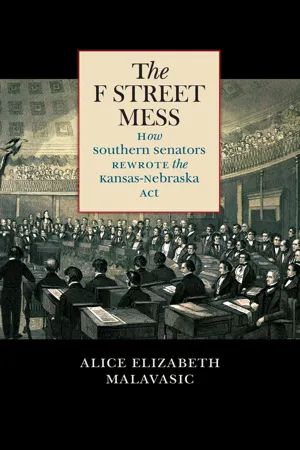
The F Street Mess
How Southern Senators Rewrote the Kansas-Nebraska Act
- 280 pages
- English
- ePUB (mobile friendly)
- Available on iOS & Android
eBook - ePub
Chapter One: Rivalries and Alliances
Freshman congressman John C. Calhoun of South Carolina exploded onto the national stage in 1811 earning the moniker “The Young Hercules” for his prowar stance against Great Britain.1 The name suited him. He was tall, angular, and arrestingly handsome, with thick black hair and “luminous” eyes so hypnotic that those who gazed into them could never quite recall the color.2 But unlike Dorian Gray, Calhoun’s struggles were not locked away in a hidden portrait. Years of chronic poor health would erode the herculean body of his youth. His hair would turn white and brittle, his eyes dark and foreboding. And yet the intellectual vigor and Svengali-like charisma he brought with him in 1811 would never wane. Over the next four decades he would use both to navigate in and out of political alliances, successfully slaying rivals at home, while holding at bay those in Washington. His policy positions would become an ideology, and his ideology would build a following. Two of those followers, Robert M. T. Hunter and James Murray Mason, would join Calhoun’s Washington cadre in 1837 and like their leader they would have to learn to swim in the rough political waters of the emerging second political party system.
By the time the Twenty-Fifth Congress convened in special session in Washington on September 4, 1837, the city and the nation had been under a process of physical and political reconstruction for nearly a quarter of a century.3 The collapse of the first political party system, the rise of universal manhood suffrage, and the election of Andrew Jackson had caused political realignments and personal reinventions that made nineteenth-century America a different world from eighteenth-century America. Even before the Federalist Party was destroyed by its opposition to the War of 1812, the Republican Party had divided internally between “Old Jeffersonians” and “Nationalists” factions. In 1828 the Old Jeffersonians, or “Radicals,” aligned themselves with Andrew Jackson, becoming Democratic Republicans or Jacksonian Democrats. The Nationalist Republicans divided between those who stayed with the Jackson party, becoming its conservative wing, and those who left to form the oppositional Whig Party. Unlike the Democrats who were relatively unified behind Jackson, the Whigs of the 1830s were less a cohesive national party than a loose coalition of disparate sectional factions. United initially by mutual opposition to Andrew Jackson and what they believed to be his abuse of executive power, fundamental philosophical and policy differences between nationalists, states’ rights conservatives, and nullifiers made each distrustful of the other and unable to agree on a single candidate to run in 1836 against Jackson’s hand-picked successor, Martin Van Buren.4 As a result Van Buren won the presidential election with 170 electoral votes to his closest Whig rival, William H. Harrison’s 73 votes. Not even his opponents’ combined electoral vote of 124 was close to Van Buren’s margin of victory but his percentage of the popular vote, 50.9 percent, suggested a more evenly divided electorate that was also reflected in the congressional results. The Democratic Party’s slim control of Congress was susceptible therefore to any issue that affected those interests not yet firmly aligned with either the Democratic or Whig parties, and unfortunately for Van Buren he had inherited two such issues, economic depression and a growing abolitionist movement in the North.5 The intertwined crises of depression and abolitionism and a growing insurgency against Van Buren’s power base of New York and Virginia, led by pro-bank, soft-money Democrats, threatened both the party’s control of Congress and Van Buren’s control of the party. In order to pass his Independent Treasury bill at the special session in 1837 Van Buren needed an alliance with his old political rival, Senator John C. Calhoun of South Carolina.
In terms of political friendship, those who enter into an alliance do not have to like each other, but often members of alliances have and will “deemphasize personal differences or even deny that they exist” to keep the alliance together. If an alliance holds, it can eventually evolve into personal friendship, but neither political alliances nor personal friendships “stand up well under the strain of repeated and serious divergence of positions.”6 Such was the relationship between John C. Calhoun and Martin Van Buren between 1821 and 1837. Calhoun and Van Buren shifted in and out of political alliances so frequently it was difficult for their loyalists, especially Calhoun’s, to follow.
The two men first met in Washington City in November 1821, when Secretary of War Calhoun paid a social call on the newly arrived freshman senator from New York.7 By some measurements the two could not have been more different. At 6′2″ Secretary Calhoun towered over 5′6″ freshman Senator Van Buren. Calhoun had been promoting a nationalist agenda since his early days as a War Hawk in the House of Representatives and was not trusted by the “Old” or “Radical” wing of the party, whereas Van Buren, a strict constructionist and states’ rights conservative, was. Van Buren supported the congressional caucus system for nominating presidential candidates. Calhoun opposed it and called instead for a national convention. But the two had more in common than their physical and political differences suggested. They were young men, both thirty-nine years old. Both were lawyers. Both had successfully taken on older powerful politicians in their home states and won.8 Both knew their national ambitions were tied to maintaining political control at home, and both, relentlessly ambitious, needed the other to achieve those ambitions.
Biographers and historians argue that Calhoun never equaled or understood Van Buren’s political skills, in part because Calhoun never acclimated himself to the democratic style of politics that emerged in the 1820s. Van Buren not only understood the new democratic politics; he perfected it. The argument is correct to a point. For sixteen years Van Buren the politician bested Calhoun the intellectual. But by the special congressional session in 1837 Calhoun would learn the game.
Van Buren and Calhoun formed their first alliance in 1821, when Van Buren solicited Calhoun’s help in defeating the incumbent House Speaker and political opponent from New York, John W. Taylor. Calhoun, who desired Van Buren’s support for his first presidential bid in 1824, obliged. With Calhoun’s help, Taylor was defeated thereby increasing Van Buren’s power in Washington and solidifying his base at home. In return Calhoun got nothing except the election of Virginia Radical Philip Barbour to the speakership. Barbour was a close friend of Calhoun’s presidential rival, William Crawford. Three years later, Van Buren became Crawford’s campaign manager, and Calhoun withdrew from the race.9
After Calhoun’s withdrawal, he was placed on both John Quincy Adams and Andrew Jackson’s tickets as the vice presidential candidate. Because he was on two tickets, Calhoun won the office of vice president outright with 131 electoral votes.10 The four-way race for the presidency, between Andrew Jackson, John Quincy Adams, William Crawford, and Henry Clay had to be decided in the House of Representatives. There Andrew Jackson, the leader in both the popular and electoral vote, was defeated by John Quincy Adams. It was known then and today as “the corrupt bargain” because Adams subsequent appointment of Clay was seen by the Jackson people as a deal for Clay’s support in the House.11 For Vice President–elect Calhoun, Adams’s election in the House was more than just the overthrow of popular will; it weakened his future presidential chances by positioning his arch rival Clay in an equally strong seat of succession.12 Calhoun was an oppositional vice president for the next four years.
Calhoun and Van Buren reunited again in 1828, this time to elect Andrew Jackson president. Van Buren had just been reelected to a second term in the U.S. Senate by an impressive 105 to 39 victory in the state legislature. Shortly thereafter Vice President Calhoun invited Van Buren to his estate, Oakly, in Georgetown where they devised a strategy.13 Calhoun, the incumbent vice president under Adams, agreed to be Jackson’s running mate in the fall, thereby lending the ticket “respectability” among the establishment still distrustful of Jackson, and Van Buren agreed to bring into Jackson’s camp the radical strongholds of New York, Pennsylvania, Virginia, Georgia, and North Carolina.
Van Buren’s part of the alliance was more difficult. William Crawford, the titular leader of the Radical faction, distrusted Jackson and hated Calhoun even more. His price for bringing the Radicals into Jackson’s camp was the removal of Calhoun from the ticket. But Van Buren feared if Calhoun was dropped from the ticket he would be replaced by Van Buren’s rival and early Jackson supporter, Dewitt Clinton. Even if Calhoun was not dropped from the ticket, Jackson leaned toward Clinton for secretary of state, which was the job Van Buren coveted. Calhoun supported Van Buren for State, and Clinton’s death on February 11 settled everything else. Calhoun stayed on the ticket, and the Radicals supported Jackson anyway. On March 4, 1829, Andrew Jackson was inaugurated the seventh president of the United States. Vice President Calhoun and Secretary of State Van Buren became the heirs apparent to what many believed was a one-term presidency.14
Whether Calhoun’s fall from grace was predetermined by Van Buren and the Radicals or the result of unexpected social and political events beyond his control is subject to debate. Calhoun biographer Charles Wiltse argues in his seminal work that Jackson not only accepted Calhoun’s elimination as a precondition for the Radicals’ support, but he also participated in the plan to politically eliminate him after the election. Jon Meacham’s more recent biography on Jackson confirms “the calculating part” of Jackson’s character and argues Jackson “tucked away” information on Calhoun “until he needed it.” But Irving Bartlett is less conspiratorial in his treatment arguing that most of the events, while beneficial to Van Buren, were unplanned. Added to the serendipity of events was Calhoun’s naiveté in believing he could hold himself above the new politics. He left Washington shortly after the inauguration and did not return until Congress reconvened in December.15
On the other hand, Van Buren, who had been elected governor of New York upon Clinton’s death, resigned the seat immediately after Jackson appointed him secretary of state and moved to Washington. He used the eight months between congressional sessions to establish “a personal rapport with Jackson that Calhoun never enjoyed.”16 Over the next three years Van Buren’s friends within the administration engaged in political sabotage against the vice president, while Van Buren went on horseback rides with Jackson. As his relationship with the president evolved from an institutional friendship to a personal one, the relationship between Jackson and Calhoun deteriorated, setting the stage for Calhoun’s expulsion from Jackson’s ticket in 1831 and the Nullification Crisis in 1833.
The events that led to Calhoun’s expulsion began with the social ostracism of Secretary of War John Eaton’s wife by Washington’s elite in 1829.17 It culminated in the winter of 1831 after Jackson questioned Calhoun’s condemnation of his conduct during the 1819 Seminole Indian War. Fearing that open warfare between Jackson and his vice president would lead to a Whig victory in 1832, some within the Jackson and Calhoun camps endeavored to heal the breach between the two men but to no avail. In February 1831 the correspondence between Jackson and Calhoun regarding the Seminole War was published by Calhoun supporter Duff Green.18 Jackson, who had announced for a second term, used the scandal to drop Calhoun from the ticket. That March Calhoun left Washington for South Carolina. During his absence Martin Van Buren and John Eaton voluntarily stepped down from the cabinet, allowing Jackson to force the resignations of Secretary of Treasury Samuel Ingham, Secretary of the Navy John Branch, and Attorney General John Berrien, all Calhoun men. Jackson nominated Van Buren for ambassador to England and in August Van Buren left for London.
Van Buren may or may not have been directly involved in the Seminole War controversy, but his supporters, William Crawford, John Eaton, and William Lewis, certainly had been. Whether Calhoun’s next move was motivated by personal revenge or professional concerns is also subject to debate, but when Congress reconvened after the New Year, Calhoun’s supporters arranged for a tie vote on Van Buren’s Senate confirmation, allowing Vice President Calhoun, who had returned from South Carolina, to cast the deciding vote against him. Jackson recalled Van Buren from London, dropped Calhoun from the ticket, and made Van Buren his running mate. The Calhoun–Van Buren alliance was once again over, if it had ever existed at all.
Andrew Jackson often referred to Calhoun as that “Catiline,” a reference to the Roman politician who was convicted by the Roman Senate of conspiring to overthrow the Republic. Indeed, the political maneuvering between friend and foe during Jackson’s first term resembled something out of ancient Rome. Four years of infighting had created a rift within the party that some Jackson Democrats feared would lead to a National Republican/Whig victory in 1832. It did not. Jackson, along with his new vice presidential running mate, Martin Van Buren, beat their strongest rival, Henry Clay, with 54.5 percent of the popular vote.19 The Electoral College margin was even wider, 219 to 49.20 But looming over Jackson’s second term was the pending constitutional struggle over nullification, and the continued presence of his vice president for the remaining four months of his first term, John C. Calhoun.
The 1820s was a time of economic recession in the South. Throughout the decade cotton prices steadily decreased, commodity prices increased, and human resources dwindled. South Carolina alone lost 200,000 people through emigration. The region blamed the protective tariff of 1828, which raised duties on imports 30 percent to 50 percent, for the ongoing depression.21 Southerners called it the Tariff of Abominations.
In response to the tariff of 1828, the South Carolina legislature published four thousand copies of a pamphlet titled the South Carolina Exposition and Protest, which argued the state’s right to nullify federal law it determined unconstitutional. The Exposition and Protest had been anonymously written by Calhoun, then Adams’s vice president. He based his argument on Madison and Jefferson’s theory of state interposition espoused in the Virginia and Kentucky Resolutions of 1798 and 1799.
But Calhoun had written the Exposition and Protest, “as a warning rather than as a statement of present policy.”22 Like most southerners and westerners in 1828, Calhoun believed the Jackson administration would make tariff reform a top priority. He did not. Instead, Jackson’s response was tepid, and his failure to propose a major tariff reduction in his first annual message to Congress convinced Calhoun that northern manufacturing interests were dictating Jackson’s tariff policy.23 A bill was eventually passed in 1832, but it was too little, too late for South Carolina.24 By the summer of 1832 Calhoun was losing control over the tariff issue in his home state. With state elections looming, extremists had taken Calhoun’s warning in the Exposition and Protest as justification for secession if the federal government did not lower the tariff. Those opposed to nullification, the “Unionist...
Table of contents
- Cover Page
- Title Page
- Copyright Page
- Dedication
- Contents
- Acknowledgments
- Introduction: Conspiracy
- Chapter One: Rivalries and Alliances
- Chapter Two: Heirs of Calhoun
- Chapter Three: Nebraska
- Chapter Four: Senatorial Junta
- Chapter Five: The Power to Repeal
- Chapter Six: Kansas
- Chapter Seven: We Must Settle This Question
- Epilogue
- Notes
- Bibliography
- Index
Trusted by 375,005 students
Access to over 1.5 million titles for a fair monthly price.
Study more efficiently using our study tools.
Frequently asked questions
Yes, you can cancel anytime from the Subscription tab in your account settings on the Perlego website. Your subscription will stay active until the end of your current billing period. Learn how to cancel your subscription
No, books cannot be downloaded as external files, such as PDFs, for use outside of Perlego. However, you can download books within the Perlego app for offline reading on mobile or tablet. Learn how to download books offline
Perlego offers two plans: Essential and Complete
- Essential is ideal for learners and professionals who enjoy exploring a wide range of subjects. Access the Essential Library with 800,000+ trusted titles and best-sellers across business, personal growth, and the humanities. Includes unlimited reading time and Standard Read Aloud voice.
- Complete: Perfect for advanced learners and researchers needing full, unrestricted access. Unlock 1.5M+ books across hundreds of subjects, including academic and specialized titles. The Complete Plan also includes advanced features like Premium Read Aloud and Research Assistant.
We are an online textbook subscription service, where you can get access to an entire online library for less than the price of a single book per month. With over 1.5 million books across 990+ topics, we’ve got you covered! Learn about our mission
Look out for the read-aloud symbol on your next book to see if you can listen to it. The read-aloud tool reads text aloud for you, highlighting the text as it is being read. You can pause it, speed it up and slow it down. Learn more about Read Aloud
Yes! You can use the Perlego app on both iOS and Android devices to read anytime, anywhere — even offline. Perfect for commutes or when you’re on the go.
Please note we cannot support devices running on iOS 13 and Android 7 or earlier. Learn more about using the app
Please note we cannot support devices running on iOS 13 and Android 7 or earlier. Learn more about using the app
Yes, you can access The F Street Mess by Alice Elizabeth Malavasic in PDF and/or ePUB format, as well as other popular books in Historia & Historia de la Guerra de Secesión. We have over 1.5 million books available in our catalogue for you to explore.