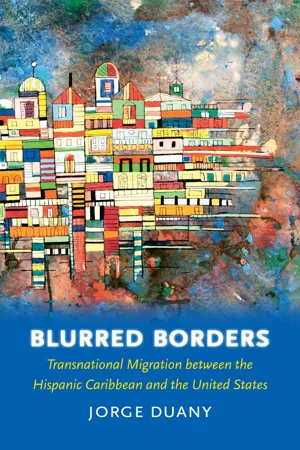
In this comprehensive comparative study, Jorge Duany explores how migrants to the United States from Cuba, the Dominican Republic, and Puerto Rico maintain multiple ties to their countries of origin.
Chronicling these diasporas from the end of World War II to the present, Duany argues that each sending country’s relationship to the United States shapes the transnational experience for each migrant group, from legal status and migratory patterns to work activities and the connections migrants retain with their home countries. Blending extensive ethnographic, archival, and survey research, Duany proposes that contemporary migration challenges the traditional concept of the nation-state. Increasing numbers of immigrants and their descendants lead what Duany calls “bifocal” lives, bridging two or more states, markets, languages, and cultures throughout their lives. Even as nations attempt to draw their boundaries more clearly, the ceaseless movement of transnational migrants, Duany argues, requires the rethinking of conventional equations between birthplace and residence, identity and citizenship, borders and boundaries.
eBook - ePub
Blurred Borders
Transnational Migration between the Hispanic Caribbean and the United States
- 304 pages
- English
- ePUB (mobile friendly)
- Available on iOS & Android
eBook - ePub
Blurred Borders
Transnational Migration between the Hispanic Caribbean and the United States
About this book
Information
1 Rethinking Transnationalism
Conceptual, Theoretical, and Practical Problems
In the introduction, I distinguished analytically between a nation’s borders and boundaries. I also pointed out that diasporas usually remain connected to their nations of origin over long periods of time. As I stress in this chapter, transnationalism can undermine the state’s legal definition of boundaries by blurring cultural borders.1 The identities of many diasporic peoples (including my own) cannot be contained within a single nation-state, nor can their practices and discourses be completely understood from a well-bounded political, territorial, or linguistic perspective.
Since the 1990s transnationalism has spurred a minor academic industry among migration scholars, with an increasing number of books, dissertations, anthologies, journal issues, articles, conferences, workshops, courses, and research centers devoted to its study. Together with the closely related concept of diaspora, transnationalism has captured the imagination of social scientists and humanists. However, persistent problems plague the field of transnationalism, including the operational definition of the concept; the classification of various types; the explanation of its causes and consequences; its alleged novelty; its relationship with assimilation; and its future beyond the first generation of immigrants. In particular, scholars have engaged in lively debates as to whether Puerto Rico, Cuba, and the Dominican Republic are exemplars of transnationalism.
This chapter delves into some of the main issues in the study of transnationalism. This exercise will set the stage for the comparative analysis of Cubans, Dominicans, and Puerto Ricans in the United States and Puerto Rico. Focusing on three very different diasporas from the same region (the Hispanic Caribbean) and to the same countries (the United States and Puerto Rico) reveals both the underlying parallels and range of variation in contemporary transnationalism. Preexisting ties between sending and receiving countries, whether colonial, neocolonial, or postcolonial, shape the size, composition, settlement patterns, and incorporation of migrant flows. A comparative transnational perspective entails suspending the illusion that the nation-state can entirely encapsulate a citizen’s thoughts, loyalties, and actions.
A Brief Intellectual Genealogy
In 1916 the U.S. journalist Randolph Bourne coined the expression “transnational America” to challenge the myth of the melting pot, which justified the assimilation of immigrants into Anglo-Saxon culture. Instead, Bourne posited that newer European groups (such as Germans, Scandinavians, and Poles) in the United States retained vigorous connections to their homelands, rather than becoming unhyphenated Americans. He then argued that the United States should be more cosmopolitan in accommodating ethnic groups with origins other than Anglo-Saxon. Bourne’s essay was a passionate plea for cultural pluralism, which later writers would elaborate under the banner of multiculturalism.
Unfortunately, the term transnationalism fell out of common and academic use for decades, while the assimilation model prevailed in migration studies, at least in the United States. In the 1950s economists began to write about “multinational” and later “transnational” corporations simultaneously operating in several countries, usually headquartered in industrialized North America, Western Europe, and Japan. During the 1970s scholars in the field of international relations extended the term transnationalism to nongovernmental organizations that cut across boundaries between countries (Levitt and Waters 2002: 7). By the 1980s social scientists widened the concept to groups that move across international boundaries yet remain attached to their home communities (Glick Schiller, Basch, and Szanton Blanc 1995). When applied to migrants rather than corporations, transnationalism suggests that people may transgress borders and boundaries, inhabiting the interstitial social spaces between them; hence such migrants have been called “borderless people” (Michael Peter Smith 1994).
The earliest and most influential formulation of the transnational migration paradigm was in the volume edited by Nina Glick Schiller, Linda Basch, and Cristina Blanc-Szanton, Towards a Transnational Perspective on Migration (1992). Shortly thereafter, their coauthored work, Nations Unbound (Basch, Glick Schiller, and Szanton Blanc 1994), spelled out more systematically the conceptual and methodological implications of the new model. Later, other scholars expanded, refined, or criticized the transnational perspective on migration (see, among others, Cordero-Guzmán, Smith, and Grosfoguel 2001; Levitt and Nyberg-Sørensen 2004; Olwig 1997; Pessar and Mahler 2003; Portes, Guarnizo, and Landolt 1999; Portes, Haller, and Guarnizo 2002; Rouse 1995; Vertovec 2009; and Waldinger and Fitzgerald 2004). By now, transnationalism has become entrenched in migration studies, heralded as “one of the most promising potentials for social research for the twenty-first century” by its proponents (Guarnizo 1997: 287) but derided as an “intellectual fashion” by its detractors (Waldinger and Fitzgerald 2004: 1176).
Several writers have argued that the contemporary phase of the world economy, which has accelerated the volume and speed of international population flows, requires a new approach to migration. Many have sought to rethink conventional categories for social analysis — such as nation, state, citizenship, race, ethnicity, class, gender, and identity — in light of globalization. One of the basic problems is to define, describe, and explain the lasting connections of various migrant settlements to their home countries. A key intellectual puzzle for contemporary scholars is how people reconstruct their identities and imagine their communities across borders and boundaries. The cultural dimensions of globalization have been conceptualized as transnationalization, hybridization, Creolization, syncretism, bricolage, and even “mondialization” (from the French monde or world) (Appadurai 1996; Hannerz 1996; Renato Ortiz 1996, 1997). The earlier term, transculturation, coined by Cuban anthropologist Fernando Ortiz (1947), has also been recovered to capture the mixture of cultural practices of different origins in migrant flows.
Defining Transnationalism
Glick Schiller, Basch, and Blanc-Szanton (1992: 1) approach transnationalism as “the processes by which immigrants build social fields that link together their country of origin and their country of settlement,” including “multiple relations — familial, economic, social, organizational, religious, and political — that span borders.” These authors call those who develop and maintain such relations “transmigrants.” For instance, Hispanic Caribbean migrants may simultaneously participate in several political systems, send money to their countries of origin, and define themselves in culturally hybrid terms, such as Dominican American or Cuban American. Glick Schiller, Basch, and Blanc-Szanton’s conceptualization encompasses the constant movement of people across nations as well as occasional practices such as sending gifts and packages back home. Although this approach allows one to compare transnational actors and practices with variable scales and distributions, it runs the risk of diluting the character of the “transnational.”
In contrast, Alejandro Portes, Luis Guarnizo, and Patricia Landolt (1999: 219) limit transnationalism to “occupations and activities that require regular and sustained social contacts over time across national borders for their implementation.” This definition applies well to transnational enterprises as an “alternative form of economic adaptation,” which requires investments in capital, labor, and markets in more than one nation (see also Portes and Guarnizo 1991; and Portes, Haller, and Guarnizo 2002). Thus, for Portes, Guarnizo, and Landolt, some economic activities — such as trading ethnic goods between the Spanish-speaking Caribbean and the United States — are transnational, while others — such as sporadic shopping trips to Miami or New York — are not. These authors also reject the neologism transmigrant because it adds little to the standard term migrant. Other cumbersome expressions such as deterritorialized nation-state and transborder citizenship, proposed by Glick Schiller and her colleagues, can be similarly critiqued (Basch, Glick Schiller, and Szanton Blanc 1994; Fouron and Glick Schiller 2001).
Unfortunately, the definition of transnationalism in Portes, Guarnizo, and Landolt (1999) leaves out many practices that bind people in different countries, such as purchasing clothes and cars from the United States in the Caribbean, and consuming Caribbean food and music in the United States. Indeed, most Latin American and Caribbean immigrants participate in “nostalgic trade,” importing home-country products such as beer, rum, coffee, cigars, bread, cheese, and other foodstuffs. This practice is connected to other transnational activities such as telephoning, traveling, and sending money to the country of origin (Orozco et al. 2005). When such activities are taken into account, the scope of transnationalism becomes much more expansive.
In this book, I use transnational as a middle-ground concept. By transnationalism, I mean the construction of dense social fields through the circulation of people, ideas, practices, money, goods, and information across nations. This circulation includes, but is not limited to, the physical movement of human bodies as well as other types of exchanges, which may or not be recurrent, such as travel, communication, and remittances. Such exchanges may involve direct state intervention — as in government attempts to promote and profit from remittances — or they may take place in the absence of the state — as in smuggling undocumented migrants. To quote Peggy Levitt and Nina Glick Schiller (2004: 1009), transnationalism “connect[s] actors through direct and indirect relations across borders between those who move and those who stay behind.” This definition provides an intermediate stance between nearly all-inclusive and extremely exclusive approaches (see Goldring 1996; Levitt and Nyberg-Sørensen 2004; Sørensen and Olwig 2002; and Vertovec 2009). Furthermore, the definition comprises different types of linkages across various kinds of borders (not just state boundaries), including widely dispersed kinship networks and households.
Cataloging Transnationalism
Some of the earliest scholars of transnationalism portrayed it as an undifferentiated global phenomenon. For instance, Roger Rouse (1995: 366–67) states that “Third World migrants” serve as “conduits for the further movement of money, goods, information, images, and ideas across the boundaries of the state.” Aside from the dubious validity of the Third World category, such a blanket statement tends to homogenize transnational migration from Latin America, the Caribbean, Asia, and Africa. It also restricts transnationalism to movement across state boundaries. But each migrant group develops a distinctive brand of transnationalism based on its own historical legacy, cultural practices, settlement patterns, and mode of incorporation into the host society, as well as the policies of sending and receiving governments and other factors.
I consider the Dominican, Puerto Rican, and Cuban diasporas to be transnational, but the three cases vary greatly in their citizenship status, relationship to the homeland, possibility of return, timing of the flows, length of stay abroad, and so on. As the Cuban American sociologist Silvia Pedraza (2007) has observed, irregular contacts between Cuban émigrés and their homeland have stunted a transnational Cuban community in the United States. Since 1959 U.S. and Cuban policies — as well as the politics of exile — have curtailed the exchange of people, goods, and ideas between Havana and Miami. In contrast, migrants, money, and cultural practices circulate much easier and more frequently among Puerto Rico, the Dominican Republic, and the United States. To invert the title of a chapter by Basch, Glick Schiller, and Szanton Blanc (1994), “Different Settings, Same Outcomes,” similar settings may produce different outcomes for transnationalism.
One way to solve the puzzle of transnationalism is to distinguish various kinds of the phenomenon. Luis Eduardo Guarnizo and Michael Peter Smith (1998) propose a basic contrast between transnationalism “from above” and “from below.” Transnationalism from above refers to the actions of powerful elites and institutions, such as transnational corporations, military bodies, the mass media, supranational political movements, and interstate entities. This type of transnationalism includes global companies such as Microsoft, CNN, MTV, McDonald’s, and Disney, as well as the United Nations, the World Bank, the International Monetary Fund, and the Catholic and evangelical churches with a worldwide reach.
Transnationalism from below refers to the grassroots initiatives of ordinary people, small businesses, some nongovernmental organizations, and nonprofit institutions, such as migrant workers and refugees, the ecological and indigenous movements, human rights groups, and hometown associations. It is unclear exactly where some “transnational” actors, such as traffickers of illegal drugs and undocumented migrants, would fit into this typology. Furthermore, some authors refer to “transnationalism of the middle” as an intermediate location in the global-local continuum, such as many informal religious practices occupy (Mahler and Hansing 2005b). In any case, most scholars have been primarily concerned with labor migration as a form of “transnationalism from below.”
Building on Guarnizo’s and Sarah Mahler’s suggestions (see Guarnizo and Smith 1998; and Mahler 1998), José Itzigsohn and his colleagues (1999) have contrasted “narrow” and “broad” transnational practices. Narrowly defined, transnationalism consists of highly institutionalized activities and constant population flows between two countries, such as membership in Dominican political parties in the United States. Broadly defined, transnationalism involves a low level of institutionalization and sporadic physical displacement between two countries, such as carrying bags full of merchandise back home when returning from infrequent trips abroad (which some anthropologists have called “suitcase trading”). Although this classification does not spell out the causes and consequences of each form of transnationalism, it helps locate transnational practices along a wide continuum of intensity and regularity.
Guarnizo (2000) also sees two forms of transnational activities, the “core” and the “expanded.” Core transnationalism comprises an individual’s habitual practices, while expanded transnationalism involves occasional responses to, for example, political crises or natural disasters. Again, this typology does not explain why some groups engage transnationally more often than others. It is also unclear just how frequent a practice has to be in order to be deemed core or expanded. A similar analytical problem arises when trying to disentangle the economic, political, and sociocultural dimensions of transnationalism, which often reinforce each other (Portes, Guarnizo, and Landolt 1999).
Explaining Transnationalism
Scholars have enumerated several causes of contemporary transnationalism (Basch, Glick Schiller, and Szanton Blanc 1994; Glick Schiller, Basch, and Blanc-Szanton 1992; Guarnizo and Smith 1998; Portes, Guarnizo, and Landolt 1999). The expansion of global capitalism since World War II accelerated the worldwide integration of financial and labor markets. In turn, the search for cheap labor in developing economies intensified the movement of people seeking employment abroad. In addition, the technological revolution in mass transportation and electronic communications has compressed time and space, especially through jet airplanes, cellular phones, fax machines, videotapes, cable and satellite television, the Internet, and e-mail. Consequently, it has become less expensive and time-consuming to travel to, trade with, and communicate with other countries.
Scholars disagree, however, about the local effects of globalization on people’s everyday lives. According to its critics, globalization has deepened inequality among regions, countries, classes, races, and genders (Guarnizo and Smith 1998). To more optimistic analysts, the rise of transnational networks has multiplied cosmopolitan practices (Hannerz 1996) and even created the possibility of a postnational or diasporic citizenship (Laguerre 1998). Certainly, the neoliberal discourse of globalization celebrates borderless states and consumer markets, as well as the free flow of capital, if not labor, across formerly insurmountable boundaries.
Regardless of how one defines transnationalism, it usually entails the movement of workers between countries. Technical innovations, such as the microchip revolution, have greatly reduced the time and cost of circulating people, images, and ideas among the Caribbean, the United States, Europe, and other parts of the world. In this context, the transnational movement of people is only one aspect — albeit a crucial one — in the worldwide exchange of capital, commodities, technology, information, ideology, and culture (see Appadurai 1996; Basch, Glick Schiller, and Szanton Blanc 1994; Guarnizo and Smith 1998; Hannerz 1996; and Renato Ortiz 1996, 1997).
Transnationalism is as much a political as an economic phenomenon. During the 1990s six Latin American countries (Brazil, Colombia, Costa Rica, the Dominican Republic, Ecuador, and Mexico) amended their constitutions to extend dual citizenship and political rights to their growing diasporas. Furthermore, social institutions bridging several nations (such as confederations of political parties, churches, grassroots movements, and other nongovernmental organizations) have proliferated. Nation-states have surrendered much of their sovereignty to global and regional forces by establishing common markets, free trade, and other international agreements. In many countries, public policies have moved toward “de facto transnationalism,” accepting the limitations of strictly national approaches to the movement of capital, labor, and even controlled substances (Sassen 1999).
Why Does Transnationalism Matter?
Contemporary transnationalism has many theoretical and practical implications. Among them is the challenge to the “straight-line assimilation” model that dominated immigration research in the United States during the first half of the twentieth century (Pedraza 2006; Portes and Rumbaut 2006). This model posited the inevitable absorption of immigrants into their host societies, through gradual elimination of their linguistic, religious, and other cultural differences. Instead, transnationalists have shown that contemporary migrants may develop multiple identities, lead bifocal lives, express loyalties to more than one nation, and practice hybrid cultures (Basch, Glick Schiller, and Szanton Blanc 1994; Duany 2008a [1994]; Glick Schiller, Basch, and Blanc-Szanton 1992; Glick Schiller, Basch, and Szanton Blanc 1995; Itzigsohn et al. 1999; Levitt 2001; Portes, Guarnizo, and Landolt 1999; Vertovec 2009). Current strategies of immigrant adaptation do not always lead to complete assimilation by the second or third generation, as earlier theories had predicted. Alejandro Portes and Min Zhou (1993) have argued that “segmented assimilation” includes various forms of incorporation, depending on the immigrants’ human capital, context of reception, community of residence, and other variables. Rather than assimilate into mainstream U.S. culture, some groups might adopt the lifestyle of a racial or ethnic minority such as African Americans, Hispanics, or “people of color.”
Even more broadly, Glick Schiller, Basch, and Blanc-Szanton (1992) claim that transnationalism subverts established concepts in the social sciences, including nation, ethnicity, race, class, and gender. In their view, nation-states can no longer capture (if they ever could) people’s multiple and overlapping identities (such as local, regional, racial, ethnic, translocal, or even postnational allegiances). Contemporary migrants often combine their experiences in their societies of origin and settlement to create a new kind of self-awareness.
Scholars may themselves promote or hinder the interests of transnational actors when engaging in public debates about immigration, multiculturalism, bilingualism, or remittances (Glick Schiller, Basch, and Szanton Blanc 1995). For instance, Steven Vertovec (2009) has assessed recent efforts by national and international organisms to facilitate circular migration. Contemporary transnationalism has hastened the back-and-forth movement between people’s homelands and other countries, as I have documented for Puerto Rico (Duany 2002: chap. 9). Whether circular migration can be managed ...
Table of contents
- Cover Page
- Blurred Borders
- Copyright Page
- Dedication
- Contents
- Tables and Figures
- Acknowledgments
- Abbreviations
- Introduction
- 1 Rethinking Transnationalism
- 2 In the Entrails of the Monster
- 3 The Contemporary Hispanic Caribbean Diasporas
- 4 A Transnational Colonial Migration
- 5 The Orlando Ricans
- 6 Revisiting the Exception
- 7 Beyond the Rafters
- 8 Los Países
- 9 The Dominican Diaspora to Puerto Rico
- 10 Transnational Crossroads
- Conclusion
- Notes
- Works Cited
- Index
Trusted by 375,005 students
Access to over 1.5 million titles for a fair monthly price.
Study more efficiently using our study tools.
Frequently asked questions
Yes, you can cancel anytime from the Subscription tab in your account settings on the Perlego website. Your subscription will stay active until the end of your current billing period. Learn how to cancel your subscription
No, books cannot be downloaded as external files, such as PDFs, for use outside of Perlego. However, you can download books within the Perlego app for offline reading on mobile or tablet. Learn how to download books offline
Perlego offers two plans: Essential and Complete
- Essential is ideal for learners and professionals who enjoy exploring a wide range of subjects. Access the Essential Library with 800,000+ trusted titles and best-sellers across business, personal growth, and the humanities. Includes unlimited reading time and Standard Read Aloud voice.
- Complete: Perfect for advanced learners and researchers needing full, unrestricted access. Unlock 1.5M+ books across hundreds of subjects, including academic and specialized titles. The Complete Plan also includes advanced features like Premium Read Aloud and Research Assistant.
We are an online textbook subscription service, where you can get access to an entire online library for less than the price of a single book per month. With over 1.5 million books across 990+ topics, we’ve got you covered! Learn about our mission
Look out for the read-aloud symbol on your next book to see if you can listen to it. The read-aloud tool reads text aloud for you, highlighting the text as it is being read. You can pause it, speed it up and slow it down. Learn more about Read Aloud
Yes! You can use the Perlego app on both iOS and Android devices to read anytime, anywhere — even offline. Perfect for commutes or when you’re on the go.
Please note we cannot support devices running on iOS 13 and Android 7 or earlier. Learn more about using the app
Please note we cannot support devices running on iOS 13 and Android 7 or earlier. Learn more about using the app
Yes, you can access Blurred Borders by Jorge Duany in PDF and/or ePUB format, as well as other popular books in History & Latin American & Caribbean History. We have over 1.5 million books available in our catalogue for you to explore.