- 296 pages
- English
- ePUB (mobile friendly)
- Available on iOS & Android
eBook - ePub
About this book
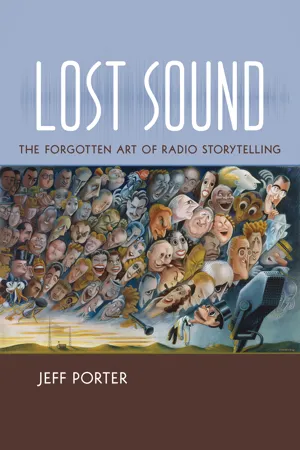
From Archibald MacLeish to David Sedaris, radio storytelling has long borrowed from the world of literature, yet the narrative radio work of well-known writers and others is a story that has not been told before. And when the literary aspects of specific programs such as The War of the Worlds or Sorry, Wrong Number were considered, scrutiny was superficial. In Lost Sound, Jeff Porter examines the vital interplay between acoustic techniques and modernist practices in the growth of radio. Concentrating on the 1930s through the 1970s, but also speaking to the rising popularity of today’s narrative broadcasts such as This American Life, Radiolab, Serial, and The Organist, Porter’s close readings of key radio programs show how writers adapted literary techniques to an acoustic medium with great effect. Addressing avant-garde sound poetry and experimental literature on the air, alongside industry policy and network economics, Porter identifies the ways radio challenged the conventional distinctions between highbrow and lowbrow cultural content to produce a dynamic popular culture.
Information
Subtopic
Communication Studies1: Acoustic Drift
Radio and the Literary Imagination
Only ten years earlier, it was anyone’s guess how to make money from broadcasting, but by 1936 the industry had stabilized itself around a wired network system and lucrative strategies for selling time to sponsors.1 That year, the Green Hornet radio show first aired on Detroit’s WXYZ. North of the border, the Canadian Broadcasting Corporation took to the airwaves, as did the New Zealand Broadcasting Service further away. From Windsor Castle, the BBC aired King Edward’s abdication speech, heard by an estimated 20 million listeners. In the same year, CBS broadcast H. V. Kaltenborn’s eyewitness account of Spanish Civil War combat from southern France, the first-ever live battle report. In Berlin, the Reichs-Rundfunk-Gesellschaft transmitted the Summer Olympics to forty countries in twenty-eight different languages. “What the press has been in the nineteenth century,” Goebbels predicted in a 1933 speech, “radio will be for the twentieth century.”2 On a lighter note, from Radio City’s studios in New York, ventriloquist Edgar Bergen introduced Charlie McCarthy to American listeners, not long after Fanny Brice launched her little-girl vocal routine as Baby Snooks.
The year 1936 was also when the German-born art and film theorist Rudolf Arnheim published radio’s first serious study. In the opening pages of Radio, Arnheim was eager to recognize radio as an autonomous art form with its own unique aesthetic properties, a medium as compelling as painting and film.3 “Broadcasting,” he wrote, “has constituted a new experience for the artist, his audience and the theoretician: for the first time it makes use of the aural only, without the almost invariable accompaniment of the visual which we find in nature as well as in art. The result of even the first few years’ experiments with this new form of expression can only be called sensational.” At the core of this new art was the material quality of sound. Arnheim defined sound not as a means to an end, a substance waiting to be made relevant by other devices, but as a medium with its own form of expressiveness. A work of radio art was thus capable of “creating an entire world complete in itself out of the sensory materials at its disposal—a world of its own which [did] not seem defective or to need the supplement of something external.”4
So powerful was the aurality of radio, Arnheim argued, that it could never be limited to mere communication or to the realm of the spoken word. The impact of voice exceeded speech: “It should be realized that elementary forces lie in the sound, which affects everyone more directly than the meaning of the word, and all radio art must make this fact its starting point. The pure sound in the word is the mother-earth from which the spoken work of art must never break loose, even when it disappears into the far heights of word-meaning.”5
Arnheim believed that as an art of sound, radio could not only hurdle space, abolishing territorial borders, but also test the boundaries of hearing, producing tensions between pure sound and the experience of meaning. On radio, the attentive listener hears words and, more importantly, acoustic properties such as intonation, timbre, pitch, resonance, tonality, and vocal intensities—what Arnheim called “tone-colours”—that do not always refer to the message. As Arnheim understood, sound and sense do not necessarily coincide in the mind of the listener. The word first comes to us as a sound, enveloped by other sounds. It is only later, on a higher level of abstraction, that we detach the word from its soundscape, parsing its meaning according to linguistic codes. For a brief moment, though, the spoken word and its noise are fused, merged in what Arnheim calls a “sensuous unity” exterior to language: “The aural world consists of sounds and noises. We are inclined to give the first place in this world to the spoken word. . . . We must not forget, however, especially when we are dealing with art, that mere sound has a more direct and powerful effect than the word. . . . It is difficult at first for most people to realize that, in the work of art, the sound of the word, because it is more elemental, should be of more importance than the meaning. But it is so.”6 Arnheim was asking readers to think of sound as a semiotically complex phenomenon in itself, detached from verbal meanings. As a statement about art, advancing the priority of sound over the law of meaning was consistent with avant-garde ideas—such as those associated with Luigi Russolo’s Noise Art, F. T. Marinetti’s Bruitism, Dada’s sound poetry, Antonin Artaud’s Theatre of Cruelty, and Pierre Schaeffer’s musique concrète—even if it was not very amenable to an emergent radio industry that saw its future in the economics of sponsorship. Once sound was no longer tethered to linguistic meaning, a radical form of radio art was implied, as Douglas Kahn has noted, a possibility unlikely to please the guardians of American radio.7
Phonophobia
In fact, cultural nervousness about the psychodynamics of radio sound had already appeared. The worry was that if sound did not always coincide with meaning, then listeners might stray from radio’s message. This anxiety was an early concern of radio research. As Hadley Cantril and Gordon W. Allport wrote in 1935, when Americans became mesmerized by a technology that exalted the “auditory sense” above all others, the sound of radio could become a source of distraction, interfering with chores and activities and even disrupting the content of radio itself, leaving programs half-heard.8 Americans did housework, handicrafts, and farm work with the radio on; they drank, smoke, embroidered, talked, danced, played bridge, did homework, and made meals against the backdrop of daily broadcasts, presumably inattentively.
The problem of the distracted listener surfaced as a pressing theme in American public discourse during the 1930s, much the way Internet surfing worries today’s cultural elite. Educators and reformers lamented that listeners were not giving radio programming their undivided attention. Surveys indicated that many Americans simply did not focus on radio shows. Young people in particular, it was thought, lacked sufficient concentration to give radio its proper due, failing to listen with discerning interest to radio’s speaking voices and their messages. Without greater attentiveness, reformers feared, American listeners would lose their critical edge, becoming more passive, even lazy. To avoid bad habits, listeners were advised to consult with network guides in newspapers so as to make more deliberate programing choices. They were encouraged to organize attentiveness groups, and it was even suggested that “intelligent” listening habits be taught in the schools.9
In the view of the cultural elite, Americans were experiencing what I would describe as a kind of acoustic drift, straying from radio’s message. If this was true, the cause was not so much that their minds were elsewhere but that, as Arnheim noted, it was the nature of sound to stray from the work of meaning. “Since sound follows the listener wherever he turns, radio tends to become the auditory foil of daily occupations, attracting sporadic attention, but not really commanding its audience. . . . Pure sound,” he wrote, encourages the mind to “wander.”10
America’s cultural elite may have had radio’s socioeconomic influence in mind when preaching against distracted listening, but the logocentric assumptions they brought to the medium—especially the assumption that radio’s form should always be inseparable from its message-bearing content—were not necessarily in its best interests. As Jacques Derrida explained in his critique of Edmund Husserl in Speech and Phenomena, the assumed unity of thought and sound in the logos is a fundamental theme of philosophy, but that unity is a figment of the philosophical imagination. In particular, Derrida contested the teleological essence of speech and the idea that meaning (the signified) is made present, if not transcendent, in the spoken word. Such presence is possible, Derrida observed, only when the signifier is in absolute proximity to the signified. Only then are voice and thought one, combining to make what Aristotle called the phone semantike (the signifying voice/sound).
Should that unity be disturbed, such as when I see myself write (rather than hear myself speak), this proximity is broken and its integrity is dissolved, in which case meaning becomes that much more recalcitrant.11 For Derrida, logocentrism depends on the absolute unity of various pairings: voice and thought, sound and sense, signifier and signified.12 In their quest for unmediated meaning and for a signified that transcends its own making, logocentric systems crave the coherence of the sign and will do almost anything to protect it. In the aesthetics of radio, as in any art, these unities are inevitably compromised to a greater or lesser degree. The more ambitious radio became—the more it sought to exploit its own medium—the less respect it would pay to the coherence of the sign and the more it would seek out its own materiality. With its literary turn in the mid-1930s, broadcast storytelling acquired a sonic depth that often called attention to the nature of radio itself.
Sound has always presented certain challenges to the logos, as in the scream, or wordless music, or polyphony, or noise itself, which is often experienced, Jacques Attali claims, as an “aggression against the code-structuring messages.”13 Even in opera, the tension between language and voice is so great as to be threatening, since the voice beyond words is a thing not only of fascination but of great danger.14 Sound may tell a story, as Salomé Voegelin points out, but it is often fleeting and uncertain: “Between my heard and the sonic object/phenomenon I will never know its truth but can only invent it, producing a knowing for me.”15
Such uncertainty (what Julia Kristeva would call “negativity”) reflects the recalcitrance of sound in the signifying process, which is perhaps the most important effect of what I am calling acoustic drift.16 Acoustic drift refers to the uncoupling of sound from sense, to those moments when sound becomes unmoored from the anchor of language. In the most ordinary way, acoustic drift is common when we face unfamiliar sound structures, as in a foreign language. To a non-native speaker, the Proustian sentence—Longtemps, je me suis couché de bonne heure—will come nearer music than speech if heard rather than read.17 When sonority takes a detour from the message, the listener will roam back and forth between a sound’s sonic properties and its meaning, deferring the complex coding that turns acoustic information into meaningful words.18 Typically, modes of listening oriented toward speech require the paring down of the sound stream to a linguistic unit, reducing noise and minimizing the expressive potential of the phonetic to discrete letters. Acoustic drift has the capacity to delay that process, suspending the coded interpretation of a message or what Michel Chion calls “semantic listening.”19
Radio as an acoustic medium plays at the border of sound and sense, constantly producing (and adapting to) the tension between word-meaning and sound-meaning. This tension has been a productive one for radio, especially during its heyday when radiophonic practices provoked a surplus of acoustic signs that challenged modes of listening. Radio carried more voices and sounds into the ear, as Joe Milutis has suggested, than the mind could stand.20 The radio listener had to sort through a head full of sound, parsing meaning from sound effects, music, voice, and spoken words. If the literary turn in radio confused the line between phonocentric and logocentric interpretive routines, that in itself was a kind of noise that interfered with the unity of sound and sense.
Radio may have been new, but phonophobia was old—as old as Socrates—and manifested itself as a preference for language-as-word over meaning-in-sound.21 As Pope famously admonished: “The sound must be an echo to the sense.”22 Whether in music or voice, sound should not diverge from the word that certifies its meaning, for once it departs from its textual grounding, sound becomes senseless or threatening, all the more so, as Mladen Dolar notes, because of its alluring powers.23 The voice should stick to the letter. Sound that does not contribute to making sense is, in this tradition, discarded as either frivolous or monstrous. For phonophobia, the work of sound is to support the bringing about of meaning: reduced to an acoustic signifier, sound should make utterance possible and then disappear in the signified.
Warnings such as Pope’s have a long history. Similar concerns, especially those inspired by phonophobia, can be traced to Plato, who gives strongest expression to his logocentric zeal in his critique of the lyricism of Homer, the musical poet. Plato charged in The Republic that Homer was a “creator of phantoms,” a mere imitator who, like the tragedians, produced images without knowledge of the truth. No one, for instance, should believe that Achilles, the son of a goddess, could have desecrated t...
Table of contents
- Cover Page
- Lost Sound
- Copyright Page
- Contents
- Illustrations
- Acknowledgments
- Introduction
- 1: Acoustic Drift
- 2: Prestige Radio
- 3: Mercury Rising
- 4: You Are There
- 5: The Screaming Woman
- 6: The Museum of Jurassic Radio
- 7: Radio as Music
- 8: All Things Reconsidered
- Notes
- Bibliography
- Index
Trusted by 375,005 students
Access to over 1.5 million titles for a fair monthly price.
Study more efficiently using our study tools.
Frequently asked questions
Yes, you can cancel anytime from the Subscription tab in your account settings on the Perlego website. Your subscription will stay active until the end of your current billing period. Learn how to cancel your subscription
No, books cannot be downloaded as external files, such as PDFs, for use outside of Perlego. However, you can download books within the Perlego app for offline reading on mobile or tablet. Learn how to download books offline
Perlego offers two plans: Essential and Complete
- Essential is ideal for learners and professionals who enjoy exploring a wide range of subjects. Access the Essential Library with 800,000+ trusted titles and best-sellers across business, personal growth, and the humanities. Includes unlimited reading time and Standard Read Aloud voice.
- Complete: Perfect for advanced learners and researchers needing full, unrestricted access. Unlock 1.5M+ books across hundreds of subjects, including academic and specialized titles. The Complete Plan also includes advanced features like Premium Read Aloud and Research Assistant.
We are an online textbook subscription service, where you can get access to an entire online library for less than the price of a single book per month. With over 1.5 million books across 990+ topics, we’ve got you covered! Learn about our mission
Look out for the read-aloud symbol on your next book to see if you can listen to it. The read-aloud tool reads text aloud for you, highlighting the text as it is being read. You can pause it, speed it up and slow it down. Learn more about Read Aloud
Yes! You can use the Perlego app on both iOS and Android devices to read anytime, anywhere — even offline. Perfect for commutes or when you’re on the go.
Please note we cannot support devices running on iOS 13 and Android 7 or earlier. Learn more about using the app
Please note we cannot support devices running on iOS 13 and Android 7 or earlier. Learn more about using the app
Yes, you can access Lost Sound by Jeff Porter in PDF and/or ePUB format, as well as other popular books in Media & Performing Arts & Communication Studies. We have over 1.5 million books available in our catalogue for you to explore.