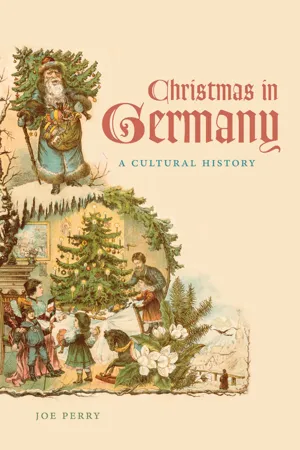
For poets, priests, and politicians — and especially ordinary Germans — in the nineteenth and twentieth centuries, the image of the loving nuclear family gathered around the Christmas tree symbolized the unity of the nation at large. German Christmas was supposedly organic, a product of the winter solstice rituals of pagan “Teutonic” tribes, the celebration of the birth of Jesus, and the age-old customs that defined German character. Yet, as Joe Perry argues, Germans also used these annual celebrations to contest the deepest values that held the German community together: faith, family, and love, certainly, but also civic responsibility, material prosperity, and national belonging.
This richly illustrated volume explores the invention, evolution, and politicization of Germany’s favorite national holiday. According to Perry, Christmas played a crucial role in public politics, as revealed in the militarization of “War Christmas” during World War I and World War II, the Nazification of Christmas by the Third Reich, and the political manipulation of Christmas during the Cold War. Perry offers a close analysis of the impact of consumer culture on popular celebration and the conflicts created as religious, commercial, and political authorities sought to control the holiday’s meaning. By unpacking the intimate links between domestic celebration, popular piety, consumer desires, and political ideology, Perry concludes that family festivity was central in the making and remaking of public national identities.
- 416 pages
- English
- ePUB (mobile friendly)
- Available on iOS & Android
eBook - ePub
About this book
Information
1 Scripting a National Holiday
Und der Engel sprach zu ihnen: Fürchtet euch nicht! Siehe, ich
verkündige euch große Freude, die allem Volk widerfahren wird;
denn euch ist heute der Heiland geboren, welcher ist Christus,
der HERR, in der Stadt Davids.
Und das habt zum Zeichen: ihr werdet finden das Kind in
Windeln gewickelt und in einer Krippe liegen.
Und alsbald war da bei dem Engel die Menge der himmlischen
Heerscharen, die lobten Gott und sprachen:
Ehre sei Gott in der Höhe und Frieden auf Erden und den
Menschen ein Wohlgefallen.
verkündige euch große Freude, die allem Volk widerfahren wird;
denn euch ist heute der Heiland geboren, welcher ist Christus,
der HERR, in der Stadt Davids.
Und das habt zum Zeichen: ihr werdet finden das Kind in
Windeln gewickelt und in einer Krippe liegen.
Und alsbald war da bei dem Engel die Menge der himmlischen
Heerscharen, die lobten Gott und sprachen:
Ehre sei Gott in der Höhe und Frieden auf Erden und den
Menschen ein Wohlgefallen.
—St. Luke, chapter 2, verses 10–14, Luther Bible (1912 edition)
Dear, sweet heart! Christmas Eve is certainly an ideé fixe among the Berliners, because not just children but everyone in the family and close friends as well exchange a jumble of gifts. There is always something sweet in this desire to give each other so much joy.
—Caroline von Humboldt to Wilhelm von Humboldt, 23 December 1815
IN 1815 CAROLINE VON HUMBOLDT, wife of Wilhelm von Humboldt, the enlightened educator, philosopher, and Prussian diplomat, set up Christmas trees in her parlor on Unter den Linden, the main thoroughfare in the Prussian capital of Berlin. Caroline described the scene and the family's Christmas Eve celebration in letters to Wilhelm, who was in Frankfurt to negotiate territorial realignments in the aftermath of Napoleon's defeat. “On both ends of a long table, two small Christmas trees burn brightly with lit candles,” Caroline wrote, trying to include her husband in the festivities, however far away he might be. “The Countess Dübin surrounded one with all types of presents for her little ones, I used the other for Hermann.” The children, who the day before had been “beside themselves with impatience,” now found satisfaction. Hermann's “main gifts” included “a theater, a very nice construction set, a squadron of Cossacks, and so on,” and “there was hardly room” for the many presents for Caroline, Adelheid, Gabriella, August, and the rest of the company. The mood was set by the glow of the “many candles and small lights” and the illuminated chandelier, which “made the atmosphere unusually pleasant.” The holiday was a success, Caroline assured her husband. Despite his absence, the family and friends found “so much joy” in the holiday experience.1
Later claims that Caroline's was “the first Christmas tree in Berlin” call attention to the origin myths of what would become a set of very German holiday traditions.2 The remade Christmas celebrated by the Humboldts and other members of the German Bildungsbürgertum, the upper strata of bourgeois society who valued cultivation and education as the key indicator of self-identity, reflected a broader transformation of the Early Modern festival cycle. Across the seventeenth and eighteenth centuries, Baroque celebration became increasingly bourgeois, enlightened, and politicized.3 Like other modern festivals, the German Christmas we know today is a hybrid, a blend of distinct but interrelated celebrations once observed in church, popular culture, and court society. The 25th of December was the high point of a series of religious holidays, including Advent Sundays, a number of saint's days, and “Holy Eve,” when observant Christians attended midnight or early-morning mass. Religious traditions coexisted, sometimes uneasily, with diverse superstitions and customs. From 30 November, St. Andrew's Day, to Epiphany on 6 January, popular celebration was shot through with what British ethnographer Clement Miles in 1912 called “pagan survivals.” In rural areas, elves and spirits visited village farmyards on Christmas Eve, animals spoke, and young girls dropped molten lead into water to predict their future marriage partners.4 In towns and cities, burghers and artisans celebrated with carnivalesque parades, mumming, and charivaris, fueled by profligate drinking and feasting. At court, New Year's Eve dominated the cycle of early-winter feasts and parties; aristocrats and courtiers exchanged small presents as tokens of admiration and friendship.
Though local practices persisted well into the twentieth century, particularly in rural areas, the diversity of popular celebration slowly gave way before a great wave of cultural innovation. “German Christmas” became more singular, standardized, domesticated, and sentimental, as its now-familiar features spread out from the households of the Bildungsbürgertum in a complicated process of cultural transmission. During the long nineteenth century, the modern holiday moved indoors and adopted a tamer set of rituals, embodied in the new symbols of the Christmas tree and the Weihnachtsmann (Father Christmas). The emotional charge of sacred observance was transferred to sentimental feelings of family love. Rowdy public rituals of overindulgence became private family feasts. Aristocratic gifts of sociability turned into tokens of affection between middle-class husbands, wives, and children. The result was a reinvented celebration that turned on sensory pleasure and emotional depth—the hallmarks of a modern, expressive individual at home in “a self-enclosed family of feeling.”5 Once a year, family members became the central players in private dramas of love and affection as they enacted sentimental scripts of domestic intimacy around the Christmas tree. “Christmas has turned out to be most beautiful,” Caroline von Humboldt wrote to her husband. “Oh, only you are missing, dear heart!”6 It was no mistake that Goethe's Young Werther, in one of the foundational texts of modern Western love, commits suicide on the day before Christmas Eve. The holiday was an emotionally laden celebration of emergent bourgeois lifestyles, and Goethe's novella introduced a generation of German readers to its rituals and meaning.7
German speakers seemed to have a special aptitude for Christmas. By the middle of the nineteenth century, locals and foreigners alike believed that the German holiday was a “ritual of Gemütlichkeit,” or domestic comfort and coziness, and that Gemütlichkeit itself was a character trait that was typically German.8 Observers began to speak of a special German Christmas mood, the Weihnachtsstimmung, an enthusiastic display of affection and happiness, piety and reverence, surprise and gratitude. The mood was encoded in a set of holiday scripts—a body of Christmas stories by famous authors like Goethe, Friedrich Schleiermacher, and E. T. A. Hoffmann, which all stressed the intense feelings of “paradisical joy” and Innerlichkeit, or inwardness, that enveloped the family on Christmas Eve. These classic texts were joined by a profuse number of less-famous Christmas stories written by a veritable army of churchmen, teachers, and children's authors. According to this ever-growing prescriptive literature, Christmas was supposed to be profound; yet it was also sentimental, an exaggerated celebration of middle-class family feeling. Personal diaries, memoirs, and letters suggest that Germans tried to act the part. Christmas Eve was “the most beautiful time of every year,” remembered Friedrich von Bodelschwingh in a typical comment about his childhood in the early 1880s. The sight of the decorated tree evoked “deep amazement” and brought his family to “the threshold of paradise.”9
These family performances were richly productive. Holiday observances shaped and expressed ideas about the boundaries between public and private lives, social status, confessional difference, regional particularities, and national solidarities. When Germans gathered around the Christmas tree in the nineteenth century, they envisioned themselves members of a society built on shared values and traditions. The family Christmas literature read by the middle classes portrayed celebration as a moment of national incorporation in which the rich joined the poor in a harmonious yet hierarchical civic community. If this remained an imaginary—and quite bourgeois—resolution to all manner of stubborn social antagonisms, the holiday nonetheless became a powerful symbol of the nation united. In this way, the holiday helped transform differentiated social groups based on estates and local allegiances into a middle-class “national citizenry.”10
The publication of Professor Hugo Elm's finely wrought Goldene Weihnachtsbuch (Golden Christmas Book) in 1878, seven years after German unification, testified to the consolidation of national Christmas customs. In Elm's hands, the now resolutely German holiday was inseparably linked to visions of faith, family, Volk, and fatherland—all portrayed with sentimental sympathy on the book's cover (see Figure 1.1). “Under all corners of heaven, this consecrated, Holy Night will be celebrated with the same feelings,” Elm wrote. “The German-Christian customs, closely attached to this marvelous festival, will conquer hearts everywhere and after their introduction will captivate everyone with their particular tenderness.”11 Elm was hardly alone. A generation of theologians and ethnographers reported that a specifically German Christmas combined the winter solstice rituals of Nordic tribes with the solemn pieties of Christian observance, evidence of the deep historical roots of the national Volk. Christmas songs, stories, decorations, foods, and gifts became symbols of a uniquely German identity, and by 1900 the holiday was arguably Germany's most successful national celebration.
The construction of universal Germanness around the Christmas tree was a contested project. The holiday drew much of its charge from its ability to combine the sacred and the secular, and its history across the nineteenth century was deeply entangled in the religious conflicts of the period. From the start, Christmas evolved out of a culture of reform Protestantism, which emphasized family intimacy and forged new links between piety and bourgeois domesticity; it was no mistake that the Luther Bible became German national literature, and Luther's translation of Luke's verses became the Christmas story for millions of Germans.12 The Christmas tree, the Weihnachtsmann, even opening presents on Christmas Eve—these mainstream features of “German” Christmas had a distinct Protestant cast, and Catholic clergymen responded by repeatedly calling on parishioners to remain faithful to the holiday traditions of the true church. At the same time, Christmas anchored a national Christian culture that could include Catholics as well as Protestants; unlike German Jews or supposedly atheistic socialists, clergy and laity in both Christian denominations celebrated the birth of Christ. In the ongoing project of making Germans, Catholics could use Christmas to claim a place in the Christian nation—even as they struggled to come to terms with the predominantly Protestant national culture.13 The growth of a mass consumer culture further blurred religious differences. The new material goods sold in national markets could reinforce denominational separatism, but they also proved conducive to the construction of a cult of domestic piety enjoyed by Catholics and Protestants alike.
Despite confessional tensions, contemporaries repeatedly claimed that the German Christmas celebrated social and national unity. The emergence of a shared culture of sentimentalism and domestic piety, embedded in family ritual and material culture, suggests that they were at least partially correct.
INVENTING THE CHRISTMAS MOOD
Buffeted by the Napoleonic Wars and the Revolutions of 1848, Germans experienced the first half of the nineteenth century as a period of crisis and transition, driven by territorial reorganization, political reaction and reform, and protoindustrialization. The Biedermeier years also witnessed the “awakening of the bourgeois world,” as German families experimented with changing notions of parenting, familial affections, and gendered separate spheres.14 The corresponding reinvention of Christmas as a family holiday drew sustenance from and helped fashion these private values and structures. A burst of popular creativity reworked existing holiday observances, producing new family rituals and classic carols like “Silent Night” (1818), “O How Joyfully” (1819), and “Oh Christmas Tree” (1826)—the latter being the first song to mention this now-indispensable decoration.15
The early nineteenth century also brought intense emotional innovation. This “was the golden age of private life,” writes historian Michelle Perrot, “a time when the vocabulary and reality of private life took shape.”16 Gathered around the Christmas tree, German families affirmed ordinary life and all its pleasures. Family observances domesticated notions of Christian morality and charity and celebrated the ideal of a free and expressive individual, whose ability to access and articulate emotional depths came to define the very essence of humanity.17 The ability to share such feelings and activities—to be a self in this newly formed emotional community—was at first limited to an elite stratum of the educated and, for the most part, Protestant bourgeoisie. As early as the 1850s, however, commentators asserted that the Christmas mood was universal, at least in German-speaking central Europe. As a bourgeois editorialist proclaimed in December 1844, Christmas turned the German lands into the Heimath der Innigkeit und Gemüthlichkeit (sic), the homeland of inwardness and coziness.18
How can we account for this rapid cultural transfusion? Two widely read texts from the first decades of the nineteenth century—Friedrich Schleiermacher's The Christmas Celebration: A Conversation (1806) and E. T. A. Hoffmann's The Nutcracker and the Mouse King (1816)—allow one to unpack, as it were, the constituent elements of the Christmas mood. In The Christmas Celebration, Schleiermacher used the holiday as a setting to explore the inter-penetration of faith, piety, and family life. His move to locate the sacred in everyday life and love rather than in formal ritual or liturgy, expressed with some subtlety in the book, reinvigorated Protestantism in the first decades of the nineteenth century and informed the Kulturprotestantismus, or cultural Protestantism, of the nineteenth century.19 Hoffmann's famous romantic fairy tale, on the other hand, contains an early and in-depth description of the family rituals that would become increasingly widespread in the years to come. Hoffmann's evocative prose captures the intense emotional excitement generated by family festivities and reveals the way Christmas made space for the play of the senses. Taken together, these classic Christmas stories show one way that the intertwined feelings of piety and intimacy were woven into the Christmas mood. The Christmas Celebration and The Nutcracker furthermore suggest that the hallmarks of what later observers would label “a good German Christmas” took shape in a specific social strata. Schleiermacher and Hoffmann were both educated cosmopolitans, living in the Prussian and Protestant territories of Berlin-Brandenburg. Though the feelings and rituals they described became popular across region, class, and confession over the course of the long nineteenth century, they never lost the specific marks of their milieu-based origins.
In 1806, when The Christmas Celebration appeared, the thirty-eight-year-old Schleiermacher was already one of the leading Protestant intellectuals of his time. Trained as a theologian, philosopher, and classicist, Schleiermacher had studied at the University of Halle; worked as a chaplain and pastor in Berlin, Halle, and Stolpe; and written books on religion, ethics, and church-state relations. His circle of acquaintances included Goethe and the Humboldts, and by his death at age sixty-five, he had produced an extensive body of work that cemented his reputation as a central figure in the evolution of modern Protestant theology.
Schleiermacher's Christmas novell...
Table of contents
- Cover Page
- Christmas in Germany
- Copyright Page
- Dedication
- Contents
- Acknowledgments
- Introduction Germany's Favorite Holiday
- 1 Scripting a National Holiday
- 2 Contradictions in the Christmas Mood
- 3 Christmas in Enemy Territory
- 4 Under the Sign of Kauflust
- 5 Christmas in the Third Reich
- 6 Ghosts of Christmas Past
- Conclusion The Nation around the Christmas Tree
- Notes
- Bibliography
- Index
Trusted by 375,005 students
Access to over 1.5 million titles for a fair monthly price.
Study more efficiently using our study tools.
Frequently asked questions
Yes, you can cancel anytime from the Subscription tab in your account settings on the Perlego website. Your subscription will stay active until the end of your current billing period. Learn how to cancel your subscription
No, books cannot be downloaded as external files, such as PDFs, for use outside of Perlego. However, you can download books within the Perlego app for offline reading on mobile or tablet. Learn how to download books offline
Perlego offers two plans: Essential and Complete
- Essential is ideal for learners and professionals who enjoy exploring a wide range of subjects. Access the Essential Library with 800,000+ trusted titles and best-sellers across business, personal growth, and the humanities. Includes unlimited reading time and Standard Read Aloud voice.
- Complete: Perfect for advanced learners and researchers needing full, unrestricted access. Unlock 1.5M+ books across hundreds of subjects, including academic and specialized titles. The Complete Plan also includes advanced features like Premium Read Aloud and Research Assistant.
We are an online textbook subscription service, where you can get access to an entire online library for less than the price of a single book per month. With over 1.5 million books across 990+ topics, we’ve got you covered! Learn about our mission
Look out for the read-aloud symbol on your next book to see if you can listen to it. The read-aloud tool reads text aloud for you, highlighting the text as it is being read. You can pause it, speed it up and slow it down. Learn more about Read Aloud
Yes! You can use the Perlego app on both iOS and Android devices to read anytime, anywhere — even offline. Perfect for commutes or when you’re on the go.
Please note we cannot support devices running on iOS 13 and Android 7 or earlier. Learn more about using the app
Please note we cannot support devices running on iOS 13 and Android 7 or earlier. Learn more about using the app
Yes, you can access Christmas in Germany by Joe Perry in PDF and/or ePUB format, as well as other popular books in History & German History. We have over 1.5 million books available in our catalogue for you to explore.