Taking an ethnographic approach to understanding urban violence, Enrique Desmond Arias examines the ongoing problems of crime and police corruption that have led to widespread misery and human rights violations in many of Latin America’s new democracies. Employing participant observation and interview research in three favelas (shantytowns) in Rio de Janeiro over a nine-year period, Arias closely considers the social interactions and criminal networks that are at the heart of the challenges to democratic governance in urban Brazil.
Much of the violence is the result of highly organized, politically connected drug dealers feeding off of the global cocaine market. Rising crime prompts repressive police tactics, and corruption runs deep in state structures. The rich move to walled communities, and the poor are caught between the criminals and often corrupt officials. Arias argues that public policy change is not enough to stop the vicious cycle of crime and corruption. The challenge, he suggests, is to build new social networks committed to controlling violence locally. Arias also offers comparative insights that apply this analysis to other cities in Brazil and throughout Latin America.
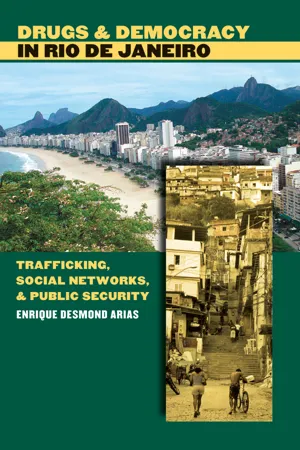
eBook - ePub
Drugs and Democracy in Rio de Janeiro
Trafficking, Social Networks, and Public Security
- 304 pages
- English
- ePUB (mobile friendly)
- Available on iOS & Android
eBook - ePub
Drugs and Democracy in Rio de Janeiro
Trafficking, Social Networks, and Public Security
About this book
Trusted by 375,005 students
Access to over 1.5 million titles for a fair monthly price.
Study more efficiently using our study tools.
Information
NOTES
Preface
1 On the United States, see, for example, Abinger, Five Points; and Asbury, The Gangs of New York. On Brazil, see Holloway, Policing Rio de Janeiro.
2 Perlman, The Myth of Marginality; and Leeds and Leeds, A Sociologia do Brasil Urbano.
3 On tours of favelas, see Irish Times, “Please Don’t Shoot the Tourist,” 7 June 2004, 15.
4 For more on the imperfection of internal control in favelas, see Arias and Rodrigues, “The Myth of Personal Security.”
Introduction
1 On business closings, see Penglase, “The Shutdown of Rio de Janeiro,” 3-6.
2 Goldstein, Laughter Out of Place, 201. See also Alvito, “A Honra de Acarí,” 156; and Holston and Caldeira, “Democracy, Law, and Violence,” 266-69.
3 Pereira, “An Ugly Democracy,” 217.
4 Alves Filho and Pernambuco, “No Front Inimigo,” 24-37; Soares, Meu Casaco de General, 269; and Fernandes and Rodrigues, “Viva Rio,” 11-12.
5 Colburn, “Fragile Democracies,” 76-80; Kruijt and Koonings, “Introduction,” 1-30; Pinheiro, “The Rule of Law,” 1-3; and Vilas, “Participation, Inequality, and the Whereabouts of Democracy,” 26-29.
6 Sives, “Changing Patrons,” 83-85; Human Rights Watch/Americas, Violência X Violência; Manaut, “Containing Armed Groups,” 139-42, 143, 148-52; Guillermoprieto, The Heart That Bleeds, 114-17; Gunst, Born Fi’ Dead, 10-11; Young Pelton, “Kidnapped in the Gap,” 64-72, 92-98; Pécaut, “From the Banality of Violence to Real Terror,” 142-47, 149-52; and Bowden, Killing Pablo, 1-70.
7 Caldeira, “Crime and Individual Rights”; Huggins, Political Policing, 201-4; and Koonings, “Shadows of Violence,” 232-33.
8 For some of these exceptions, see Griffith, “Transnational Crime in the Americas,” 63-86; Serrano, “Transnational Crime in the Western Hemisphere,” 85-152; Clawson and Lee, The Andean Cocaine Industry; Koonings and Kruijt, Societies of Fear; Bailey and Godson, Organized Crime and Democratic Governability, 139-42, 143, 148-52; and Guillermoprieto, The Heart That Bleeds.
9 On the history of favelas as an other to the city, see Perlman, The Myth of Marginality, 1-3, 12-17; and Zaluar and Alvito, “Introdução,” 7-19.
10 Múcio Bezerra, “Entrevista: Roberto Kant,” O Globo, 9 June 2002, 18.
11 Fernandes, Private but Public, 148-49. See also Fernandes and Rodrigues, “Viva Rio,” 11-12.
12 Soares, Meu Casaco de General, 269.
13 Fernandes, Private but Public, 104-15.
14 Múcio Bezerra, “Entrevista: Roberto Kant,” O Globo, 9 June 2002, 18.
15 Soares, Meu Casaco de General,269.
16 Perlman, The Myth of Marginality, 1-3, 12-17; and Zaluar and Alvito, “Introdução,” 7-19.
17 See, for example, Zuenir Ventura, “O risco da ‘Colombina,’” O Globo, 22 June 2002, B12.
18 Leeds, “Cocaine and Parallel Polities in the Brazilian Urban Periphery,” 47-50, 73-78; Zaluar, A MáquinaeaRevolta; Alvito, As Cores de Acarí, 149-54, 160-64; and Burgos, “Dos parques proletários ao Favela-Bairro,” 34-45.
19 See Perlman, The Myth of Marginality, 1-3, 12-17; and Burgos, “Dos parques proletários ao Favela-Bairro,” 35-43.
20 Burgos, “Dos parques proletários ao Favela-Bairro,” 43.
21 Leeds, “Cocaine and Parallel Polities in the Brazilian Urban Periphery,” 50.
22 Ibid., 73-76.
23 Alvito, As Cores de Acarí, 162-64.
24 Ibid., 59-78. A similar argument can be seen in Sives, “Changing Patrons,” passim.
25 On types of clientelist ties, see Grindle, “Patrons and Clients in the Bureaucracy,” 43-49. On patron-client relations in Rio, see Gay, Popular Organization and Democracy in Rio de Janeiro.
26 Grindle, “Patrons and Clients in the Bureaucracy,” 53.
27 On clientelism, see also Auyero, Poor People’s Politics, 81-118.
28 Tilly, “War Making and State Making as Organized Crime,” 170-71.
29 Malkin, “Narcotrafficking, Migration, and Modernity in Rural Mexico,” 101.
30 Mark Bowden’s Killing Pablo, a book on the life of Pablo Escobar, offers some interesting insights into this. He suggests that Escobar might have been able to live out his days as a wealthy and powerful criminal without ever touching off significant law enforcement efforts to bring him to justice had he not tried to enter the political arena. It was only after he tried to become a public figure and was elected an alternate member of Congress that the state began to make extensive efforts to bring him to justice. So long as he accepted his low social status and worked through accepted contacts with state actors he could influence the political system. When he violated these status rules and demanded official acceptance of illegal activities, the state moved against him. See Bowden, Killing Pablo, 35-59.
31 By differentially equal, I mean that actors possess different levels of status in different spheres and that although neither actor has clearly higher status overall, in some spheres one actor has more status than the other actor, and vice versa. Recent work on clientelism has however shown some of the statu...
Table of contents
- Title Page
- Copyright Page
- Table of Contents
- Dedication
- PREFACE
- Acknowledgements
- ABBREVIATIONS
- Introduction
- ONE - Setting the Scene: Continuities and Discontinuities in a “Divided City”
- TWO - Network Approach to Criminal Politics
- THREE - Tubarão
- FOUR - Santa Ana
- FIVE - Vigário Geral
- SIX - Comparative Analysis of Criminal Networks in Brazil and Latin America
- SEVEN - Theorizing the Politics of Social Violence
- EPILOGUE
- NOTES
- BIBLIOGRAPHY
Frequently asked questions
Yes, you can cancel anytime from the Subscription tab in your account settings on the Perlego website. Your subscription will stay active until the end of your current billing period. Learn how to cancel your subscription
No, books cannot be downloaded as external files, such as PDFs, for use outside of Perlego. However, you can download books within the Perlego app for offline reading on mobile or tablet. Learn how to download books offline
Perlego offers two plans: Essential and Complete
- Essential is ideal for learners and professionals who enjoy exploring a wide range of subjects. Access the Essential Library with 800,000+ trusted titles and best-sellers across business, personal growth, and the humanities. Includes unlimited reading time and Standard Read Aloud voice.
- Complete: Perfect for advanced learners and researchers needing full, unrestricted access. Unlock 1.5M+ books across hundreds of subjects, including academic and specialized titles. The Complete Plan also includes advanced features like Premium Read Aloud and Research Assistant.
We are an online textbook subscription service, where you can get access to an entire online library for less than the price of a single book per month. With over 1.5 million books across 990+ topics, we’ve got you covered! Learn about our mission
Look out for the read-aloud symbol on your next book to see if you can listen to it. The read-aloud tool reads text aloud for you, highlighting the text as it is being read. You can pause it, speed it up and slow it down. Learn more about Read Aloud
Yes! You can use the Perlego app on both iOS and Android devices to read anytime, anywhere — even offline. Perfect for commutes or when you’re on the go.
Please note we cannot support devices running on iOS 13 and Android 7 or earlier. Learn more about using the app
Please note we cannot support devices running on iOS 13 and Android 7 or earlier. Learn more about using the app
Yes, you can access Drugs and Democracy in Rio de Janeiro by Enrique Desmond Arias in PDF and/or ePUB format, as well as other popular books in Politics & International Relations & Latin American & Caribbean History. We have over 1.5 million books available in our catalogue for you to explore.