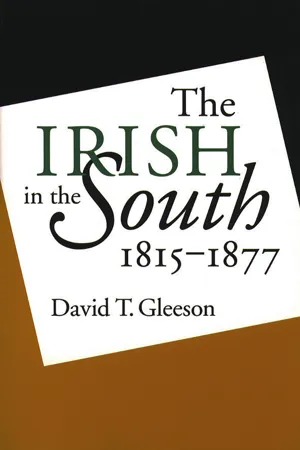
The only comprehensive study of Irish immigrants in the nineteenth-century South, this book makes a valuable contribution to the story of the Irish in America and to our understanding of southern culture.
The Irish who migrated to the Old South struggled to make a new home in a land where they were viewed as foreigners and were set apart by language, high rates of illiteracy, and their own self-identification as temporary exiles from famine and British misrule. They countered this isolation by creating vibrant, tightly knit ethnic communities in the cities and towns across the South where they found work, usually menial jobs. Finding strength in their communities, Irish immigrants developed the confidence to raise their voices in the public arena, forcing native southerners to recognize and accept them — first politically, then socially.
The Irish integrated into southern society without abandoning their ethnic identity. They displayed their loyalty by fighting for the Confederacy during the Civil War and in particular by opposing the Radical Reconstruction that followed. By 1877, they were a unique part of the “Solid South.” Unlike the Irish in other parts of the United States, the Irish in the South had to fit into a regional culture as well as American culture in general. By following their attempts to become southerners, we learn much about the unique experience of ethnicity in the American South.
- 296 pages
- English
- ePUB (mobile friendly)
- Available on iOS & Android
eBook - ePub
The Irish in the South, 1815-1877
About this book
Information
CHAPTER ONE
THE IRISH DIASPORA
Like the Jews, to whom the term “diaspora” was first applied, the Irish also scattered to many countries throughout the world. The concept of flight, however, distinguishes a diaspora from general immigration. “Diaspora” implies that the migration was in some way involuntary. This perception of forced migration is a strong element in the folklore of Irish immigration. Even Irish people who made rational economic decisions to leave Ireland often felt that they had no choice at all. This fact was particularly true in the greatest period of Irish emigration—the nineteenth century. Most of the millions who left the island in this period were economic migrants. Most believed, however, that they were political exiles, driven out by Britain’s misrule of their homeland. Thus, the Irish migrants who arrived in the United States were highly politicized. Upon arrival, they were already cognizant of not just the economic contrasts between America and Ireland but also the political differences. The Irish who came to the American South saw not only the variances between the two countries but also those between their new region and Ireland. Despite the harsh realities of immigrant life in the South, Irish immigrants’ awareness of the contrast did not dissipate. Whatever calamity befell them, at least they were no longer under the heel of Irish landlords and the British legal and military regime that had enforced their misrule. Understanding why they left and what they perceived they had left behind is vital to comprehending the Irish immigrant experience in the nineteenth-century South.
“The Flight of the Earls” in 1607, when the leaders of Ireland’s great sixteenth-century native rebellion abandoned their lands for friendlier Spain, began the tradition of England’s interference in Ireland equaling Irish exile. Their flight provided an example for other unsuccessful rebels to follow. The soldiers defeated in trying to restore the Catholic King James II to his throne in the aftermath of the Glorious Revolution became famous as the “Wild Geese” when they left Ireland to join various European armies. Their defeat affirmed William of Orange as the new king of England, Scotland, and Ireland. In Ireland his victory ushered in the era of the Ascendancy, a minority Anglican ruling class. The Ascendancy wanted to make sure that Catholic Ireland never again flexed its military or political muscle. Through their parliament in Dublin, members of the Ascendancy systematically kept Catholics, and Dissenters, out of political power. Dismissing Catholics as dangerous ignorant papists, they passed a series of discriminatory religious, economic, and political “penal laws” and made the majority of the Irish population second-class citizens in their own country.1
Resentment among the disfranchised remained, however. Although the 1690 victory was more complete than any other English attempt to control the Catholic native Irish, the victors did not eradicate or expel the defeated. In many parts of Ireland, Catholics remained on or close to their ancestral lands. Here a culture of alienation grew among the old landed elites who longed nostalgically for the good old days before the interference of the horrible foreigners from England. This disaffection was best illustrated in the contemporary Gaelic poetry. Poets railed against “Saxon curs,” “Luther’s followers,” and “Calvin’s mob.” In their poems, the misfortune these foreigners had brought on Ireland made the Irish people the most oppressed in the world. Only the Jews, one Dublin writer believed, were more unfortunate and more ensnared in “daoirse” (slavery) than the Irish.2 This resentment permeated the popular culture of the poorer Irish. Even those who managed to survive the sporadically enforced penal laws and restore some form of economic prosperity remained aware of the previous dispossession and the continued potential of their return to abject poverty.3
The majority of Ireland’s Catholics did live in poverty. Ireland endured two major famines, and barely avoided several more, in the eighteenth century. Outbursts of agrarian violence were common and occasionally substantial.4 Escape to the New World in the eighteenth century did not provide the opportunities that it would in the nineteenth century. Those who ended up in the American colonies usually had not chosen to go there. According to Kerby Miller, approximately 100,000 Irish Catholics “emigrated” to the British American colonies in the eighteenth century. Quickly finding themselves handicapped by “poverty, bond service and the recruiting sergeant,” Irish Catholic colonials tended to work as indentured servants, to be convicts, or to serve as members of the British armed forces. They usually “toiled in obscure places for hard taskmasters” and lived rather “brutish lives.” Miller believes that these emigrants were “rootless” in “familial and cultural” terms, because they usually emigrated as individuals rather than as family units. They were dispersed throughout the colonies, and by necessity English became their public language. Their families at home in Ireland, however, continued to speak Gaelic.5 They also lost their Catholicism. Having left an Ireland with a very weak church structure for the colonies, where Catholicism barely existed, migrants who wanted any religious solace had to become Protestant. Nineteenth-century Irish clerics who came to the South determined not to let contemporary immigrants go the way of their eighteenth-century predecessors. Because of the previous cultural breakdown and resulting disappearance of their relatives and friends, the Irish conceived of America as a dark place of exile where loved ones were never heard from again.
A second group of Irish people perceived America differently. They did not take as long to become enamored with North America. The Protestant residents of the northern part of Ireland, whose ancestors had come from Scotland and England and who had been “planted” (i.e., settled on land seized from the native Irish by the English Crown) in the province of Ulster since the early 1600s, saw America more as an escape than an exile.6 These Ulster folk, known in popular terms as the “Scots Irish,” were predominantly Presbyterian.7 Their religious dissent led the Anglican-dominated Irish parliament to discriminate against them, despite the Dissenters’ crucial role in King William’s victory in Ireland. The Anglican rulers of eighteenth-century Ireland saw the Ulster Presbyterians as a serious threat to their power and influence, because, unlike the disfranchised Irish Catholics, Dissenters remained a vociferous political force. The authorities passed a series of laws that withdrew official recognition of Dissenter marriages and made nonattendance at Anglican services and nonrecognition of Anglican episcopal authority prosecutable offenses. In 1704, the Test Act stated that all public officeholders had to take sacraments in the (Anglican) Church of Ireland. Despite the passage of the Toleration Act in 1719, Church of Ireland clergy and politicians continued to discriminate against Presbyterians.8
Along with religious persecution, Ulster Presbyterians also faced economic hardship. With the acquiescence of the Ascendancy, English protectionism restricted Irish wool exports. This action brought about the growth of and subsequent dependence upon a linen industry in Ulster. Periodic crises in the linen industry led to falling prices for flax, increased rents, and ultimately evictions. The Scots Irish settlers, therefore, faced two prospects: stay and resist prejudice and economic uncertainty, or, like their ancestors, begin a new life somewhere else. Thousands opted for the latter.9
One positive effect of the linen industry on the Scots Irish proved to be increased communication with the American colonies. Ships arriving at Derry and Belfast gave the Scots Irish an opportunity to catch the return trip to New York City or Philadelphia. Around 250,000 Irish Presbyterians came to America via this route in the eighteenth century. They immigrated primarily to New York and Pennsylvania, where they settled in uninhabited lands in the west. Later in the century, some of the Scots Irish migrated through the Shenandoah Valley to the backcountries of Virginia, the Carolinas, and Georgia. The Scots Irish thrived well in the southern colonies, and three North Carolina governors actively welcomed them. Arthur Dobbs, governor from 1754 to 1765 and himself a native of Carrickfergus, County Antrim, Ulster, recruited settlers from Ireland and other colonies.10 By 1761, the Scots Irish filled the South Carolina piedmont. Andrew Pickens and John Pickens Jr. followed the typical pattern of Scots Irish migration within the colonies. They had been justices of the peace in Augusta County, Virginia, in 1745; they moved to the Waxhaws in South Carolina by 1751 and on to the Savannah River valley by 1762.11
Scots Irish emigration peaked between 1770 and 1775, but it did not disappear. Between 1851 and 1855, over 44,000 people left the predominantly Presbyterian counties of Antrim and Down for the United States. Many of these migrants were native Catholic Irish, but some were from a Dissenter background. For example, Robert McElderry of Lynchburg, Virginia, a Protestant migrant from County Antrim, kept a steady correspondence with his relatives in Ireland in the 1850s. He boasted that every “Sabbath” he went to a Presbyterian service in the morning and a Methodist one in the evening. Benjamin Wilson left Belfast in 1839. He settled in Randolph County, Alabama, and eventually helped found a Presbyterian church in Atlanta, Georgia.12 The majority of the Scots Irish, however, had taken part in the American Revolution and in the politics of the new nation. On the whole, they had been avid patriots. Their memories of oppression in Ireland made them zealots for American freedom and supporters of a democratic American culture. Thus, they played an important role in creating a distinctive American society.13
They and their fellow Americans’ efforts for “life, liberty, and the pursuit of happiness” had a profound impact on their old country. The American Revolution impressed Irish people of every class and faith. Some feared its ideology, while others embraced it. Ironically, the political changes of revolution and independence, brought about in large part by the Scots Irish, changed the attitude of the native Catholic Irish toward America. Patriot leaders like Benjamin Franklin and John Adams tried to encourage a reciprocal revolution in Ireland. The republican rhetoric of the new United States appealed to the Irish who resented British dominance of their affairs. Gaelic poets eulogized the efforts of George Washington in his fight against the “Boors of Britain.” One poet rejoiced at “the sturdy Washington[’s]” victories over the “arrogant robbers.” The future president’s endeavors earned him comparisons to such great Irish heroes as Brian Boru, an eleventh-century high king, and Patrick Sarsfield, the dashing cavalry hero who had tried to halt William of Orange’s invasion of Ireland.14
The more important impact, however, occurred among the Presbyterian population. With their familial links to America and their educational links with Scottish universities, many Presbyterian Ulstermen considered themselves educated men of the Enlightenment and the world. They admired the American patriot’s struggle against despotism. When war broke out between the United States and Great Britain in 1776 and escalated in 1778 with the involvement of France, Ulster Presbyterians rallied to defend Ireland against a French/American invasion, but many secretly admired the American patriots. Despite the initial promise of Irish legislative independence (granted by Great Britain in 1782 to ensure Ireland’s loyalty), these Ulster Protestants had become frustrated by the continued political and economic interference from London, particularly patronage and the reluctance of the still Ascendancy-dominated parliament in Dublin to pass real reform. This political frustration caused bitterness, which began to overshadow the Protestants’ harsh memories of bloody Catholic uprisings. The Catholics had not done anything to harm Presbyterians in over eighty years. All the insults and injuries, it seemed, now came from an Anglican Ascendancy ancien régime propped up by the British government.15
The outbreak of the French Revolution in 1789 turned frustration into action. It was one thing for Americans raised in a tradition of liberty to throw off the yoke of a despot, but for the French to also do it, that was something different. If the people of Papist France, whose government epitomized autocracy, could become enlightened and embrace the concepts of liberty, equality, and fraternity, then why not Ireland? Perhaps, the Dissenters believed, the same metamorphosis could occur among Irish Catholics. Presbyterian Belfast celebrated Bastille Day with great gusto, and in 1791 a group of republican-France supporters with the aid of some Protestants from Dublin founded the Society of United Irishmen. Their aim was to unite Catholic, Protestant (Anglican), and Dissenter in Ireland’s cause.16
The Anglo-Irish Ascendancy definitely recognized the threat to its power. An alliance of the Ulster Presbyterian Enlightenment ideology and Catholic peasant unrest was a potent concoction. In 1793 Dublin authorities banned the society and drove many of its leaders overseas. All the crackdown accomplished was to move the United Irishmen from radical ideas to radical actions. Exiled to the United States and France, they plotted revolution. In Ireland the society went underground and continued to grow. Rebellion eventually broke out in May 1798, first in the Catholic southeast and later the Presbyterian northeast. After some initial success the rebels met their demise at Vinegar Hill, County Wexford, and Ballinahinch, County Down. A minor French invasion in the west in the late summer was also unsuccessful. There were swift reprisals. Mass execution and deportation were the order of the day. Casualties in the rebellion and its aftermath totaled around 30,000.17 Many towns had been destroyed during the trouble, and the estimated property damage amounted to over £1 million. One witness of the rebellion’s aftermath remarked: “In the capital the streets were crowded with the widows and orphans of those who had fallen in battle. In the country, I beheld villages everywhere burned and razed to the ground.”18
The physical and economic consequences were great enough, but the political repercussions were even greater. The United Irishmen had politicized many sections of the Irish population. They created Irish republicanism and made v...
Table of contents
- Cover Page
- Title Page
- Copyright Page
- Dedication
- Contents
- Illustrations
- Acknowledgments
- Introduction: The Forgotten People of the Old South
- CHAPTER ONE: The Irish Diaspora
- CHAPTER TWO: Urban Pioneers in the Old South
- CHAPTER THREE: Earning a Living
- CHAPTER FOUR: Family, Community, and Ethnic Awareness
- CHAPTER FIVE: Keeping the Faith
- CHAPTER SIX: The Irish, the Natives, and Politics
- CHAPTER SEVEN: The Know-Nothing Challenge
- CHAPTER EIGHT: Slavery, State Rights, and Secession
- CHAPTER NINE: The Green and the Gray
- CHAPTER TEN: Irish Confederates
- CHAPTER ELEVEN: Postwar Integration
- CONCLUSION: Irish Southerners
- APPENDIX: Occupational Status Classification
- Notes
- Selected Bibliography
- Index
Trusted by 375,005 students
Access to over 1.5 million titles for a fair monthly price.
Study more efficiently using our study tools.
Frequently asked questions
Yes, you can cancel anytime from the Subscription tab in your account settings on the Perlego website. Your subscription will stay active until the end of your current billing period. Learn how to cancel your subscription
No, books cannot be downloaded as external files, such as PDFs, for use outside of Perlego. However, you can download books within the Perlego app for offline reading on mobile or tablet. Learn how to download books offline
Perlego offers two plans: Essential and Complete
- Essential is ideal for learners and professionals who enjoy exploring a wide range of subjects. Access the Essential Library with 800,000+ trusted titles and best-sellers across business, personal growth, and the humanities. Includes unlimited reading time and Standard Read Aloud voice.
- Complete: Perfect for advanced learners and researchers needing full, unrestricted access. Unlock 1.5M+ books across hundreds of subjects, including academic and specialized titles. The Complete Plan also includes advanced features like Premium Read Aloud and Research Assistant.
We are an online textbook subscription service, where you can get access to an entire online library for less than the price of a single book per month. With over 1.5 million books across 990+ topics, we’ve got you covered! Learn about our mission
Look out for the read-aloud symbol on your next book to see if you can listen to it. The read-aloud tool reads text aloud for you, highlighting the text as it is being read. You can pause it, speed it up and slow it down. Learn more about Read Aloud
Yes! You can use the Perlego app on both iOS and Android devices to read anytime, anywhere — even offline. Perfect for commutes or when you’re on the go.
Please note we cannot support devices running on iOS 13 and Android 7 or earlier. Learn more about using the app
Please note we cannot support devices running on iOS 13 and Android 7 or earlier. Learn more about using the app
Yes, you can access The Irish in the South, 1815-1877 by David T. Gleeson in PDF and/or ePUB format, as well as other popular books in History & North American History. We have over 1.5 million books available in our catalogue for you to explore.