- 424 pages
- English
- ePUB (mobile friendly)
- Available on iOS & Android
eBook - ePub
Stonewall Jackson at Cedar Mountain
About this book
Robert Krick untangles the myriad accounts by participants who fought the battle on both sides, and he offers an illuminating portrait of the Confederate general commanding his troops under the extraordinary pressures of combat.
Information
Chapter 1: John Pope’s Difficult Adjustment
John pope found nothing but trouble in Virginia in 1862. The general was a forty-year-old career soldier, a graduate of the United States Military Academy, and a veteran of the Mexican War. Pope graduated seventeenth in the remarkable West Point class of 1842, which produced nearly a score of men who became general officers during the Civil War. During the war’s early days Pope had stumbled into easy success in the western theater. His brightest ally was his political record—he was a staunch Republican at a time when the radicals of that party were wielding enormous power in Washington. Pope had actually been court-martialed for political impudence against Democratic President James Buchanan before the war.
Three distinguished Northern military writers, collaborating in a paper about Pope’s Virginia campaign, offered a synoptic view of the man: “Personally, Gen. Pope was of quick temper, impatient of contradiction, rude in manner, and gifted with a vivid imagination.” The new Federal hope in Virginia clearly was not gifted in the field of human relations. Men said that his orders were pretentiously datelined from “headquarters in the saddle.”1 As soon as the men of both Union and Confederate armies heard of the dateline they jocularly derided the general as a man who did not know his headquarters from his hindquarters and kept one where the other should have been.
Northern jokes about Pope contained some bitterness, and Southerners would soon be bitter as well. Pope issued a patronizing circular to his troops in a maladroit effort to heighten their morale. “I have come to you from the West,” he wrote, “where we have always seen the backs of our enemies.” Confederate successes in Virginia, he felt sure, had resulted from timid soldiering by the Federals. “Let us discard such ideas,” Pope exhorted, as “taking strong positions … lines of retreat [and] … bases of supplies.”2 His new subordinates of all ranks growled and glared.
A series of draconian general orders which tumbled from Pope’s pen sent a wave of outrage through the South and offended many in his own army as well. The first ordered his men to “subsist upon the country,” taking from Southern civilians without reimbursement. Another declared that Virginia families would be held responsible for any damage done by Confederates in their neighborhoods; any damage to Federal troops or supplies would be assessed against all civilians within a five-mile radius. Some offenders would “be shot, without awaiting civil process.” All citizens unwilling to take the oath of allegiance were to be sent outside the army’s lines, their property confiscated. Execution without trial awaited any civilian who violated this stringent oath.3
This was very strong stuff indeed. Two years later, when chivalry had been thoroughly emasculated, the Union’s most prominent officers behaved in about the same fashion. Human savagery in war has since come to know no bounds, and in the twentieth century everyone behaves in this manner. In July 1862, though, Pope was a man ahead of his time (as well as immune to conscience). Pope’s bravado disgusted his own army. At a grand review, some of the troops exhibited blatant disrespect for their new leader. A gathering of officers, some of them wearing generals’ stars, brought forth “cuss words of such vigor” against Pope that observers were “appalled.” “Ordinary words being totally inadequate to express one’s feelings, swearing became an epidemic,” reported one blue-clad general. An English correspondent for Cornhill Magazine interviewed Pope on the eve of the battle of Cedar Mountain and recorded a vivid impression of the general. The Englishman’s account is vivid and detailed:
Tall, corpulent, and athletic, with keen dark eyes, and beard and hair black as midnight, Gen. Pope had all the air of a commander. Vain, imprudent, and not proverbially truthful; but shrewd, active, and skilled in the rules of warfare, Pope could be great and little too. He was clothed with scrupulous neatness, his hair and beard carefully dressed, his cigars exquisite in flavor. He spoke much and rapidly, chiefly of himself; swore roundly at intervals, was petulant at trifles, and sanguine of impending success.4
John Pope was not a man of great capacity, and it is easy to imagine that his blustering style might have covered a great uneasiness and confusion. The Civil War he had known in Missouri was much different from that in Virginia. In the West, divided sentiments led to brigandage and irregularities, including savagery not only between contending armies but also between civilians. One of Pope’s apologists reported that the general was amazed at the unanimity of Confederate sentiment in Virginia. The effects of this civilian hostility on his own military security, and on his knowledge of Confederate movements, were obviously large and negative.5 An aide to Pope later defended his chief in an unpublished memoir that portrays the officer corps and enlisted men of the army as so thoroughly cowed that shock tactics were necessary and suggests that Pope directed his bombastic general orders toward that goal. In a pungent reaction, one of Pope’s fellow Union generals summarized the prevailing attitude when he said: “I don’t care for John Pope a pinch of owl dung.”6
Pope’s grumbling army was about forty-five thousand men strong, including sixty-five hundred cavalry under the competent leadership of John Buford and George Bayard.7 The infantry was arranged in three corps, commanded by Franz Sigel, Irvin McDowell, and Nathaniel P. Banks. Sigel was a German immigrant of very limited military attainments, but he had well-placed political friends and enjoyed the admiration of his troops. McDowell had commanded the Federal army that was routed at First Manassas. He was an uninspiring but solid officer, but his politics were suspected by paranoid Washington politicians.
General Banks was the man against whom Stonewall Jackson actually fought at Cedar Mountain. The two were old adversaries, and the results were always the same. It is easy to sympathize with Banks because Jackson overmatched everyone. The Northerner was forty-six years old and had spent his life in politics and railroading. Banks was far more aggressive than most Union commanders. At a “sham-fight” shortly after Pope’s arrival, Banks “was with difficulty restrained by his staff from charging one of his infantry squares at the head of his cavalry escort.” Vast personal bravery and ambition of the same dimensions made Banks formidable.8 Banks was not nearly so inept as his critics were wont to declare, but he was beyond question more politician than soldier. His main claim to fame was a career as Speaker of the House of Representatives while representing Massachusetts in that body.
In early August, Pope’s command threatened Lee’s left and rear from an arc centered on Gordonsville. Although Pope’s force included about twice as many men as Jackson could muster, they were spread from Fredericksburg to the foothills of the Blue Ridge. These far-flung Union detachments were also suffering from more than simple unhappiness with their new general. The weather raged brutally hot and sickness ran rampant. As a result of “imprudence in eating unripe fruit, and … neglect of sanitary precautions, many of the men were ill, and many died.”9 John Pope and forty-five thousand sweating, muttering subordinates were about to come up against Stonewall Jackson, and they would not be equal to the task.
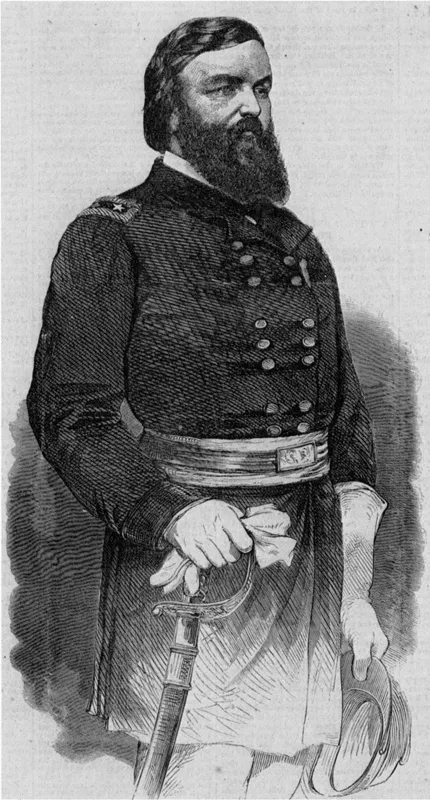
Major General John Pope: “tall, corpulent … vain, imprudent, and not proverbially truthful.” (Harper’s Weekly)
Confederate commander R. E. Lee was prompted by Pope’s shenanigans to write to Stonewall Jackson: “I want Pope to be suppressed.” In an official document, Lee referred to the new Federal leader as “miscreant Pope,” and in other correspondence Lee was atypically blunt in his comments. Months later, after Pope had been thoroughly suppressed, Lee’s official report noted that he had sent Jackson toward Gordonsville on July 13 from the environs of Richmond to “restrain, as far as possible, the atrocities which [Pope] threatened to perpetrate upon our defenseless citizens.”10
Less than two weeks before Jackson left Richmond on Pope’s trail, Lee had fought and won the Seven Days’ battles, pushing George B. McClellan’s Northern army from the outskirts of the Confederate capital. Jackson reached Gordonsville on July 19 and assessed his enemy’s strength and intentions. He told Lee that Pope was too strong to be driven. Since Lee could not afford to reinforce his lieutenant, he directed him “to observe the enemy’s movements closely, to avail himself of any opportunity to attack that might arise.” McClellan’s languorous behavior gave Lee the chance to send A. P. Hill’s strong division from Richmond to Jackson’s assistance on July 27.11
Even after the addition of Hill’s six big brigades, Jackson could not count more than half the strength that Pope had at hand. He determined nonetheless to find an opening for the sort of hard, quick offensive thrust that was his trademark. A successful sally would disconcert Pope and delay the unfolding of his campaign. As the situation developed, Jackson conceived the notion of defeating Pope by moving rapidly to Culpeper, interposing himself between pieces of the Northern army, and defeating them by turns.12 Stonewall’s most recent independent operations, precisely two months before around Cross Keys and Port Republic, had been based on an identical premise. His tactics had not worked particularly well at that time.
When Jackson made his headquarters in Gordonsville on July 19, he took up residence temporarily at the home of the Reverend D. B. Ewing. The general, it was noted, appeared jaded and unwell, as Captain Blackford would have gladly attested. Jackson complained that he had not suffered so much since his Mexican War days—but then Jackson always savored the chance to complain about his health. The small Ewing daughters cheered Stonewall’s spare moments; children always amused the general. The fresh fruit available in this agricultural country refreshed him, as did the relatively bracing climate (anything is better than the Richmond swamps in midsummer). The Ewing girls eventually wangled uniform coat buttons from Jackson, and great treasures those were, then and now alike. Near the end of July, Jackson carried his army down into Louisa County to make use of the superb pasturage for which that locality has always been justly famous.13
The moving army, as usual, had no idea where it was going or why when the move began on July 29. One of Jackson’s headquarters entourage marveled: “It seems strange to see a large body of men moving in one direction and only one man in all the thousands knowing where they are going.… They will go until ordered to stop.” During the march on July 30, the same bemused officer wrote: “The General … has very little to say to anyone.” No military man has ever been more secretive than was Jackson, as any number of witnesses have reported. A Southern general who watched Jackson in his renowned Valley campaign summed up crisply: “If silence be golden, he was a ‘bonanza.’”14
While the men and animals of Jackson’s army enjoyed the lush Green Springs area of Louisa County, the Southern cavalry kept busy along the line of the Rapidan. Most of the Confederate horsemen belonged to the famed Laurel Brigade, which had its origins in the loosely organized Shenandoah Valley command that had been Turner Ashby’s. When Jackson left the Valley in June 1862, the cavalry brigade stayed behind and successfully screened the movement. Now the Valley horsemen were back with Jackson, east of the Blue Ridge and spread between Gordonsville and Orange.
The Laurel Brigade was now commanded by General Beverly H. Robertson. Robertson was thirty-five years old, a career officer, and a West Point graduate—and Jackson disliked him very much. When Lee’s cavalry chief, J. E. B. Stuart, showed up in the midst of the Cedar Mountain fighting, observers in the army interpreted his arrival as a fortuitous coincidence. Historians have accepted that interpretation.
Two members of Stonewall’s staff knew better. One of the witnesses was Jackson’s medical officer, Hunter Holmes McGuire. During the first days of August, Jackson found McGuire eating a raw Bermuda onion in a desperate effort to dispel dusty heat and thirst. The general was teasing McGuire about his taste, in the heavily humorless way that Jackson sometimes exhibited, when Robertson rode into the cheerful tableau. Stonewall immediately asked the question he always had ready for his mounted arm: “Where is the enemy?” When Robertson calmly replied, “I really do not know,” the glee vanished from Jackson’s face, his countenance turned black, and he abruptly moved away without speaking further. Jackson immediately telegraphed to Lee, asking for Stuart’s services. Lee suspected that his subordinate was demanding too much from Robertson, but he sent Stuart up to look around.15
Quarreling between contending cavalry pickets gained momentum and on August 2 a hot little fight erupted in the streets of Orange Court House. Three Federal cavalry regiments—the First Vermont, First Michigan, and Fifth New York—crossed the Rapidan River at Raccoon Ford and moved against Orange from the north. In the northern outskirts of the village one company of the Eleventh Virginia Cavalry met the Yankees. The Northerners easily drove the Virginians through town and beyond, but help was on the way. The Seventh Virginia Cavalry galloped into action led by its colonel, William E. Jones, who was known to one and all by the well-earned sobriquet of “Grumble.”16
The main Federal column was enjoying “a stillness like that of death,” according to one man in its ranks, when Grumble Jones burst upon them. Screaming horse soldiers soon jammed the streets, firing carbines and pistols, slashing and stabbing with sabers. “The fight was furious in the narrow streets,” reported a member of the Fifth New York.17 There was hardly room to move or to breathe, and men reacted differently. Strong men from both sides pushed into the fray; their timid cousins withdrew from the concentrated mayhem. Someone heard Grumble Jones say frankly that “half of his men charged and half discharged.”18
At this pivotal moment Major Thomas Marshall (grandson of the great Chief Justice John Marshall) led a squadron of the Seventh Virginia in by the railroad depot in a flank attack. Before Marshall’s little column could swing the balance, it was in turn struck inopportunely in flank by a Federal force riding to the sound of the guns. His retreat cut off, young Marshall emptied his pistols into his adversaries and then was knocked unconscious by a saber stroke. Grumble Jones was winning his way through the streets and personally shot dead a Yank...
Table of contents
- Cover Page
- Stonewall Jackson at Cedar Mountain
- Copyright Page
- Contents
- Acknowledgments
- Prologue
- Chapter 1: John Pope’s Difficult Adjustment
- Chapter 2: Jackson and Hill Clash
- Chapter 3: A Slow March to Battle
- Chapter 4: Jackson and Winder as Gunners
- Chapter 5: Confused Preparations in the Woods
- Chapter 6: Augur’s Attack
- Chapter 7: The Confederate Left Dissolves
- Chapter 8: Federal High Tide
- Chapter 9: Jackson Waves His Sword
- Chapter 10: The Cavalry Charge
- Chapter 11: The Fourteenth Georgia Fills the Breach
- Chapter 12: Counterattack
- Chapter 13: Mopping Up in the Cornfield
- Chapter 14: After Dark
- Chapter 15: August 10
- Chapter 16: August 11
- Appendixes
- Notes
- Bibliography
- Index
Trusted by 375,005 students
Access to over 1.5 million titles for a fair monthly price.
Study more efficiently using our study tools.
Frequently asked questions
Yes, you can cancel anytime from the Subscription tab in your account settings on the Perlego website. Your subscription will stay active until the end of your current billing period. Learn how to cancel your subscription
No, books cannot be downloaded as external files, such as PDFs, for use outside of Perlego. However, you can download books within the Perlego app for offline reading on mobile or tablet. Learn how to download books offline
Perlego offers two plans: Essential and Complete
- Essential is ideal for learners and professionals who enjoy exploring a wide range of subjects. Access the Essential Library with 800,000+ trusted titles and best-sellers across business, personal growth, and the humanities. Includes unlimited reading time and Standard Read Aloud voice.
- Complete: Perfect for advanced learners and researchers needing full, unrestricted access. Unlock 1.5M+ books across hundreds of subjects, including academic and specialized titles. The Complete Plan also includes advanced features like Premium Read Aloud and Research Assistant.
We are an online textbook subscription service, where you can get access to an entire online library for less than the price of a single book per month. With over 1.5 million books across 990+ topics, we’ve got you covered! Learn about our mission
Look out for the read-aloud symbol on your next book to see if you can listen to it. The read-aloud tool reads text aloud for you, highlighting the text as it is being read. You can pause it, speed it up and slow it down. Learn more about Read Aloud
Yes! You can use the Perlego app on both iOS and Android devices to read anytime, anywhere — even offline. Perfect for commutes or when you’re on the go.
Please note we cannot support devices running on iOS 13 and Android 7 or earlier. Learn more about using the app
Please note we cannot support devices running on iOS 13 and Android 7 or earlier. Learn more about using the app
Yes, you can access Stonewall Jackson at Cedar Mountain by Robert K. Krick in PDF and/or ePUB format, as well as other popular books in History & American Civil War History. We have over 1.5 million books available in our catalogue for you to explore.