In a story that spans from the founding of immigrant parishes in the early twentieth century to the rise of the Chicano civil rights movement in the early 1970s, Roberto R. Treviño discusses how an intertwining of ethnic identity and Catholic faith equipped Mexican Americans in Houston to overcome adversity and find a place for themselves in the Bayou City.
Houston’s native-born and immigrant Mexicans alike found solidarity and sustenance in their Catholicism, a distinctive style that evolved from the blending of the religious sensibilities and practices of Spanish Christians and New World indigenous peoples. Employing church records, newspapers, family letters, mementos, and oral histories, Treviño reconstructs the history of several predominately Mexican American parishes in Houston. He explores Mexican American Catholic life from the most private and mundane, such as home altar worship and everyday speech and behavior, to the most public and dramatic, such as neighborhood processions and civil rights marches. He demonstrates how Mexican Americans' religious faith helped to mold and preserve their identity, structured family and community relationships as well as institutions, provided both spiritual and material sustenance, and girded their long quest for social justice.
eBook - ePub
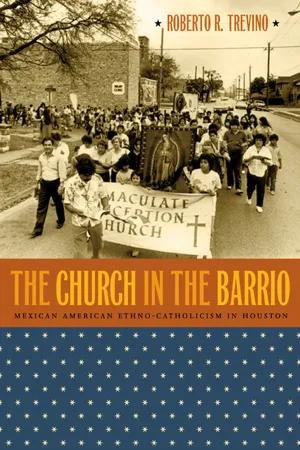
The Church in the Barrio
Mexican American Ethno-Catholicism in Houston
- 328 pages
- English
- ePUB (mobile friendly)
- Available on iOS & Android
eBook - ePub
About this book
Information
Topic
SozialwissenschaftenSubtopic
Nordamerikanische GeschichteChapter One
Tejano Catholicism
and Houston’s Mexican American Community
Tejano Catholicism
and Houston’s Mexican American Community
They started gathering at four in the morning at the rail depot where the nuns were supposed to depart. There were about 300 of them by nine o’clock, 300 angry Mexicans. They were furious at their bishop for not letting some refugee Sisters of Charity from Mexico stay and minister to their community in Brownsville. The nuns were badly needed, and the parishioners, though impoverished, were willing to help feed and house them. But the bishop refused, and he ordered the nuns to move along quickly. Incensed, the protesters’ numbers and passions quickly swelled. Three thousand strong, they made fiery speeches and unhitched and pulled away the rail car the sisters were going to board. ¡Que se vaya el obispo! yelled the crowd— Make the bishop go! ¡Fuera el obispo! they cried—Out with the bishop! The police were unable to control them. Desperate, the mayor appealed to the bishop to calm the crowd, but the bishop refused. He declined to face his parishioners—the “half-civilized Mexican greasers,” as he was wont to call them.1
This telling incident in Brownsville, Texas, in 1875 reveals important This telling incident in Brownsville, Texas, in 1875 reveals important elements that helped shape the lives of Mexican Catholics in Texas and elements that helped shape the lives of Mexican Catholics in Texas and the Southwest. In the nineteenth century and well into the twentieth, most Mexican Americans were both socially and religiously marginalized; they were, in the eyes of many Americans, a pariah community. The same was true in early twentieth-century Houston. There, parishioners considered themselves muy católicos, very Catholic, yet churchmen and Anglo society often held them in contempt. Over time, however, Mexican and Mexican American Catholics in the Bayou City shed much of their status as social outcasts and made strides toward greater participation in the city’s religious and civic life. How can we explain this? The answer to that question is the central story of this book, and to begin to answer it we must first understand the historical context in which that gradual transformation took place.
This chapter traces the history of Tejano Catholicism and the development of Houston’s Mexican community. It introduces the concept of Mexican American ethno-Catholicism: a home-and community-based faith that melded Spanish medieval Christianity and New World indigenous religion into a style of Roman Catholicism ambivalently tied to the formal church but inextricably fused with the people’s ethnic identity. This chapter, then, forms the backdrop for the remainder of the book, mapping the religious and historical landscape across which Mexican Catholics journeyed to forge a place for themselves in the Bayou City.
Católicos in a Changing Society
The antecedents of Tejano Catholicism and Houston’s Mexican community reach back to 1519, when Spanish explorers claimed the territory that later became Texas as part of Spain’s empire in the Americas. Spain never paid much attention to Texas because it lacked the glitter of the Aztec empire in central Mexico. Consequently, the scattered outposts of hardy soldiers, priests, and colonists who represented Spain’s tenuous claim to frontier Texas remained isolated from Spanish culture and institutions, separated by vast distances from the hub of colonial society in Mexico City and imbued with a spirit of independence.2 By the time Mexico broke from Spain in 1821, the Gulf Coast winds had long since swept away any trace of El Orcoquísac, a fort and mission complex that once stood some thirty-five miles east of present-day Houston. Spain lost Texas to Mexico but laid the foundation of Mexican and Mexican American Catholicism.3 In turn, Mexico lost Texas when a flood of illegal immigrants from the United States set the stage for the war of Texas independence, a revolution that the Texans won at the battle of San Jacinto in April 1836—in the swampy land that eventually developed into suburbs of the soon-to-be city of Houston.4
Seeking to protect its flock in the predominately Protestant Republic of Texas, the Vatican began paying more attention to this region by transferring administrative control of it from the northern Mexican Diocese of Linares to the Diocese of New Orleans in 1840. In 1847 Rome established the Diocese of Galveston, and in 1849 Bishop John M. Odin imported a small group of French missionaries, the Oblate Fathers of Mary Immaculate, to work among the Mexican population in Texas. The Oblates faced huge difficulties, given the enormity of the Galveston Diocese (which then comprised all of present-day Texas and some neighboring territories), their widely scattered parishioners, and a perennial shortage of clergy.5 Class differences, cultural animosities, and racism compounded these problems. Clerics steeped in European values and traditions directed the church’s work well into the twentieth century. Mostly French initially, some of these churchmen denigrated Mexicans and their brand of Catholicism. In deep South Texas, for instance, two highly placed clerics, Father Florent Vandenberghe and Father Dominic Manucy, dreaded having to work with destitute Mexican parishioners, preferring instead “civilized” people, that is, Americans and European immigrants—their racial and cultural cousins who gave them greater financial support.6 Clearly, the Catholic Church in Texas mirrored the racial hierarchies and social relations of the time, and, consequently, some of its policies helped propagate the social inequality that marked the lives of Mexicans and other people of color.
In the face of prejudice and neglect, Texas Mexicans developed an ambivalent relationship with the institutional church, alternately accepting and rejecting its requirements and ultimately interpreting and practicing their faith in ways that met their own needs. They had an unbounded reverence for Our Lady of Guadalupe and other saints and often expressed great respect for the priesthood. Mexicans followed the basic tenets of Roman Catholicism and faithfully observed traditional holy days, but they also ignored some requirements, such as marrying within the church. And they clung to unsanctioned traditions such as home altar worship, a custom that bypassed the institutional church by personally invoking the intercession of saints. In the eyes of most churchmen, Mexicans were not good mass-and-sacraments Catholics; clergymen often criticized their sporadic church attendance and chafed at their “indifference” toward the sacraments. On the other hand, priests noted how scrupulously Mexicans attended to particular rituals, especially baptism and confirmation. Tejanas and Tejanos were ignorant about doctrine, reports claimed, but they displayed great reverence for certain aspects of the faith; they saw themselves as “good” Catholics, while church leaders often viewed them as “bad” ones.7
Ethnic animosity and class and cultural barriers partly explain these polar views, but they also stemmed from the distinct histories of Latin American and U.S. Catholicism. The Catholicism Spain brought to the Americas in 1492 was actually medieval Christianity, the religion shared by western Europeans before Martin Luther’s Reformation split them into warring factions of Protestants and Catholics in 1517. In what is now central Mexico, conquered indigenous peoples syncretized the old Spanish medieval Christianity with their own religions, giving rise to a distinct “Mexican” Catholicism. Somewhat later in Europe—after the Columbian voyages and the Protestant Reformation—a new form of Catholicism began to develop as a result of the Council of Trent (1545– 63). Often called the Counter-Reformation, the Catholic reform and revitalization movement that began at Trent led to the rise of “Tridentine” Catholicism (derived from Tridentum, Latin for the city of Trent, Italy). This new style of Roman Catholicism—a modernized and intellectualized version of the old medieval Christianity—spread throughout northern and western Europe. Later it came with the British to North America, where eventually it would confront the old medieval Christianity—or “pre-Tridentine” Catholicism—the Spanish had brought earlier.
These two Catholic traditions differed in important ways. Tridentine Catholicism emphasized doctrinal knowledge and decorum over emotional display; required strict church attendance and adherence to church-approved practices; and tended to separate the sacred from the secular and “real” religion from superstition or other popular religious customs that the church hierarchy regarded as inferior “folk” Catholicism. In contrast, Catholicism in New Spain (Mexico) remained essentially pre-Tridentine, flavored by the Mesoamerican religious world-view with which it blended during the initial Spanish conquest and evangelization. This way of being Catholic embraced the permeability of the spiritual and material realms—religion, superstition, and magic all overlapped in daily life. Pre-Tridentine Catholics worried little about the nuances of theology or the issue of decorum in worship, finding in pilgrimages, saint veneration, and feasts ample outlets for their fervent religious expression and celebration. This outlook typified fifteenth-and sixteenth-century European Christians, most of whom “were still viewing life through a Medieval prism, possessing a worldview that knew no separation between religion and society. . . . The two realms were interwoven in such a way that it was unthinkable to distinguish the sacred from the secular, to separate religion from the activities of daily life.”8
Over time this pre-Tridentine way of being Catholic spread northward from central Mexico to the Spanish northern provinces (present-day Texas and the Southwest). There, during centuries of frontier isolation, it became the Spanish/Mexican cultural core, permeating and integrating all aspects of Tejano life and becoming intimately tied to the people’s very identity—it became Tejano ethno-Catholicism. This was the religious and cultural world of Texas Mexicans when, after the Mexican-American War of 1846–48, they suddenly found themselves under the critical eye of a more modernized Roman Catholic Church of the United States.
Anxious to find its niche in a Protestant nation, the Catholic Church supported the U.S. takeover of the Southwest and portrayed the Mexican Catholicism it encountered there as an embarrassing anachronism. All of this did not augur well for Texas Mexicans, a mestizo (mixed-race) people who followed a religious tradition loathed by their conquerors.9 Nonetheless, nineteenth-century Mexican American Catholics made sense of their lives through their ethnoreligion:
By taking those beliefs and practices from Catholicism that fit into their life as poor and oppressed folk, Tejanos continued syncretizing old religious world views. While seemingly backward and superstitious at times, their religion rejected the lessons of passivity and resignation historically inculcated into dependent classes by institutional Catholicism. . . . Instead, their religion . . . gave them a vital insight into life, one which . . . played a crucial role in perpetuating the conditions of normalcy in Tejano homes. It was what permitted them to go on searching for an improved economic, social, and political life.10
Texas Mexicans held tenaciously to their own brand of Catholicism because it suited their particular spiritual needs and helped them deal with their social subordination. “By taking refuge in this religious world . . . [Mexican Catholics] were also preserving one of the most important roots of their cultural identity.” Catholic lay societies also reinforced a sense of peoplehood. By creating and controlling these institutions themselves, Mexicans expressed their independence from the clergy and strengthened their communities.11 A form of cultural resistance, ethno-Catholicism gave Tejanos the self-respect and confidence with which to cope with material deprivation and social marginality; it served them well despite the disdain with which much of the modern Catholic leadership and society viewed it in the nineteenth century.
As the twentieth century dawned, Spanish priests increasingly replaced the French missionaries who had predominated in the work among Texas Mexicans.12 But, although they could at least communicate with their parishioners, Spaniards often proved to be as condescending toward Mexicans as their predecessors, and an icy gap separated them from their charges.13 Nuns and priests fleeing the dislocations of the Mexican Revolution of 1910 augmented the work of the Spanish clergy in Texas during the early twentieth century. The church set up “Mexican” churches, clinics, and other facilities so as not to offend Anglos accustomed to separation of the races.14 Thus both immigrant and native-born Mexicans had long been social and religious outsiders in the eyes of many Americans when Houston’s colonia (community) began to form.
Mexicans in the Bayou City:
Beginnings, 1836–1930
Beginnings, 1836–1930
In August 1836, John and Augustus Allen mapped and began selling land in a speculative town they named Houston, in honor of the hero of Texas independence, General Sam Houston. The creation of the Allen brothers’ masterful boosterism, the new town began inauspiciously on the mosquito-and snake-infested banks of Buffalo Bayou, only twenty miles from the site where Texas independence had been won scarcely four months before.15 There was a Mexican presence in Houston from the city’s very beginning, albeit involuntary. Alongside slaves, Mexican prisoners of war cleared and drained the swampy land on which Houston was built, and local officials parceled out some 100 prisoners as servants in the city between 1836 and 1839.16
Apparently, few Mexicans lived in Houston during most of the nineteenth century. Mexican immigrants were not drawn as much to the East Texas region around Houston as they were to El Paso, San Antonio, and the Rio Grande Valley, places with large and long-established Mexican populations. East Texas Anglo communities steeped in Deep South traditions preferred white and Negro sharecroppers; they made it clear that Mexicans were not welcome.17 Consequently, Mexicans were almost invisible in Houston during most of the nineteenth century. Census counts listed only six to eighteen individuals in the city at various times between 1850 and 1880.18
Meanwhile, in the last three decades of the nineteenth century, far-reaching changes unfolded in Mexico and the American Southwest that would steadily draw more Mexicans and Mexican Americans into Houston. The 1870s saw the beginning of intensive industrialization in Texas and the Southwest, as well as in Mexico under the dictatorship of President Porfirio Díaz, in ways that complemented both regions. In the headlong rush to modernization, the expansion of railroads throughout the Southwest and into northern and central Mexico proved pivotal by interlocking the regions’ economies and people. The c...
Table of contents
- Table of Contents
- Title Page
- Copyright Page
- Illustrations
- Preface
- Introduction
- Chapter One. Tejano Catholicism and Houston’s Mexican American Community
- Chapter Two. Ethno-Catholicism: Empowerment and Way of Life
- Chapter Three. The Poor Mexican: Church Perceptions of Texas Mexicans
- Chapter Four. Answering the Call of the People: Patterns of Institutional Growth
- Chapter Five. In Their Own Way: Parish Funding and Ethnic Identity
- Chapter Six. The Church in the Barrio: The Evolution of Catholic Social Action
- Chapter Seven. Faith and Justice: The Church and the Chicano Movement
- Epilogue
- Appendix
- Notes
- Bibliography
Trusted by 375,005 students
Access to over 1.5 million titles for a fair monthly price.
Study more efficiently using our study tools.
Frequently asked questions
Yes, you can cancel anytime from the Subscription tab in your account settings on the Perlego website. Your subscription will stay active until the end of your current billing period. Learn how to cancel your subscription
No, books cannot be downloaded as external files, such as PDFs, for use outside of Perlego. However, you can download books within the Perlego app for offline reading on mobile or tablet. Learn how to download books offline
Perlego offers two plans: Essential and Complete
- Essential is ideal for learners and professionals who enjoy exploring a wide range of subjects. Access the Essential Library with 800,000+ trusted titles and best-sellers across business, personal growth, and the humanities. Includes unlimited reading time and Standard Read Aloud voice.
- Complete: Perfect for advanced learners and researchers needing full, unrestricted access. Unlock 1.5M+ books across hundreds of subjects, including academic and specialized titles. The Complete Plan also includes advanced features like Premium Read Aloud and Research Assistant.
We are an online textbook subscription service, where you can get access to an entire online library for less than the price of a single book per month. With over 1.5 million books across 990+ topics, we’ve got you covered! Learn about our mission
Look out for the read-aloud symbol on your next book to see if you can listen to it. The read-aloud tool reads text aloud for you, highlighting the text as it is being read. You can pause it, speed it up and slow it down. Learn more about Read Aloud
Yes! You can use the Perlego app on both iOS and Android devices to read anytime, anywhere — even offline. Perfect for commutes or when you’re on the go.
Please note we cannot support devices running on iOS 13 and Android 7 or earlier. Learn more about using the app
Please note we cannot support devices running on iOS 13 and Android 7 or earlier. Learn more about using the app
Yes, you can access The Church in the Barrio by Roberto R. Treviño in PDF and/or ePUB format, as well as other popular books in Sozialwissenschaften & Nordamerikanische Geschichte. We have over 1.5 million books available in our catalogue for you to explore.