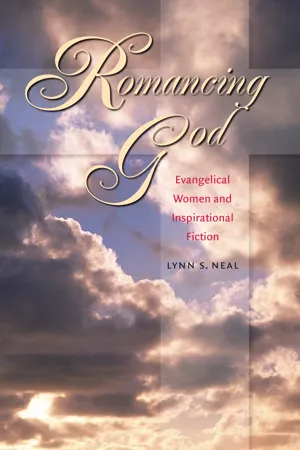
In the world of the evangelical romance novel, sex and desire are mitigated by an omnipresent third party — the divine. Thus romance is not just an encounter between lovers, but a triangle of affection: man, woman, and God. Although this literature is often disparaged by scholars and pastors alike, inspirational fiction plays a unique and important role in the religious lives of many evangelical women. In an engaging study of why women read evangelical romance novels, Lynn S. Neal interviews writers and readers of the genre and finds a complex religious piety among ordinary people.
In evangelical love stories, the success of the hero and heroine’s romance rests upon their religious choices. These fictional religious choices, readers report, often inspire real spiritual change in their own lives. Amidst the demands of daily life or during a challenge to one’s faith, these books offer a respite from problems and a time for fun, but they also provide a means to cultivate piety and to appreciate the unconditional power of God’s love. The reading of inspirational fiction emerges from and reinforces an evangelical lifestyle, Neal argues, but women’s interpretations of the stories demonstrate the constant negotiations that characterize evangelical living. Neal’s study of religion in practice highlights evangelicalism’s aesthetic sensibility and helps to alter conventional understandings — both secular and religious — of this prominent subculture.
- 264 pages
- English
- ePUB (mobile friendly)
- Available on iOS & Android
eBook - ePub
About this book
Information
Chapter 1: The History of Evangelical Romance
“But your people, Jean?”
“My people all love you and honor you,” said Jean, with shining eyes. “They think you are magnificent! They cannot say enough about you. But, Jasper, listen, if every one in this wide world were against you, even my dear people, I should marry you anyway and stay with you! I couldn’t live any longer without you!”
He looked into her eyes, and he drank in her trust and loveliness, and beautiful self-surrender as if it had been some life-giving draught; then he laid his hand upon her hair and pressed her closer to him.
“Oh, you wonderful woman!” he said.
So when it was announced most informally that a wedding would take place no one was surprised. Indeed, Jean’s girl friends had been embroidering and chattering away over wedding gifts for a week before it was whispered officially that they would be needed.
... It was sunset again, gold and ruby sunset, when they went home to his house, after the wedding supper. The sky was broad and clear translucent gold, with a deep heart of pure ruby blazing out behind the rose-wreathed cottage when Jean saw it for the first time. There alone at last together in their own home they stood with ruby and golden light from the sunset windows mingling with the soft flicker of fire light, and looked into each other’s eyes and knew that their heavenly Father had been good to them.1
In the closing scenes of Grace Livingston Hill’s The Finding of Jasper Holt, Jean and Jasper finally surmount the obstacles keeping them apart and marry, secure in their love and the love of God. Kept apart by Jasper’s bad reputation (largely undeserved) and Jean’s family, the couple reconciles in the last four pages of the novel. Having rescued Jean’s nephew from being trampled by a bull, Jasper sustains life-threatening injuries, but redeems himself in the eyes of Hawk Valley and Jean’s family. As Jean keeps vigil at his side, Jasper begins to recover and they affirm their love for each other. In the end, their faithfulness to God and each other is rewarded as they wed with the approval of family and friends. For Hill, a successful romance depended upon both hero and heroine having a personal relationship with God. Often viewed as a redeemed or baptized version of a secular romance novel, what is perhaps most surprising about this story is its original date of publication: 1915.
Finding Grace: Remembering the Evangelical Romance
Frequently overlooked in the annals of American Protestantism, the writing of Grace Livingston Hill (1865–1947) blends faith with fiction in ways that reflect aspects of a Protestant past while revealing glimpses of an evangelical future. Hill’s prolific writing and sales success exemplify evangelicalism’s long and intimate involvement with various media forms. Simultaneously, Hill’s work itself represents the offspring of this involvement—evangelical romance novels—and provides one of the reasons for its emergence as a genre in the late 1970s and early 1980s. Her combination of religion and romance illustrates how evangelical women have navigated the contested terrain of popular culture as creators of products, arbiters of taste, and makers of meaning.
Economic necessity and evangelical desire transformed Grace Livingston Hill from amateur writer into professional scribe. She enjoyed writing from an early age and found inspiration in her aunt Isabella Alden, who authored the “Chautauqua Girls” series. However, it was the deaths of Hill’s husband and father, combined with the need to support her family, that eventually provided the catalyst for her career. Having already authored poems, Sunday School lessons, and short stories, she then turned to her writing with clear goals for her literary future. Hill wanted to find an established company to market her work, an expert editor to improve her writing, and a respected publisher willing to include her salvation message. According to her grandson and biographer, Robert Munce, “At family prayer time each night, the family asked for guidance for Grace in her writing and in choosing a publisher.” Their prayers were answered in the form of J. B. Lippincott who began publishing Hill’s combination of “religious inspiration blended with boy-meets-girl romance” in 1908. Over the course of her life she wrote 105 novels, which are still published and read today. In 1946, interviewer James M. Neville wrote, “Mrs. Hill’s romances hold to a steady 16,000 copies. Her reprint sales are more than double that number, leading the field, according to a recent survey, with a total of 76 titles to date. Each reprint sells 33,000 copies, or more. She publishes three novels a year.”2
Like other Christian authors, Hill viewed her work as an extension of her religious life. She told Neville, “I have attempted to convey, in my own way, and through my novels, a message which God has given, and to convey that message with whatever abilities were given to me.” Crediting God with both her talent and her message, Hill felt obliged to use her skills and employed the romance formula as her evangelistic medium. For Grace Livingston Hill and other conservative Protestants, a God-given gift should not be ignored or disregarded, a belief drawn from interpretation of biblical passages such as Matthew 25, the parable of the talents. In this tale, the master entrusts three of his servants with talents or coins. Honoring their master, the first servant turns his five talents into ten and the second makes two into four. Both servants cared for and built on their gifts and were rewarded accordingly by their master. In contrast, the fearful third servant buried his one talent in the ground and returned it alone to his master. He hid his talent and as a result earned his master’s condemnation: expulsion to a place where tears fall and teeth gnash. Like the two loyal servants, Hill, a faithful steward of her abilities, honored her God and honed her gift through writing religious romance. For her and other evangelicals, the medium, be it romance or radio, remained neutral. The message conveyed shaped the artistic form into a force for good or ill. Implicitly, this attitude, exemplified in Hill’s interpretation of her vocation, exhibits a utilitarian attitude toward the arts— “the view,” according to J. I. Packer, “that the value of anything is to be found in the extent to which it is useful and productive as a means to an end beyond itself.” The end, for conservative Protestants, meant a Christian or more Christian life. Rejecting the notion of art for art’s sake, novels like The Finding of Jasper Holt served not the gods of literature, but rather, in Hill’s view, the God of life.3
Grace Livingston Hill’s goals reflected common evangelical ideas about the utility of media and the arts. Conservative Protestants had long used existing cultural forms and invented new genres in their efforts to evangelize the world. Media analyst Quentin Schultze states that “from the founding of the Plymouth colonies to the present, the United States has been an incredible laboratory in which evangelicals have been able to experiment with every imaginable form and medium of communication” and historian Leonard Sweet documents “evangelical mastery of the media” from the Great Awakening to Oral Roberts. In the mid-eighteenth century evangelicals established the first American religious periodical, Christian History, and revivalist George Whitefield helped create the “evangelical newspaper and magazine.” In the nineteenth century, technological developments made the printing of novels, newspapers, and magazines more affordable and accessible. With the increasing popularity of the printed word, evangelicals expanded their experiments with publishing. Recognizing the power of print while encountering texts that did not endorse their values or beliefs, evangelicals “entered the very market they feared, and in some ways they mastered it.” Fighting fire with fire, evangelicals established publishing houses, tract societies (most notably the American Tract Society) and became “key developers of new technologies of print.”4
Throughout this history, evangelistic intentions legitimized these media efforts and indeed became a criterion of evangelical aesthetic judgments. However, in the realm of fiction, literature and religion forged an uneasy alliance. Utilitarian concerns for evangelism governed evangelical literary efforts; nevertheless, even as they experimented with fiction’s redemptive possibilities, such fiction remained suspect. Unlike other types of media, novels directly juxtaposed the truth of Christianity with the falsehood of fiction. Departing from truth, unleashing the imagination, promoting idleness (and perhaps even idolatry), fiction was an unwieldy weapon at best in the war for lost souls. Leland Ryken, evangelical literary critic, states: “Christians have traditionally found it difficult to grant integrity to this world of the imagination and have responded in two directions. One tendency has been to discredit imagination and fantasy as being untruthful, frivolous, a waste of time, dangerous escapism and something to be left behind in childhood. The other tendency has been to suppress the imaginary element in literature and to act as if literature is a direct replica of life, in effect abolishing the world of the imagination and merging it with empirical reality.”5 Fears about fiction also reflected doubts about women. Their domination of novel reading raised concerns about the “nature” of woman and her ability to handle imaginative material. In her study The Woman Reader, 1837–1914, Kate Flint recounts, “First, the argument ran, certain texts might corrupt her innocent mind, hence diminishing her value as a woman. Second, it was often put forward that she, as woman, was peculiarly susceptible to emotionally provocative material.” Flint cites warnings written as far back as 1566 about women reading romance novels and demonstrates how “these Renaissance prescriptive remarks concerning women’s reading were remarkably close, in outline, to ones which were repeated during the next three centuries.”6 Despite anxiety about both fiction and women, for some in the early and mid-nineteenth century, evangelistic potential trumped these fears. They began to claim imaginative literature as a vehicle for religious instruction and “the reading of novels crept gradually into the range of permitted activities because the content of many of them indicated the market could be made to respond to moral concerns.”7
This acceptance occurred, in part, through the work of female authors, including Susan Warner, Harriet Beecher Stowe, and E. D. E. N. Southworth. Many scholars have excavated the importance of this literature. Studies range from examining how these nineteenth-century authors and characters subverted gender roles to analyses of the opposition between women’s “sentimental” fiction and men’s “literary” fiction. Fewer treatments explore the relationship between this literature and its contemporary counterparts, a relationship that constitutes an important element in the emergence of evangelical romance novels. Drawing on domestic ideology, which touted the power of women’s pious influence in the home and in the world, and an evangelical aesthetic, which legitimated fiction through its faith-based message, nineteenth-century women like Stowe and Warner forged simultaneous literary careers and Christian ministries. They wrote, according to literary scholar Jane Tompkins, “for edification’s sake,” and “the highest function of any art, for Warner as for most of her contemporaries, was the bringing of souls to Christ.” To achieve this, they composed sentimental novels for and about women that celebrated conservative Protestant piety as well as love and the home. As Mary Kelly notes of the authors and their subsequent work, “their perspective was private and familial, their allegiance was to the domestic sphere,” and they were, Nina Baym adds, “profoundly oriented toward women.”8 While romance did not always drive these nineteenth-century plots, it often remained an integral part of the story. In Uncle Tom’s Cabin, Stowe narrates the love between George and Eliza and their eventual triumph in establishing a free Christian family. The Minister’s Wooing even more explicitly celebrates romantic love with the story of James and Mary, and Susan Warner’s best-selling Wide, Wide World emphasizes Ellen’s love with John as well as her growth in Christianity.9
Even as sentimental fiction declined in popularity in the late nineteenth century, Hill built on this foundation as she constructed her vision of the Christian romance. Indeed both evangelical and secular romances trace their lineage back to these nineteenth-century novels. In Fantasy and Reconciliation, Kay Mussell proposes that “today, romance formulas differ from their eighteenth- and nineteenth-century predecessors because each era finds its own models for the familiar tale; and yet the fictional world they describe remains remarkably unchanged over time.” The works of each “era,” past and present, center around “the course and culmination of one woman’s love story” or, as another scholar put it, “the formation and assertion of feminine ego.”10 However, only Grace Livingston Hill and the subsequent evangelical romance preserved the nineteenth-century emphasis on God and Protestant faith. Like those from earlier novels, Hill’s heroines radiate evangelical purity and piety—the hallmarks of domestic ideology—but romance drives the plot as her heroes respond immediately to this feminine influence. For example, upon first seeing Jean, in The Finding of Jasper Holt, Jasper thinks: “She was the sudden startling revelation of some pure dream of his childhood, the reality of which he had come to doubt.” The description continues, “Her face was wonderfully pure, free from self-consciousness and pride, yet she looked as if she knew her own mind and could stand like a rock for a principle.” This purity and steadfastness inspires Jasper Holt to convert and live a life worthy of Jean’s love.11
At the same time that Hill drew on the past to augment her literary success, conservative Protestantism looked to an uncertain future. Foes, in the form of “higher criticism” and Darwinism, forced evangelicals to define and defend the fundamentals of their faith. Gender norms and popular culture provided the battlegrounds for this emerging conflict. Even as these “militantly anti-modernist Protestant evangelicals” —to quote historian George Marsden—upheld Victorian gender ideology, they sought to diminish women’s power in the church and discredit the dominance of their emotional piety. In this war with modernism, the emerging voice of fundamentalists “promoted a manly Christianity to replace the perspective and practices of feminized evangelical Protestantism.” Armed with the doctrines of biblical inerrancy and premillennial dispensationalism, conservative Protestants shifted the focus of faith from women to men, and from heart to head. Deeming women’s faith too emotional and unintellectual, this militant and manly Christianity sought respectability even as it retreated from previous ways of engaging with “the world.”12
After 1925, as many scholars have documented, the once prominent and respected evangelicals became the parochial and ridiculed fundamentalists. They built their own institutions—publishing houses, Bible institutes, and Christian colleges—and created, according to Joel Carpenter, “a distinct religious movement,” one concerned about women and wary of the arts. “Fundamentalists of the first half of our century,” argues Roger Lundin, “wrote almost no essays of significance on the arts. When the arts are mentioned in fundamentalist works, either their value or their use is called into question.”13 During this period of retreat and regrouping, the “material Christianity” so pervasive in the previous century became a liability. Colleen McDannell writes, “What in the nineteenth century was considered tasteful and pious, in the twentieth came to be seen as tacky and irreligious.” Associated with women, owning Christian things signaled a believer’s weakness, and perhaps even her worldliness.14 Advocating “muscular Christianity” and a “Christ against culture” position, fundamentalists became increasingly suspicious of women, fiction, and the arts in general. Grace Livingston Hill, however, while remaining a committed conservative Protestant, continued to write her brand of fiction. Evangelistic goals and her call from God superseded fundamentalist fears.
Hill honed the evangelical romance formula, boy plus girl plus conservative Protestant Christianity equals a happy marriage, and navigated her way through the less-than-hospitable waters of the era. In writing salvation into her stories, Hill’s work complied with the demands for evangelism. However, her novels contained elements of the formulaic feminized faith that made fundamentalists afraid for their masculinity and modernists anxious for the arts. Her emphasis on women’s faith challenged the rise of a more manly Protestan...
Table of contents
- Cover Page
- Romancing God Evangelical Women and Inspirational Fiction
- Copyright Page
- Dedication
- Contents
- Illustrations
- Acknowledgments
- Prologue
- Chapter 1: The History of Evangelical Romance
- Chapter 2: The Discipline of Fun
- Chapter 3: The Evaluation of Romance
- Chapter 4: The Ministry of Romantic Fiction
- Chapter 5: The Fashioning of Faith
- Chapter 6: The Romance of God
- Epilogue
- Notes
- Bibliography
- Index
Trusted by 375,005 students
Access to over 1.5 million titles for a fair monthly price.
Study more efficiently using our study tools.
Frequently asked questions
Yes, you can cancel anytime from the Subscription tab in your account settings on the Perlego website. Your subscription will stay active until the end of your current billing period. Learn how to cancel your subscription
No, books cannot be downloaded as external files, such as PDFs, for use outside of Perlego. However, you can download books within the Perlego app for offline reading on mobile or tablet. Learn how to download books offline
We are an online textbook subscription service, where you can get access to an entire online library for less than the price of a single book per month. With over 1.5 million books across 990+ topics, we’ve got you covered! Learn about our mission
Look out for the read-aloud symbol on your next book to see if you can listen to it. The read-aloud tool reads text aloud for you, highlighting the text as it is being read. You can pause it, speed it up and slow it down. Learn more about Read Aloud
Yes! You can use the Perlego app on both iOS and Android devices to read anytime, anywhere — even offline. Perfect for commutes or when you’re on the go.
Please note we cannot support devices running on iOS 13 and Android 7 or earlier. Learn more about using the app
Please note we cannot support devices running on iOS 13 and Android 7 or earlier. Learn more about using the app
Yes, you can access Romancing God by Lynn S. Neal in PDF and/or ePUB format, as well as other popular books in Theology & Religion & Literature & the Arts in Christianity. We have over 1.5 million books available in our catalogue for you to explore.