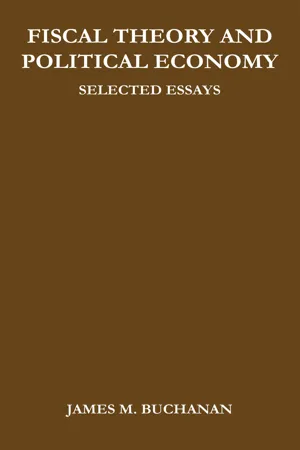
This important collection of eight interrelated essays fills a gap in English-language literature in public finance and fiscal theory. The author consistently emphasizes the central role of collective decision making in fiscal theories as well as the methodological setting in which positive proportions in fiscal theory must be developed.
Originally published in 1960.
A UNC Press Enduring Edition -- UNC Press Enduring Editions use the latest in digital technology to make available again books from our distinguished backlist that were previously out of print. These editions are published unaltered from the original, and are presented in affordable paperback formats, bringing readers both historical and cultural value.
- 200 pages
- English
- ePUB (mobile friendly)
- Available on iOS & Android
eBook - ePub
About this book
Information
II: “LA SCIENZA DELLE FINANZE”: THE ITALIAN TRADITION IN FISCAL THEORY*
I. INTRODUCTION
Now that the important early Swedish contributions on monetary and cycle theory have been made available, it may be asserted that the single most important national body of doctrine which remains largely unknown to and unappreciated by English language economists is the Italian work in fiscal theory. The linguistic barrier has served effectively to prevent the dissemination of the Italian contribution in this area of applied economics, an area which has been an Italian speciality for at least a century. The only book which has been translated is De Viti De Marco, First Principles of Public Finance.1 While this book is perhaps the most outstanding single work, its contribution cannot readily be appreciated by those not familiar with the Italian tradition. This explains the extremely divergent reactions of Henry Simons and F. C. Benham to the book, Simons calling it a “monument to confusion,” while Benham was acclaiming it as the best book ever written in public finance.2
A whole body of doctrine, extending over a hundred years and including literally hundreds of contributions by scores of scholars, cannot adequately be summarized and critically discussed in a single essay. In spite of this, I shall attempt in this paper to sketch the broad outlines of the Italian tradition, to isolate a few of the important contributions, and to relate these to the present state of fiscal theory.
PROCEDURE
I shall limit my discussion largely to what may properly be called the “classical” Italian tradition in public finance theory. Chronologically, this covers approximately a sixty-year period extending from 1880 to 1940. With the exception of the work of Francesco Ferrara, which is extremely important, although its influence was exerted in an indirect way, I shall not consider precursors of the main figures in Italian thought. I shall not discuss contemporary works of the post World War II period except in so far as these may serve to clarify older contributions and controversies.
After a brief survey of the institutional setting of Italian public finance, I shall first attempt to identify some of the background factors which appear to have exerted some influence on the main Italian ideas and to have produced certain general characteristics in Italian thought. There follows an effort at classifying the Italian works into two broad categories, a classification which is necessarily somewhat incomplete. The second half of the paper begins with the discussion of what I consider to be the important contributions of the Italians. Properly following this, I shall conclude with a summary comparison of the Italian with the Anglo-Saxon tradition.
THE INSTITUTIONAL SETTING
Contrary to the conventional practice in England and the United States, the study of public finance in Italy is an independent branch of scholarship. It does not comprise a part of the economics curriculum in the universities; it has a separate curriculum and a separate existence all its own. Normally it is taught and discussed as the science of finance and financial law. Political and legal aspects of finance have been considered integral parts of the discipline, equally important with the economic aspects.
This status has not been entirely a happy one. The doctrinal independence of public finance has been attacked and defended in a continuing controversy. One group, represented by the late Professor Benvenuto Griziotti, has defended the separateness of public finance on the basis of the subject matter. This position follows the Germanic tradition of “Staatswissenschaft.” In this view, finance should be studied in its total setting which includes the legal, political, administrative, and economic aspects. These various disciplines are included insofar as they are relevant to the consideration of problems of financing state services. The approach taken by this group has something in common with the American institutionalists, notably with the position of Commons.
The opposing group has tried to emphasize the economic approach to state fiscal activity. While this attitude admits differentiation in the subject of study, it holds that the fundamental distinction should be in method. The importance of the non-economic aspects of fiscal problems is not denied; but proponents of this view are willing to allow these to be considered by non-economists.
The whole controversy over the independence of finance as a separate branch of scholarship has contained much that is sterile. The controversy has, however, served to emphasize certain methodological issues which have been neglected or glossed over in the English-language tradition. These will be discussed in some detail at a later point. But perhaps the most important influence of the doctrinal independence itself has been that public finance, as a branch of scholarship, has attracted many of the better scholars. The science of finance has probably been even more widely respected than general economic theory, and the best Italian economists have felt themselves compelled to do some work in the field. With the single exception of Pareto, who was not without major influence although he was not a direct contributor, all of the outstanding Italian economists have devoted some time to finance theory.
A disadvantage of the doctrinal independence has been that an excessive amount of work has been done in this field relative to others. Although there probably exist external economies to scholarly research in the specific sub-branches of economics, surely the Italians have, in many cases, gone beyond the limits of the full exploitation of such economies. But having established chairs in public finance at many institutions, and having a literal “publish or perish” rule for selection and promotion, Italian scholars have been sometimes forced into relatively unproductive work.
II. BACKGROUND INFLUENCES
FERRARA AND THE CLASSICAL ECONOMICS
The influence of classical economics upon Italian fiscal thought cannot be separated from that of Francesco Ferrara. The important classical writings were made available to Italian scholars in translation in the 1850’s through the famous series, Biblioteca dell economista. Ferrara selected the works to be translated, supervised the translations, and himself wrote lengthy prefaces to the individual selections. In these prefaces, as in his courses of lectures, Ferrara was intensely critical of many aspects of classical thought. On the whole, his criticisms are excellent by modern criteria, and he anticipated many of the neo-classical contributions. He anticipated, and in some respects surpassed, the subjective-value theorists. He was forceful in his emphasis that value theory must be based on individual behavior, his whole construction departing from what he called “the economic action,” the author of such action being the individual who feels, thinks, and wants. The classicists were criticized for their attempts to construct an objective theory of value, and Ferrara was perhaps the first economist completely to shed all of the mercantilist trappings in his rejection of economics as the science of wealth. Value was determined by both utility and cost, with exchange value representing a comparison of these two forces. As a single principle, he developed the idea of the cost of reproduction as a measure of value, meaning by this the cost which would have to be incurred if the unit in question were to be reproduced. This principle was extended to apply to goods and services which were not physically reproducible by the introduction of the idea that it is the utility produced by the good, not the good itself, which determines value. Ferrara does not appear to have explicitly discussed diminishing marginal utility as such, although its acceptance is clearly present in his work, as Pareto recognized.3
The Physiocratic and classical distinction between productive and unproductive labor was all but demolished by Ferrara. In very persuasive fashion, he showed that the particular form of a good is unimportant, and that immaterial goods or services are equally valuable with material goods. He also rejected the Ricardian rent theory on the basis of a surprisingly modern argument. The idea of differential rent is held to be an undesirable and incorrect heritage of the Physiocratic concept of net product. Rent, or net product, is held to accrue to all factors, not to land alone, and rent, as a distributional share, is attributed to the superior productivity of the productive inputs which receive it.
With this general approach to economic theory, Ferrara was able to reach a profoundly different conception of fiscal activity from that reached by the English classical economists or implied in their works. First of all, he recognizes that social or collective action as well as individual action must be based on individual choice. The state is conceived ideally as a natural outgrowth of the division of labor, and the government is considered as a “producer” of such services as justice, defense, etc. .. . In its pure form, the tax is held to be a payment for such state-supplied services which provide positive utility to the individual.4 The expenditure for these public services may be as productive as that for private goods and services. In this recognition of the tax as a price and of the productivity of public services, the foundation stone for the whole Italian fiscal tradition is laid. The whole of society enjoys the fruits of state services; specific mention is made of schools, port facilities, roads, asylums, and hospitals. It is to the advantage of each citizen to cede a portion of his private goods to the state in exchange for such services.
This broad view of the fiscal process might suggest that Ferrara was less libertarian than the English classicists. Such is, however, not the case. The “economic” conception of fiscal activity was, to Ferrara, an ideal. In the actual state of the world, Ferrara considered that the levy of taxes tended to be oppressive and constituted the “great secret through which tyranny is organized.” Although his analysis is not developed in terms of the specific contrast, Ferrara’s distinction between the philosophical or “economic” concept of fiscal activity and the historical or “oppressive” concept may also be considered as an early statement of the more refined distinctions which were later to be very important in Italian fiscal thought.5
Although recognizing that public services may be productive, Ferrara was intensely critical of the view, which had been expressed by German writers, that merely because tax revenues are transformed into public spending and are returned to the economy, society does not undergo a net loss. He emphasized the necessity for spending the tax proceeds productively, and he constantly referred to the required comparison between utility and cost.6 The tax is the instrument by which the consumption of one type of good (public) comes to be substituted for another (private). The test of efficiency is always to be found in a comparison of these two consumptions.
Interestingly, Ferrara’s influence on the development of Italian fiscal thought appears to have been rather indirect. Until the publication of his lectures in 1934, Italian scholars made little reference to his works. Yet the similarity between the basic conceptual framework developed by Ferrara and the subsequent development in Italy suggests that his ideas were instrumental. The explanation is probably provided in the direct influence which Ferrara exerted on the thinking of the early writers, notably Pantaleoni and, through him, on De Viti De Marco. Thus it came to be that subsequent Italian scholars looked to Pantaleoni and De Viti as the sources of their discipline, only to awaken in the 1930’s to find that Ferrara had been the genuine fountainhead of ideas.
Regardless of the means through which they were transmitted, Ferrara’s ideas muted the impact of the classical implications at precisely those points where these implications could bear on fiscal theory. In Anglo-Saxon fiscal thought, this sort of influence has been absent. Here is explained, at least in part, several important differences in the two developing bodies of fiscal doctrine.7 It explains why the Italians have from the beginning recognized the spendings side of the fiscal account as an integral part of fiscal activity, whereas, even today, this has not yet been fully incorporated into the English tradition. As a corollary to this, the greater Anglo-Saxon emphasis on sacrifice theories of taxation is more readily understandable. The concept of net sacrifice as a result of the fiscal process has been almost completely absent from Italian works. The Ferrarían influence also explains why the single tax has had little support in Italy.
THE THEORY OF UTILITY
While the Ferrarían model was influential in taking some of the rougher edges off classical economics, it was equally important through its positive contribution in preparing the groundwork for a ready acceptance of the subjective-value approach and the theory of marginal utility. And it is only after Ferrara’s major work was completed, and also after the subjective-value decade of the 1870’s, that Italian fiscal theory emerged in its fullest sense. The origins of “classical” Italian theory, represented in the works of Pantaleoni and De Viti De Marco, appeared in 1883 and 1888 respectively. These represent attempts to apply the theory of marginal utility to the activity of the public entity. While this attempt to explain state action in terms of the marginal calculus was but natural to the Italian familiar with Ferrara’s works, it was foreign and unnatural to the Englishman or the American imbued with Ricardo’s principles, and therefore was never carried out.
Interestingly, Pantaleoni first applied the marginal calculus to the theory of public expenditure rather than the theory of taxation. He tried to construct a theory of public spending analogous to the theory of consumption for the individual with the decision-maker being the average or representative member of the legislative assembly. Public revenues were to be distributed among the various possible employments so as to equalize the marginal yields from equivalent units in the minds of the average legislator.
De Viti was more ambitious. He attempted to show that an “economic” theory of the whole fiscal process could be developed. His fundemental early work, Il carratere teorico del’ economia finanzictria (1888), was conceived independently of the work of Emil Sax which appeared in Austria one year earlier and it is, in many respects, vastly superior to the Sax effort. The stated purpose of De Viti’s monograph is that of extending the principles of theoretical economics to fiscal activity. The extension is accomplished by accepting the state as the subject for study in lieu of the individual. The task of the economist is held to be that of studying the behavior of the state in fulfilling its tasks, not that of determining the ends of state activity. While the motives for state action may be different from those of individual action, the overriding principle remains that of “minimum means,” and, on this principle, De Viti tried to erect his theory. Public activty is held to be eminently productive, and it serves to satisfy collective needs. But the production of public services is costly, and there is required a comparison of satisfaction and cost; this comparison is the essence of the financial calculus.
THE THEORY OF GENERAL EQUILIBRIUM
With the work of Pantaleoni and De Viti De Marco in the 1880’s, Italian fiscal theory achieved an indep...
Table of contents
- Cover Page
- Fiscal Theory and Political Economy
- Copyright Page
- Dedication
- ACKNOWLEDGMENTS
- CONTENTS
- INTRODUCTION
- I: THE PURE THEORY OF GOVERNMENT FINANCE: A SUGGESTED APPROACH*
- II: “LA SCIENZA DELLE FINANZE”: THE ITALIAN TRADITION IN FISCAL THEORY*
- III: SOCIAL CHOICE, DEMOCRACY, AND FREE MARKETS*
- IV: INDIVIDUAL CHOICE IN VOTING AND THE MARKET*
- V: POSITIVE ECONOMICS, WELFARE ECONOMICS, AND POLITICAL ECONOMY*
- VI: THE METHODOLOGY OF INCIDENCE THEORY: A CRITICAL REVIEW OF SOME RECENT CONTRIBUTIONS*
- VII: COMPARATIVE TAX ANALYSIS AND ECONOMIC METHODOLOGY*
- VIII: FEDERALISM AND FISCAL EQUITY*
- INDEX OF AUTHORS
- INDEX OF SUBJECTS
Trusted by 375,005 students
Access to over 1.5 million titles for a fair monthly price.
Study more efficiently using our study tools.
Frequently asked questions
Yes, you can cancel anytime from the Subscription tab in your account settings on the Perlego website. Your subscription will stay active until the end of your current billing period. Learn how to cancel your subscription
No, books cannot be downloaded as external files, such as PDFs, for use outside of Perlego. However, you can download books within the Perlego app for offline reading on mobile or tablet. Learn how to download books offline
Perlego offers two plans: Essential and Complete
- Essential is ideal for learners and professionals who enjoy exploring a wide range of subjects. Access the Essential Library with 800,000+ trusted titles and best-sellers across business, personal growth, and the humanities. Includes unlimited reading time and Standard Read Aloud voice.
- Complete: Perfect for advanced learners and researchers needing full, unrestricted access. Unlock 1.5M+ books across hundreds of subjects, including academic and specialized titles. The Complete Plan also includes advanced features like Premium Read Aloud and Research Assistant.
We are an online textbook subscription service, where you can get access to an entire online library for less than the price of a single book per month. With over 1.5 million books across 990+ topics, we’ve got you covered! Learn about our mission
Look out for the read-aloud symbol on your next book to see if you can listen to it. The read-aloud tool reads text aloud for you, highlighting the text as it is being read. You can pause it, speed it up and slow it down. Learn more about Read Aloud
Yes! You can use the Perlego app on both iOS and Android devices to read anytime, anywhere — even offline. Perfect for commutes or when you’re on the go.
Please note we cannot support devices running on iOS 13 and Android 7 or earlier. Learn more about using the app
Please note we cannot support devices running on iOS 13 and Android 7 or earlier. Learn more about using the app
Yes, you can access Fiscal Theory and Political Economy by James M. Buchanan in PDF and/or ePUB format, as well as other popular books in Business & Business General. We have over 1.5 million books available in our catalogue for you to explore.