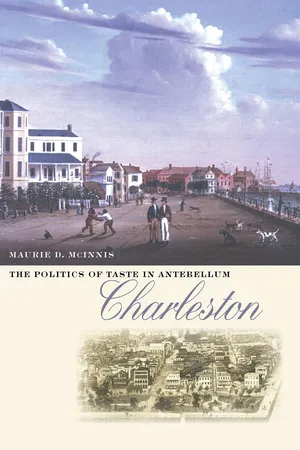
At the close of the American Revolution, Charleston, South Carolina, was the wealthiest city in the new nation, with the highest per-capita wealth among whites and the largest number of enslaved residents. Maurie D. McInnis explores the social, political, and material culture of the city to learn how--and at what human cost--Charleston came to be regarded as one of the most refined cities in antebellum America. While other cities embraced a culture of democracy and egalitarianism, wealthy Charlestonians cherished English notions of aristocracy and refinement, defending slavery as a social good and encouraging the growth of southern nationalism. Members of the city's merchant-planter class held tight to the belief that the clothes they wore, the manners they adopted, and the ways they designed house lots and laid out city streets helped secure their place in social hierarchies of class and race. This pursuit of refinement, McInnis demonstrates, was bound up with their determined efforts to control the city's African American majority. She then examines slave dress, mobility, work spaces, and leisure activities to understand how Charleston slaves negotiated their lives among the whites they served. The textures of lives lived in houses, yards, streets, and public spaces come into dramatic focus in this lavishly illustrated portrait of antebellum Charleston. McInnis's innovative history of the city combines the aspirations of its would-be nobility, the labors of the African slaves who built and tended the town, and the ambitions of its architects, painters, writers, and civic promoters.
- 408 pages
- English
- PDF
- Available on iOS & Android
eBook - PDF
The Politics of Taste in Antebellum Charleston
About this book
Information
Topic
ArchitectureSubtopic
History of ArchitectureTable of contents
- Contents
- Acknowledgments
- Introduction
- 1 A Bird’s-Eye View
- 2 A Walking Tour
- 3 The Public Landscape of Racial Control
- 4 Temples for Posterity
- 5 Public Art and Politics
- 6 Ordering the Backlot
- 7 The Gothic Revival
- 8 Life in the Yard
- 9 A Love of Display
- Epilogue
- Notes
- Bibliography
- Index
- Color plates
Trusted by 375,005 students
Access to over 1.5 million titles for a fair monthly price.
Study more efficiently using our study tools.
Frequently asked questions
Yes, you can cancel anytime from the Subscription tab in your account settings on the Perlego website. Your subscription will stay active until the end of your current billing period. Learn how to cancel your subscription
No, books cannot be downloaded as external files, such as PDFs, for use outside of Perlego. However, you can download books within the Perlego app for offline reading on mobile or tablet. Learn how to download books offline
We are an online textbook subscription service, where you can get access to an entire online library for less than the price of a single book per month. With over 1.5 million books across 990+ topics, we’ve got you covered! Learn about our mission
Look out for the read-aloud symbol on your next book to see if you can listen to it. The read-aloud tool reads text aloud for you, highlighting the text as it is being read. You can pause it, speed it up and slow it down. Learn more about Read Aloud
Yes! You can use the Perlego app on both iOS and Android devices to read anytime, anywhere — even offline. Perfect for commutes or when you’re on the go.
Please note we cannot support devices running on iOS 13 and Android 7 or earlier. Learn more about using the app
Please note we cannot support devices running on iOS 13 and Android 7 or earlier. Learn more about using the app
Yes, you can access The Politics of Taste in Antebellum Charleston by Maurie D. McInnis in PDF and/or ePUB format, as well as other popular books in Architecture & History of Architecture. We have over 1.5 million books available in our catalogue for you to explore.